Athu Oru Kanakalam

Athu Oru Kanakalam has all the right ingredients to be a good film, but despite an acclaimed director, an interesting storyline and impressive performances from the cast it doesn’t all come together as it should. The film begins by exploring the issues of class and the pressure of social expectation which is interesting and engaging, but then it loses direction after the interval and the end is basically a disappointment.

Srinivasan (Dhanush), nicknamed Cheenu, is the only child of middle class parents and spends his days lazing around with his friends after finishing his degree. He is lazy, spoilt and petulant seemingly as a result of his mother’s indulgence. His father Ganeshan (Delhi Ganesh) is a strict disciplinarian with a tendency to violent outbursts as he berates Cheenu for his apathy and lack of enthusiasm with job hunting. Cheenu insists that he is nothing like his father and is obviously afraid of him, but as we see when he is out with his friends, he has exactly the same violent temper and tendency to strike out when he is angry. Cheenu’s mother is sidelined throughout the film and rarely gets a chance to speak. Mostly she is helpless and unwilling to intervene between father and son.
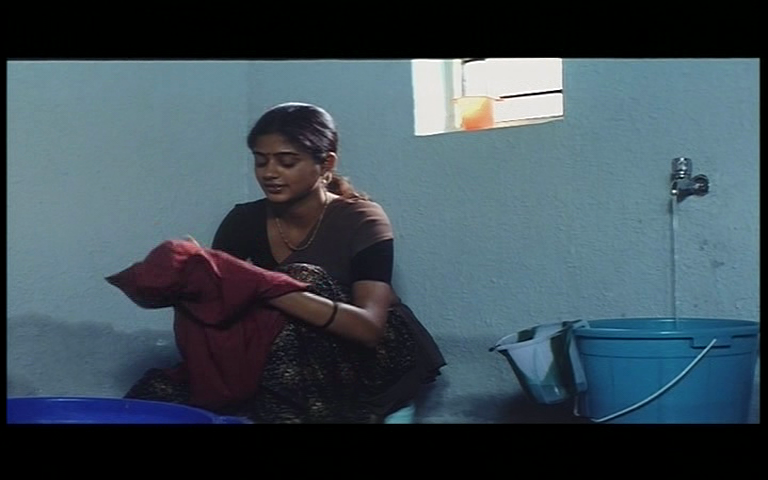
When his parents go away for a few weeks, the family maid Satya (Kalai Rani) is unwell and sends her daughter Thulasi (Priyamani) in her stead. Cheenu and Thulasi were friends as children and while Thulasi is obviously still attracted to Cheenu, he initially doesn’t recognise her. Although younger, Thulasi is more mature than Cheenu. She is also very aware of her social status and despite her attraction to him acts like any proper young servant girl should. On the other hand, he behaves like any typical young man when faced with a pretty girl, and his gauche reactions seem very natural.
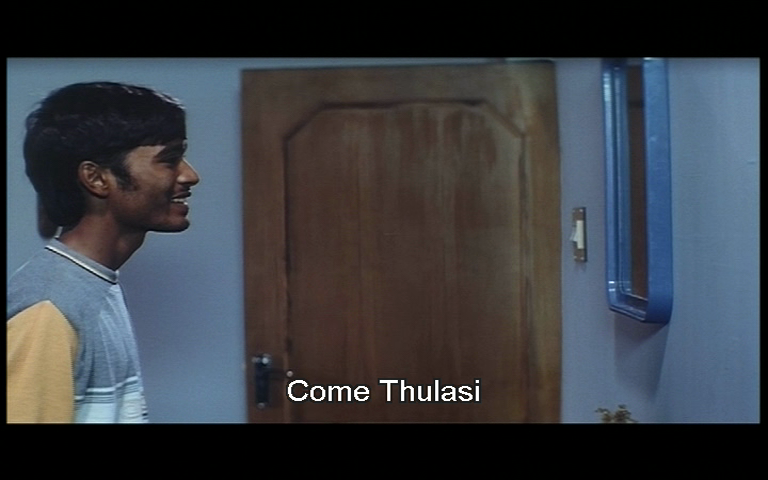
In the space of the few days they have, they end up falling in love and into a committed relationship –this is the dream period of the film title. Balu Mahendra shows their romance developing in a song and doesn’t spend much time on it. It’s obvious they are in love and Cheenu is determined to marry Thulasi, we don’t need to know any more about it than that. This is a lovely song, and I’m sorry I can’t find a better quality version.

Cheenu tells his friends a little about his romance, but doesn’t introduce them to Thulasi and actually hides her in the bathroom when one of his friends visits. He seems ashamed of his relationship with a girl from a lower class. It’s hard to decide if this is also partly because he is trying to hide the relationship from his father as Cheenu is very well aware that he will not approve. The difficulties of an inter-class relationship are well explored and developed despite the initial romance not being given the same treatment, and the pair’s behaviour is realistic in this context. The development of Cheenu’s character here is convincing and Dhanush is believable as the young man realising that he will have to change his ways and actually get a job if he wants to marry against his family’s wishes. Priyamani is exuberant in her role as Cheenu’s lover and the change in her outlook as she realises the obstacles they have to face appears genuine and natural.

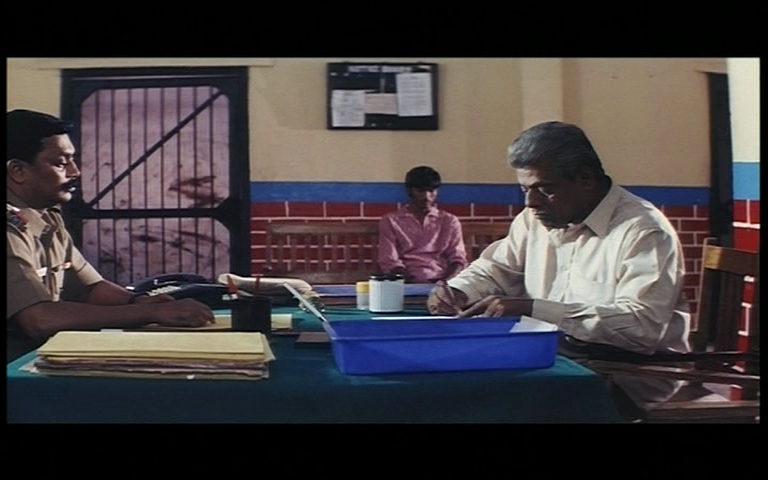
When Cheenu’s father does discover the relationship his reaction is predictable and dramatic, and Cheenu responds in kind. He vows to marry Thulasi despite the opposition from their respective families and the disapproval of his friends. It looks as if the romance may be the making of Cheenu but before he can follow through with his plans, he ends up in jail after a night out drinking with his friends.

When Ganeshan decides to teach his son a lesson and leave him in jail overnight his plans go badly wrong as Cheenu kills another prisoner and consequently receives a prison sentence for murder. I like the fact that although the prison term is obviously a plot point to keep the lovers separated, there is a strong emphasis on the consequence of violent behaviour. Despite the death being an accident, Cheenu has to acknowledge the result of his action and although unapologetic, he accepts that he has to pay for his mistake.
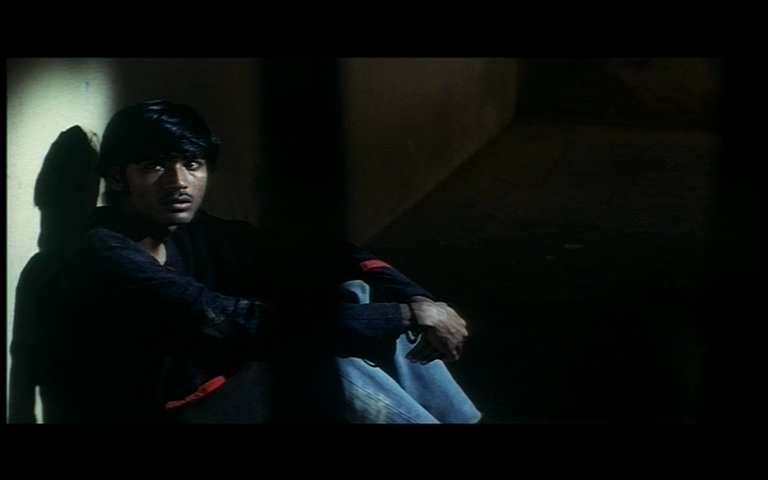
From such a promising beginning, the second half of the film loses the realism that kept the story interesting. The director starts to rely on prison clichés with brutal film guards, sympathetic fellow prisoners and a fairly ridiculous fight scene. Naturally there is an opportunity for Cheenu to escape just when he has found out that Thulasi is in dire straits and he absolutely has to go to her. Another problem is that Thulasi’s role is greatly reduced and she only appears on screen to cry and plead with various policemen and prison guards. Priyamani is wasted in these scenes and although she does her best there is very little she can do to make her character less of a caricature. The end is particularly disappointing as the film seems to be building up to a dramatic conclusion that never actually happens.

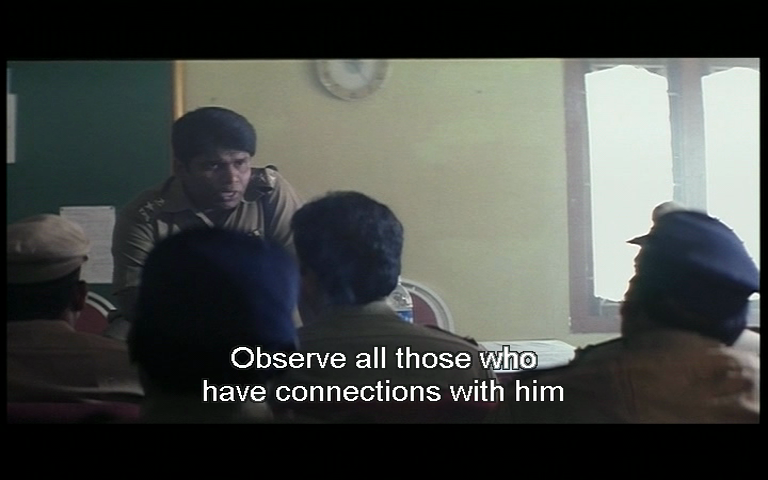
Despite the issues I have with the second half of the film, there are some good points. Dhanush does an excellent job of conveying the fear and trepidation of a young naïve man sent to prison. Cheenu’s interactions with the other prisoners are an interesting contrast to his relationship with his father and despite the clichés the prison scenes never descend into farce. There are quite a few jokes referring to the skinniness of Dhanush throughout the film, and most of the humour has a light touch. It is also good to see intelligent police officers who don’t search aimlessly for an escaped prisoner but actually investigate and have a reasonable plan to capture Cheenu.

The music by Ilayaraja is beautiful and haunting but is used mainly as a way to show some of the story: the childhood friendship between Thulasi and Cheenu, their romance and Cheenu’s relationship with his mother. One exception is the first song which is a bizarre item number with nothing to do with the story. It is purely an excuse for a skin show from Tejashree with some rather lewd lyrics (even in subtitles) and the film would have been improved by its absence.

I was disappointed in this film. While it kept my interest and was perfectly watchable, mainly due to the lead actors performances, it should have been so much better. I enjoyed seeing two of my favourite actors together and they did have an onscreen chemistry which helped make the romance more believable. While the film succeeds in the most part to be realistic it would have benefitted from a tighter second half and a more exciting climax – but perhaps that wouldn’t have been as true to life. Then again, it may just be that I’m not used to a Tamil drama actually having a (nearly) happy ending!  3 ½ stars

Paruthiveeran

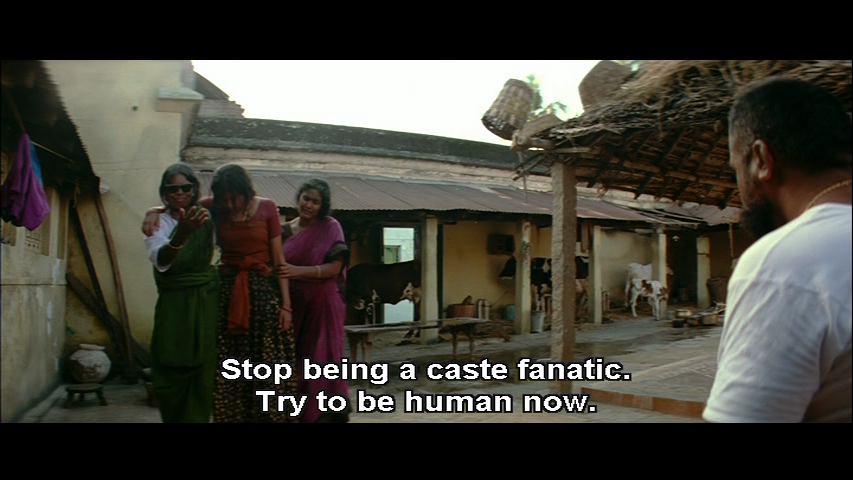
The film opens at a temple festival, full of colour and music. The camera draws the eye in through a range of points of view, creating the feeling of being part of the milling crowds. It’s all very colourful and entertaining, and then the knives come out. We’re in a place divided by caste and old grudges, where the police are the law but not the authority.

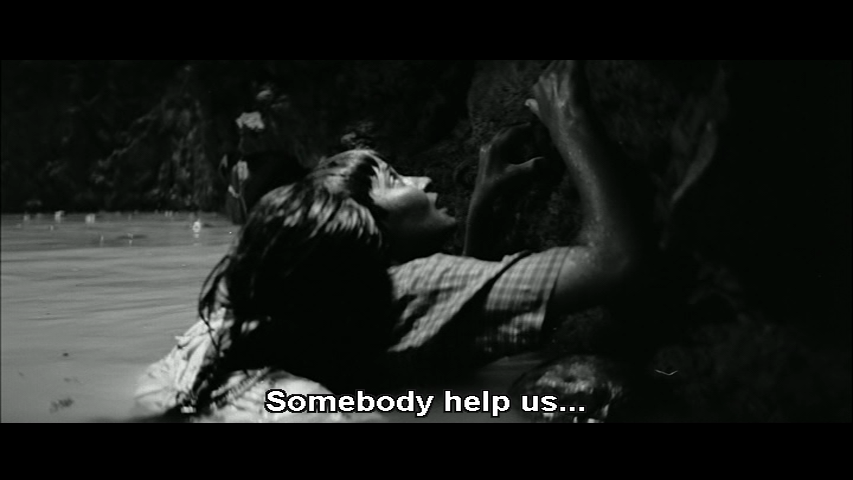
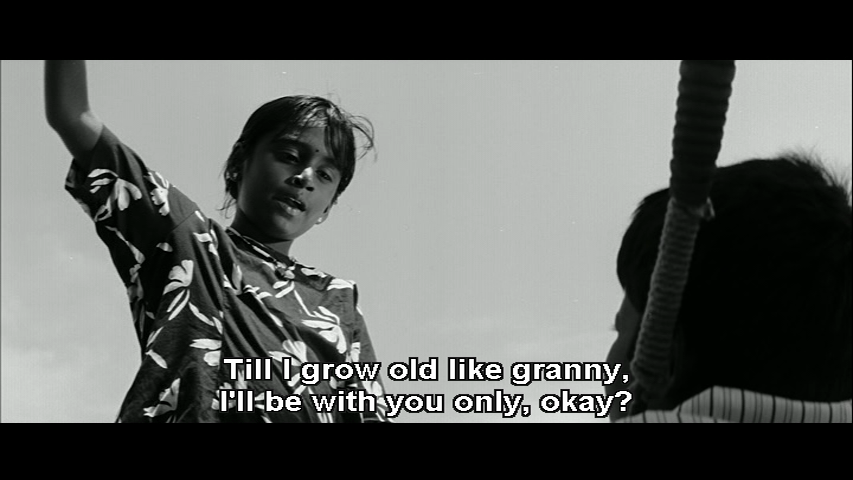
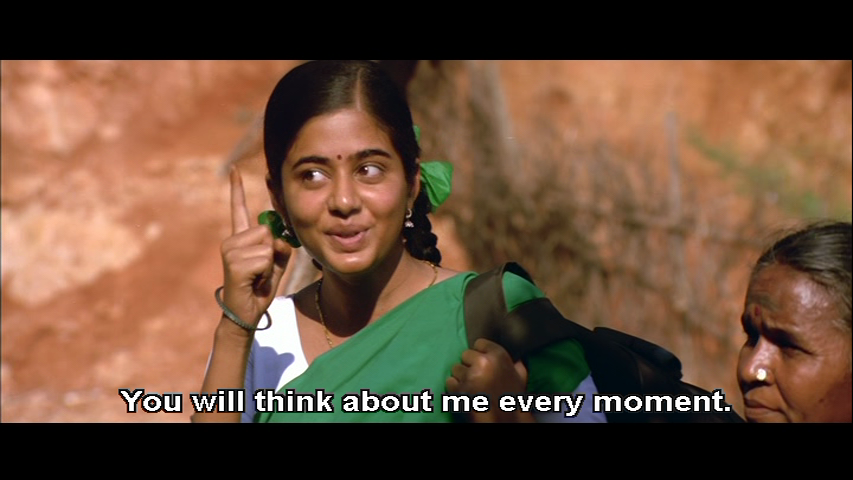
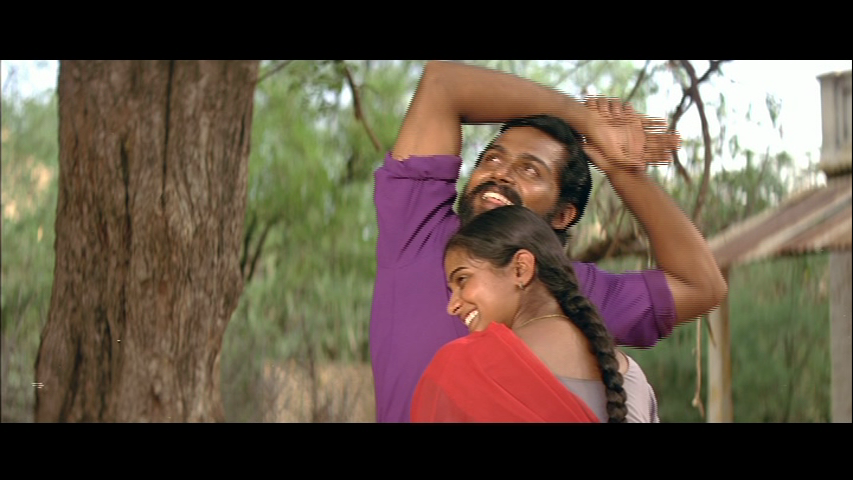
In a black and white flashback, a young girl is pushed into a well. Her cousin, Paruthiveeran, helps to keep her alive, and an obsessive love is born. The children become friends and promise to be together always, even after they grow up.  Soon Muthalagu tells anyone who will listen and everyone else as well, that she will marry Paruthiveeran and only him.

Back in the present day Paruthiveeran, or Veeran, played by Karthi (knife wielding ne’er do well from the opening sequence) and Muthalagu (Priyamani) are still in the village. What will happen to a strong willed girl who refuses all other offers and stands up to her father? Why would she want Veeran who is a drunken womaniser, not interested in her and not particularly attractive? Priyamani and Karthi make the melodrama more compelling than it might seem.

There are lots of spoilers ahead so if you really don’t want to know, please stop now.

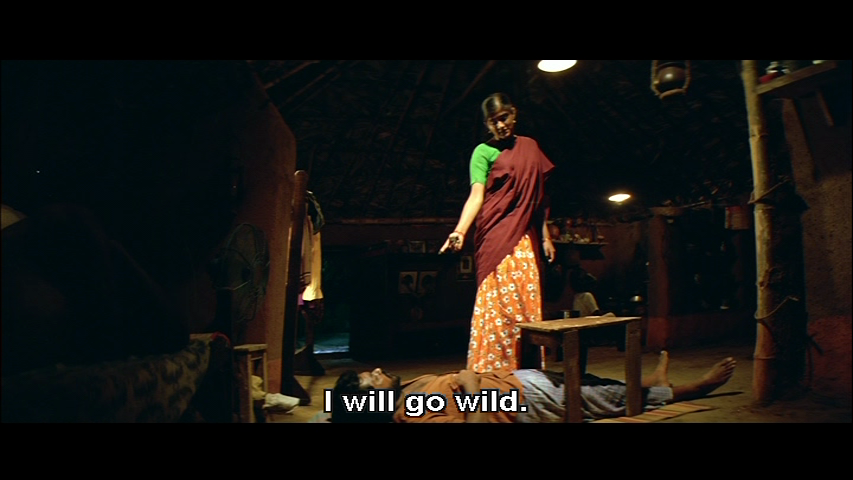
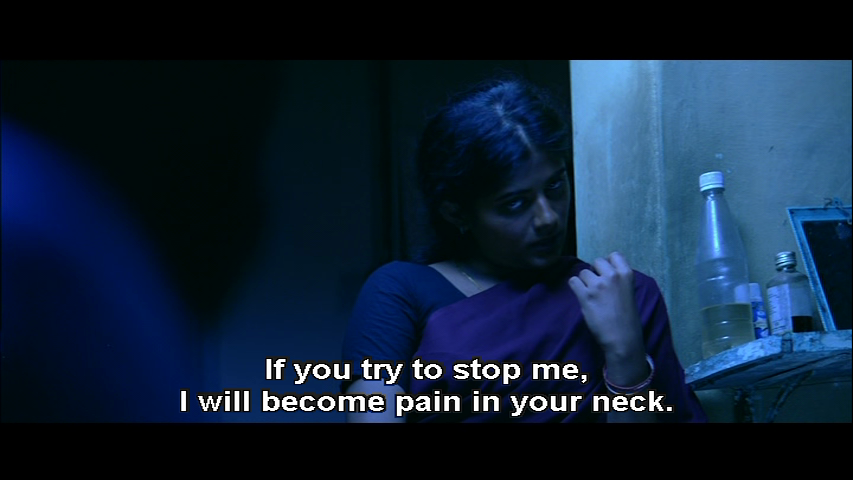
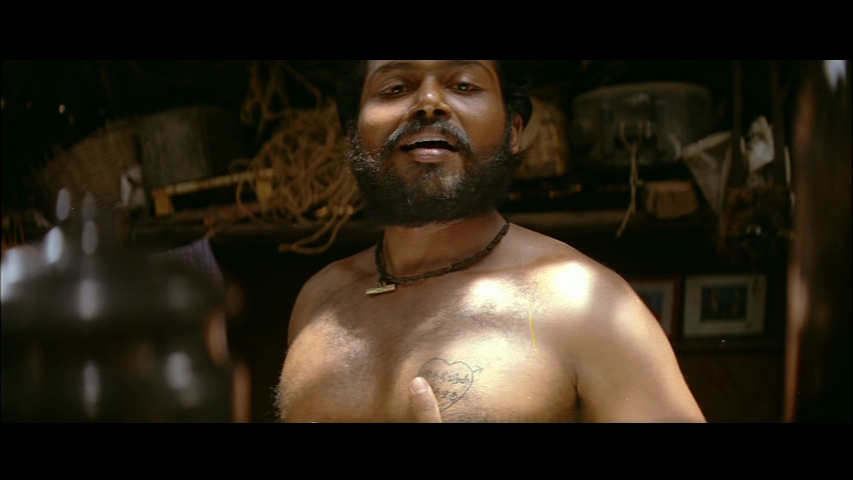
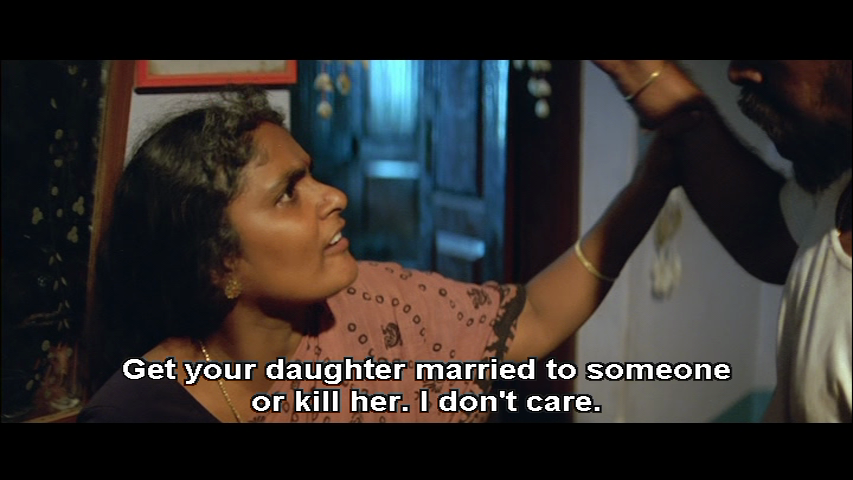
Muthalagu is an interesting character, and not your usual romantic girly heroine. Priyamani’s performance is totally convincing, even as I was rolling my eyes at some of her character’s choices. Muthalagu is complex yet single minded and while I couldn’t see myself ever obsessing over Karthi, I could believe that she was.  She is beaten and verbally abused by both of her parents but will not flinch, and even threatens her father in return. Her teachers and others keep asking why she wants to throw herself away on a man who is usually in jail, why she would deliberately fail 4 years of school so she can postpone being married off. She takes poison rather than marry another man. She drugs Paruthiveeran, ties him to his bed and tattoos her name on his chest.

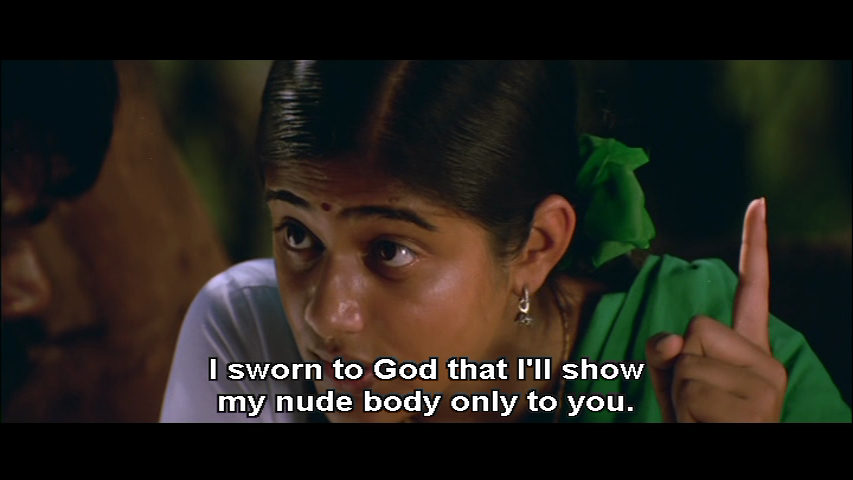
This is not a shrinking violet, but nor is she a crazed caricature. She knows everyone is talking about her, but she never tries to hide her feelings or make any pretence. She believes Paruthiveeran is her fate, they are meant to be together and she will not break her promise to him or to god. There is no swaying her, not even his protests can persuade her.

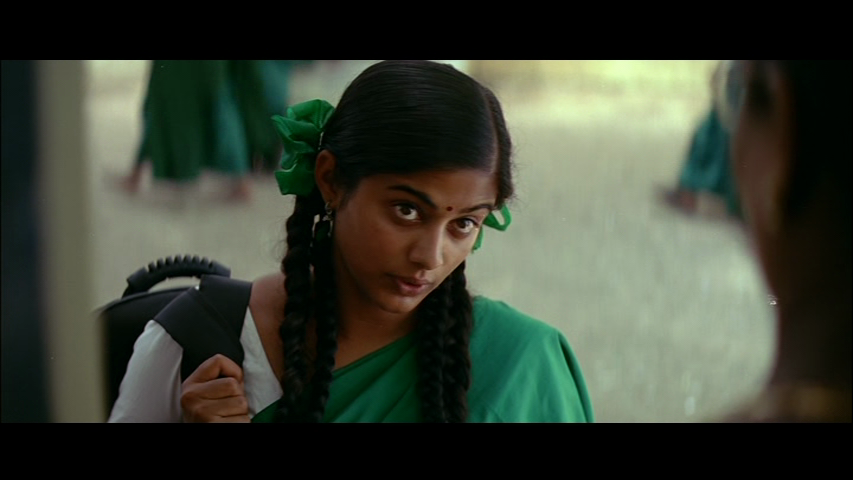
It’s not a glamorous role – most of the time Priyamani is in plaits with the scrubbed face no makeup look. She doesn’t try to make crying look pretty; she lets the anger and frustration burn through. Her body language and facial expressions really capture a mix of arrogance and uncertainty. When Muthalagu smiles, she is a radiant young girl in love. Priyamani has been praised to the skies for this role and bagged a number of awards, and I can see why.

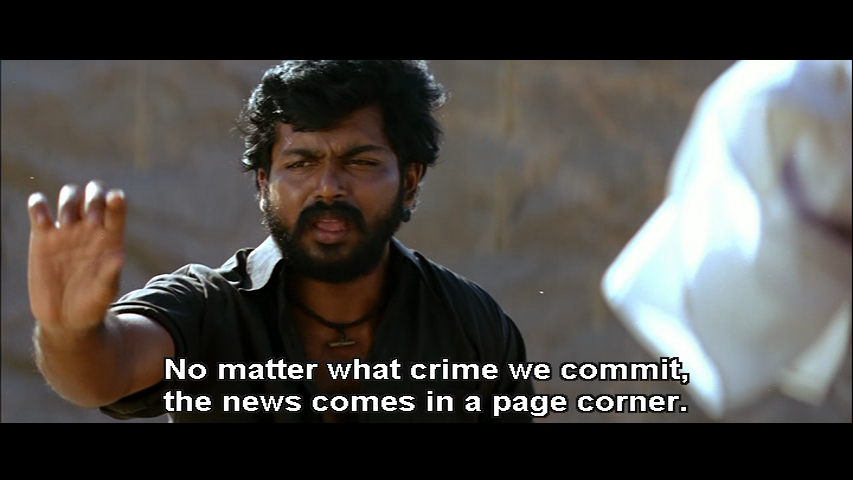
Karthi did his best in his debut to give his character some depth.  Veeran is a bully and a bit of an idiot, his only ambitions seem to be to upset local dimwit Douglas and to commit a big enough crime to go to Madras prison.

He spends a lot of the film hanging around with his equally useless uncle Sevvalai (Saravanan), getting into fights, avoiding Muthalagu and shagging an assortment of women (some paid, some volunteers). He basically steals a prostitute from some local men (he gives her back when he is done), and is asked to share one of his girls with them one day – a throwaway line that will have repercussions. He rejects and humiliates Muthalagu time and time again, and he is as frustrated by her obsession as she is by his resistance.I did enjoy his visible transformation to the semi-domesticated boyfriend; once again, ruler straight side parted hair seems to be the Good Boy indicator. But how good can he possibly be? Well, he does get that tattoo amended to have both their names enclosed in a heart so I suppose that is a commitment.

Once the two admit their now mutual feelings, the film starts to go off the rails a bit in search of more dramatic tension.  The family feud gains intensity, caste violence takes the stage and some of the characters seem to go out of focus. There is another flashback sequence that explains the origin of the family enmity, but I didn’t think such detail was all that necessary.

The film builds to a finale that is both highly melodramatic and somehow shockingly real. Deciding to make a break from the village and start a life together, Paruthiveeran hides Muthalagu in his shack and leaves to protect his uncle. Unfortunately, that sleazy guy from the prostitute episode sees her and decides it is time to claim his dues. After a horrible gang rape sequence that is disturbingly matter of fact, Veeran comes back to find her dying. I don’t think this is a case of a ‘bad girl’ being marked for death – Muthalagu died because of Veeran’s actions and who he was, and she didn’t seem to be subject to a directorial judgement by Ameer Sultan. The death scene was well written, and not at all sickly sweet. Muthalagu’s parting words to Veeran are a demand for some kind of explanation as to how she could have waited her whole life, and ended like this. And I was asking the same thing. Veeran decides he must cover up the dishonour to his love, and perhaps also use her death to have one last shot at her father.  What he did startled me and while it made a sort of sense, the ick factor was high. Karthi did reasonably well with the extremely emotional scenes, but it was in the quieter sorrowful moments that he really convinced. It was quite unnecessary that we got an eyeful of Karthi’s butt in the final scenes but whoever pre-ripped his clothes was very determined. I am sparing you the sight.

The support cast are very good – they look and sound the part and this isn’t a glossy view of country life. I wasn’t so taken with the little girl who played young Muthalagu. Her voice was a monotone buzz that grated, but her expressions were fun and she managed to be precociously flirty and still a child. Saravanan as Sevvalai is good but doesn’t get much to do apart from support Karthi. The grandmother and mother (Sujatha) in Muthulagu’s family are intense and their performances are high on energy but not overly histrionic. I really felt the tension in her family, and it made the typical family disapproval scenes much more compelling.

Yuvan Shankar Raj’s soundtrack is excellent. Some tracks sound as though they are sung by traditional singers rather than studio artists, and I think that works really well in building the sense of place. The rural setting is very picturesque and appealing, and the cinematography captures both the energetic village life and the open countryside.

The flashbacks took up too long, and the ending is what I have come to think of as typically ‘everyone dies or lives unhappily ever after Tamil romance’. I’m never very happy about the depiction of rape in films, but I think this was given some weight and treated as an assault, not a justly deserved punishment. It was not made to be the girls fault, despite what her rapists may have said, and I appreciated the writing that made the scene compelling. Priyamani is the reason I picked up the DVD in the first instance, and her performance is remarkable. I don’t imagine I will feel the need to watch it again anytime soon, but I did like seeing great acting, a strong female character and some interesting relationships on screen. I give it 3 and 1/2 stars.

Yamadonga

And so we come to the third film in our “South Indian Cinema Induction Programme” – Yamadonga.
Yamadonga features enough gilt to dazzle even our well trained Bollywood eyes, demonic antics from Lord Yama and some fantastic and well choreographed fight scenes. This is a film from the same director as Magadheera, and SS Rajamouli certainly knows how to entertain. His stories are engaging and full of action. This is no exception!

Yamadonga also features NTR Jr, grandson of NTR and renowned as one of the best dancers in the business. NTR Jr although a fine figure of a man, somehow just does not look like a dancer despite his much vaunted weight loss and fitness regime of late. And then he just pulls some astonishing moves and we are left gasping and dumbfounded :‘how did he do that – that’s just not physically possible!’ His ability allows the choreographers to push their limits, and those of the poor backing dancers, in order to showcase the amazing technique of this star. His extensive classical dance training is evident in the balance and control he exhibits in both dance and fight choreography. He certainly seems to exemplify the current mould of South Indian Cinema leading men as an all dancing all fighting all action Hero.

The film starts with an amulet which has been blessed by Lord Narasimha and is given to the young Maheshwari, known as Mahi. She gives it to a boy she meets at the fair who appears to her as a prince on a flying horse when he rescues her from a broken merry-go-round. This is Raja, a thief even at this young age, who later tries to sell the amulet. On finding out it is worthless in monetary terms he throws it away, but it always makes its way back to him, in sometimes quite bizarre ways.

12 years later, the young girl is now treated as a servant by her grandfather’s family who have taken over the house and fortune left to her when he died. Raja is a con-artist and thief who stumbles across an attempt by Mahi’s family to eliminate her and assume total control of her fortune.

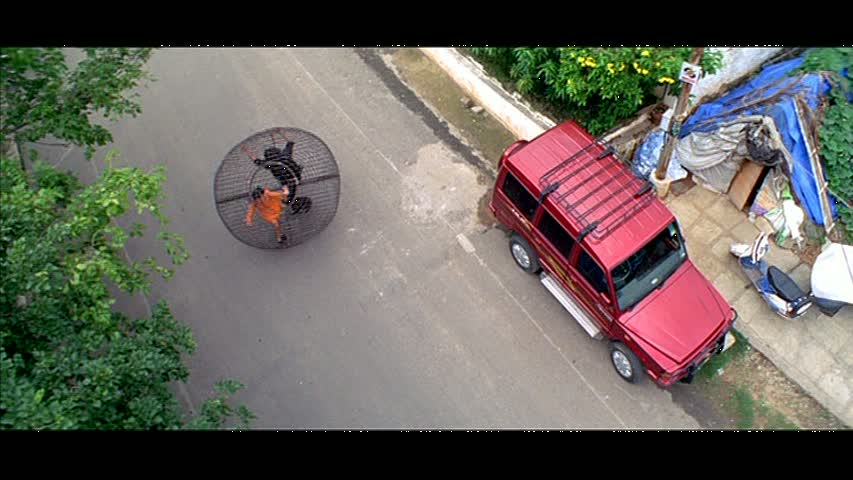
Raja and Mahi cross paths again when she is on the run from kidnappers (hired by her family) and mistakenly takes the dress Raja has been sent to steal. As he defends the dress (and incidentally Mahi) from the kidnappers, she once again sees a prince come to rescue her, but has no idea they have met before. Who else but Rajamouli would have his heroine hurtle around the street inside a gigantic wire ball, with the hero in pursuit battling goons, disrupting traffic and generally creating mayhem as he rescues her!

Raja tries to get rid of Mahi before he finds out that she is an heiress, whereupon he changes tactics and tries to ransom her to the family who really don’t want her back. Earlier, following a failed heist, Raja and his friend Sathi ended up drunkenly abusing Lord Yama, who overheard (of course he overheard – he’s a God!) took offence, and decided to arrange for Raja’s death. Once in Yamaloka (or Heaven as our subtitles call it) Raja manages to create havoc as he ends up in control of the realm. In order to get rid of him, Lord Yama has to return him to life. Things get even more complicated when Raja sees the truth and genuinely falls in love with Mahi, and Lord Yama comes to Earth to try and make Raja sin so that he will have to return to Heaven. There are many twists and turns with some great dancing and inspired fight scenes before Raja finally gets the girl and she gets her prince!

The movie does drag a little before the intermission when Raja is in Heaven. This whole sequence could have been shortened in our opinion without losing any of the story. However it does allow for a couple of great dance sequences and a chance for yet more gold and sparkle.

The dance scenes are a real highlight of this film. NTR Jr is a beautiful dancer and SS Rajamouli has made very good use of his talents. There is even a picturisation cleverly worked to look as if NTR and NTR Jr are dancing together– an awesome idea, sadly not fully realised due to some pretty clunky CGI work in a couple of spots. Rajamouli’s team make excellent use of modern technology with the sweeping camerawork adding to the sense of speed and movement in the dances.

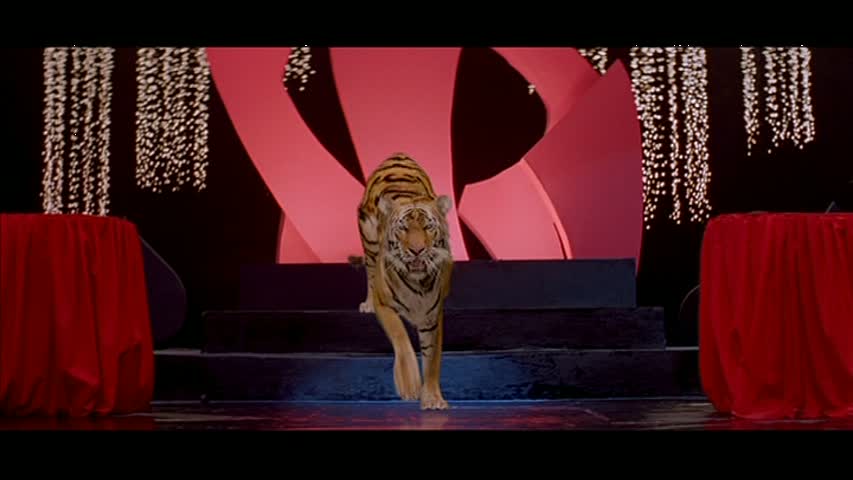
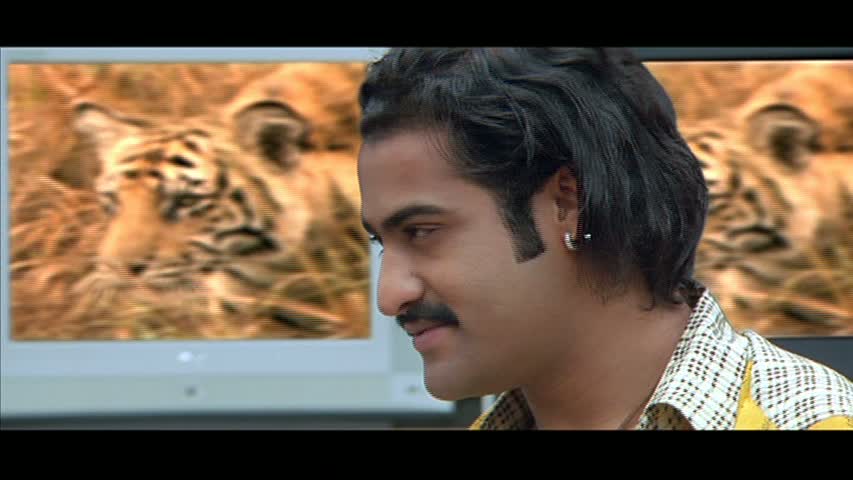
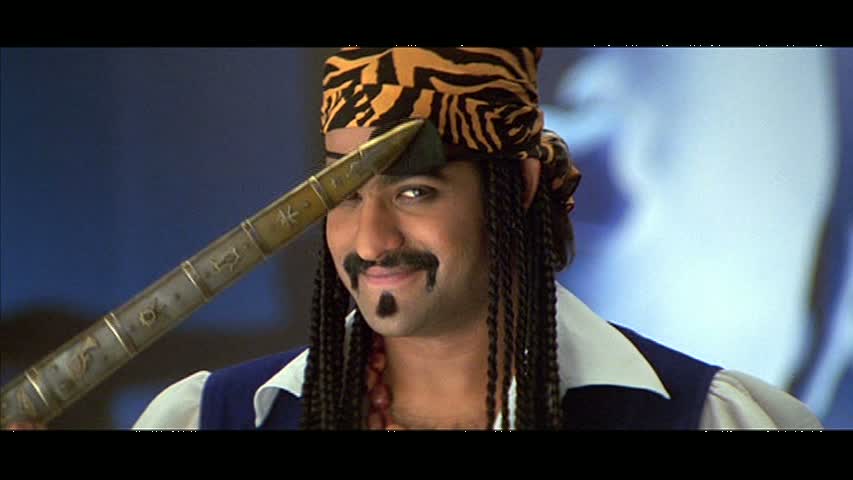
SS Rajamouli’s love of CGI tigers is shown again in one of the best filmi hero entrances when the tiger transforms into NTR Jr!

The tiger/leopard/big cat of your choice theme is used throughout the film:

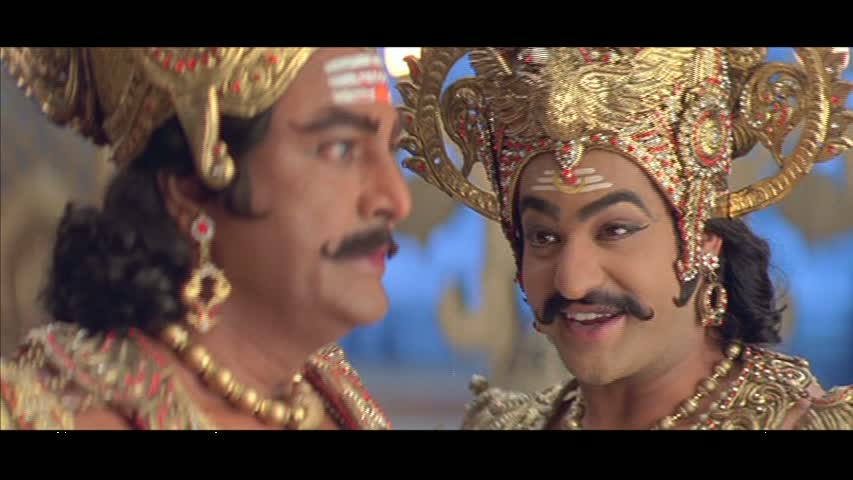
Heaven is wonderfully sparkly and golden, and you can imagine the artistic director just covering anything that didn’t move fast enough in gold paint. Lord Yama and Raja (when he is in Heaven) are fantastically costumed.

Priyamani as Mahi is beautifully moving as the girl badly treated by her abusive, grasping family and just joyous when she is falling in love with the oblivious Raja. She is an actress we will watch out for, after this and her pivotal performance in Ravanan. Mamta Mohandas makes the most of her role as the “other woman”, the scheming fence and loan shark Dhanalakshmi, and is great fun in scenes where Lord Yama assumes the form of Dhanalakshmi in order to tempt Raja. There are many clever visual and musical motifs recurring throughout the film, adding to the feeling of destiny at work.

Heather says: This is another fantastic film from Rajamouli. He really does know how to tell a story! This is also a great showcase for NTR Jr who combines his awesome dancing skills with some very good acting.  In particular his comedy is very well executed, and between Raja, Lord Yama and Chitraguptudu (nicely played by Brahmi) the comedy is very well integrated into the story.  Mahi’s character was also beautifully and sympathetically played by Priyamani.  Despite playing a downtrodden character for most of the film, she managed to show Mahi as capable of fighting back, and was excellent in her scenes with NTR Jr.  Also a word of praise for Mamta Mohandas who really was a delight to watch and did a fantastic job as Lord Yama pretending to be Dhanalakshmi.  This was the first NTR Jr film I watched and he totally blew me away with his dancing.  Needless to say I now have seen most of his films!  Yamadonga does tend to drag a little in the middle when they are in heaven, but the glorious costumes somewhat make up for the slower pace.  Overall an excellent film and I give this 4 1/2 stars.

Temple says: Yamadonga is a very engaging film, despite the flaws in pacing. I watched it again recently with a friend and it still keeps my attention. One major distraction for me was, I am somewhat ashamed to admit, the appalling hairstyle of NTR Jr. I don’t mind the long hair, but if you’re going to straighten your hair, do it properly! And that includes the back of your head! Anyway – apart from the unfortunate 70s era blow-waved Tarak, the rest of the film looked brilliant. Heaven looked so sparkly and fancy and rather like a Faberge egg – it was gorgeous and the attention to detail was lovely. I enjoyed little touches like Yamadharmaraja handing his mace to two soldiers who immediately buckle under the weight, and the cavalcade of NTR avatars. I really liked the wardrobe for the leading ladies too – the colours and fabrics looked great and seemed really appropriate for each character. The songs were a highlight, particularly for the dancing. Priyamani made a fantastic effort to keep up with NTR Jr and her energy was so appealing. On the downside, I really didn’t like Ali’s character in this film, and found his “comedy” track to be irritating. He is my least favourite Telugu comedian at this stage – perhaps because his characters are often a bit sleazy or negative. The film loses a star from me because of the draggy midsection and the really stupid tribal statue skit. I give this 4 stars.