Thillana Mohanambal

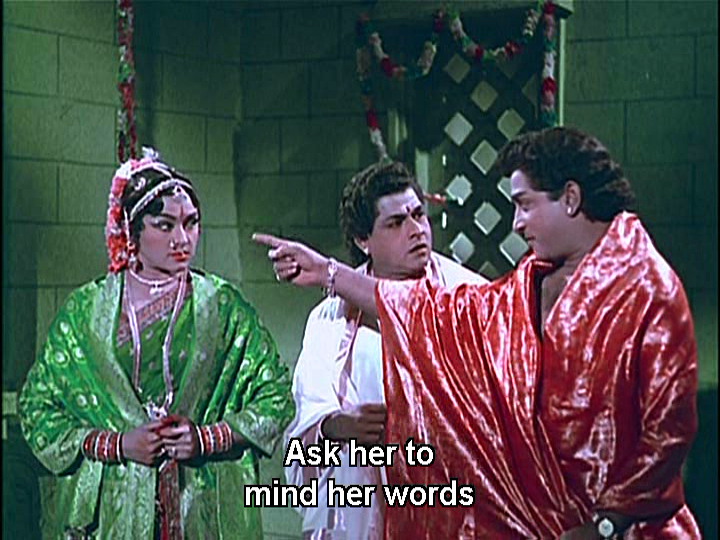
Padmini is Mohanambal, a beautiful and exceptionally talented bharatanatyam dancer. Sivaji Ganesan is the less beautiful but equally talented musician, nadaswaram player Sikkal Shanmughan. Crossing paths at a temple festival sparks fly between them but within minutes they go from this:

To this:

They challenge each other to a contest of dance versus music at some later date. So the stage is set for a fiery romance, riddled with misunderstanding, thwarted by pride and a meddling mother (Vadivambal, played by C.K. Saraswathi).

Mohana believes that dance is for everyone and for all occasions, inspired by the world around the dancer as well as a gift of god. Sikkal is more of a princess, demanding that his audience give him full attention and due reverence as he displays his gift. He believes art exists for god and for the artist. He refuses Mohana’s invitation to stay and watch her dance, but sneaks back later to see this.

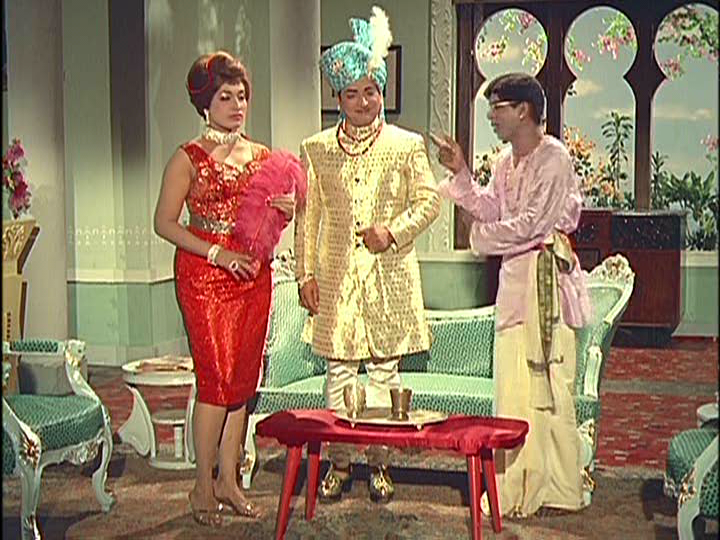
There are some interesting observations on women in the performing arts and Mohana is certainly subject to some assumptions by men who desire her beauty and talent. Her mother seeks to ensure a wealthy man as her daughter’s protector or husband, but Mohana rejects all offers even before her feelings for Shanmughan are an issue. Nagalingam (K Balaji) is one thwarted suitor and a kidnapping attempt results in a comedy fight scene that I could have done without. I don’t quite get the undersized guy with stupid hair as instant hilarity, and there are two of them (double the fun?). This diversion means Mohana and her group catch the same train as Sikkal who has been waiting in the hopes they might turn up.

Padmini is gorgeous and her dance training is evident in her deportment and expressions as she uses all of her skill in conveying Mohana’s emotions. She also does an exceptionally good eyelash flutter. Sivaji is more old school theatrical, and lays it on almost as thick as his makeup. But his somewhat rubbery face is wonderfully expressive, especially his eyes, and he does have palpable chemistry with Padmini. There is a delightful scene of wordless communication and voiceover on the train journey that is funny, romantic and beautiful.

There is lots of sparring between the two and she is not the heroine to fall in love and lose her sense of self. I liked seeing a young lady who was a bit of a brat, very self-confident, and who felt no need to be apologetic. I don’t think I would enjoy her half as much in real life, but she did keep my attention in the film. And there was no suggestion that she should give up dancing to be a servant of Sikkal’s muse. She was a dancer and was valued for her gift.

There are abundant comedy elements. Manorama is Jil Jil Ramamani, a folk dancer and girl of suspect virtue. Her ‘comic’ dances are strange, and perhaps the subtitle team decided to make sure we knew this was a modern film:

In addition to being the butt of many jokes, she does play a significant role at several points in the story. Manorama made her character both a caricature and quite sympathetic. I was left thinking Jil Jil understood herself and how others saw her, and she retained some dignity despite the silliness. Nagesh as Vaithy had a role that just irritated me. He is a Jerry Lewis kind of character, so if you like the style, you may have warmer feelings towards him than I do.
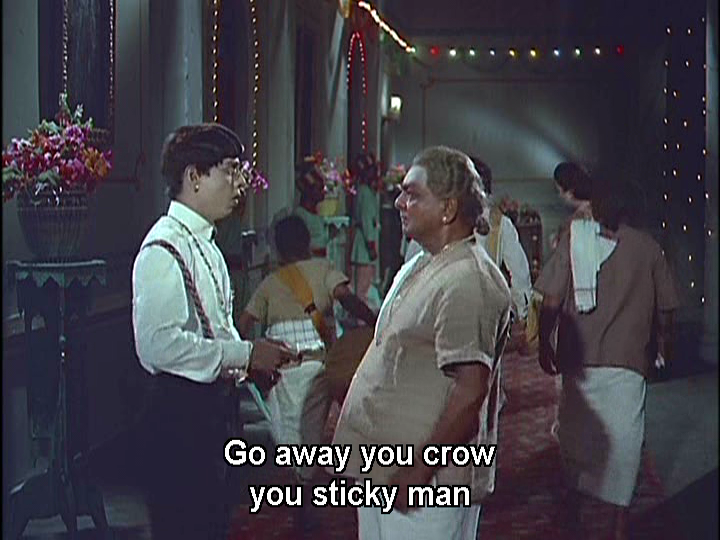
His presence extends the story with pranks and frauds, and a longwinded and obtuse approach to being a go-between. The supporting characters are pretty broadly drawn and usually played for comedic effect or buffoonery. There is some excellent face throughout.

There are pointed references to the issues of art versus money, the dedication of great artists and who owns art.  Sikkal storms out of a private party rather than be ‘owned’ by the landlord and plays an impromptu concert to the locals gathered outside. I particularly enjoy this face off where the classical versus modern question is settled judging by the smug expression on Sivaji’s face (wait for the white couple to turn up at about 4 min):

https://www.youtube.com/watch?v=XAATvR7kXWk

Mohana is pursued with increasing vigour by the landlord and the ensuing scenes are quite farcical. I was quite annoyed that Sikkal immediately assumed Mohana was playing him, without speaking to her or investigating. He just did the heroic leap to the conclusion that she was duplicitous and decided to feel sorry for himself. I might have been more tolerant of manly brooding in a more attractive character, but really I just wanted to slap him. He then departs to sulk with Jil Jil, now calling herself Rosarani, who owns a drama company. Word of this gets back to Mohana who knows about his misunderstanding but had hoped he might still be interested. Rather than giving up, judging or moping, she decides to confront him.

Jil Jil and Mohana show themselves to be more decisive and action oriented than many a filmi heroine. I have doubts over the subtitle translation of some of the relationships as people refer to the landlord wanting Mohana to live with him, but he is also referred to as a groom, there is mention of dowry and so on and he has a wife already. In one scene, Padmini begs him not to spoil both their lives and mentions women being enslaved by money. So I am guessing she would have been his mistress but perhaps the subtitle team decided to sanitise the arrangements. Regardless, her modesty and chastity helps to persuade the landlord to be a brother rather than a suitor.

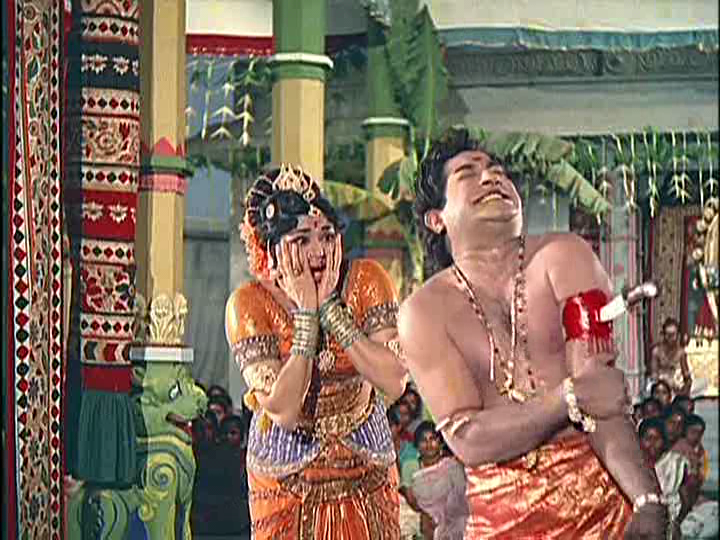
Mohana knew that the only way to keep Sikkal from leaving India with Jil Jil was to appeal to his artistic pride. The Thillana contest goes ahead. Nagalingam returns for skulduggery resulting in Sikkal taking a knife to the arm. Sivaji really milks the scene, thrashing around like a fish out of water for what seems like minutes. This injury prompts a further outbreak of overacting, and Sikkal gets another opportunity to feel sorry for himself again. Thanks to yet another smart competent woman (his nurse Mary) he begins to see that perhaps he has been a little narrow minded.
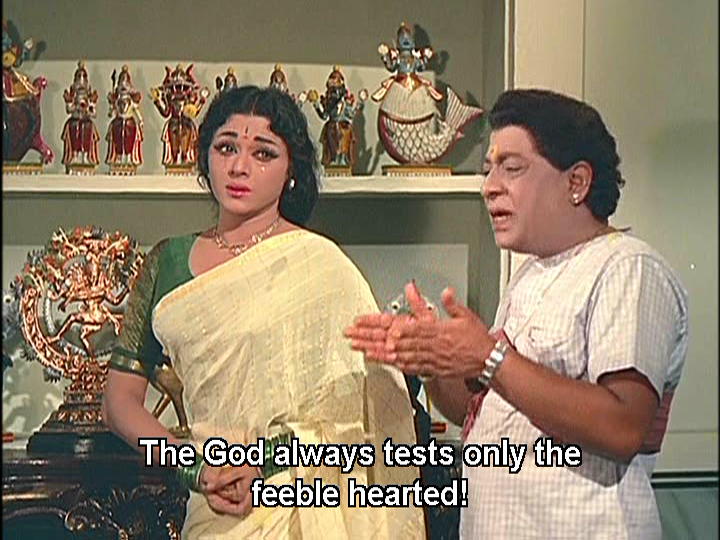
The finale is predictable but unravels over yet another complex scheme to sell Mohana, this time to a King. She defends herself, verbally and physically, and finds an ally in the very peculiarly accented Queen. Her chastity proves transformative once again, and the King decides to be a good husband.
Sikkal jumps to conclusions (yes, again!) and flings himself around chewing the scenery. This time Mohana has had enough and decides to resolve things. The climax is very filmi and over the top but the duelling diva personalities of the leads made it less unbelievable than it might have been.

This is such a pretty film. The ladies wear beautiful jewellery and costumes, there are lots of sparkly things, the temple locations and houses are lovely. It also has quite a timeless feel, with only a couple of scenes overtly placing the story in the late 1960s. The story is an overblown romantic melodrama but the theme of art and excellence gives the characters much more substance than I expected.  The female characters stand on their own feet, and have their own plans and desires. Padmini and Sivaji are exceptional and really made me care about their relationship even as their characters annoyed me sometimes. And of course, Padmini’s dancing alone makes this worth a look. Who won the contest you ask?  Art was the winner! 4 stars.

Arundhati

Arundhati is a wonderful revenge story with plenty of melodrama, over the top action and what appears to have been an unlimited budget for blood.  Add in a heroine driven storyline with some excellent performances and it makes for a worthy  addition to the South Indian Cinema Induction Programme.

We learn through flash-back that Arundhati was a princess of Gadwal, trained in the arts of dance and war.  Her bravery even as a child was likened to the goddess Jejamma, so this was how she was known.

Her sweet and innocent older sister, Bhargavi was married off to Pasupathi, the evil and depraved nephew of the King, who enjoyed a protected status despite his raping and murdering ways.  After he attacked and killed Jejamma’s blind dancing teacher, Bhargavi killed herself.

In revenge the precocious young Arundhati beat Pasupathi, tied him to a horse and drove him from the kingdom.  Despite extensive injuries he didn’t die, but was rescued by a group of Agoras and learned to be even more evil, which we didn’t think was possible.

Having his vile talents augmented by the knowledge of tantric arts and by the possession of malevolent spirits, he returned to take revenge on Arundhati, fortuitously arriving on the day of her wedding.

Some excellent posturing and slashing later, including a take on the drum scene from House of Flying Daggers, Arundhati defeated him and imprisoned him in the palace, still alive but trapped in a fairly well constructed tomb.

Two generations later and there is a new Arundhati, who comes back to town for her marriage.  Pasupathi is now an evil spirit, confined in his grave in the ruined fort by various amulets and prayers which prevent his escape.  He uses the influx of naive newcomers to try and break free of his prison. He tricks a young couple into entering the fortress where one disappears and the other becomes insane.  Attempts by the mad man to break open the grave are thwarted, and he ends up being chained up in the village.  Pasupathi is able to lock doors and move objects to try and kill Arundhati’s father, but luckily can’t use the same tactics to escape.

Just as an aside to all heroines and disposable sidekicks – if you go into a building and have to break cobwebs which are thick enough to block your way, there is a very good chance that the friend you are looking for is not actually there, since otherwise there would already be a path of broken cobwebs – just a suggestion!

Eventually and inevitably Pasupathi manages to break free and torments Arundhati. She now has to come up with a way to vanquish this evil spirit for good, otherwise he will claim her as his wife and all of her family will die.   She has some help in the form of a Muslim fakir who seems to be pretty well unstoppable, which is just as well as there are many attempts on his life!  Sadly he is pretty inept at passing on the simple instructions he was given to stop Pasupathi or the second half might have ended much sooner. Everyone else who tries to help her dies – usually in very gruesome and bloody ways!  Did we mention this film had an exceptional gore and blood budget? The heavy-breathing Pasupathi manages get Arundhati exactly where he wants her – but will he succeed in his evil plans of rape and revenge? Will Arundhati remember her brave heritage and triumph over her immortal adversary?

Anushka excels in her double role as both the modern day Arundhati and the warrior princess.  In Jejamma mode she is masterful and determined, while in the modern day avatar Anushka manages very well to convey the despair and madness as Pasupathi torments Arundhati with images of her family’s fate.  She carries the film, and manages to be compelling, beautiful and convincing. However, there are some scenes later in the film that drag on for far too long. There is really only so much whimpering and scrambling that Anushka can do in her modern day character before the impact of her reactions fades. The young actress Divya Nagesh who played the young princess Arundhati was a delight to watch as she faced down the original Pasupathi.   Sonu Sood appeared to revel in his role and conveyed the total depravity of his character with great gusto and much eye twitching madness.  He seemed to be having such a great time as the completely evil Pasupathi and we just love him in this total manic mode! There is a downside to this wholehearted effort. He is just having too much fun and it detracts enormously from the characterisation. In some scenes he looks like he is barely restraining laughter and as a result Pasupathi just isn’t really evil enough to be truly frightening. As the second half was quite drawn out and hinged on Arundhati’s fear of Pasupathi, the lack of real menace did make the film feel overly long and the uneven pace was jarring.  Sayaji Shinde puts in a very credible performance as the knowledgeable fakir, and we loved seeing Manorama as the old servant who fills in the back story for modern day Arundhati and us.

The music is well integrated into the drama, and all songs serve a purpose. The cinematography is excellent and both the set and costume design really enhance the story. The special effects are for the most part used well, but there is a tendency to overdo things. The blood and gore team were especially enthusiastic!

The novel (to us) use of death by coconut was dramatic but repetitive and once again, key scenes dragged on a bit too long to sustain the drama. The climax of the film seems to stop and start. Modern day Arundhati had to scramble around crying and panicking for ages until the two storylines started to piece together for the conclusion. We theorised that the director still had a couple of days and half the blood budget left to use and decided to just go for it. The ending is bloody and violent and yet uplifting once it really gets going.

Heather says: I loved this film.  The two leads are fantastic and the child princess Arundhati does a really good job for such a young actress.  The story is very heavily focused on Anushka, and this is probably one of the film’s flaws in that the other characters don’t ever really engage us.  Sonu Sood is totally manic, which makes for some great viewing but not necessarily the best approach for his character. His Pasupathi was too cartoonish to ever be scary, particularly in the latter half of the film where the heavy breathing began to become wearing.  However, he was very watchable and certainly seemed to be making the most of his time in the film.  There were a few too many plot points clashing with each other at the end, and modern day Arundhati was just a little too wimpy. But still a very watchable film – I give this 4 ½ stars.

Temple says: I really enjoyed seeing a tough yet feminine heroine driving what is for the most part an action film. Anushka is stunning in this, and deserved the critical acclaim and awards. I like Sonu Sood but his hamming annoyed me. It wasn’t really the role for a lighthearted villain and would have benefited from a more menacing performance. As it was, he reminded me of a character from an old TV series – Catweazle. You can go look that up and see what I mean! The film really is the story of the bitter enmity between Arundhati and Pasupathi so that lack of serious venom detracted a bit from the overall impact. The pacing was all over the place too – some scenes dragged on far too long, while others rushed through interesting bits of the back story. The modern day avatar of Arundhati didn’t get much to do apart from crying and running until towards the end of the story.  But thanks to the amazing screen presence of Anushka the film is absolutely rivetting at times.  I give this 4 stars – it would  have been less except for her extraordinary performance.