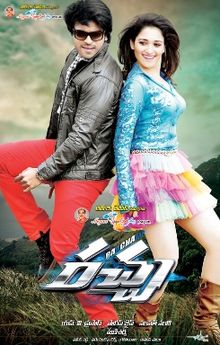
Rachcha

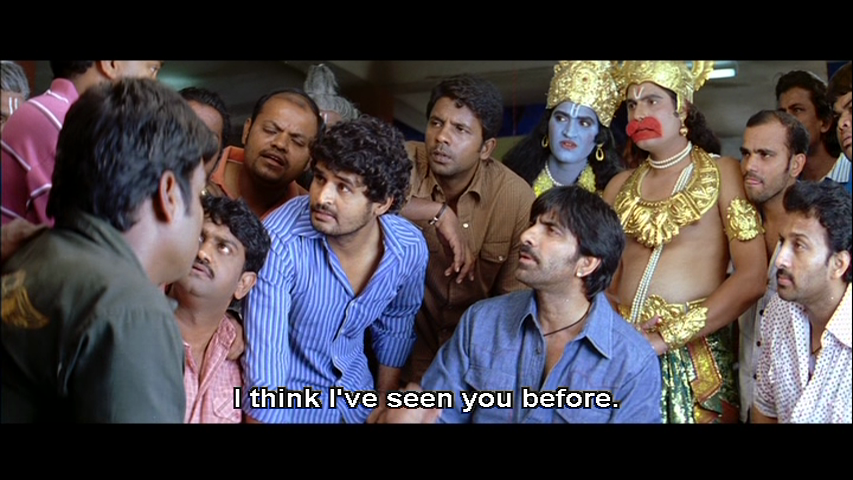
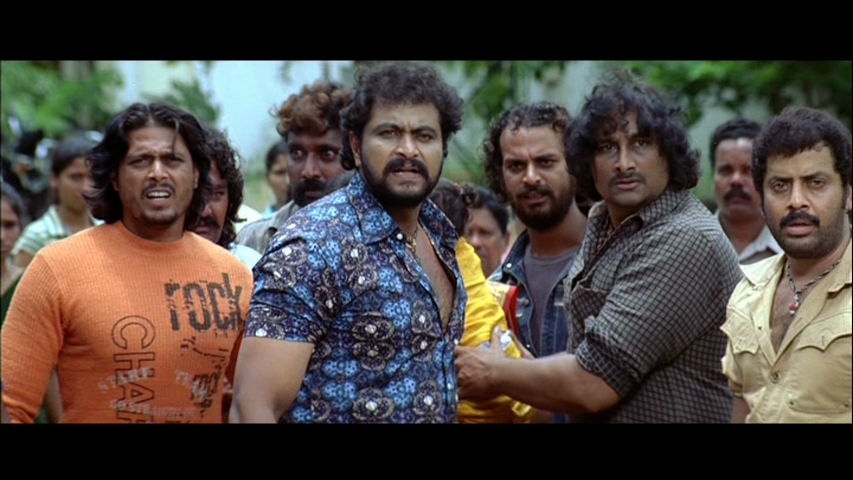
Rey! 3am and we were still discussing Charan’s amazing hair, his dedication to bringing the cape back and the total masala fun of Rachcha.  Another adventure without subtitles, we saw it with an appreciative audience notable for the number of women attending. Usually we hear a high pitched squeal of fandom and look around to see a dude in a suit. But Charan seems to bring the ladies out, and we can see why. There’s plenty of action, excellent choreography and at least for Charan, some superb costumes. Charan channels Chiru in his own inimitable style and with a nod to the camera that says he knows what we’re thinking, while Tamanna holds her own in both the dancing and drama stakes.

The film starts with the opening banner of Mega Supergood Films and, since any reference at all to the word ‘mega’ had the audience screaming, ensured that we were deafened right away. After a flashback involving young Raj, a significant necklace and the extremely dramatic death of his parents, we learn that present day Raj (Ram Charan) is being brought up by comedy stalwart M.S. Narayana and his wife (Sudha). ‘Betting’ Raj spends his days, well, betting and when his adopted father needs a liver transplant it’s the ‘logical’ way for him to raise money. He accepts a wager with James (Ajmal Ameer) to make the daughter of a rich businessman fall in love with him. Raj and James have a history involving a train, 2 cars and a game of chicken, so Raj is not without some reservations, but his situation is desperate.

Chaitra (Tamanna) is that rich girl. Chaitra never seems to go anywhere without her escort of 2 motorbike outriders, 4 SUVs and various bodyguards, so it’s a real challenge for Raj to approach her at all. Luckily he has accomplices (a flock of comedy uncles) so Raj is able to attend to the serious business of flirtation. In one of the many fun tributes to Chiranjeevi sprinkled through the film Raj infiltrates her medical college to the strains of Shankar Dada MBBS and all the collar popping and swagger that goes with it. Naturally it doesn’t take long for Chaitra to appreciate the well styled hair and many charms of Raj. Or does she? Tamanna is a very capable actress, and she does get a bit more to do in Rachcha than we expected. Unfortunately she does get a few scenes where she seems more like an escaped mental patient as she marvels at waterfalls, flowers, a fence painted yellow etc.


As we knew from Badrinath, Tamanna has a great imagination for song costumes and accessories. Raj appears in a couple of full length capes and with a number of scarves. At one stage we thought perhaps she had been expecting a hero more famous for his multiple layers of singlets, shirts, jackets and scarves, but Charan wore it all with aplomb. The curse of the blind stylist only seems to strike at Tamanna but does strike hard and often. The constant mini skirt and short shorts outfits were not particularly flattering, and the choreography and camera angles didn’t help.

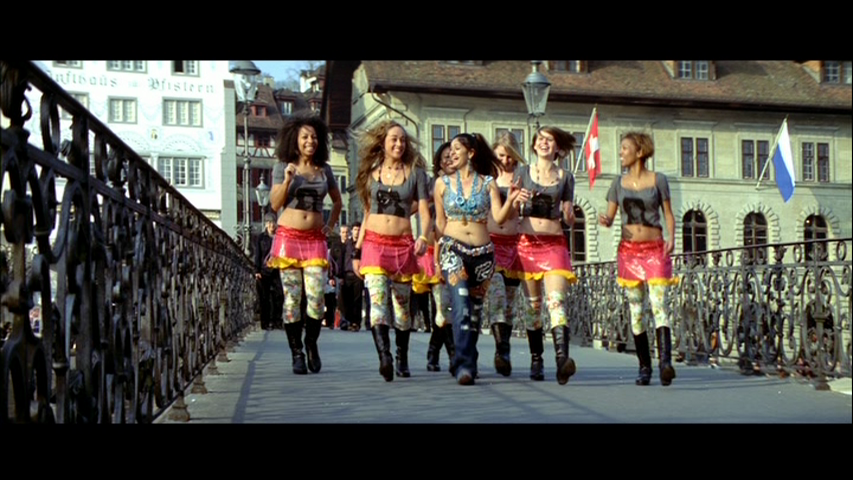
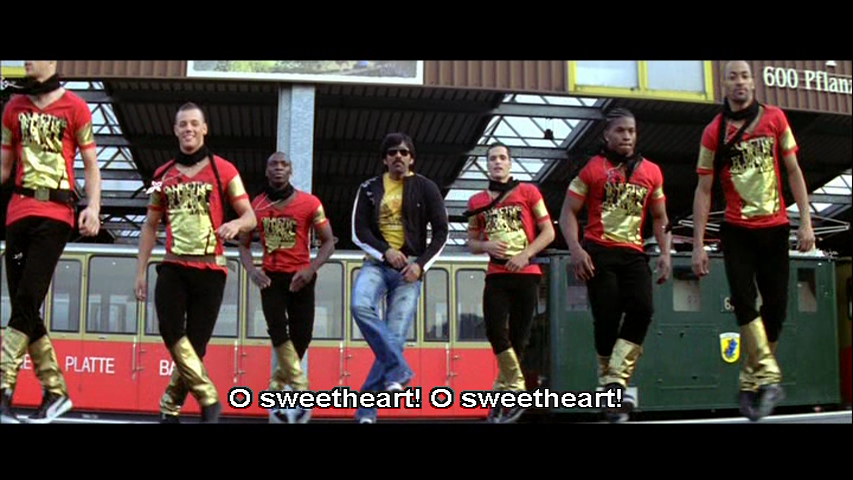
Mani Sharma’s songs aren’t brilliant musically speaking, but the picturisations are awesomely entertaining and the choreography is excellent. The costume teams go all out (poor Tamanna) and the dancing is infectiously energetic and engaging. Charan just gets better and better. He has a good musicality and a sense of the overall appearance of a song. He doesn’t fall into the trap of substituting too many tricks and gymnastics for dancing. It’s a pleasure to watch him, and his facial expressions in the songs are highly entertaining. Tamanna is his match in energy and expression.

http://www.youtube.com/watch?v=qYiKYe8w9ew

The two actually dance together rather than just using the heroine purely for her glamour quotient and it feels like a real partnership. There isn’t any sizzling chemistry but more of a camaraderie which works well enough to make their romance acceptable, especially considering the rather dubious origins in a bet.

Chaitra’s father Bellary (Mukesh Rishi) is not impressed by Raj and when the pair escape he sends for the big guns in the form of Dev Gill in manic villain mode. You can tell he is insane because he wears a coat inspired by Noddy and Big Ears or a high school production of Pirates of Penzance. He had a pathological attachment to this coat and he never appeared without it. This diluted his menace considerably as we giggled uncontrollably every time we saw him.

The second half explains the real reason for the  bet, and sets up the climax. The flashback episode is too long but it leads up to an excellent fight. The action scenes are brilliantly choreographed, using Charan’s physical skills to great effect. Raj was a resourceful and efficient fighter, usually going for the classic ‘kick em in the nuts’ approach rather than anything too impractical. Although he used a flaming wheel and even threw a motorbike at his atttackers in one scene so he was never dull. Sampath Nandi toyed with the audience when he put Charan, Dev Gill and a helicopter in one scene, teasing with the possibility of a Magadheera replay. Rather sensibly the director chose to leave Charan on the ground and let him deal with his problems the old-fashioned way – with a very impressive axe.

There is a pointless appearance by Ali. Brahmi, Venu Madhav and Srinivasa Reddy were moderately amusing in their roles and at least the story did have a flimsy reason for their presence. Srinivasa Rao Kota, Nasser, Raghu Babu and various others turn up and do their usual thing. Satya Krishnan makes a small appearance in a fun women vs men backyard cricket match, and there are some really enjoyable little moments with minor characters. We have to give a big shout-out to the backing dancers and the rather listless ‘dance students’ for their efforts. The comedy and subplots were all more or less tied to the main story which helped keep things moving along. The audience dissolved into hysterics when a man at a roadside restaurant knocked back his drink and then picked up a chicken and sniffed it. Granted that alone was pretty funny, but we did wonder if perhaps there was a reference there that we didn’t spot?

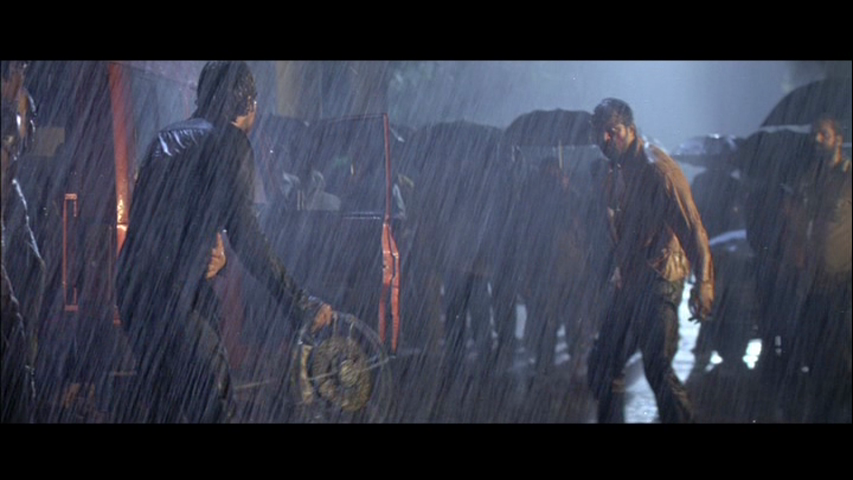
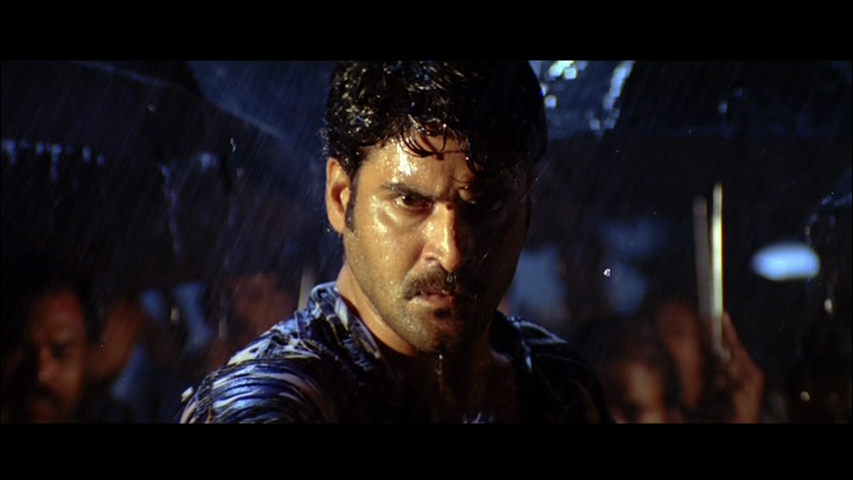
There were plenty of references throughout the film to Chiranjeevi movies and Charan wears a number of outfits that are pure Chiru style. White trousers, black socks and white loafers made a come back, as did loud shirts and colour blocking. He has his father’s mannerisms down pat and it added another dimension to the film to see how many of these tributes we could pick up. And we think it is a smart way for him to deal with the pressure of expectation – he is always compared to his father, so why not own those references and play them with his own style. We were a little disappointed that the significant necklace (which Chaitra could only discover late in the story) meant that Charan kept to a rather modest look, but Vaana Vaana with the dancing in the rain was some compensation.

We have now seen both the original Vaana Vaana from Gang Leader and this remix on the big screen, and the Mega Men certainly know their way around a rain song!

Rachcha is Charan’s vehicle and he delivers a full mass performance that is exciting and very watchable. Tamanna got plenty of cheers from our audience for her dancing and at her speech just before the climax. The songs and fights are so well executed that they had us cheering along too. It’s a visually pleasing film, and has a sense of fun in amongst the action and drama. The story is a familiar one, very much inspired by the type of films Chiru made back in the day, but who says that’s a bad thing? Despite a plethora of comedy uncles, Sampath Nandi delivers a fun and entertaining film that we both want to watch again.

Neninthe

Neninthe is an enjoyable mass entertainer with a dollop of romance and a splash of action, all set in the Telugu movie making world. There are plenty of references to popular Telugu film personalities starting right from the opening titles, and lots of opportunities to guess who various characters are based on. The humour is funny and cynical, and I really like most of the performances. But despite pointing out the blurred line between reality and film fantasy almost all of the conflicts and questions are resolved in ‘only in movies’ style, and not always in tongue in cheek fashion. I don’t think it’s meant to be a realistic expose of the film industry, and that isn’t how I viewed it, but the story would have benefited from a more careful eye on how these elements were blended.

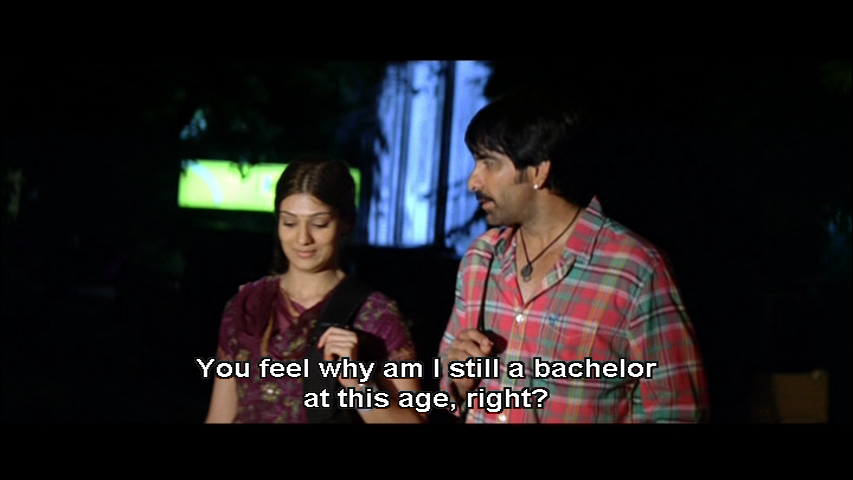
Ravi (Ravi Teja) is an aspiring director. He lives with his ailing ma (Rama Prabha), and is a driven character. Ravi navigates the ego traps and financial shenanigans of the movie industry, all with one goal – to direct his film, ‘Neninthe’. He is brutally honest at times and fiercely determined to succeed in directing his own story. Ravi Teja is a very good actor, especially when he tones down the sleazy uncle act, and this role is great as it spans drama, humour and action. Ravi observes the characters around him, often with a sarcastic muttered aside.

With characters like the infamous director Idli Vishwanadham (Brahmanandam) and associates including producer Sayaji Shinde and production assistants Venu Madhav and MS Narayana, he has lots of material.

Ravi is pragmatic about love and expects marriage to wait on his priorities. I really liked seeing Ravi with his friends, especially his mate who is desperate to be a villain, and mother and they all had a nice rapport.

Ravi is a regular guy, albeit with heroic powers when required and can easily thrash a dozen hulking great rowdies. The trigger is more likely to be his career than a girl. Ravi is prepared to compromise over a lot of things, but not his film.

There are setbacks and sadness in his life, but he keeps going, even when it seems he must run out of energy. He represents the idealism and passion of film makers for their craft as well as being the vengeful, protective hero.

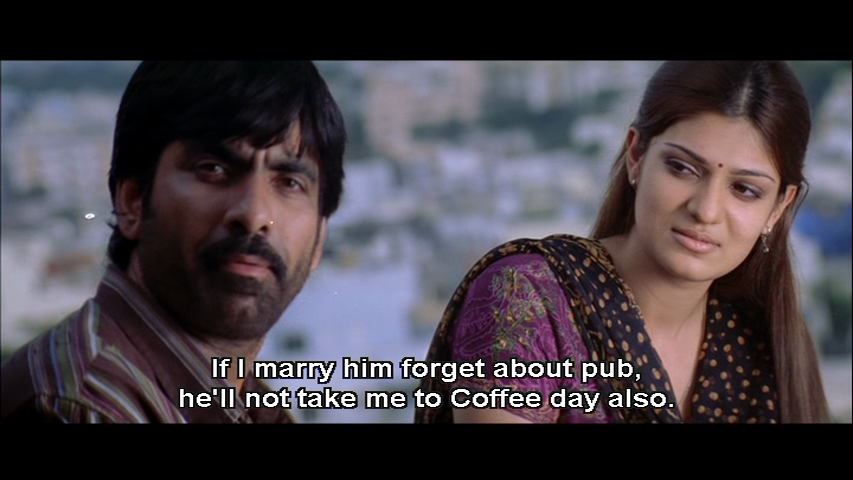
Sandhya (Siya) is an alleged dancer who has no ambition other than her next meal and not getting pimped out by her creepy brother-in-law (Krishna Bhagawan). Both the actress and the role are quite insipid and I wanted to slap her on more than one occasion. Sandhya is pursued by Yadu (Supreet), a local thug accustomed to taking what he wants. She, of course, falls for Ravi and seems to think that she can just leave every problem in her life for him to solve because her love places him under that obligation. It is quite annoying to hear her whining about how Ravi never helps her when she does bugger all to help herself. I am sure it would be hard to ditch the sadistic brother-in-law, but it’s even harder to walk away if you have no spine to speak of.  Anyway, she seems set on Ravi, and equally set on changing him.

Ravi helps her get a starring role, and her fortunes improve especially as her brother-in-law stops trying to sell her, but the couple start to drift apart. The scenes where Sandhya and Ravi discuss their relationship are well written, and Ravi Teja is believable as the man in love but not blind to practicalities. Siya has some good moments, especially when she is annoyed at Ravi, but she fades when the other stars are present. There was potential for Sandhya to be more interesting but Siya is as convincing an actress as she is a dancer and the script is lightweight.

Subbaraju is ‘Miracle Star’ Mallik. He was one of the first Telugu ‘That Guys’ that I could pick out from the pack. You know the guys – always a sidekick, policeman or henchman (not to be confused with ‘That Comedy Uncle’). I admit I may have paid particular attention because Subbaraju is rather good looking, even in the shirts they dug up for this film (see them hanging up in the screencap above). But I also noticed him as he seems to be more of a character actor than just a stock ‘type’ and can handle a range of roles. So that got me thinking about the trajectory from supporting actor to hero, and why there are so many ‘types’ and so few honest to goodness character actors in Telugu films nowadays.

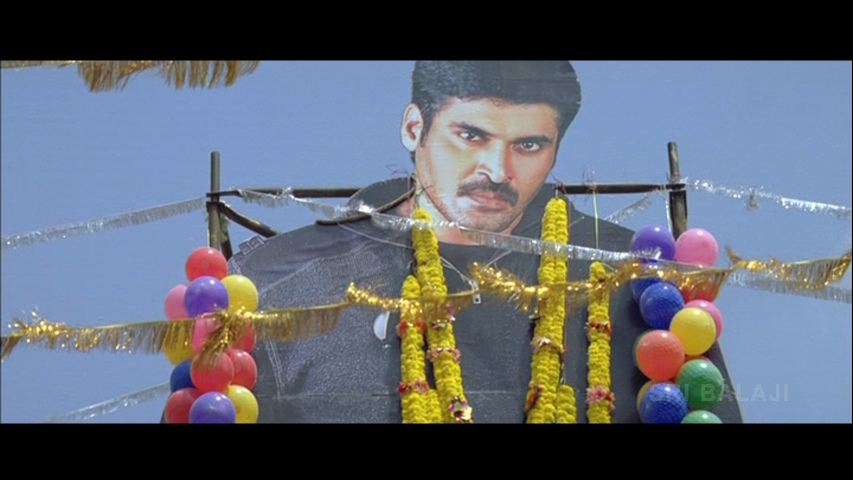
Puri Jagannadh has fun with Mallik as the stereotypical hero, and Subbaraju gives it the right balance of sincerity and parody. He spouts dialogue recycled from Pokiri and then asks if it isn’t a bit over the top, and has a flock of minions fussing over him. Mallik swans about like a total diva and he proves he isn’t above using his fame when it suits. But he also voices concern about the obsession of the die-hard fans and how far they go in the name of their idols, and that forms a substantial sub-plot.

There was a mix of gratitude, ego, and resentment in Mallik’s dialogue about the fans and the effect their expectation has on movie making. If he had spoken to one particular nutter at the right time there may not have been a funeral at which to make that speech, but I suppose that would have been too sensible.

Mumaith Khan is the item girl, and her character is Malik’s girlfriend. Their scenes together are good, except for Mumaith’s occasionally stilted dialogue delivery. They serve more to comment on the obsessions of the press than to provide another romantic element in the film.

That song rhymes bus station with frustration. I just thought I’d mention it as Chakri’s music is pretty lacklustre and that’s all I ever seem to remember.

A confronting ‘movie meets real life’ moments occurs after Mumaith and Mallik break up over scurrilous rumours in the press. Mumaith overdoses, and on the way to hospital her car is hijacked by a couple of Yadu’s men who then rape her. She gets out of her hospital bed to deliver a speech (full of bleeps) to the press about their penchant for creating news with no regard for the individuals or the effect these stories have. It’s a sharp observation, but I wish it had been delivered in a different setting. Anyway, once again a valid point was made via a sensational set-up.

There is a salacious element in the media when discussing many actresses, and I doubt the same journalists would approve if that tone was directed at their sister or cousin. This would have been an interesting story to film post the advent of Twitter, since that is often what passes for ‘news’ these days. I like Rana Daggubati as an actor but I don’t think his recent tweet about luggage going astray warranted several paragraphs in the Times of India!

Supreet as Yadu is hilarious and utterly repulsive as he tries to woo Sandhya instead of just assaulting her as per his usual approach. Yadu’s attempts to be appealing are amusing even as my skin was crawling. It was like watching a bear trying to eat with chopsticks –unnatural and bizarre yet compelling. And his gang have some of the worst hair I’ve seen in ages. He is menacing, and doesn’t hold back on the crazy. Yadu’s obsession with Sandhya and the ensuing conflict with Ravi bring the film to a gory final confrontation.

The other supporting actors are generally fine and their characters are integral to the story. There are ambitious would-be directors, assistants to uphold the status of their boss, financiers and distributors as well as family and friends. It’s a crowded film, but the story and relationships remain clear. There are some fairly awesome song costumes too!

Puri Jagannadh doesn’t stop at movie references in the dialogue – he uses music snippets and visuals, and Ravi even uses a reel of film as a weapon. The dialogue sometimes sounds like a lecture but overall I find the subject and the characters engaging enough. It’s a very well planned and designed film. I just wish he had put as much effort into executing the story. 3 ½ stars.

Quite apart from the potshots at various industry types, I’m also convinced that Puri Jagannadh may hate a segment of his audience. Specifically, me. Why?

Exhibit A

Exhibit B

So who gets a song requiring beachside cavorting?

You’ve been warned.

Heather says: Although there are a lot of elements I do like about this film, there are also a few I don’t like, and it was those that I noticed more on re-watching Neninthe for this review. However it’s one of the best performances I’ve seen by Ravi Teja who is very watchable and charismatic here, although (and I can’t believe I’m saying this) I do think I prefer him unwaxed! I also love the back-drop of the film industry as the setting for the story and the way that Puri Jagannadh manages to get across the routine repetitiveness associated with filming rather than the glitz and glamour that most people associate with movies. However I find the story rather bitty with elements that don’t gel  together quite as well as they should. Sandhya has so much to deal with that perhaps it’s not surprising that she doesn’t seem to know where to start. Her character seems to veer between hang-wringing and ineffectual ‘woe-is-me’ to being quite strong and decisive when it comes to making sure that she gets exactly what she wants from Ravi. I found all this dithering to be annoying, and couldn’t feel very much sympathy for her character at all. In fact I think the film would have been better without the romance factor, as it could make just as much sense that Ravi helped her career because he was a nice guy who felt she deserved better. There didn’t seem to be any zing to the romance and apart from the songs, no chemistry between the two actors.

On the other hand I do like Brahmi’s bumbling director and think that the comedy is generally well integrated into the main story. Like Temple, I’m a big Subbaraju fan, and I totally loved him as the ‘miracle star’.  Watching this for the second time and about a year and many films later, I did pick up more of the nuances in his performance, and in particular the way his character interacted with the cast and crew as well as the members of his fan association. I think he’s a great actor and apart from doing justice to his role as a stereotypical ‘hero’ he really looked the part too. Mumaith Khan is another of my favourite performers and while she seemed to be basically playing herself, I appreciated the way she appeared on camera with minimal make-up and gave a fairly convincing lecture about the evils of fame. As Temple has mentioned there are many good and valid points made about the way stars are treated by fans, the press and the industry but I agree that the set-up to deliver these messages tended to overshadow the points that Puri Jagannadh was trying to make.

I did notice that the subtitles appeared better than usual – there was a  ‘shut your gob’ in there which I appreciated as a very English idiom rather than the usual more stilted direct translations and there were quite a few of these more colloquial interpretations. I also enjoyed the shots of the orchestra with real musicians playing violins properly rather than the usual half-hearted attempts that drive me crazy!

This is still an entertaining film despite the irritating heroine and lacklustre romance. I’d recommend watching at least once for some excellent performances and the general overall view of the movie industry. 3 ½ stars.

Dookudu

Another Adventure Without Subtitles! Dookudu is the much awaited release for ‘Prince’ Mahesh Babu and we knew it would be huge. We arrived early for the 8.30pm show, which gave us the opportunity to watch the staff deal with the problem of getting the first show crowd out through the 700 or so people crowding into the small foyer. Once people emerged, the waiting audience clapped and cheered them like they were rockstars, and it was a very festive atmosphere. As one lady said  – why come to the cinema unless you’re going to have a good time?

It was about 10pm before the film finally started, not that anyone was complaining. There was plenty of cheering, accompanied by the sounds of tearing newspaper, as everyone got ready for Mahesh’s appearance.  There was discussion about whether there might be the odd flash of elbow (Yes there was, and even a glimpse of princely tummy) and just how many shirts can Mahesh Babu wear and still manage to fight? (There is apparently no limit to what Mahesh can do, or how many shirts he can wear.)

The film starts with politician Shankar Narayan (Prakash Raj) who is so well loved by the people that we know he’s heading for a gruesome end. Sure enough he’s attacked and left for dead by his rivals who include Kota Srinivasa Rao, Sayaji Shinde and various other Telugu film baddies. Somehow Shankar survives, in a coma and hidden in a secret location, and he finally comes round some years later to a changed world. His son Ajay (Mahesh) is a policeman rather than a politician as his father had planned, a number of his friends and colleagues are dead and the family have moved out of their old house. However the doctor instructs Ajay not to shock or distress his father in any way, for example by telling him the truth, as this will be bad.

Mahesh is introduced in full throttle action hero style, complete with title song. He takes on a room full of bad guys with nothing but his comic timing, guns and a whole lot of biffo.  Ajay is a super cop – invincible and fearless. He is also quite prepared to play outside the legal system if that is what it takes. After one such scene we did have a quick discussion about the omnipresent singlet under all the layers of shirts, and whether it was actually bulletproof. Whatever the reason, the bad guys consistently fail in their efforts to eliminate our hero, while he has no such issues dealing with them. Mahesh can convincingly portray a furious rage in a very low key acting style, and he is also more than capable of bantering dialogue with the comedy uncles. It’s a role tailor made for him, and while he wears his police uniform a little on the baggy side the character is a perfect fit.

Ajay does a deal with Brahmi who’s taken over their house and in the process convinces him that he’s taking part in a reality TV show which forms a large part of the comedy in the film. Ajay pretends to be a politician and keeps his life as a policeman secret from his father, while all the time plotting revenge on his fathers attackers. It’s no wonder Ajay is always on a short fuse – he must be exhausted from all the pretending. And the killing.

Ajay finds out through another investigation that mafia boss Nayak (Sonu Sood) was involved in the assault on Shankar. It looks at first as if Sonu is about to reprise his role in Ek Niranjan as the stylish and psychotic villain, but sadly his wardrobe fails to deliver. Despite the nice cravats and the random and occasional application of grey to his hair and moustache, Nayak is a subdued and fully clothed villain who just loves his little brother a bit too much.  We enjoyed the Sheila ki Jawani dance break and we think Sonu did too, but it was shortlived. Most of the posturing is left to his faithful sidekicks played by Ajay and Subbaraju. That’s fine with us since they’re both Cinema Chaat favourites and we did enjoy watching the satin shirted Subbaraju try to mime to his boss that Mahesh was really an undercover policeman. Oh for a pen when you need one…

Along the way, Ajay takes his gang of trusty colleagues to Turkey, apparently just so he can say ‘Operation Istanbul’ as there is no other discernible reason for the location. He meets Prashanthi (Samantha), a fashion designer and, unknown to him, daughter of his clownish boss (Nasser). While Ajay and Prashanthi have the usual confusions before falling in love there is no substance to Samantha’s role and she’s soon side lined. There is little chemistry between Samantha and Mahesh, maybe because they spend hardly any time together on screen. Samantha looks beautiful, and wears whatever the costume department have dreamed up. That seems to be her sole purpose in the film as she doesn’t actually do anything.

There was more comedy with M S Narayana and one very funny skit where he took off a number of films including Magadheera and Robot. A little comedy can go a long way, but here it was integrated into the main story and with Mahesh adding to the comedy dialogue there were parts that were very funny, even to us non-Telugu speakers. The rest of the audience were roaring with laughter throughout the speeches. Master Bharath put in an appearance too. Was he necessary? Probably not. And yes there were some unfortunate stereotypes masquerading as comedy, but for the most it was entertaining.

The supporting cast was very strong, if largely underutilised. Shafi, Tanikella Bharani and Sudha had little to do, and Satya Krishnan was given maybe one line of dialogue. It’s a big budget film when you can hire some of the best and then not do anything with them!

The action sequences are excellent, and it’s hard to go wrong with a good impaling. Sreenu Vaitla has come up with several ways of illustrating the ‘eye for an eye’ concept, all of them extremely gory. The camera work and special effects were great and added impact on top of the already impressive stunts. We enjoyed the flashes of lightning when Ajay was beating Nayak to a pulp, and the changes of tempo in the film speed that underpinned the dramatic tension.

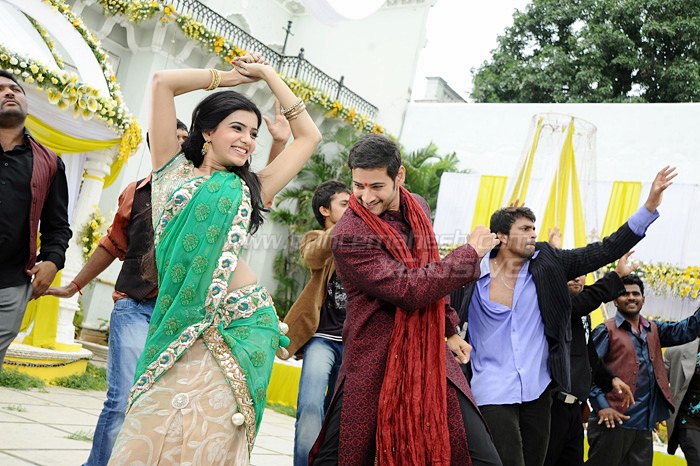
The song picturisations were less successful, and the songs by S.S Thaman are not so memorable on their own. Mahesh can dance reasonably well so it was disappointing not to see more use being made of his skills, and we wondered who decided it was a good idea to give him Abhishek Bachchan’s choreography. Chulbuli Chulbuli was spectacular with plenty of feathers and some enthusiastic backing dancers, although clearly ‘inspired’ by Kilimanjaro. The nightclub song lacked a good item girl but made very good use of the male backing dancers, grinning madly in satin pants and ruffles,  and had a giant guitar shaped light-up floor so that was pleasing. We must also congratulate the set designer for the impressive selection of chandeliers and lamps, especially the chandelier in the hospital ward.

Dookudu has a charismatic hero in a strong if silly storyline, and it is a technically excellent film in the mass entertainment style. It might not be the greatest film ever made, but it was  really fun to watch, especially with the awesome Melbourne audience.