Madrasapattinam

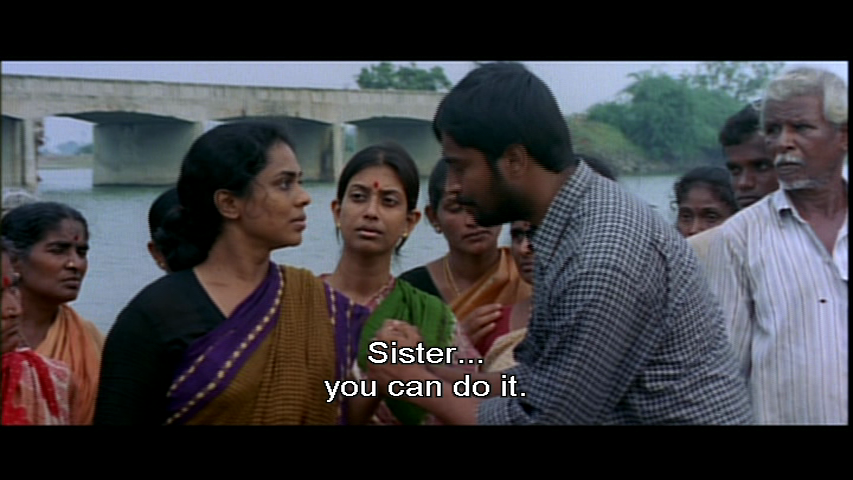
I picked up Madrasapattinam with a little trepidation; after all Indian historical films featuring a cast heavy on English actors don’t usually bode well. But I was pleasantly surprised as, although there are tinges of Lagaan and a few cringe-worthy moments, overall Madrasapattinam fares somewhat better than expected. There is still the issue of almost uniformly ‘evil English’ and ‘good Indian’ characters, meaning most of the supporting cast are very one-dimensional. However the leads give good enough performances that apart from one notable exception, I could ignore the clichés and just enjoy how beautiful the film looks.

The film begins with the elderly Amy Wilkinson determined to return to India and find a man she last saw some 60 years previously. Ostensibly she wants to return a Thali necklace given to her as she feels it does not belong to her. As she is also quite seriously ill she travels with her increasingly whiney and irritatingly useless granddaughter Catherine who is supposed to be looking after her. To aid her search Amy has a photograph she took in 1945 but little else other than a name.

When they arrive in Chennai Amy starts to relive her time in India, when she was the young daughter of the Governor, and this is when the film really comes alive.  The young Amy is picked up at the station by the Commissioner of Police, Robert Ellis (Alexx O’Nell), and straight away he’s my biggest problem with this film. Why does every English bad guy have to be the most evil and despicable person on screen? It’s very obvious from the first time we meet him that this is a man with absolutely no redeeming features whatsoever and it’s difficult to keep watching and not just skip his scenes. In my opinion he could have been made much more interesting if he was just thoughtless and greedy rather than consistently evil, but sadly he’s just vile and repulsive and it’s very obvious from the very beginning how he is going to behave throughout the film.

On the trip to the Governor’s residence Amy meets Parithi (Arya) in classic ‘meet the hero’ style since she sees him running to save a donkey from the path of her runaway car. Parithi works as a dhobi and in his spare time he wrestles with local trainer Ayyakanu; a man with an impressive moustache who isn’t afraid to get down and dirty in the ring himself. Added to Partithi’s ability to run, wrestle and save animals is his most perfect feature – he can iron. Naturally Amy falls in love with her ‘brave man’ as he fights against the English plans to build a golf course on the area where the villagers work and live. It becomes a personal vendetta between evil Robert and Parithi as they are both also competing for Amy’s attention and since they are playing by different rules you know that it’s not going to end well.

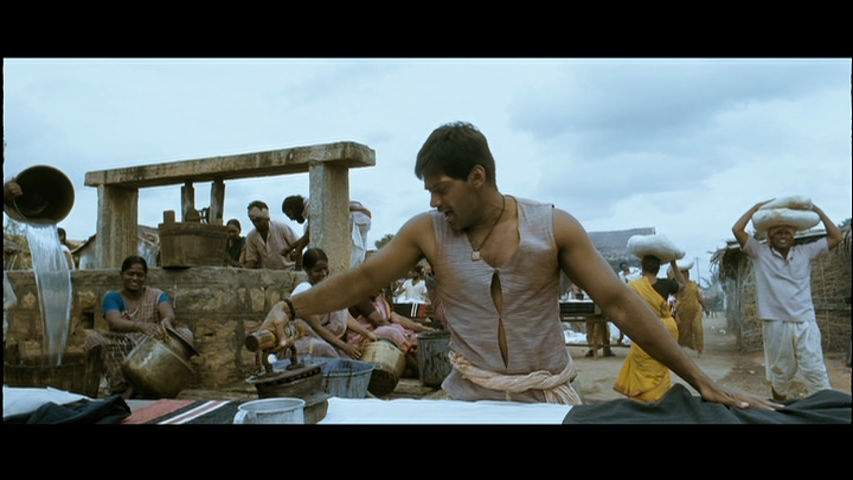
Amy and Parithi meet each other in secret, and there are some lovely scenes as they struggle to overcome their language barrier. They have an ingenious if somewhat laborious method of communication, as Amy draws pictures on her clothes of where and when they will meet which Parithi then has to launder off. Amy spends much of her time in the village with her camera, and the villagers seem to love her just as much as she loves them. However when Indian Independence finally arrives it means the end of her romance unless she can escape with Parithi. Their plans are naturally foiled by evil Robert who chases them through the Independence celebrations determined that if he can’t marry Amy then no-one will.

The romance between Amy and Parithi is the best part of the film. Amy Jackson is stunningly beautiful and is convincing as a young English girl in the post-war period. She is nicely restrained in her scenes with Parithi, but charmingly natural with Parithi’s sister Selvi and the village children. Arya is excellent as the strong and mostly silent Parithi who is determined not to back down in the face of the English oppression.

There are many genuinely funny scenes which are well integrated into the narrative, and these help the film from getting too bogged down in all the drama of the fight for the village and the seemingly doomed romance. Tension is well build up in the chase scenes although these could have been cut a little without losing too much of the suspense. Cochin Hanifa as the translator Nambi and Nassar as Ayyakanu are the best of the supporting actors but the story revolves around Amy and Partithi and no-one else has an awful lot to do.

The film does look beautiful with well constructed sets which seem to be representative of 1940’s Madras, particularly to someone like me who’s only ever seen the modern version from 1990 onwards. There are one or two instances of rather dodgy CGI but these are fleeting and don’t really disrupt the story so they are ignorable. The end credits feature old pictures of Madras landmarks followed by their current appearance which really was fascinating. One anachronism for me was one of the actors had an apparent artificial eye. While this was possible from the time period, I don’t really think it’s all that likely that a dhobi would have had access to this especially post WWII where prosthesis were a luxury. But that’s just my obsession and I’ll just see how many people spot him.

The modern day scenes are somewhat hampered by an incredibly wooden performance from Lisa Lazarus as Amy’s granddaughter although Carole Trungmar is rather better as the elderly Amy and her periods of abstraction fit her character well. The story is compelling and the final scenes in the present day give a satisfying conclusion. While the soundtrack by G. V. Prakash Kumar is perfectly adequate it doesn’t stand out as particularly memorable. The first song is set in the dhobi village by the river and I’m sure intentionally, is very reminiscent of Ghanana Ghanana Ghir from Lagaan, although in this case they are asking the rain not to come. The rest of the songs have less dancing than I would have preferred but we do get the opportunity to see Arya in an outfit that looks as if he has just escaped from a totally different period film as consolation.

While evil Robert and the standard ‘English opression’ storyline did annoy me in this film, the romance is quite charming and I think the two leads manage to carry the story well. The parts of this film that I like, I really do like very much but the parts that I don’t like, I really do dislike very much. Which means a lot of fast forwarding when rewatching. As far as historical romances go it’s certainly not the worst I’ve seen and I give it 3 stars, although one of those is for a hero who can iron!

Temple says: I don’t have the same issue with evil Robert that Heather does. He shouts, snarls, twitches, bullies his underlings, has a pit full of decomposing bodies in his backyard and constructs overly elaborate revenge plans. In short, he’s like almost every other filmi villain. I do have an issue with the atrocious acting by the guy who plays Amy’s father. Distractingly bad. Given to long….pauses. For no reason. And delivered other lines. Like this. Staccato. Caroline Trungmar was not impressive as the older Amy as she seemed catatonic for most of the film but her Titanic inspired role was mostly to sit and look like she was remembering so I may be a bit harsh in my judgement. The tradition of really bad acting by white extras seems to be alive and well and was embraced by many in this cast.  As they were mostly caricatures rather than fully developed characters I don’t know that a more nuanced performance would have been much help. The Indian supporting cast were all pretty good, and Cochin Hanifa is lots of fun as are Parithi’s friends.

I was more distracted by the indeterminate historical period of the costumes and dialogues. As the film starts in 1945, the European costumes are often very wrong indeed and the dialogue sounds as though some of it was lifted from Dickens rather than a comparatively modern family. And the Europeans’ manners at the dance…well.

But the film is really about Parithi and Amy and if you can enjoy their developing love story, then it is a pleasant enough timepass. Arya is excellent as the strong silent type, prone to flexing and ironing. Who could ask for more? Ok well, if you want more, he also wrestles.  Amy Jackson looked more like a footballer’s girlfriend than a 1940s heroine but I think she is one of the least embarrassing gori love interests in an Indian historical film that I have seen. Their interactions are simple and often Amy follows Parithi about as he works, allowing us to observe the villagers life and see the diverse supporting characters in play. They have a nice rapport, and the scenes with Selvi (Parithi’s sister) are genuinely touching.

The look of old Madrasapattinam is very picturesque and the olden days scenes are pretty and dominated by sepia tones that help keep the mood of past times. The modern city of Chennai is a contrast in grey and blue, cold and confusing. This feels very much like a pastiche of Lagaan and Titanic with a dash of Kisna and it is entertaining rather than informative.

I give this 3 stars – for a good looking film, with good looking stars and a positive message that men who iron are heroes.
Aaranya Kaandam

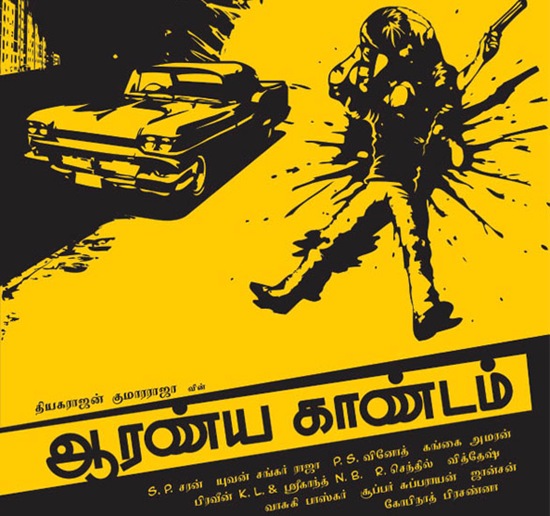
Aaranya Kaandam should come with a warning – an excess of fake violence, actual real life violence against chickens and naked Jackie Shroff. Yes really! Jackie Shroff takes his clothes off in this film.  We have no idea why the organisers of the Indian Film Festival decided to choose this film over many other excellent Tamil releases this year. Perhaps they wanted to see Jackie with his kit off, but why we all had to suffer is a mystery!

The film is a long (too long) tale of double crosses by Pasupathy (Sampath Raj) when he is caught between two rival factions of gangsters. One gang is led by the aging Ayya (Jackie Shroff) and Pasupathy starts out as his more adventurous and able lieutenant. Ayya resents his younger henchman and when Pasupathy organises a drug deal through a corrupt cop to steal cocaine from a rival gang we know it’s all going to turn out badly. Adding to the mix are Ayya’s mistress Subbu who wants to escape, Kaalayan who manages to stumble across the drugs, his competent little son Kodukkapuli, and the other gang leaders Gajapathy (who has an impressive pair of ears) and his brother Gajendran.

Although the overall story is interesting there is too much time spent setting the scene and explaining exactly who is who.  First time writer and director Thiagarajan Kumararaja seems to have been heavily influenced by films such as Traffic and Pulp Fiction where there are a number of apparently unrelated threads which come together to form the climax of the film. But while he manages to  bring the various storylines to a more or less satisfactory conclusion, they don’t all work as well as each other. In addition to the pacing problems, there is a heavy reliance on gimmicky edits and lighting effects that lose their impact through over use. The actual cinematography was excellent, and the street and interior scenes were saturated with colour. Again, we suspect some of the highly stylised angles and use of colour filters was influenced by films like Traffic but it lacked structure so it looked a bit too try-hard.

The soundtrack is a mish mash of musical styles and sounds. We think this might have been meant to create an art house feel, but really it sounds more like someone bought a world music CD and used that instead of going to the trouble of composing anything special. Like the gimmicky editing the music became intrusive and sometimes detracted from the scenes, often simply because it was too loud.

The story of Kaalayan and his son is rather laboured and the inclusion of some rather nasty cock-fighting scenes with lots of lingering slow motion shots and buckets of gore was quite unnecessary. A lot of this could have been cut without losing any of the backstory in our opinion.  The child actor was fairly effective, and the audience certainly responded to his performance.

Sampath Raj puts in an impressive performance as the man trying to work his way out of a difficult situation. He has a good hero run, and puts it to use frequently throughout the film.

We know that traditionally anyone who is Jackie’s friend in a film seems to be marked for a horrible death or at least significant misfortune so we were expecting the wheels to fall off for Pasupathy. Jackie Shroff grunts his way through a series of inexplicable grimaces and as we mentioned decides to bare all. Thankfully there is pixilation but just not enough of it. Jackie Shroff himself may have preferred a larger area of pixilation as frankly it appears there was not all that much to be covered up! It’s not surprising that Subbu wants to escape from his early morning coughs and gurgles as well as the obvious horror of naked Jackie. Ravi Krishna is the gullible Loser who gets caught up in her plans for flight. Both he and Yasmin Ponnappa in her debut role turn in good performances despite a hackneyed plotline.

What does work is the dialogue, which seems snappy and funny despite the overuse of swearing in the subtitles. According to our Tamil language expert the characters weren’t actually swearing most of the time, so it seems strange that the subtitles decided to include as much profanity as they did. Especially when it seemed that every second word out of the kid’s mouth was something that our parents would still disapprove of. Maybe they knew there wasn’t enough plot to last the distance?

Temple says: This was a bore and a disappointment. The entertaining moments were few and far between, and the direction wasn’t focussed enough to make the incident heavy plot stay on track. I quite like Sampath Raj and if the story had been better balanced, this might have been a good gangland thriller. As it is, it’s a mess. I give it 2 stars – for Sampath Raj and so the torture of the poor roosters wasn’t in vain.

Heather says: While I didn’t find this film boring, it really wasn’t pleasant to sit through. There was a lot of really unnecessary violence of the gruesome and graphic kind, and the rooster fight scenes were totally unwarranted. Jackie Shroff was a real disappointment, although I didn’t have high expectations from him anyway. I can think of many actors who would have played this role much more convincingly – although all preferably without the nude scene! There were some good moments hidden amongst the carnage, some reasonable performances from a number of the actors, and even some good comedy. But not enough to save this film from collapsing under the weight of all the various plot threads. 2 stars from me.

Aayutha Ezhuthu

A little bit of research informs us that Aayutha Ezhuthu was supposed to be a call to the youth of the nation to take up politics and generally to encourage political awareness. We really don’t know if this was true, since this film seems to show that life in politics is apt to be short, violent and fraught with danger. In addition, the wily politician who sets up the main characters seems to be thriving through his various corrupt dealings, so perhaps the film serves more to show what the problems are within the system. Aayutha Ezhuthu uses the converging storylines of three characters to set the scene and their subsequent interactions form the rest of the story. As the story unfolds the film becomes more of a straight ‘good guys’ vs. ‘bad guys’ although it’s not totally clear who exactly are the ‘good guys’ here.

The film opens with three main characters following their own storylines in traffic on a bridge. The same scene is shown from the viewpoint of each of these three and, after each vignette, we are shown that same character’s life in the few months prior.

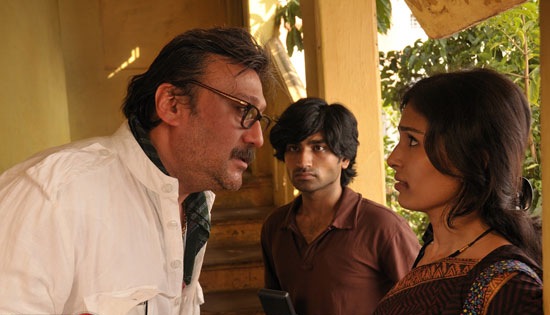
First we meet Inba, played by Madhavan in an uncharacteristically brutal role for him.  He is a thug, who works for his brother mainly ensuring a local politicians campaign runs smoothly. Inba beats his wife and almost casually chooses violence over any other form of social interaction. Inba’s current employer, Selvanayagam the local politician played by Bharathiraja, is the spider in the centre of the web.  He employs Inba to police his rallies, and is in direct conflict with the second character in the drama, Michael.  Through their involvement with each other, the third, Arjun is drawn into the fray.

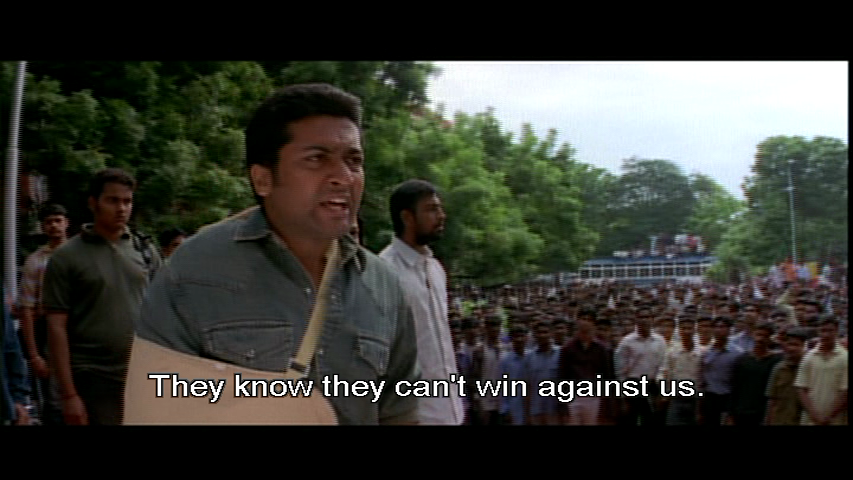
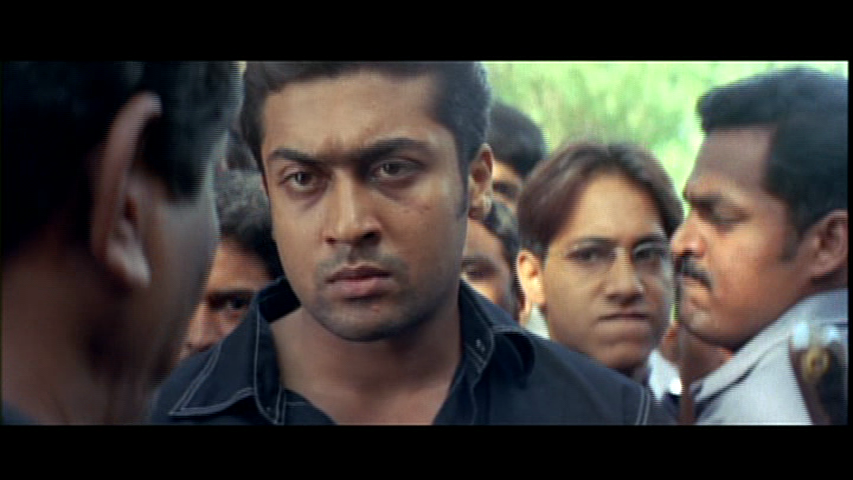
Suriya plays Michael Vasanth, a student, apparently a mathematical genius and also a political activist.  Not for him the more normal student methods of agitation such as demonstrations or debates, he prefers to be more direct in his approach and encourages retaliatory action.  This brings him into direct conflict with Selvanayagam and thus ultimately with Inba.  Suriya also seems out of place in his role.  He is muscular and obviously powerful, which doesn’t fit the image of a serious scholarship winning student.  His solution to problems faced by local villagers seems to be almost as confrontational as Inba’s violent tactics.  He appears belligerent and selfish as we see him brush off his mother’s concerns and treat his girlfriend badly. Although it is quite conceivable that students will use such extreme tactics, as has frequently been seen in many countries of the world, this approach just felt wrong with these characters. Perhaps this was partly an issue with the subtitles which may not have conveyed the dialogues accurately, but Michael came across as a very unpleasant character and his political aspirations felt more self-serving and less for the public good than perhaps was intended.

The final character in the drama is Arjun, played by Siddharth.  A playboy who has just finished his studies and plans to head to the US, Sid at least seems to fit the role he has been given.  His approach to life seems much more in keeping with his character and his pursuit of Meera, while typically filmi does feel much more genuine than Michael’s relationship.  By a series of coincidences all three are on the same bridge at the same time.  Inba uses this opportunity to get rid of Michael by shooting him, which sends him falling into the river past Arjun’s shocked gaze.

The storylines all converge at this point, and the aftermath of the confrontation is played out to its bloody and somewhat inevitable conclusion given the arrogance and brutality of the main characters.

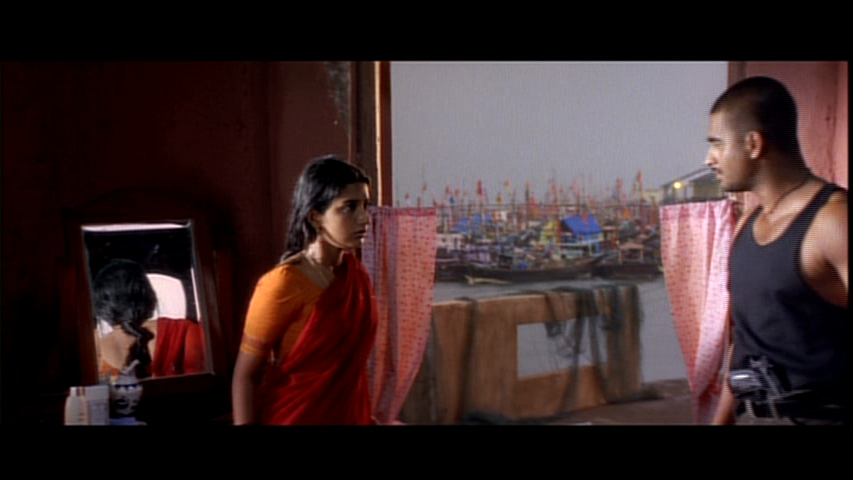
What are much more interesting about this film are the female characters.  Although she is regularly abused by Inba, his wife Sasi is a very strong personality who is determined to wean him away from his brother’s influence and stop his forays into crime. Their relationship is very realistically portrayed by Meera Jasmine who is fantastic as the battered wife. Despite her family’s objections to her husband, Sasi enlists them to help get Inba a job, so she obviously has great powers of persuasion.  Madhavan’s scenes with her are the best in the film and she was very compelling in her performance. Trisha in her role as Meera is less of a driving character, but she is part of the reason why Arjun changes his playboy ways as he slowly falls in love with her.  She is convincing and effective in the initial scenes, but towards the end of the film she appears to be sidelined. Esha Deol plays Geetha, who is involved with Michael.  There is a lot of potential in their relationship as he doesn’t want to get married and asks Geetha to move in with him instead.  This opportunity to look at the issues surrounding marriage and commitment is squandered as the theme is never really developed further.  Geetha lies to her parents and to Michael’s mother and never really becomes anything other than the woman in Michael’s life.

However these three women, as well as the various female characters that stand for election in the story, seem to be at least an attempt to show women as other than just the pretty wife, girlfriend or daughter.  There is more meat to their roles here, although it’s not sustained and ultimately only Sasi makes a lasting impact.

Because of the belligerence behind Michael’s actions it’s hard to see him as one of the good guys.  The virtual worship of him by the other students contributes to the impression of arrogance and he imposes his will on everyone around him without any seeming thought to the consequence.  Despite his thuggish ways, Inba appears as the more sympathetic character as he is genuinely trying to change his ways, but cannot get out of the cycle of violence he has lived with all his life.  The supporting characters all seem to have their own agendas as well, keeping the whole feel of the film as one of corruption and deceit.  The only genuine people seem to be the villagers caught up in the struggle for their village. While the film tries to be a statement on youth and politics, the end result seems to disregard Michael’s supposed motivation and political ambition and highlight the futility of anything other than corruption and violence as a means to achieve and hold on to power.  The secondary plot line of Inba’s attempts to escape his violent lifestyle is much better handled. While Meera Jasmine is the standout performance, both Trisha and Esha Deol ultimately aren’t given enough screen time to be effective.  A special mention for Sriman who played the character of Dilli, and was excellent in his role as Inba’s conscience.

Heather says: I really didn’t like this film.  For me it may have worked better if the casting of Madhavan and Suriya had been the other way round.  I found that Suriya didn’t fit the image of a student at all. He is too old and not convincing, while Madhavan in his role switches between mayhem and maniacally happy.  This didn’t seem to fit either the characters lifestyle or generally bleak prospects.  As a man recently released from prison, with a pregnant wife and no real job aspirations other than working for his brother, the ‘crazy happy’ was difficult to swallow.  Some of this was to show the reason why his wife stayed with him, and indeed some of these scenes were much less overdone.  This may have been a directorial decision as Abhishek Bachchan appears very similar in his characterisation of Beera in Raavan. I stuck with the film mainly because of the relationship between Inba and Sasi which was very well portrayed. Siddarth’s character was also quite watchable, and overall the story was interesting, but I was very tempted to fast forward every time Suriya was on screen. I have liked him in the other films I have seen him in and was horrified by him in this.  I really wanted his character to die as quickly as possible, just so that I did have to suffer through his flexing and belligerence.  I wish I had liked this film more but thought it was a potentially good story that for me was ruined by bad choices in the cast and poor directorial decisions. 2 1/2 stars from me.

Temple says:  This is another film that, like Leader, is well made but not likeable. I have issues with the character of Michael and his immunity from consequences. Everyone around him is made to pay for his activism but he escapes with a few flesh wounds. Surya was unappealing as he seemed to show only the arrogance of Michael and gave me nothing to respect in that character. Unlike Heather, I really liked Madhavan’s performance in this. I thought he really made sense of Inba and Sasi’s relationship, and showed the complexity of his character. He was boyishly impulsive, and casually brutal in turns. He showed the pressure Inba felt to be a man’s man and ignore his wife unless they were behind closed doors. Their relationship was compelling as Meera Jasmine showed the gamut of attraction and repulsion depending on which side of her husband’s nature was dominating.  I didn’t get the impression he was ‘crazy happy’, he was just a thoughtless guy who wanted what he wanted, and was happy so long as things ran his way. I thought the whole cast, with the exception of Surya, did a good job and made the most of their roles. I did have to laugh (a lot) at the idea of Esha Deol teaching French though! So, while I don’t like the inherent message that corruption is OK as long as you say you mean well, I do think this film was compelling and well made. The only disappointment was the lack of follow through on what seemed to be interesting roles for women. 4 stars from me.