5 Centimetres per Second

5-centimeters-per-second-poster

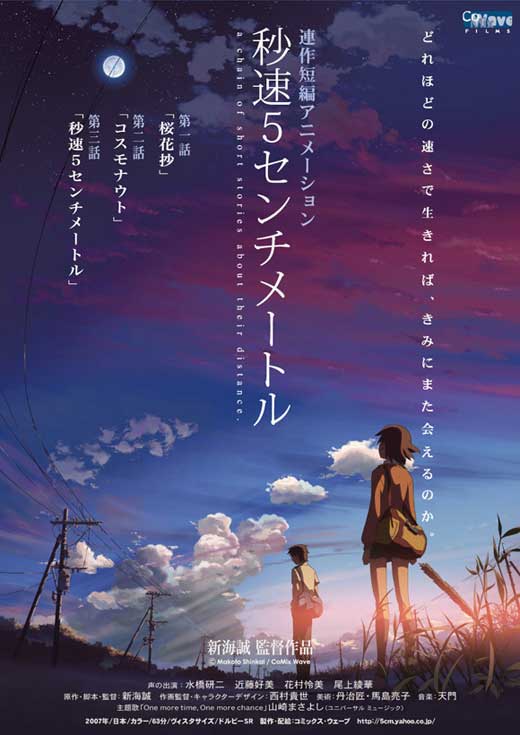
Shinkai Makoto’s 5 Centimetres per Second (or Byōsoku Go Senchimētoru) deals with themes of love, isolation and separation. With 3 episodes spanning over 20 years from the late 90s, and at just over one hour running time, he tells the story of the love of a lifetime in a spare, elegant, and quite melancholy manner.

The film is stylised and has a strong manga influence in its construction and framing. Longer passages of action are interspersed with single frame shots that speak for the characters inner thoughts, or condense a series of events. The kids are largely alone and set against a larger world, small figures running through their school and town that seems frozen – there are trains and things but little sign of human activity. Takaki says when he dreams of Akari he always sees her alone. The story is mostly told from his perspective, although he is the least emotionally articulate, and Akari is elusive although more expressive.

Cherry Blossom (episode 1) introduces Takaki and Akari. They have been close friends for years, both transferred to their current school when their parents relocated to town for work. A few years later Akari’s parents moved away and the pair have communicated by letter since. Yes, this is a pre email and social media long distance love.

His family are planning to move again, this time to the other side of the country, and Takaki wants to see Akari one last time. He plans a train trip but is delayed by blizzards, and in all the waiting around he can’t avoid confronting his fears that Akari won’t be there but he can’t even contemplate not continuing with the journey.

Of course Akari did wait. They see each other for what may be the last time. They talk, they share their first kiss, and it is sweet and sad.

Cosmonaut (episode 2) is set a few years later when Takaki is settled in his new school. There is another girl, Kanae Sumida, who likes him. He seems oblivious though, and treats her as a friend. Sumida falls for him at first sight but also seems genuinely interested in understanding him, and Takaki is honest with her about his fears and doubts which just makes him all the more appealing and different from other boys. Kanae realises that while she loves him he doesn’t really see her, he’s always looking for something in the distance. If only she knew his dreams were full of Akari, even if he didn’t always recognise her. She resigns herself to a one sided love, and decides not to tell him.

In the final, and titular, episode Akari and Takaki have long since lost track of each other. It’s 2008 and he is living alone, working hard, not doing much else. She is planning her wedding for the coming New Year. He realises that he has lost his enthusiasm for life and had forgotten his fascination with its possibilities and mystery. His girlfriend Risa broke up with him because she knew there was something else he was yearning for, and she wasn’t part of it. So he quits his job and emerges from his tiny drab apartment in time to see the cherry blossoms again. He walks by the spot he and Akari had wanted to visit to see the sakura all those years ago, and passes by a woman who looks very familiar.

I know people who hated the open ending but I think it suits the melancholy tone. This story isn’t really boy meets girls, boy loses girl, boy finds girls again. It’s about how time, distance, the minutiae of life can take us down a different path. Kids who couldn’t overrule their parents moving towns, growing up to realise that if you love someone they are under no obligation to feel the same, deciding what matters to you. We drift, maybe a little faster than 5 centimetres per second, and get caught up in currents and cross winds. I think Takaki just accepted that he needed to stop obsessing over what he had lost and what he had never found, and went out to see what was in store for him. I’m not convinced about the singalong ballad at the end… And what do I think the ending means? Does it mean he finds Akari and they get back together? No idea. Sometimes I think maybe they have and sometimes I think he has just come to terms with where he is in life and so can walk forward with a smile.

At just over one hour, there is a lot going on in this deceptively simple film. While the characters are presented without much detail or background, they reveal more about themselves through their interactions, in Akari’s letters, in Kanae’s inner monologues. I felt connected to them and could relate to some of their dilemmas. I like how this story leaves some things up to interpretation and doesn’t tie everything up too neatly. And I also liked that it is OK for Takaki or Kanae or Risa to be sad because of one another but that it doesn’t necessarily follow that any of them are bad people. Sometimes things just don’t turn out the way you dreamed.

Shinkai is a great story teller who can illuminate complex emotions or philosophy with a handful of frames. His “Voices of a Distant Star” is one of my favourite films ever, and I liked that this story picked up some of the same themes and developed them. The visual style is strong and with the minimal dialogues it works beautifully to create the mood and show another layer to the story.

See if it you like a bittersweet and oh so chaste love story, or just want to immerse yourself in a beautiful piece of art. 4 ½ stars! (Yes, I did take off a half for the ballad)
Lady Snowblood

Lady_Snowblood_(film)

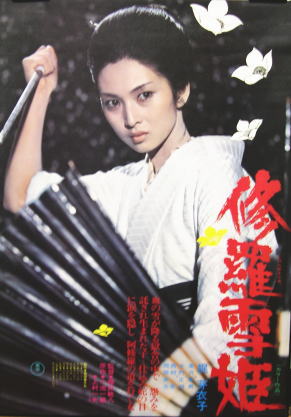
Toshiya Fujita’s Lady Snowblood (Shurayukihime) is a classic revenge tale, enlivened by an awesome heroine and a gleeful embrace of blood, gore and groovy music. If, like me, you enjoy South Indian revenge masala films or you liked Kill Bill, this is a perfect fit.

https://www.youtube.com/watch?v=MxBvPgzpoH8

Yuki (Kaji Meiko) is born to avenge her parents and brother. Her mother was jailed when she killed one of the men who raped her.  Driven and adamant, Yuki seeks out those who destroyed her family and takes her bloody revenge.

The film is based on a manga and retains the strong visual style and chapter format complete with title cards. Much of the exposition is through narrative voiceover or a character’s inner monologue, again mimicking the graphic novel. The film is set in 1882 but while the costumes and sets are notionally historical in tone, the music and editing is firmly of the 1970s. The excellent soundtrack (by Masaaki Hirao) ranges from lounge to soulful pop with a dash of funk and I felt it worked well in to underscore the action, as well as maybe showing Yuki was out of step with her time. The elements often reflect and amplify the dramatic tone, with crashing waves or howling wind mirroring Yuki’s turmoil and snow is a constant reference. The action is stylised enough that the gory scenes are still exciting but also feel a little at a remove so are less confronting. The fight scenes are heavy on red paint and sound effects that range from the metallic ring of blade through bone to the gluggy suck and slurp of soft tissue torn asunder and the sound of blood escaping from a high pressure hose. Buckets of blood and frenetic fights are contrasted with a lyrical beauty and often meditative pace.

The crime that Yuki is avenging took place before her conception, but she can recall everything from the moment that her eyes first opened. The extent of her mother Sayo’s rage and determination was shown in a darkly humorous montage of her shagging any man with a pulse in any corner of the prison, desperate to conceive the child that would avenge her family. That strong bond with her deceased mother Sayo (Akaza Miyoko) makes this vengeful tale come alive. This isn’t a second hand obsession that Yuki could walk away from. She was raised as a ‘child of the netherworld’ – someone beyond even the compassion of Buddha. Repeatedly told she had no other destiny, she saw no reason to doubt that.

From a distance Yuki is a demure kimono clad figure carrying her trademark parasol, but Kaji Meiko is fierce. Her gaze is direct and challenging as Yuki has no fear or reason to want to outlive her targets, and her voice can be harsh and edgy. Yuki’s emotions are channelled into her mission of revenge and her nihilistic world view doesn’t allow for indulgence or frivolity. But she isn’t immune to softer feelings, and sometimes that doesn’t work out so well. She acts out of some kindness towards the daughter of one of her victims and that comes back with a sting.

The action scenes are reasonably demanding especially, one imagines, in a dress and she does wear some fabulous outfits. I also loved the way her eyes would light up in some fights, whether that was sheer amusement at the paint splattered shenanigans or as a sign of Yuki not being completely frozen.

The writer Ashio Ryurie (Kurosawa Toshio) may have sad puppy eyes and tousled 70s hair, but he is more than just a bit of eyecandy. He sees the enigmatic woman and is instantly intrigued. He romanticises Yuki in some ways, but she forces him to confront the truth. She kills because she wants to, feels she has to, and she is good at it. He draws a manga of the mysterious Lady Snowblood and uses it to try and pressure the remaining two targets into revealing themselves. Even under torture he refuses to betray her. Initially she rejects his interest and affection but she does start to think about life after the mission is complete. They have some chemistry but romance is not a priority when there are so many people that require killing. And what self-respecting revenge drama could pass up the opportunity for a birth secret and a dodgy disguise?

Yuki is a loner, but she doesn’t work alone. She was kept on task by one of her mother’s friends from jail and the enigmatic priest Dokai (Ko Nishimura) who trained her to kill. She also recruited Matsuemon (Hitoshi Takagi), a kind of beggar king who uses his network to investigate the whereabouts of Yuki’s intended victims. The cast is quite small but the world within the film is rich.

See this if you like action films with a kickarse lady protagonist, enjoy the skewed manga sensibility with a strong visual punch or just want to know how much of a debt Quentin Tarantino owes to Shurayukihime. 4 ½ stars!

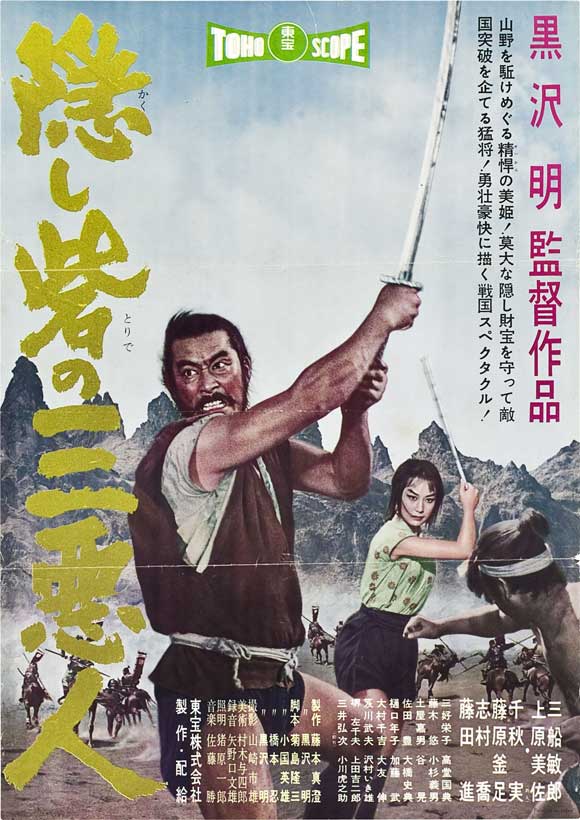
The Hidden Fortress (1958)

the-hidden-fortress-movie-poster-1958-1020506994

Akira Kurosawa’s story can be summed up simply.  Two greedy peasants are persuaded with the promise of reward to escort a man and woman across the border and smuggle a load of gold hidden inside firewood. However, they do not realize that their companions are actually a princess and her general and that the gold is intended to help Princess Yuki rebuild her clan. There is action and humour, greed meets idealism, relationships are tested and altered, and everyone learns a little along the way.

Hidden Fortress (or Kakushi-toride no san-akunin) is cited as one of the inspirations for Star Wars, and there are numerous comparison reels and articles available online if you want to learn more. While that was one of the reasons I first saw the film some years ago, it isn’t what I remember it for. This is an action packed adventure with great characters, a ripping yarn told with a splash of verve and wit. Just my cup of tea.

Hidden Fortress was also Kurosawa’s first film using the then new widescreen technology and he makes the most of his locations and staging. Using grand outdoor sets to bring a sense of realism to the background, plus Kurosawa’s own exceptional editing skills, this is almost an immersive viewing experience with nothing to break the sense of watching history unfolding. There is something about seeing a vast crowd of extras in a battle scene and knowing they were all real people, not CGI additions. It makes the epic seem even more so. In fact the camera shakes a little in a mass prison break scene, presumably from the vibration of hundreds of men running down the stairs. Kurosawa (and his cinemataographer Kazuo Yamasaki) can swoop from wide expanses and grandeur down to the small personal moments easily overlooked and forgotten.

On another level, the film may also be an ode to Toshiro Mifune’s thighs. Despite wearing the Edo period equivalent of shorty short shorts, General Rokuroto Makabe is an imperious leader of men. He tracks peasants who stumbled over some of the Akizuki clan gold and cons them into helping him. He torments them, seeing them as weak and venal with none of the ideology or purpose befitting a true warrior. But he comes to value their street smarts and knack for self-preservation.  Mifune is a charismatic actor with a robust presence. He turns in a well judged performance in a film that provides a great showcase for his charismatic alpha male persona. His horseback chase and subsequent duel is wildly suspenseful, with the camera barely able to keep up, yet you know Rokuroto will win because he just looks invincible. And seeing the general participate in a fire festival dance with dour determination to pass for a local peasant having fun was amusing.

Misa Uehara is Princess Yuki, a feisty princess in disguise trying to survive and rebuild her family’s domain. For some reason this disguise also involves short shorts but nothing too unladylike. She appears to be unfeeling but is keenly aware of the sacrifices that her people have made and the burden that places on her.  Another character says of her that she is more masculine than she is a girl, and she is certainly more competent and independent than many a movie damsel in distress was ever allowed to be. Although fleeing for her life, Yuki also gets to experience the real world for the first time in her 16 years and she finds it quite enchanting when she can put her cares aside.

She sees good and bad in people, observes poverty and other social woes. She is generally cool and decisive but doesn’t lack empathy so I found her interesting and sympathetic. I wondered whether her decisiveness was a sign of great leadership or just typically teenaged black and white thinking, but generally Yuki does the right thing. Yuki wins people’s loyalty as they believe they can trust in her integrity and not just because she has Rokuroto Makabe and his sword at her disposal.  Uehara’s timing and reactions are excellent, especially in scenes where Yuki is pretending to be a mute. Apart from being limiting to an actor, that also places the character in extra jeopardy as she is limited in her ability to respond without breaking her cover. Her dancing at the festival was an expression of joy and release, an affirmation of the strength that could come if she survived the fire.

The story is largely told through the squabbling peasants Tahei (Minoru Chiaki)and Matashichi (Kamatari Fujiwara). They are repellent and a little endearing by turn.  They roam through the post war landscape complaining bitterly that they didn’t get to make a profit despite all their (alleged) hard work. They seem to have no loyalty or principles beyond making a buck and will turn on each other at the drop of a hat. While these Everymen bring a lot of the comedy to the film they also provide the contrast between rarefied aristocratic living and a more dog eat dog perspective. The first time they see Yuki, they follow thinking a girl alone in the forest would be easy. Later on the journey, despite now knowing her as a travelling companion, they see Yuki asleep and draw lots for who should go for a walk and let the other one rape her first. When the chips are down, they cling to each other and eventually see the bigger picture. Given that most of their dialogue is moaning and crying, both actors do well to give their characters such vivid and distinct personalities. I didn’t mind seeing them suffer, but I would have wielded the editing scissors a little more in their direction.

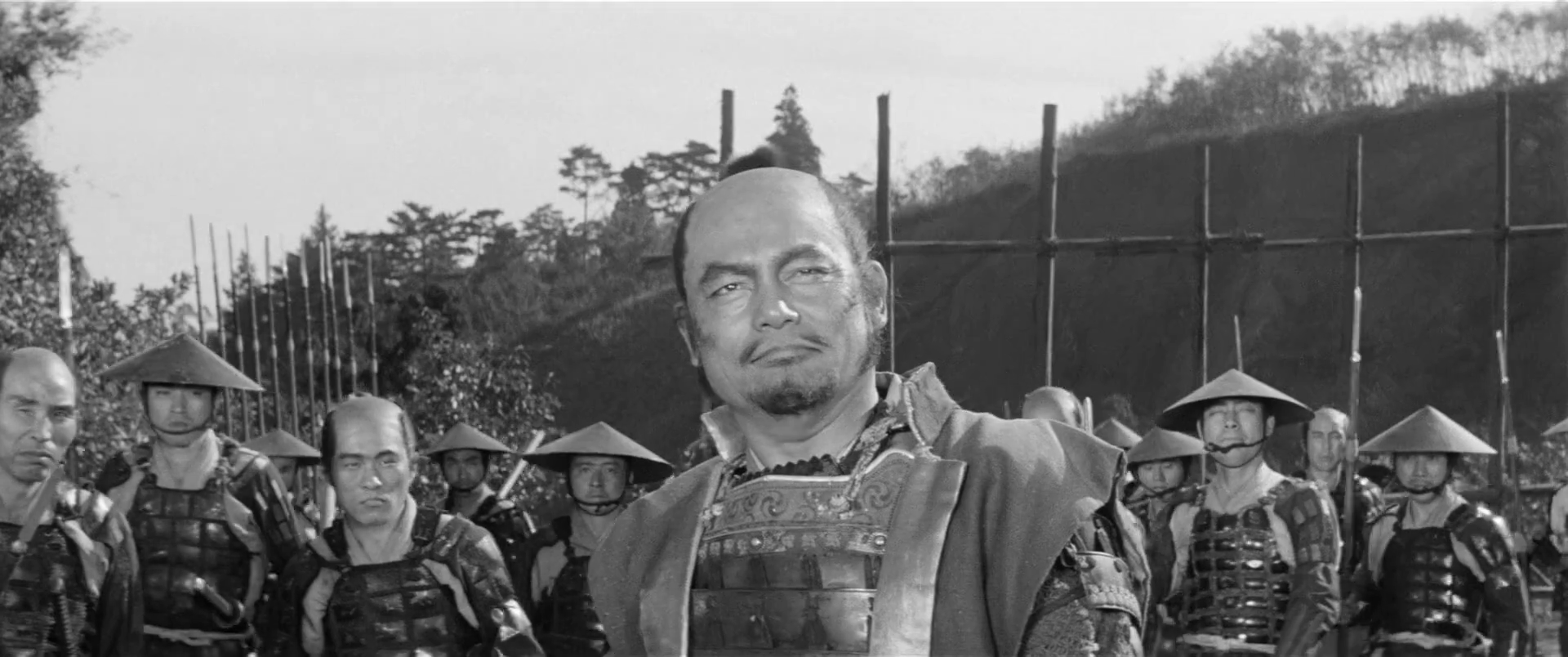
Hidden Fortress-Hyoe Tadokoro

Susumu Fujita has a small but significant role as Hyoe Tadokoro, an old adversary of Rokoruto Makabe. His wry expression conveys volumes as he squares up against a respected foe and tries to face down the blazing indignation of Yuki.

I was thrilled to see this included in ACMI’s recent Samurai Cinema program and to have the opportunity to see it on a big screen for the first time.  It is a tale of derring-do, the grand visuals still place the human element at the forefront and the characters are easy to invest in. Well, maybe not the comedy peasants so much. 4 ½ stars!