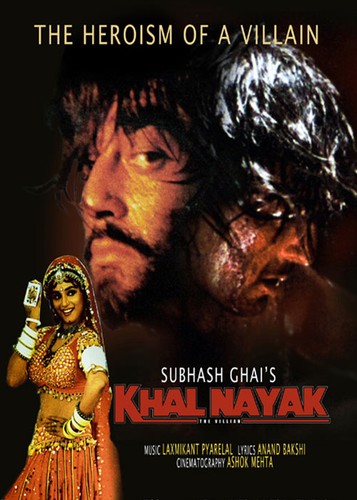
Khal Nayak

Khal Nayak poster

Subhash Ghai’s Khalnayak is a fairly predictable cops and robbers story twined with references to the Ramayana which adds depth and resonance.  There are some excellent performances, stylish visuals and excellent music. But at a shade over 3 hours, the pace is stately to the point of plodding and there is too much emphasis on the meaning, and not quite enough on the drama.

Ram (Jackie Shroff) is assigned a case to bring down a terrorist organisation. Ballu (Sanjay Dutt) is the poster boy for Roshida’s (Pramod Muthu) gang. When Ballu escapes from jail, Ram is accused of neglecting his duty to go spend time with his girlfriend Ganga (Madhuri Dixit). When what looks like every policeman in India is put on Ballus’ trail with no success, Ganga finds a way to infiltrate the gang. She sees that Ballu is not quite as bad as he seems, although he is far from being misunderstood. Eventually the police close in, and Ganga is caught between Ram, duty, and her empathy with Ballu.

Madhuri looks stunning and delivers a strong and engaging characterisation. There is nothing simpering or weak about prison officer Ganga. When she sees an opportunity to help Ram restore his reputation, she asks for his support. Then she does it anyway. When she sees Ballu needs medical help, she just goes and gets a doctor because it is the right thing to do. Madhuri does some wonderful deliberately bad acting when Ganga, having captivated Ballu, joins the gang and goes on the run.

https://www.youtube.com/watch?v=r4pb2OCfCHs

Then in Aaja Sajan Aaja she is simply incandescent as she dances for her Ram. Madhuri was also lucky as Ganga dresses in Indian attire, not the hideous synthetic 80s gear that Ballu wears when he tries to impress.


Sanjay Dutt is so very good in some scenes that it makes me angry at how bad he is for much of the film. He adopted a range of bizarre grimaces and physical tics that I think were meant to emphasise the animal side of Ballu, but just made him look ridiculous and clumsy. When he dropped the exaggerated mannerisms and just channelled the emotions, he was compelling and raw. While asserting his ownership of Ganga, Ballu accidentally defends democracy and becomes a Nayak for those people. His awakening to being respected and enjoying that feeling was nicely done, even though there was a lot of literal flag waving to make sure the point didn’t escape unnoticed.

Jackie Shroff is perfectly competent as Ram, and only tries to tear his clothes off once so that was good. For my money Ram is the least interesting character. He knows he is right, everyone knows he is right and he is not averse to using extreme force against Ballu to prove how right he is. While there is an interesting dynamic between hero and villain, there is minimal character development for Ram. A relationship between Ganga and Ballu would be a Very Bad Idea but I thought marrying Ram could be a bit suffocating.

The Ramayana elements were more obvious to me on a recent re-watch than when I first saw it, particularly the twists on that narrative. I couldn’t help but compare this with Mani Ratnam’s Raavanan (which I greatly prefer to the Hindi Raavan). In Raavanan, Ram revealed his darker side and could become as Ravana but Khal Nayak seems to say rather that Ravana has the potential to be Rama. I liked that the question of what makes a hero or a villain was articulated and that this was more than a glorification of Rama. Ganga didn’t sway from her beliefs when she was frightened, and kept her faith in Ram. Ram wanted to believe Ganga but society and the law demanded she was still put to trial. I was annoyed that she had to have her virtue validated by a thief and murderer, a man so despicable in the eyes of the law that he had besmirched her just by his proximity but whose word was still worth more than hers. I know she is Sita and he is Ravana, but still. The film plays with some of the conventions especially around the notion of hero and villain. Ram is also helped by Ballu’s testimony, his reputation restored by the hand of a sinner.

Ghai doesn’t quite go the whole hog but he does use a range of staple masala ingredients and has a lush visual style. Ram and Ballu have bloody fights that crash through walls and take to the treetops. There are long lost childhood friends and dreary paeans to motherhood. There are coincidences, speechifying and tearful reconciliations galore. The evil mastermind Roshida has a nasty disposition and lots of cats who do a fabulous job of reacting to stuff.

Rakhee gets a lot of screen time as Arti, not all of it crying. Neena Gupta makes an impression as the striking Champa. Ramya Krishnan is charismatic as Ballu’s girlfriend Sophia, and also gets both versions of the title song. What a waste to have her in such a small role, but how great to have so many powerful actresses in one film. The female characters are strong and quite distinct, but Subhash Ghai stays firmly within the conventions of 90s masala so none of them break the mould of Ma, the friend, bad girl etc.  Oh, and Anupam Kher does his customary shtick as Pandey the prison warden.

There are interesting observations about the conventions of parenting and filial behaviour. Ganga tries to evoke Ballu’s sentimental side by talking wistfully of how much he must love his Ma and how hard it must be for him to live on the run. He calls Ganga out on trying to manipulate him through sentiment, but he rejects that as unimportant to him. Question – If a villain shouts ‘Ma!’ in his sleep and there is no one to hear it, does he have feelings?

Mind you, when Ballu is beating Ram up because why not, Arti hits Ballu for assaulting Ram, Ballu shoves her so Ram belts him for hitting a Ma, then Ballu fights back and Arti comes back at him to stop him using violence.  A move straight out of the Nirupa Roy Filmi Ma Manual.

The songs are extensions or amplifications of the narrative as well as being beautiful and usually pleasingly melodic.

https://www.youtube.com/watch?v=Ftfc_c-zNx8

I am not so fond of that title track, although it does epitomise early 90s style and Ramya Krishnan works that beaded gear for all it’s worth.

Khal Nayak-Fruitbat

I had to pity choreographer Saroj Khan. Between Dutt’s own ‘dance’ style and the outfit given to Ballu in the final song, he looked more like a demented fruitbat. Seeing Ballu and the boys try their seductive dance moves on Ganga was highly amusing. But she choreographed some beautiful dances for Madhuri. I went to see the Temptations Reloaded show up in Sydney last year, and the roof nearly came off when the opening bars of Choli Ke Peeche played.

The first hour of the film could be condensed to around 20 minutes with no great loss, but things get much more interesting once events are set in motion. While it is a visually strong and often darkly dramatic film, the pace suffers from Ghai’s concentration on symbols and stylised elements rather than closely following the emotional arcs of the characters. Very much worth watching, but some patience is required. 3 ½ stars!

Kochadaiiyaan

Kochadaiiyaan Taking Superstar Rajni and turning him into an animated action hero is certainly novel and Soundarya deserves praise for breaching the boundaries of Tamil cinema and attempting something as different as motion capture animation. With Deepika Padukone as the heroine and experienced actors such as Jackie Shroff and Nasser in supporting roles, the potential is certainly there for something amazing but despite all the innovation and obvious hard work, Kochadaiiyaan doesn’t quite deliver.  K.S. Ravikumar’s story isn’t the problem. It’s a swashbuckling period adventure with enough substance to fill a couple of hours comfortably with a few credible twists in the tale.  The dialogue also seems fine, even when subtitled, and the characters are reasonably convincing within the storyline.  It’s more basic than that – the real issue here is that animation is just not as good as the real thing. Kochadaiiyaan The film tells the story of Rana (Rajinikanth), who left the kingdom of Kottaipatinam as a child and ended up as the army commander of rival nation Kalingpuri.  A flashback in the second half explains Rana’s background as the son of legendary warrior Kochadaiiyaan (also Rajinikanth) who was himself betrayed by the King of Kottaipatinam.  In between there are battles, betrayals, social justice as Rana frees slaves, and of course some romance with Princess Vadhana (Deepika Padukone).  Rana is a rather more subdued character for Rajnikanth, despite his heroic looks and charismatic style with Princess Vadhana and the swash and buckling only really starts to take off when Kochadaiiyaan appears in the second half.  Maybe it’s a case of getting more used to the style, but the film is livelier after the interval, and Kochadaiiyaan appears more splendidly heroic than his son. Kochadaiiyaan I have to admit I’m not a fan of this ‘almost life-like’ animation.  I found Polar Express creepy and much prefer my motion capture as a dash of CGI in films such as Lord Of The Rings and Transformers, or as complete fantasy like Shrek and Despicable Me.  While motion capture gives characters a relatively life-like appearance, it’s not real enough to be able to convey emotion convincingly and the lack of facial expression is disturbing, as nothing looks quite ‘right’.  It’s hard to generate any empathy with the characters despite the attempts at laughter and tears, especially when some of the smiles look more like grimaces.  It also doesn’t help that the animation here is variable, with some characters, such as the young Rana and his brother Sena appearing almost unfinished with strangely elongated limbs and disjointed necks, while the horses and elephants appear very clunky when in motion. Kochadaiiyaan Another casualty of the animation process is the dancing, which ends up appearing jerky and awkward much of the time.   It also looks a little odd to have large numbers of dancers completely in sync in the background – rather than looking impressive it just looks strange and almost sinister.   However, on the plus side, the costumes by Neeta Lulla are stunning with amazing attention to detail, which likely would not have been possible in real life.  That also applies to most of the action scenes which just wouldn’t have been possible with real actors and animals.  Peter Hein is credited as the action co-ordinator but his talent with co-ordinating fight scenes doesn’t translate well to animation.  The  scenery is generally spectacular though with  plenty of grand palaces and surreal gardens, although there are a few times when the background just looks  rather bland and unfinished.  I hadn’t heard the film soundtrack before watching the film, but the music by A.R.Rahman, is  one of the highlights and suits the rather grandiose and somewhat sweeping scale of the story.

Kochadaiiyaan

I would have preferred Kochadaiiyaan if the CGI had been limited to the background, enhancing the fight  scenes and sprucing up the scenery, while the actors played their roles instead of  using motion capture animations.  Although the downside would be that quite a number of the scenes would have to be less extravagant, it could have made for a more engaging film. However, setting aside the animation issues  I still did mostly enjoy the film, mainly due to the tale of Kochadaiiyaan and the music. The end of the film leaves a sequel likely and I hope that does happen, although the animation  issues do need to be addressed in any follow-up film.  Kochadaiiyaan is probably best watched by Rajinikanth fans but if you can cope with the animation it may be worth a watch, even if only to see the first complete motion capture Indian animation film.

Panjaa

Panjaa’s opening titles are in bold graphic novel style with a 3D effect. Eye catching and intriguing, the confident visuals match a slick modern underworld thriller where characters are not always what they seem and life is lived in shades of grey.

There is nothing really new in the conflict at the heart of the plot, but Vishnuvardhan has tweaked things just a little and saves the film from being too familiar. I saw this in the cinema, without subtitles, when it released. While the basic plot and motivations were clear, I enjoyed seeing it again on a subtitled DVD as some of the characters’ thought processes were more accessible.

Most of the film looks to have been shot on location and it adds a note of authenticity in terms of the buildings, the lighting and the sense of place. I particularly liked the ornate architecture of Kolkata, as well as the lush green of the countryside. The colour palette is subdued and the style is pared back and modern. There is nary a plaid shirt in sight!

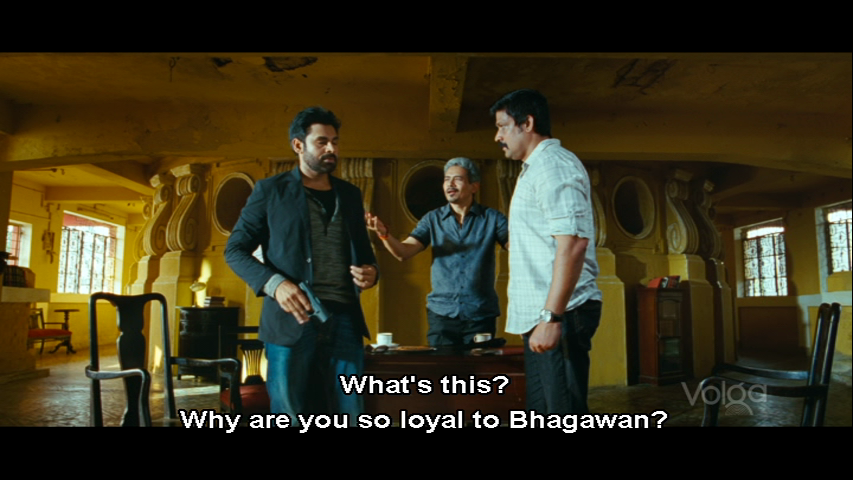
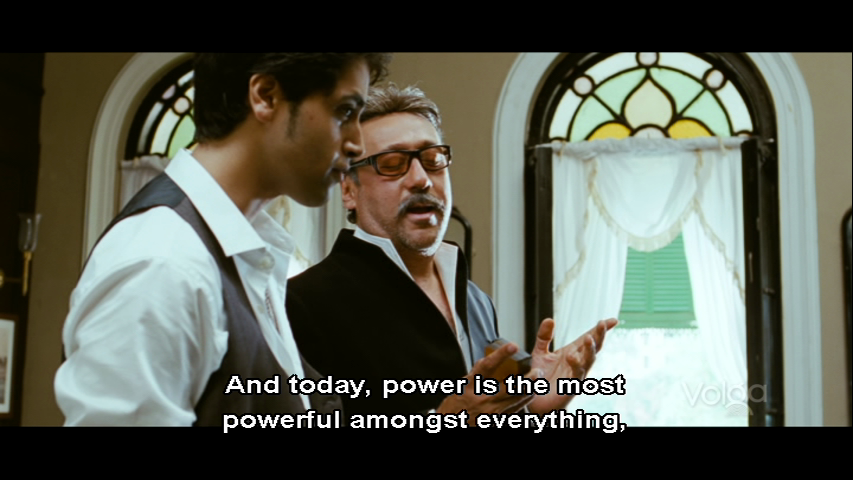
Jai (Pawan Kalyan) is the enforcer for Bhagawan (Jackie Shroff). He is a shadowy figure, always a step ahead and coolly efficient in his execution. Jai has a strong moral sense and acts according to his own notion of right and honour. He serves Bhagawan because when his mother and sister were assaulted, Bhagawan gave him justice and a refuge. But when Bhagawan’s son Munna returns from overseas, it is clear that Munna is not the kind of man Jai could tolerate, let alone support. Things escalate as Munna takes full advantage of being his father’s son.  Jai struggles between loyalty and his own code, and the need for more in his life.

Jai also struggles with the ladies. The one he wants makes him shy and tongue tied. The one that wants him is very assertive but he isn’t interested. I’m not convinced Janvi (Anjali Lavania) was necessary to the story, but it was nice to see the bad girl get to talk and think for herself. Unfortunately she ran into the brutal Munna on a bad day so it was shortlived. I like a good skanky item and this is certainly skanky.

Pawan Kalyan is a hero but Jai is almost an anti-hero. He is moral by his own lights but he is a professional killer. He is nice enough but not a good guy as such. He isn’t a dashing romantic hero although women fancy him and he doesn’t really win anything other than his own life. The final scene is ambiguous enough that it could be a vision of the future or a memory of the past so it’s not a resoundingly happy ending. Pawan Kalyan is very good as Jai. He draws the eye in all his scenes, using stillness and silence more than histrionics. His acting range easily spans Jai’s story from laid back comedy to high tension drama.

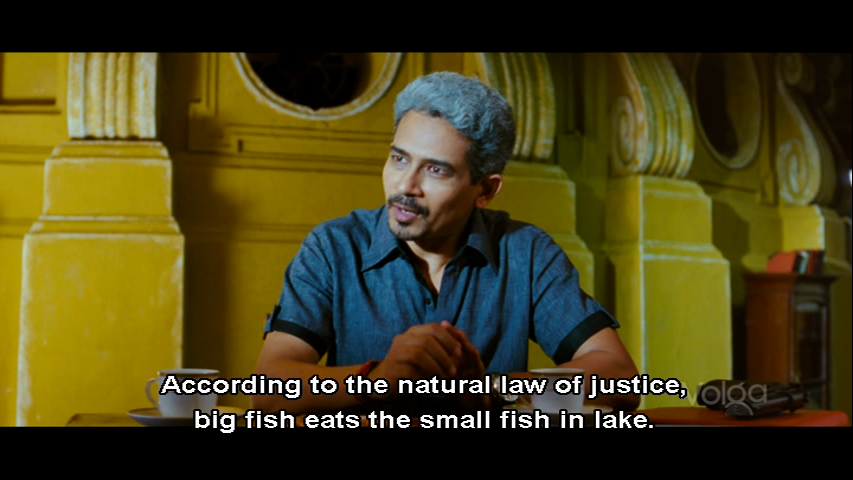
The casting is excellent. Having said that, I really do not understand the recent fad for Jackie Shroff in South Indian films. He doesn’t bring anything unique to the kind of roles he is playing, but he is adequate as Bhagawan. Munna (Adivi Sesh) is Bhagawan’s son, an overly entitled sadistic nutter. His performance is over the top but Munna needed to be hateful and I was certainly sick of the sight of him! Atul Kulkarni is excellent as rival crook Kulkarni. He conveys an intensity and intelligence that made Kulkarni seem plausible as a successful ‘businessman’. The relationship between Bhagawan, Kulkarni and Jai is revealed over time and the reactions and decisions of the main characters are consistent with what we know about them. The second tier of gangsters is represented by Tanikella Bharani as the slippery Guruvaiah and Sampath Raj as Kulkarni’s right hand, Sampath along with Amit Kumar and others in support. The interactions are well written and fairly restrained so it is possible to believe these guys can function in the real world. There are glimpses of family and other concerns that build a picture of this slice of the underworld.

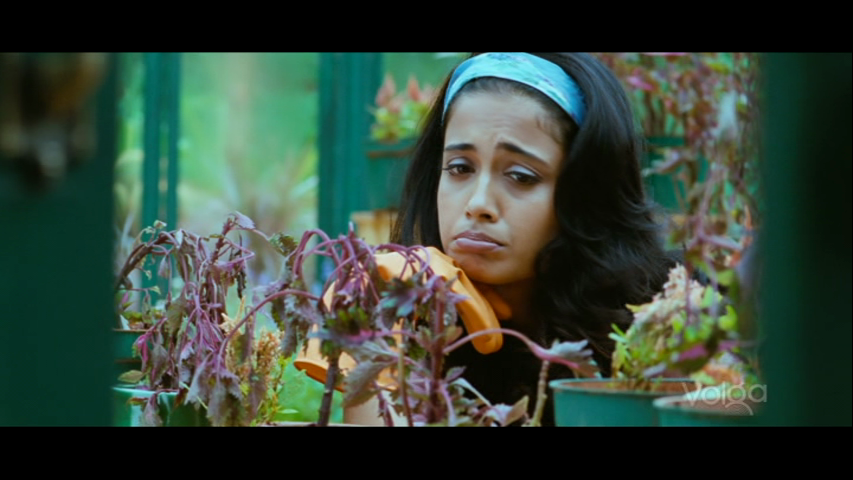
Sarah-Jane Dias is Sandhya, a tree hugging good girl who turns up to work in Jai’s nursery. Yes. Jai is a complex man and has diversified his investments into a plant nursery he runs with Chotu (Ali). Jai is drawn to Sandhya and she likes him. Their relationship starts with superficial attraction and develops through time and proximity. She has a bit more going on in her life than just waiting for Jai, but she is primarily the love interest. I liked their scenes more on the second viewing as the dialogues helped show her character as smarter than her prancing around in gumboots lead me to think (although I appreciated the work appropriate clothing). Just as things looked promising, Sandhya returns home suddenly to see her sick grandmother.

The timing coincides with Jai’s need to get out of town. The rural setting puts him back in touch with his childhood self. He is looking for love and a home, the things he lost when his family was torn apart. But his past is a threat to himself and anyone close to him so he needs to resolve that while still keeping the promises he made.

The country sojourn introduces more of the excellent support cast including Subbaraju as Sandhya’s brother Ashok and Brahmanandam in amusing form as an inept local cop. I loved that this song is essentially a tirade against the greedy and cowardly policeman Paparayudu, accompanied by uninhibited dancing and some jiggly-bellied tiger men.

Ashok is a protective brother, henpecked yet determined to remain a bachelor, and no match for the smooth townie Jai or for local rowdies. He is frantic when Sandya comes home unannounced as he knows troubles from the past will be stirred up again and he wants to keep her safe.

Subbaraju gets to show off a bit more of his acting range than normal, and when he isn’t beating up baddies he has some fun scenes with the women of the household. Ashok and the rest of the family are vivid characters and very much part of Sandhya’s life.  Back in town, Chotu (Ali) was in trouble and believe it or not, I was sad to see his predicament. Despite these being small roles, the details are nicely drawn and the actors all deliver good performances. That kind of attention and care makes Panjaa quite satisfying viewing.

The comedy is not too intrusive. Pawan Kalyan doesn’t mind playing for laughs and I really enjoyed the Mega Tribute as Jai was persuaded to pose with cut-outs for a photo. Brahmi and Ali are in character roles and their shtick is part of the story so it stays on track. The fight scenes orchestrated by Shyam Kaushal are brutal but not too bloody, and highlight Pawan Kalyan’s strengths. The editing and composition of the action sequences is top notch. Everything flows quite well and there is a consistent look and feel to the whole film.

There are some flaws. The romance between Jai and Sandhya is a bit laboured and she does far too much marvelling at blades of grass and cooing at flowers. The first half takes a while to go anywhere. ‘Paparayadu’ excepted, Pawan Kalyan looked a bit lacklustre in the dancing but the choreography wasn’t that exciting either. The soundtrack by Yuvan Shankar Raja is average and the song picturisations are quite predictable but don’t detract from the film. Overall, the positives greatly outweigh these niggles.

Panjaa is a well made thriller with good performances and a cohesive story. It’s not dazzling or wildly original, but I never found it dull. It’s a quality effort and well worth a watch, especially if you’re a fan of the genre. 3 ½ stars!