Kabhi Khushi Kabhie Gham (2001)

Kabhi Khushi Kabhi Gham

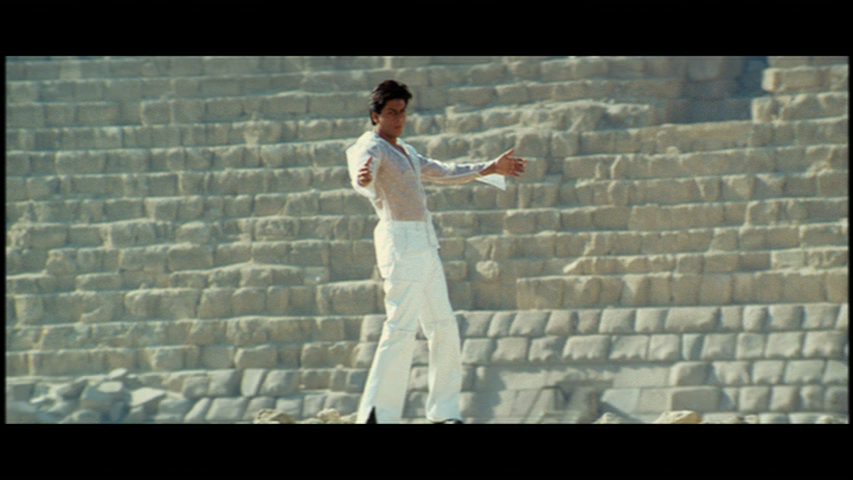
K3G is an indulgence that I only allow myself to luxuriate in occasionally.  While I love the first half of this film, despite all its flaws and typical Karan Johar extravagances, I just wish that the second half came anywhere close to the emotional appeal of the opening melodrama.  Considering the stellar cast it’s particularly disappointing that the whole doesn’t live up to the promise of its parts, but at 3 ½ hours maybe only watching the first half isn’t such an issue.  It also contains my all-time favourite Shah Rukh song with plenty of shots featuring SRK in those lacy see-through shirts, which is probably enough of an explanation for my love of this film, but K3G also brings back memories of learning Hindi and actually starting to understand dialogue without subtitles.  Special for a few reasons then, but this song is still the best part of the film.

For those who haven’t seen K3G, it’s a fairly routine story of your basic multimillionaire family and the ups and downs of their domestic relationships.  The Raichand’s live in a large ostentatious stately home which seems as far removed from India as it is possible to get despite the fact that it’s supposed to be relatively close to a lively market in Chandni Chowk.  It’s the kind of family where running late means having to hop on the helicopter to get home in time for Diwali celebrations, but despite all the lavishness of their lifestyle, it’s a family where there is a lot of love.  This is emphasised in the opening credits as Nandini Raichand (Jaya Bachchan) plays with her young adopted son, but it’s also obvious in the interactions between Rahul (naturally this can only be Shah Rukh Khan) and his father Yashvardhan Raichand (Amitabh Bachchan) as well as in the later scenes with his mother and younger brother Rohan (Kavish Majmudar).

Kabhi Khushi Kabhi GhamKabhi Khushi Kabhi GhamKabhi Khushi Kabhi GhamKabhi Khushi Kabhi Gham


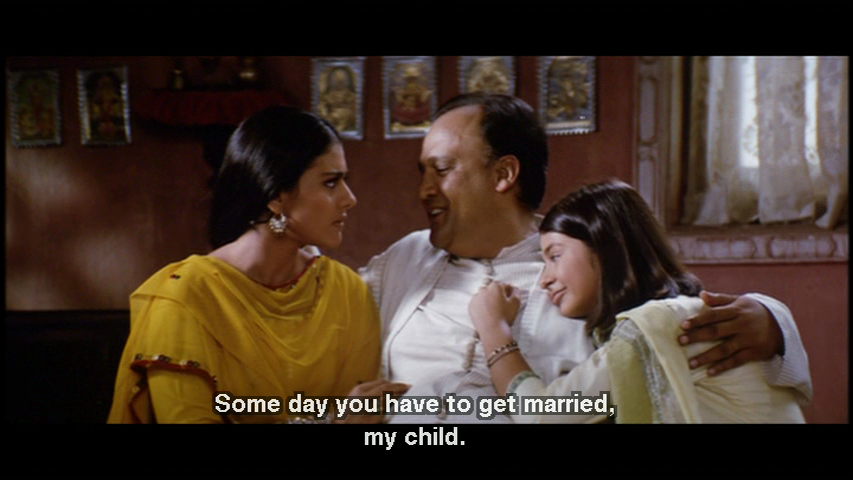
Problems arise when Yash decides that Rahul will marry Naina (Rani Mukerjee) who seems ideal for the position of rich man’s wife entrusted with carrying on the family traditions.  However Rahul has other ideas as he has fallen in love with Anjali Sharma (Kajol), the daughter of a local shopkeeper in Chandni Chowk. Just to keep things in the family, Anjali is the niece of Rohan’s nurse Daijan (Farida Jalal) and has a younger sister Pooja who is roughly the same age as Rohan.  This helps later on in the story, although initially it just seems another way of emphasising the gap between the two families.
Kabhi Khushi Kabhi GhamKabhi Khushi Kabhi GhamKabhi Khushi Kabhi GhamKabhi Khushi Kabhi Gham


The first half of the film sparkles with the romance between SRK and Kajol while the various family relationships add depth and interest to the story.  The two grandmothers, Achala Sachdev and Sushma Seth, ensure a typical Indian family feel despite the Anglicised mansion, while the glaring discrepancies between the Raichand’s home and the (somewhat sanitised) streets of Chandni Chowk are used to good effect.

Kajol is lively and boisterous as Anjali, while SRK is more retrained and less dramatically emotional which helps keep things under control.  There is a smattering of comedy in the romance too, which both SRK and Kajol handle effortlessly, and the appearance of Johnny Lever in comedy uncle mode is thankfully kept to a minimum and doesn’t disrupt the story.  The other characters all fit in too – the young Rohan is petulant and spoilt, just as a rich kid should be, while Anjali’s younger sister Pooja (Malvika Raaj) is bratty and approaching obnoxious at times, which does actually tie in reasonably well with her later persona.
Kabhi Khushi Kabhi GhamKabhi Khushi Kabhi GhamKabhi Khushi Kabhi GhamKabhi Khushi Kabhi Gham


Naturally Rahul chooses love over duty and ends up cast out of the bosom of his family, although he does have Anjali and her sister Pooja as compensation.  Of course, this is a Karan Johar film, so it’s no surprise when we reconnect with Anjali and Rahul ten years later to find that they are living in a large and opulent home somewhere in London, despite the fact that Rahul left with nothing – pretty impressive work!

Kabhi Khushi Kabhi GhamKabhi Khushi Kabhi Gham


But things start to fall to pieces once Kareena Kapoor enters the picture.  This was the first time I’d seen her in a film and it was also the last for a very long time – based solely on this dreadful performance. Hrithik Roshan as the grown up Rohan is also sufficiently unimpressive, seemingly unable to decide between the role of hot and macho student running amok in ridiculously expensive cars, or emotional wreck searching for his brother.  The two completely derail the romance and it’s hard to come up with any reason why Pooja has to dress like a call girl and act like a complete airhead.  The film also dives deep into overindulgent farce as Anjali complains about her son becoming too English (hmm, could this be because they’re living in England and he’s attending an English school?) while Rohan decides that staying with his brother while pretending to be someone else would be a good way to reconcile his father and brother.  Because that would definitely work.

If you can ignore all the self-indulgent weeping from Rohan and the insufferable unpleasantness of Pooja, the rest of the film is endurable, although unbelievably long and drawn out with a ridiculously contrived ending.  Karan Johar goes overboard trying to tug on his target NRI audience’s heartstrings with a rendition of the Indian National Anthem which seems totally out of place, and there are far too many references to ‘loving your parents’.  Even apparently when they don’t love you and repeatedly tell you so.  There are a few moments where the easy flow of the first half is almost recovered, but overall the second half is disappointing at best, particularly after such a good beginning.

Thankfully though there is still SRK, who is as charismatic as always, and the Shah Rukh and Kajol jodi works even while the story around them falls to pieces. If only the whole Kareena Kapoor and Hrithik Roshan storyline had been cut, this would have been a much more enjoyable film, although still not perfect.  Still, I do recommend watching right up until the interval – after that it’s at your own risk!   4 stars for the first half, but only 1 for the second.

Kismet (1943)

Kismet 1943 poster

Gyan Mukherjee’s Kismet was one of the biggest box office hits of the time and it still has a charm and elegance I find most appealing.

Kismet-Freedom

Shekhar (Ashok Kumar) is newly released from his latest jail stint. The first thing he does is to pick a pickpocket’s pocket and merrily resume where he left off, straight to his old fence (David). The owner of the much-stolen gold watch is an old alcoholic who was going to sell it to buy a theatre ticket. His daughter was going to perform and while he was estranged from the family, he dearly wanted to see her triumph. Shekhar seemed sympathetic and a little amused, but had no intention of confession. He just treated the old guy to a ticket and off they went.

Shekhar hears the old man’s story in a flashback that features Baby Kamala (Kamala Lakshman) dancing beautifully as his little daughter. Present day Rani (Mumtaz Shanti) sings a rousing patriotic song declaring India to be the property of Indians and not various foreign interlopers. She looks a frail but intense young lady, leaning on a crutch for support. But Shekhar wasn’t just on a social outing – he spotted a fancy necklace on the wife of Inderjit (Mubarak), the theatre owner, and decided that it would do nicely. Shekhar stashes the necklace in Rani’s belongings and manages to evade the police. He breaks into Rani’s house and really doesn’t explain why despite her half-hearted questioning. She decides Shekhar is a Nice Man as she assumes he is a friend of her father so therefore, Good. The police, led by Shah Nawaz as the inspector, know that Shekhar is a Bad Egg. He moves in to her house as a tenant, and while he initially uses Rani to improve his own situation he becomes emotionally involved and wants to help. He doesn’t do anything by conventional or honest methods and when worlds collide, Shekhar, Rani and their burgeoning love are all put to the test.

Rani’s leg could be cured if she could afford surgery and therapy, Leela is pregnant to her spineless boyfriend Mohan, and Shekhar is finding things to care about in life and weighing it all up against his relatively free existence. Who really owns the significant necklace? Will Rani dance again? Will Leela’s life be set to rights? Will Shekhar be able to live the life he wants with Rani? Will Rani accept his chequered past? And whatever happened to Inderjit’s long lost son, the one with his name tattooed on his arm? Oh masala, you’ve been around a long time!

Ashok Kumar is wonderful. He has a genial neutrality about him as Shekhar accepts that people are probably doing things for their own reasons, and those reasons are none of his concern. He isn’t a criminal out of any antisocial sentiment, and it could be argued that his brand of theft is generally not violent. My biggest issue with Shekhar was his choice of headgear. It just didn’t seem very stealthy for a thief! He is often seen through windows or doors, not really immersed in the action but appearing to be involved. And he always has an escape route. Shekhar may have a cynical outlook but his smile lights up the room. Ashok is charming and plausible as the gentleman thief, and it is easy to believe that poor sad Rani would be drawn to this competent, caring, and rather dashing beau.  Shekhar is an anti-hero who becomes heroic through his certainty of purpose and an ease in owning his choices and the consequences. He doesn’t play the blame game and actively tries to prevent his misdeeds harming others. Yes he even steals from the rich to give to the poor.

Rani and Shekhar had a nice rapport and their lullaby duet is sweet, with Dadamoni singing for himself. He isn’t as good a singer as he is an actor but there is something earnest and yet a bit cheeky in his vocal that is endearing.

Mumtaz Shanti plays Rani as melancholy and tending towards passive, but there is spirit in her teasing scenes with Shekhar and she faces down the rapacious manager and social snobbery of Inderjit with apparent ease. She must have been strong to carry on and keep her sister and crumbling household together after their father shot through. Mumtaz has a stagey and mannered acting style that hasn’t aged well so I found her less engaging than Chandraprabha or Ashok Kumar who were warmer and more natural.

Anil Biswas uses a full orchestra and chorus to provide a lush and melodious soundtrack. The songs range from patriotic anthems to wistful love songs. Ameerbai Karnataki sings for Rani, and her strong, earthy tone gives the character more substance than a more girlish or twittery vocal would have.

And if that isn’t enough, there is a young but recognisable Mehmood in his first film appearance as the childhood version of Inderjit’s missing son Madan. David as the fence was so young I almost didn’t recognise him. V.H Desai is fun as Banke, the inept but enthusiastic thief trying to get Shekhar to join in a big robbery. Kanu Roy is Mohan, the man who gets Leela knocked up but can’t man up enough to tell his father. And how nice it was to see a girl who was pregnant out of wedlock be treated like a human being by her family and friends. Leela contemplated suicide but her father didn’t hesitate for a second before taking her side. Chandraprabha gave Leela a nice dash of defiance that would have made such a pretty girl irresistible to wishy-washy Mohan.

I’d watch Ashok Kumar in just about anything, so when the awesome team at Edu Productions made Kismet available, I wasted no time in getting a copy. I often complain about how hard it is to get a decent copy of older Indian films, especially with subtitles. At last year’s Indian Film Festival Melbourne the print of Garm Hawa provided was in such bad nick it was unplayable.  I’ve read journalists taking potshots at actors like Amitabh and SRK, saying that they should do more to preserve Indian film heritage and that it is their duty. I’d like to know why such a huge industry that presumably tips a bit of dosh into the government coffers, as well as keeping the entire sequin industry afloat, needs to leave it all up to actors. Surely there has to be a better solution. And I am grateful to the lovely Edu Productions team who are doing their bit to find, clean up and most importantly share some enjoyable and beautiful films that are out of copyright. And I will stop before I get on my high horse and rant about unfair copyright claims on YouTube.

Kismet has everything I ask for in a romantic drama, namely romance and drama, and wraps it up with charm and humanity. There is redemption and a celebration of looking for gold, not for dirt.  4 ½ stars! (Minor deduction for Rani’s moping. Even when it is justified, excessive moping tries my patience. )

Nache Nagin Gali Gali

nache nagin gali gali VCD cover

I’m surprised there isn’t more written about Mohanji Prasad’s Nache Nagin Gali Gali. It’s a late 80s B movie, sure, but it stars Meenakshi Seshadri  and is full of dancing and snakey masala plot twists. I was lucky enough to watch this with the virtual company of two most excellent friendly bloggers and snake film fanciers, Beth and Liz and with access to the helpful Filmi Snake Spotter’s Field Guide.

Nache-Nagin-Gali-Gali-Meenakshi

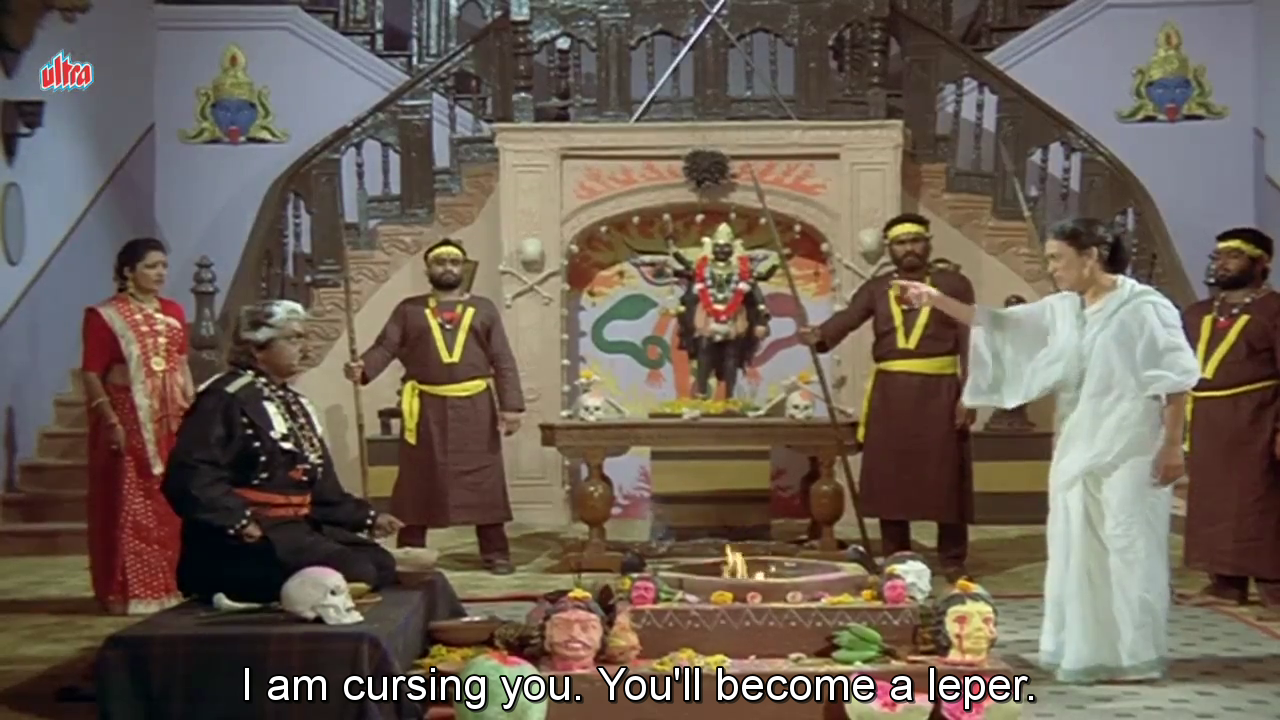
Mohini (Meenakshi) and Nagesh (Nitish Bharadwaj) are Icchadhaari Nagin; snakes who can transform into human shape. A magician (Sadashiv Amrapurkar) wants to steal Nagesh’s naag mani so he can enter a magical realm and find a cure for his leprosy.

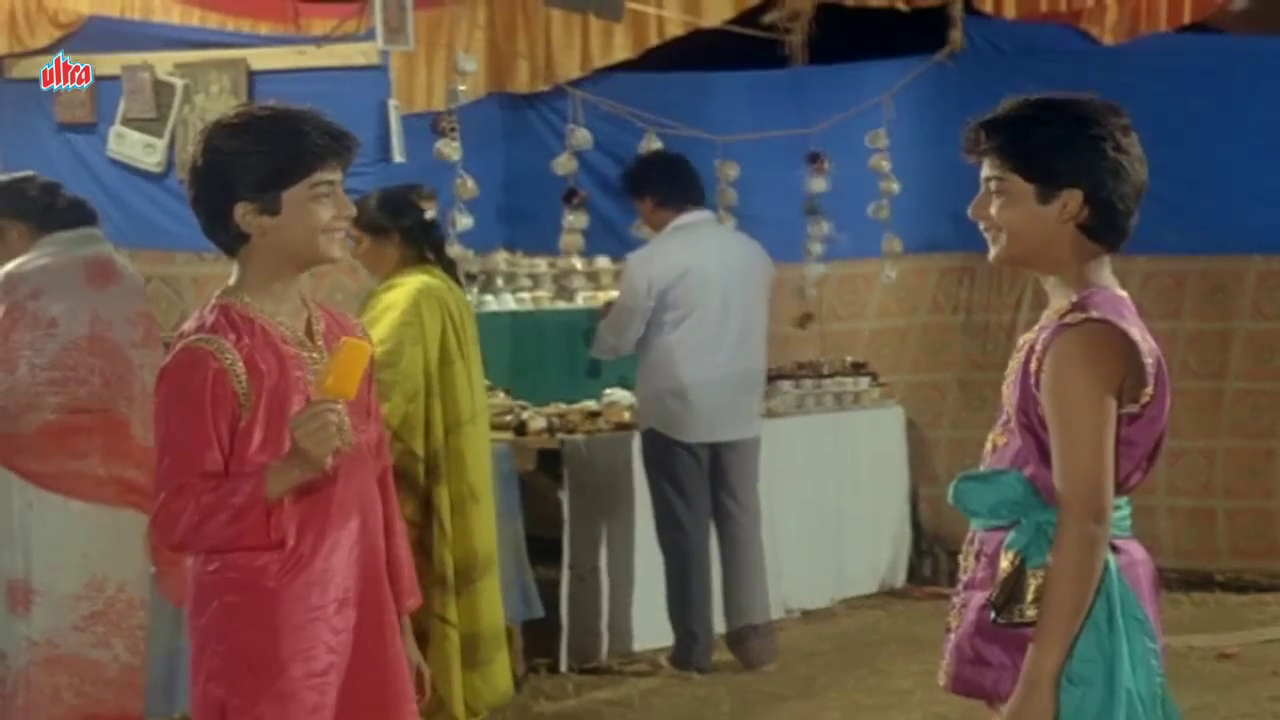
Nache-Nagin-Gali-Gali-cursed(He has a curse laid upon him by a grieving mother, the fiery Suhas Joshi, as payback for killing her son.) He could have asked his guru (Satyendra Kapoor) for help except he had him trapped in a giant bird cage and stole his power. He interrupts Mohini and Nagesh on their full moon night of love and they transform into children, hoping to hide in the crowd at a nearby fair.

Nache-Nagin-Gali-Gali-little MohiniNache-Nagin-Gali-Gali-Duplicates

In all the confusion the children are separated. Nagesh is mistaken for Kamal, a landlord’s son who he saved from being sacrificed by ‘tribal’ people, and taken home despite his denials. Kamal is taken by the sorcerer who thinks he has captured the snake. His wife Subhadra pleads to keep the boy and raise him as their son, which Kamal takes to easily thanks to some filmi amnesia. And poor distraught Mohini is rescued by kindly gypsies and raised as their own. Time passes, and the magician is running out of time to find a cure. Kamal/Nagesh takes a vow not to leave Kamal’s ma as she becomes dangerously ill when stressed so he is stuck, waiting for a solution but not doing much to find one. Nagesh and Mohini find each other, Kamal and the baddies find them, and things rattle along to the exciting final confrontation.

I really like Meenakshi as Mohini, but was even more impressed that this is a film where the entire climax sequence happens without the purported hero. Mohini and the good guru take on the evil tantric to try and prevent him from gaining more power and overcoming his creeping rot.

There are loads of special effects and there is a fairytale feel to the battle between good and evil that contrasts nicely with a quite earthy romance. I was saddened by the use of animals in some scenes, but there is only one incident where I thought there was a genuine prospect of injury or death (a snake versus mongoose battle). For the most the death and destruction is stylised so the drama plays out as engaging and a bit exciting without being at all realistic.

Meenakshi is lovely despite the hair and wardrobe choices in most scenes.

My only explanation for the backward bustle or peplum on the white dress was that perhaps it was really an egg pouch. I know if I was a self willed married lady snake I would not want to be bothering with 40 weeks of gestation plus labour. Her Mohini is heartbroken and wants to find Nagesh more than anything. But she also forms a strong loving relationship with her adopted family, and retains her sense of self-worth.

Nache-Nagin-Gali-Gali-RomeoNache-Nagin-Gali-Gali-never mess with a snakeThere are some unfortunate comedy incidents, but I quite liked seeing a creepy Romeo terrorised by the pretty snake lady.

Nache-Nagin-Gali-Gali-The Look stage 2 with lensesNache-Nagin-Gali-Gali-Mohini attacksMohini dance-fights her way through the final encounter and Meenakshi shows both the disadvantage of a small woman trying to beat a man in a physical fight and the power of her will and determination to be victorious. Her posture and energy changes to show the gradual loss of strength and the corresponding increase in desperation.

Nitish Bharadwaj plays adult Nagesh and Kamal. I have to say, apart from his mullet and some interesting outfits in songs, he made little impression. The highlight of his performance is probably his comic aversion to Roop, the girl his parents want him to marry. There is a brilliant meta moment when Roop makes Nagesh/Kamal watch her dance against the background of Sri Devi in Nagin. Roop does a terribly cheesy and not at all alluring ‘snake dance’ as Nagesh is captivated by the music, leading to his, ahem, premature transformation. I love that even in that silly scene, there is room for more plot development and film references. Nitish is adequate without being particularly good or bad.  Since his characters main contribution to the plot is just to be who they are, it all works out.

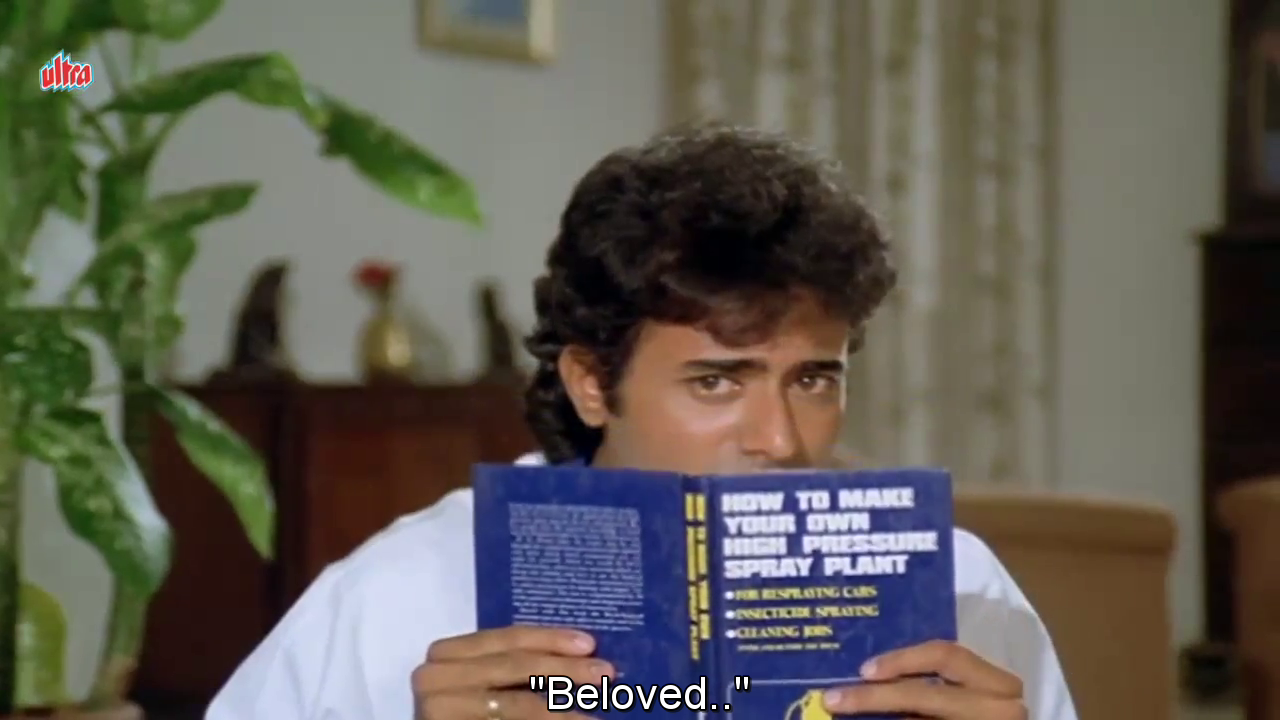
Nache-Nagin-Gali-Gali-romantic readingNache-Nagin-Gali-Gali-the chase


Was that book some kind of compulsory family reading? There are stacks of copies in the house. Perplexing.

Nache-Nagin-Gali-Gali-in chargeNache-Nagin-Gali-Gali-new interior designSadashiv Amrapurkar throws himself into the villainous role with gusto. He goes from ashram to megalomaniacal dictator décor in a heartbeat and seems content with being bad. If only he could get rid of that pesky leprosy! He spends much of the film trudging up hill and down dale, looking for the snake with the naag mani.

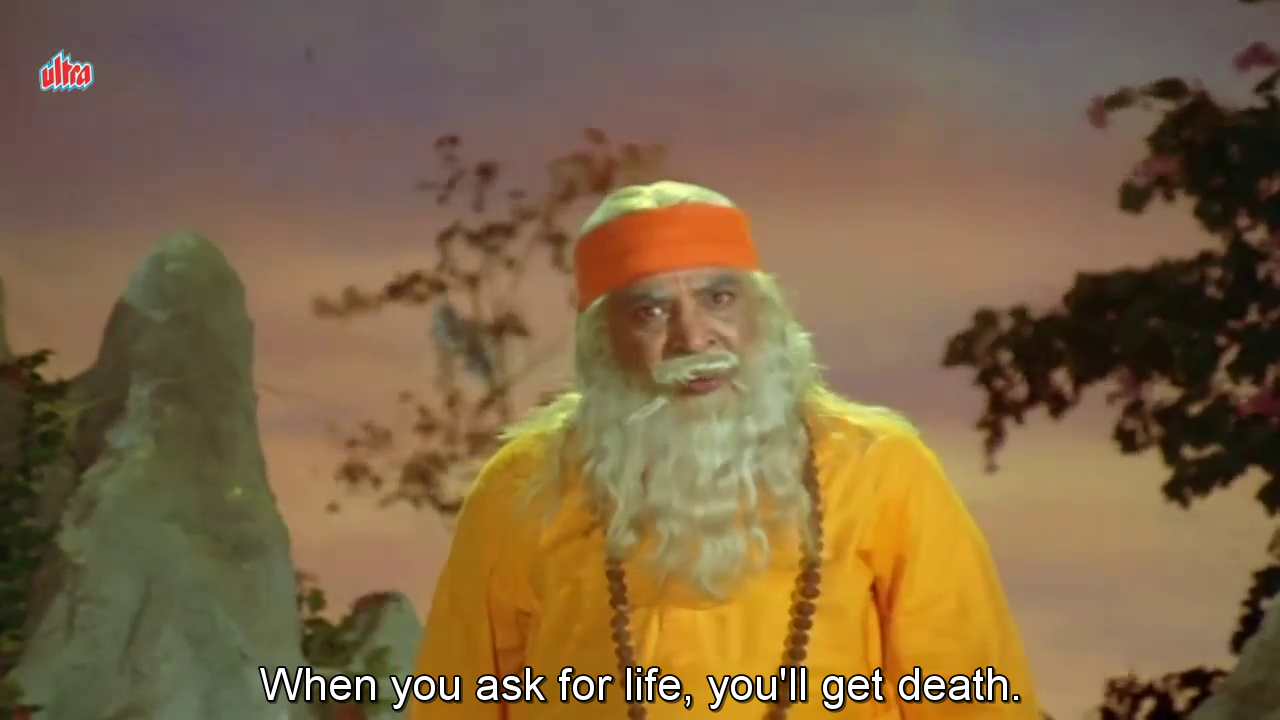
Nache-Nagin-Gali-Gali-Satyendra KapoorSatyendra Kapoor is stately and saintly in his flowing wig. He is like the voice of your conscience that never quiet goes silent. A lot of his role is done by voice over as the parrot got the most screen time. The final duel between guru and wayward disciple is something else as they transform into a series of animals with rich inner monologues.

Nache-Nagin-Gali-Gali-sporty bridal wearNache-Nagin-Gali-Gali-Sahila ChaddhaSahila Chaddha is Roop, but you could also call her Sporty Bridal Wear Lady or WTF Is She Wearing Lady. She is bubbly and determined to get her man.

I enjoyed her antics as she tried to anticipate his objections and overcome them, usually through multiple costume changes and a dance. Kamal’s mother enjoyed watching her son’s discomfort and encouraged Roop too. I never felt sorry for Roop as Kamal/Nagesh was so obviously not keen and yet she persisted. Plus she was needlessly vindictive and nearly got Mohini killed. Not cool Roop.

The songs (by Kalyanji-Anandji) are colourful and mostly uptempo. They didn’t have a huge budget for sets but they did get a good bulk deal on sequins so there is lots of sparkle.

Meenakshi does most of the dancing as Nitish Jeetendras his way around the set. He did do some slithering which was kind of interesting if not strictly speaking good. Or to quote Beth “Kya slither hai!” Both the hero and heroine were submerged in the water feature so were each subjected to the lingering clingy clothing shots. Considering snake attire, the subject matter, and the era, this film largely eschews sleaze.

Nache-Nagin-Gali-Gali-Reunited

There was some conversation about a certain “pajamas – now you see them now you don’t” scene, but these are married snakes of legal age so it is really no one business but their own.

If you want an entertaining film tinged with fantasy and magic, with baddies you can really dislike and goodies that are mostly likeable and right, packed with songs and visual effects, this would be an excellent choice. It is now available on YouTube with subtitles so why wait? 4 stars!