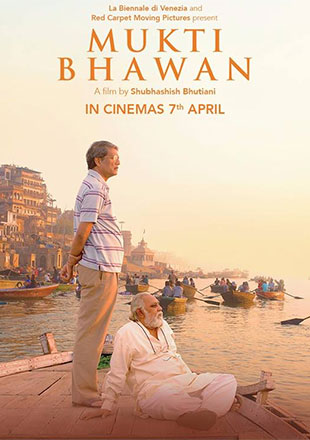
Mukti Bhawan (Hotel Salvation)

I’d be having a stern word with whoever came up with this blurb “Forget The Best Exotic Marigold Hotel; India’s new must-visit accommodation for the elderly is Hotel Salvation. Take a visit in this award-winning debut.

Shubhashish Bhutiani’s Mukti Bhawan (Hotel Salvation) is a beautifully made contemplative story of family, guilt, love, and finally death.

Dayanand (Lalit Behl) is from that blissful generation of men who don’t need to think about whether they are interrupting or are they being too demanding. Everything revolves around him. When he decides his time has come, there is no way to rationalise or compromise with him. Dayanand sulks and insists he will go to Varanasi alone because he is ready and therefore it is his time and that is where he will die. His son Rajiv (Adil Hussain) reluctantly commits to going with his father on what might be his last journey. They travel to Varanasi, and check in at the ramshackle Mukti Bhawan where people await their death by the holy Ganges. The efficient owner Mishraji (Anil K Rastogi) tells them he only allows a stay of 15 days and Dayanand is sure that will be enough. As it happens, Mishraji has a loophole whereby residents can change their names every 15 days. But he assures Rajiv the time is indeed close, although he can’t divulge any more details.

Lalit Behl is by turns childlike, childish, arrogant, demanding, apologetic and affectionate. Dayanand is not used to showing weakness in front of his family, but seems less uptight with his peers at the Hotel Salvation. Daya immediately immerses himself in the daily rituals and starts making friends with the other residents. He is there to actively prepare for his death and welcomes the process. He joins in writing obituaries and practicing yoga, and is addicted to a TV soap they watch every night. He finds community in the house. He is occasionally over the top but only when Daya is in a heightened state, and I thought every note rang true for the grumpy patriarch.

Vimlaji (Navnindra Behl) has genuinely prepared to go but can still enjoy every day she spends on earth. She says she will go when God calls, and has been waiting for 18 years. She is vivacious, the kind of lady you’d have tea and a natter with on a long train trip, but has a calm focus on her task of letting go. I liked her acceptance without finding her passively fatalistic. Vimla’s rapport with Daya is lovely, and I read somewhere the actors are married in real life which may be a factor in the warm familiarity and physical ease around each other.

Rajiv is awkward and appalled by what he sees as squalor and backward thinking, and wants his dad to either come home or go to a hospital. Rajiv is almost like a child again, hanging around on the fringes of adult conversation and not quite being able to participate. He wants to be there to do the right thing, but he doesn’t want to be there at all. He is intimidated by his father, and calls from his wife and demanding boss don’t help matters. Adil Hussain is lugubrious, tetchy, and a little fragile as Rajiv. He is in a rut at work and at home, and his father’s death plans are highly inconvenient. He doesn’t see the value in what Daya is doing, thinking of it as taking him away from work. But he starts to open up and shows that his frustration is driven by love and a maybe a bit of an inferiority complex. His scenes with Lalit Behl are emotionally complex yet very contained. There are few grand gestures or raised voices, and the acting is perfectly aligned.

Rajiv’s wife Lata (Geetanjali Kulkarni) struggles with a demanding old father-in-law and an absentee husband. Rajiv and Lata aren’t wishing for Dayanand to die but they do wish they could get some idea of how long this phase will last. When Dayanand performs the cow donation ritual, it is life and death to him, but to the family it is just an interruption. Lata wants life to be normal, unexceptional, and organised. She seems brusque but when people need her affection it is there. Her scenes with Rajiv run from shockingly direct conversation to wordless empathy and she is the bedrock of the family.

There is often a point in family crises where you’re damned if you do and damned if you don’t. Everyone has their idea on what is right and what everyone else should be doing. That tension is drawn out very well, mostly through the character of Sunita (Palomi Ghosh). She is a bright and warm girl, and has a cheeky rapport with her granddad. Daya is less strict and demanding of her and Rajiv quietly absorbs the difference in how his family interact with each other and with him. When Sunita comes to visit, Dayanand and Vimlaji sneak a bhang lassi with her because it’s Varanasi and of course they should. The three of them giggle through the day and each takes comfort in the camaraderie. When Daya hints that she might not be happy with her upcoming engagement Rajiv brushes it off. Later he confronts Dayanand about why he was made to do what was expected rather than follow his passion. Rajiv is more like his dad than he realises.

Tajdar Junaid’s soundtrack complements ambient sound of prayers and TV and kids playing. Bhutiani and his crew largely eschewed the more sensationalised Varanasi cremation clichés and instead dwell on the daily rituals, the bustle of the narrow back streets, the changing light, and the overwhelming feeling that life is a cycle. Mukti Bawan is somewhat similar in content (if not in tone) to Piku, with a dominant patriarch on a journey only he comprehends and a family who don’t quite realise they are being given precious time to say goodbye.

 

Margarita, With a Straw


Margarita, With a Straw

Shonali Bose’s 2014 film follows Laila (Kalki Koechlin) as she navigates her way through the usual rites of passage that mark the transition to adulthood. The difference here is that Laila has cerebral palsy and spends most of her time in a wheelchair. It’s rare to find a story about a disabled protagonist that’s not about overcoming great adversity, but Margarita with a Straw is simply a look at Laila’s life as she navigates her way through college. Laila may have some physical limitations, but her dreams and desires are those of any young person and she doesn’t let her disability stand in her way as she moves to New York to go to college, embarks on a same-sex relationship and starts to take control of her life. The film does have a few flaws, but with strong performances from Kalki Koechlin and Revathy, and a generally upbeat approach, it’s definitely well worth a watch.

Bose based her story on her cousin who also has cerebral palsy and the film was made in consultation with an Indian based disability agency, ADAPT which ensures the situations seem true to life. The issues Laila faces are mainly due to problems with accessibility, such as when the lift at her college isn’t working and she needs to be carried upstairs, or when her wheelchair gets bogged down in the snow in New York. For the most part Laila is a regular student and her family encourage her independence, seeing her disability as just part of Laila rather than as a liability that will hold her back.

Laila is a student at college in Delhi where she has a number of friends. Sameera (Shuchi Dwivedi) plays guitar for a rock band and Laila writes lyrics for their songs, partly because she loves music but she also has a crush on the lead singer Nima (Tenzin Dalha). However, when she reveals her attraction, his awkward response devastates Laila to the point where she feels she cannot continue at college. Luckily for her, at this point she receives an offer to study in New York and over the objections of her father, but with the support of her mother, Laila moves to the US and a new chapter in her life.

While at home Laila experimented with her developing sexuality, including surfing pornographic websites, masturbating and becoming intimate with her friend Dhruv (Hussain Dalal) who is also in a wheelchair. All of this is shown in a very matter of fact way and I can’t remember any Indian film dealing with developing sexuality in such a realistic manner, let alone one that approaches it from the viewpoint of someone with a disability. The film deserves recognition for that as well as the authentic manner in which the friends interact. Dhruv broaches the idea that Laila has ‘normal’ friends simply to try and ‘fit in’, but Bose shows her isolation as the group chat and jam outside while Laila is left alone inside in her wheelchair. These scenes are sensitively handled without ever showing Laila as self-pitying or becoming overly sentimental, which makes the situations realistic and plausible. Also well done is the reaction of Nima when faced with Laila’s attraction which seems completely typical of any adolescent when faced with a declaration of love from someone they like, but are not attracted to in a romantic way. Although these are small moments, the film is made up of many such scenes which ensure the story is about Laila and not about her disability.

Laila’s move to New York brings her into contact with an attractive fellow student Jared (William Mosely) but this time Laila is more careful after her experiences with Nima despite Jared’s seeming interest in her. However, Laila then meets Khanum (Sayani Gupta) after getting mixed up in a demonstration and their friendship develops into an intimate relationship. Khanum is blind and Sayani Gupta is good in her portrayal of someone who cannot see, but unfortunately for the most part, her character is superficial and poorly developed. Khanum appears to exist only as a means to allow Laila to explore her independence, and their relationship generally feels clunky and odd.

The film is most successful in exploring the family relationships, particularly Laila’s relationship with her mother (Revathy). Laila’s desire for independence and privacy ensures there are moments of conflict, while Revathy is excellent as a mother trying to reconcile her need to protect her daughter with the realisation that Laila needs space to grow. Towards the latter half of the film Bose tries to cram too much in to this relationship including an unnecessary illness and a rather forced scene where Laila reveals her bisexuality to her mother, but where she keeps it simple it makes for some excellent and emotional cinema.

Kalki Koechlin does an amazing job with her portrayal of someone with cerebral palsy although it does seem a shame that there wasn’t a disabled actor playing the role. The level of disability she portrays does fluctuate a little throughout the film, but overall her body language is good and convincing while the emotional highs and lows are well done.  My DVD includes a ‘making of’ which does give some insights into the difficulty of portraying the character, and it’s to Kalki’s credit that she has invested so much time into getting her characterisation of Laila right. Revathy is also excellent while the rest of the supporting cast are also good. Kuljeet Singh doesn’t have much to do as Laila’s father, but he is fantastic in the emotional scenes near the end and really impresses by how well he conveys strong emotions so subtly.

Overall, Margarita, With a Straw is an unconventional film that may be a tad uneven but succeeds due to the excellent performances and strong emotional content. Bose paints a sympathetic picture of a young woman with cerebral palsy without dwelling on the disability, but rather focusing on the issues that everyone faces as an adolescent, whether able-bodied or not. Laila’s journey towards acceptance, by her family and by herself, is often funny, frequently emotional but always engaging. 4 stars.

Margarita, With a Straw

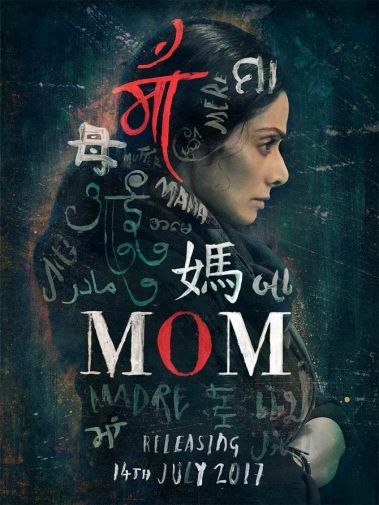
Mom (2017)

Mom

Mom starts out with an interesting take on the step-mother/daughter relationship but takes a turn midway to end as a standard revenge film with a haphazard second half and an overly mawkish finale. Thankfully Sridevi is outstanding as the mother hell-bent on revenge, and Sajal Ali, Nawazuddin Siddiqui and the rest of the cast are all excellent, making Mom better than average, despite the film’s flaws.

The first half of the film explores the tension between Devki Sabarwal (Sridevi) and her step-daughter Arya (Sajal Ali). Arya is the daughter of Anand (Adnan Siddique) and his first wife, and she bitterly resents Devki for taking her father away from her and her memories of her dead mother. Although Devki and Anand have been married long enough to have a child of their own, Arya still isn’t reconciled to her step-mother and the resulting acrimony affects every moment the family spends together. Adding to the tension is the fact that Devki is a teacher and Arya is a student in her class which allows Arya to continue the teacher/student formality even when they are at home by always addressing her step-mother as ‘madam’. The difficulties of dealing with a moody and resentful teenager are compounded by Arya’s animosity towards her stepmother, while Anand is caught in the middle trying to keep the peace. Generally Anand is a passive character who drifts along seemingly not too bothered by his daughter’s rudeness which I presume is to allow Devki the space to take centre stage later in the film. However, the relationship between Devki and her step-daughter is handled well with the family dynamic appearing authentic and the dialogues realistic, and perhaps it’s not too far a stretch that Anand avoids the situation at home rather than getting too involved.

Everything changes one night when 18-year-old Arya goes to a Valentine’s Day party at a farmhouse and doesn’t return home. She is abducted by four men in a black four-wheel drive, and Ravi Udyawar brilliantly builds and maintains the tension as he switches between a frantic Devki desperately trying to contact Arya by phone and horrifically effective overhead shots of the vehicle slowly cruising along deserted roads. The soundtrack adds to the sense of menace and there is a chilling, heart-stopping moment as the car stops and the men change who is driving. It’s horrifying because we know what is happening but all the more effective as nothing is ever shown of the violence until Arya is dumped at the side of the road.

Reading about the film and watching the trailer I was worried that Mom might go down the route of so many films about rape but Ravi Udyawar gets this part of the film totally right and sensitively handles an assault which is too often inappropriately sensationalised or set up to blame the victim. The anguish and despair felt by Devki is also well portrayed, as is Arya’s reaction, while for a change the police are rather more sympathetic although the process of gathering evidence does seem fatally flawed.

When the courts offer little in the way of justice, Anand puts his faith in an appeal and a more rigorous series of tests, while Devki has a more practical approach to her daughter’s rapists gaining their freedom. Anand’s reaction here does seem rather less plausible, but to some extent does fit with his earlier ‘ostrich in the sand’ approach to his daughter. Devki is aided by a private detective, Daya Shankar Kapoor aka DK (Nawazuddin Siddiqui) who is sympathetic to her mission. But with detective Mathew Francis (Akshaye Khanna) suspicious of Devki and Arya still as distant as ever, it seems that Devki has set herself an impossible task when she sets out to seek revenge.

Devki is shown as a strong character right from the beginning. She promptly and efficiently deals with an unpleasant incident in her classroom and appears determined to break down the barriers between herself and Arya, despite her step-daughter’s frosty attitude and carefully maintained distance. Sridevi looks radiant too while the scenes between her and Adnan Siddiqui have a genuine warmth and easy affection that speak of a good relationship. After the assault, her reaction to her daughter’s injuries is wonderfully histrionic but perfectly apt for the situation while her trepidation and uncertainty come across clearly as she embarks on her revenge. However, the screenplay doesn’t help here as DK insists that they meet in secret and the pair then proceed to arrange rendezvous in conspicuous public places where they speak to each other without seeming to take any precautions at all. Even the association with DK seems rather unlikely given their first meeting, but Nawazuddin Siddiqui runs with it regardless and manages to give his character plenty of appeal despite his slightly disreputable appearance. His DK is a more sympathetic character than first appears and he is excellent at conveying his own horror and understanding of the situation to Devki. The dialogue between the two tries to give some rationale for Devki’s actions and there is plenty of symbolism included during their meetings, but it’s really the performances from the two actors that allow any suspension of disbelief and make it even vaguely possible that Devki could act as she does.

Akshaye Khanna does the best he can with the role of the police officer assigned to Arya’s case but his character has little to do and doesn’t seem to know which side he should be on either. Mathew Francis seems to be a capable enough office but his investigations are only shown briefly and he never seems to be a serious threat to Devki’s plans. I also have some issues with the portrayal of transgenders and the completely evil nature of Abhimanyu Singh as one of the perpetrators which seems too over the top in a film that already has plenty of extreme emotion.

Anay Goswamy’s cinematography is excellent and the music from A.R.Rahman evocative and perfectly suited to each mood of the film. Where the film falls down is in the predictable nature of the second half and its failure to address the topical issue of violence against women except by suggesting the usual vigilante payback as the way to go. Naturally it makes for a more exciting film this way, but it would have been more satisfying to see more of the family’s reaction, more of Arya’s own story and her father’s struggle for justice. Better too, if Ravi Udyawar had stuck to the fractured relationships and the impact of assault, rather than following the well-trodden path of failed justice and pay-back. Even the scenes of revenge (as clichéd as they are) are glossed over swiftly and the police investigation relegated to a few brief dialogues with a bizarre about-face by Detective Mathew Francis appearing out of the blue, just in time for the film climax. Sridevi is always worth watching, but her co-stars here are all equally good, even though Girish Kohli’s screenplay limits their contribution to the story. Worth watching for the excellent performances, technically good presentation and well executed first half, just don’t expect anything more than a typical masala ending.