
I picked up Madrasapattinam with a little trepidation; after all Indian historical films featuring a cast heavy on English actors don’t usually bode well. But I was pleasantly surprised as, although there are tinges of Lagaan and a few cringe-worthy moments, overall Madrasapattinam fares somewhat better than expected. There is still the issue of almost uniformly ‘evil English’ and ‘good Indian’ characters, meaning most of the supporting cast are very one-dimensional. However the leads give good enough performances that apart from one notable exception, I could ignore the clichés and just enjoy how beautiful the film looks.
The film begins with the elderly Amy Wilkinson determined to return to India and find a man she last saw some 60 years previously. Ostensibly she wants to return a Thali necklace given to her as she feels it does not belong to her. As she is also quite seriously ill she travels with her increasingly whiney and irritatingly useless granddaughter Catherine who is supposed to be looking after her. To aid her search Amy has a photograph she took in 1945 but little else other than a name.


When they arrive in Chennai Amy starts to relive her time in India, when she was the young daughter of the Governor, and this is when the film really comes alive. The young Amy is picked up at the station by the Commissioner of Police, Robert Ellis (Alexx O’Nell), and straight away he’s my biggest problem with this film. Why does every English bad guy have to be the most evil and despicable person on screen? It’s very obvious from the first time we meet him that this is a man with absolutely no redeeming features whatsoever and it’s difficult to keep watching and not just skip his scenes. In my opinion he could have been made much more interesting if he was just thoughtless and greedy rather than consistently evil, but sadly he’s just vile and repulsive and it’s very obvious from the very beginning how he is going to behave throughout the film.


On the trip to the Governor’s residence Amy meets Parithi (Arya) in classic ‘meet the hero’ style since she sees him running to save a donkey from the path of her runaway car. Parithi works as a dhobi and in his spare time he wrestles with local trainer Ayyakanu; a man with an impressive moustache who isn’t afraid to get down and dirty in the ring himself. Added to Partithi’s ability to run, wrestle and save animals is his most perfect feature – he can iron. Naturally Amy falls in love with her ‘brave man’ as he fights against the English plans to build a golf course on the area where the villagers work and live. It becomes a personal vendetta between evil Robert and Parithi as they are both also competing for Amy’s attention and since they are playing by different rules you know that it’s not going to end well.

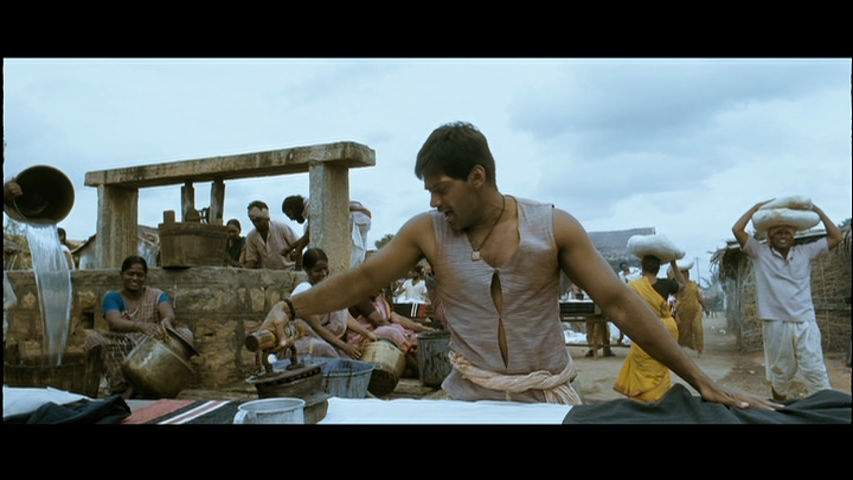
Amy and Parithi meet each other in secret, and there are some lovely scenes as they struggle to overcome their language barrier. They have an ingenious if somewhat laborious method of communication, as Amy draws pictures on her clothes of where and when they will meet which Parithi then has to launder off. Amy spends much of her time in the village with her camera, and the villagers seem to love her just as much as she loves them. However when Indian Independence finally arrives it means the end of her romance unless she can escape with Parithi. Their plans are naturally foiled by evil Robert who chases them through the Independence celebrations determined that if he can’t marry Amy then no-one will.


The romance between Amy and Parithi is the best part of the film. Amy Jackson is stunningly beautiful and is convincing as a young English girl in the post-war period. She is nicely restrained in her scenes with Parithi, but charmingly natural with Parithi’s sister Selvi and the village children. Arya is excellent as the strong and mostly silent Parithi who is determined not to back down in the face of the English oppression.
There are many genuinely funny scenes which are well integrated into the narrative, and these help the film from getting too bogged down in all the drama of the fight for the village and the seemingly doomed romance. Tension is well build up in the chase scenes although these could have been cut a little without losing too much of the suspense. Cochin Hanifa as the translator Nambi and Nassar as Ayyakanu are the best of the supporting actors but the story revolves around Amy and Partithi and no-one else has an awful lot to do.
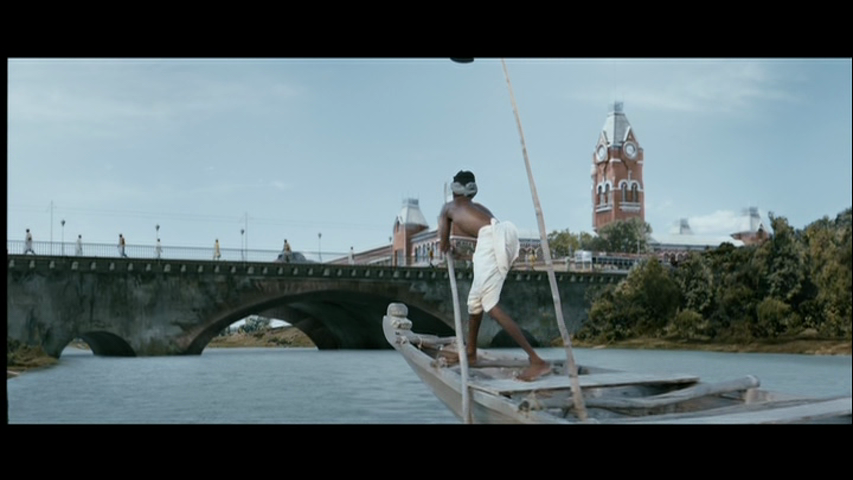
The film does look beautiful with well constructed sets which seem to be representative of 1940’s Madras, particularly to someone like me who’s only ever seen the modern version from 1990 onwards. There are one or two instances of rather dodgy CGI but these are fleeting and don’t really disrupt the story so they are ignorable. The end credits feature old pictures of Madras landmarks followed by their current appearance which really was fascinating. One anachronism for me was one of the actors had an apparent artificial eye. While this was possible from the time period, I don’t really think it’s all that likely that a dhobi would have had access to this especially post WWII where prosthesis were a luxury. But that’s just my obsession and I’ll just see how many people spot him.

The modern day scenes are somewhat hampered by an incredibly wooden performance from Lisa Lazarus as Amy’s granddaughter although Carole Trungmar is rather better as the elderly Amy and her periods of abstraction fit her character well. The story is compelling and the final scenes in the present day give a satisfying conclusion. While the soundtrack by G. V. Prakash Kumar is perfectly adequate it doesn’t stand out as particularly memorable. The first song is set in the dhobi village by the river and I’m sure intentionally, is very reminiscent of Ghanana Ghanana Ghir from Lagaan, although in this case they are asking the rain not to come. The rest of the songs have less dancing than I would have preferred but we do get the opportunity to see Arya in an outfit that looks as if he has just escaped from a totally different period film as consolation.
While evil Robert and the standard ‘English opression’ storyline did annoy me in this film, the romance is quite charming and I think the two leads manage to carry the story well. The parts of this film that I like, I really do like very much but the parts that I don’t like, I really do dislike very much. Which means a lot of fast forwarding when rewatching. As far as historical romances go it’s certainly not the worst I’ve seen and I give it 3 stars, although one of those is for a hero who can iron!
Temple says: I don’t have the same issue with evil Robert that Heather does. He shouts, snarls, twitches, bullies his underlings, has a pit full of decomposing bodies in his backyard and constructs overly elaborate revenge plans. In short, he’s like almost every other filmi villain. I do have an issue with the atrocious acting by the guy who plays Amy’s father. Distractingly bad. Given to long….pauses. For no reason. And delivered other lines. Like this. Staccato. Caroline Trungmar was not impressive as the older Amy as she seemed catatonic for most of the film but her Titanic inspired role was mostly to sit and look like she was remembering so I may be a bit harsh in my judgement. The tradition of really bad acting by white extras seems to be alive and well and was embraced by many in this cast. As they were mostly caricatures rather than fully developed characters I don’t know that a more nuanced performance would have been much help. The Indian supporting cast were all pretty good, and Cochin Hanifa is lots of fun as are Parithi’s friends.
I was more distracted by the indeterminate historical period of the costumes and dialogues. As the film starts in 1945, the European costumes are often very wrong indeed and the dialogue sounds as though some of it was lifted from Dickens rather than a comparatively modern family. And the Europeans’ manners at the dance…well.
But the film is really about Parithi and Amy and if you can enjoy their developing love story, then it is a pleasant enough timepass. Arya is excellent as the strong silent type, prone to flexing and ironing. Who could ask for more? Ok well, if you want more, he also wrestles. Amy Jackson looked more like a footballer’s girlfriend than a 1940s heroine but I think she is one of the least embarrassing gori love interests in an Indian historical film that I have seen. Their interactions are simple and often Amy follows Parithi about as he works, allowing us to observe the villagers life and see the diverse supporting characters in play. They have a nice rapport, and the scenes with Selvi (Parithi’s sister) are genuinely touching.
The look of old Madrasapattinam is very picturesque and the olden days scenes are pretty and dominated by sepia tones that help keep the mood of past times. The modern city of Chennai is a contrast in grey and blue, cold and confusing. This feels very much like a pastiche of Lagaan and Titanic with a dash of Kisna and it is entertaining rather than informative.
I give this 3 stars – for a good looking film, with good looking stars and a positive message that men who iron are heroes.


 Cinema Chaat
