Manam (2014)

Manam

Manam is a beautiful film and a breath of fresh air in an industry usually dominated by beat-‘em-up heroes and the same old innuendo masquerading as comedy.  Featuring three generations of the Akkineni family and Nageswara Rao’s final screen appearance, it could very easily have tipped into trite sentimentality, but Vikram Kumar’s screenplay keeps the film on track with an novel storyline, sweet romances and genuinely funny comedy.  I have to admit that I almost didn’t buy a ticket when I read that Manam was being advertised as a comedy, since without subtitles most of the humour tends to pass me by (even with subtitles in some cases!) but Manam would have been a watchable and entertaining film even without subs.  As it was, being able to understand the jokes and laugh at the same time as the rest of the audience was excellent.  Long may this trend for subtitled Telugu films continue in Melbourne!

Manam Manam

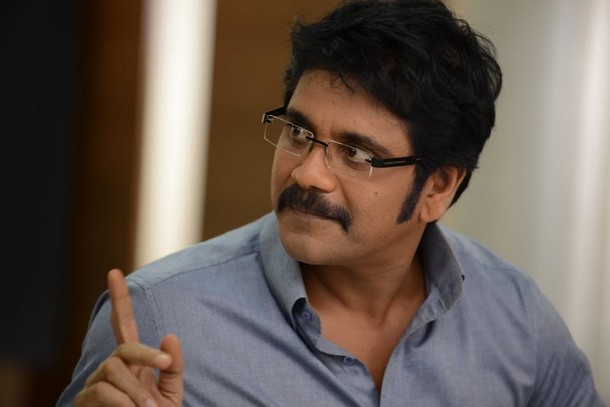
The film starts in the 1980’s with the unhappy marriage of Radha (Naga Chaitanya) and Krishna (Samantha) who bicker and fight even on the occasion of their son’s sixth birthday.  The very next day they are both killed in a car accident, leaving the young Bittu an orphan and his wish to see them happy together unfulfilled.  This doesn’t seem to have held Bittu back however, as the film moves to the present day, and the now grownup Nageshwar Rao (Nagarjuna) is in Mumbai to receive the Businessman of the Year award.  However, on the flight back to Hyderabad, Nageshwar is seated beside a young man who is the image of his late father, and this begins his crusade to bring his ‘parents’ back together again.  Nagarjuna is absolutely perfect here and his child-like wonder at discovering ‘his father’ is brilliantly portrayed.  The scene is well written too, with the just the right amount of comedy to keep it from cloying sentimentality and Vikram Kumar even manages to make the suggestion of such an occurrence seem perfectly plausible.


Samantha and ChaitanyaManamNageshwar reasons that if his father has been reborn, then his mother must be around somewhere too, and to this end he scours the streets of Hyderabad until he tracks down Priya (Samantha) who is the image of his mother and, luckily for Nageshwar and his plans, she immediately feels a connection.  Again Nagarjuna’s determined search is neatly summarised in just a few shots and the obvious unlikely coincidences feel much less contrived than expected.  It help that both Nageshwar and Priya are very likeable characters and Nagarjuna and Samantha ensure their interactions are full of genuine warmth and respect.

ManamNagarjuna

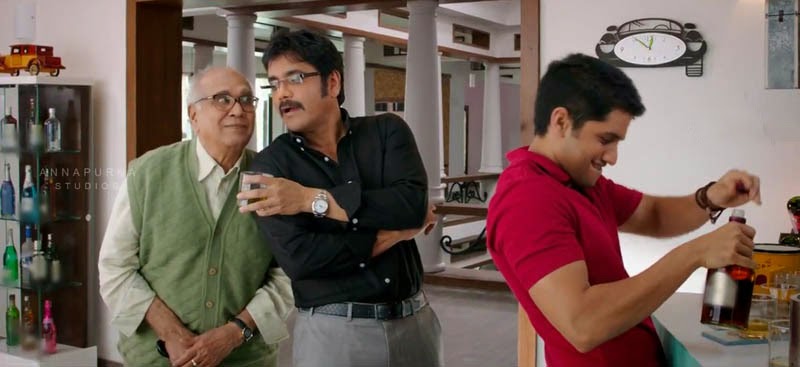
Having found his re-incarnated father and mother, Nageshwar has to find a way to re-ignite their romance.  In the midst of his attempts to bring about true love, Nageshwar finds love himself when Anjali (Shriya) commandeers his car to carry a sick man to hospital.  As it turns out, the older man is Chaitanya (Akkineni Nageswara Rao) who has seen his parents Seetharamudu and Ramalakshmi  reborn as Nageshwar and Anjali.  It’s then his turn to explain the past and try to reunite the lost lovers.
Manam

ANR is the absolute star of the show, and seems to take great delight in playing the octogenarian matchmaker.  He is mesmerising every time he appears, and his facial expressions and reactions to every other character are superb.  For his part, Nagarjuna is quietly competent as Nageshwar Rao with a subtle but effective performance, and his romance with Ramalakshmi in the second half is an absolute delight to watch.  There seems to be something in Temple’s theory that Shriya Saran’s irritation factor is related to the length of her hair, as here she has long hair and is actually pretty good.  Shriya looks beautiful and displays an engaging personality as a 1920’s traditional villager, and she is just as stunning as the cool and efficient Dr Anjali.  I vote Shriya always has long hair in her movies!

Manam

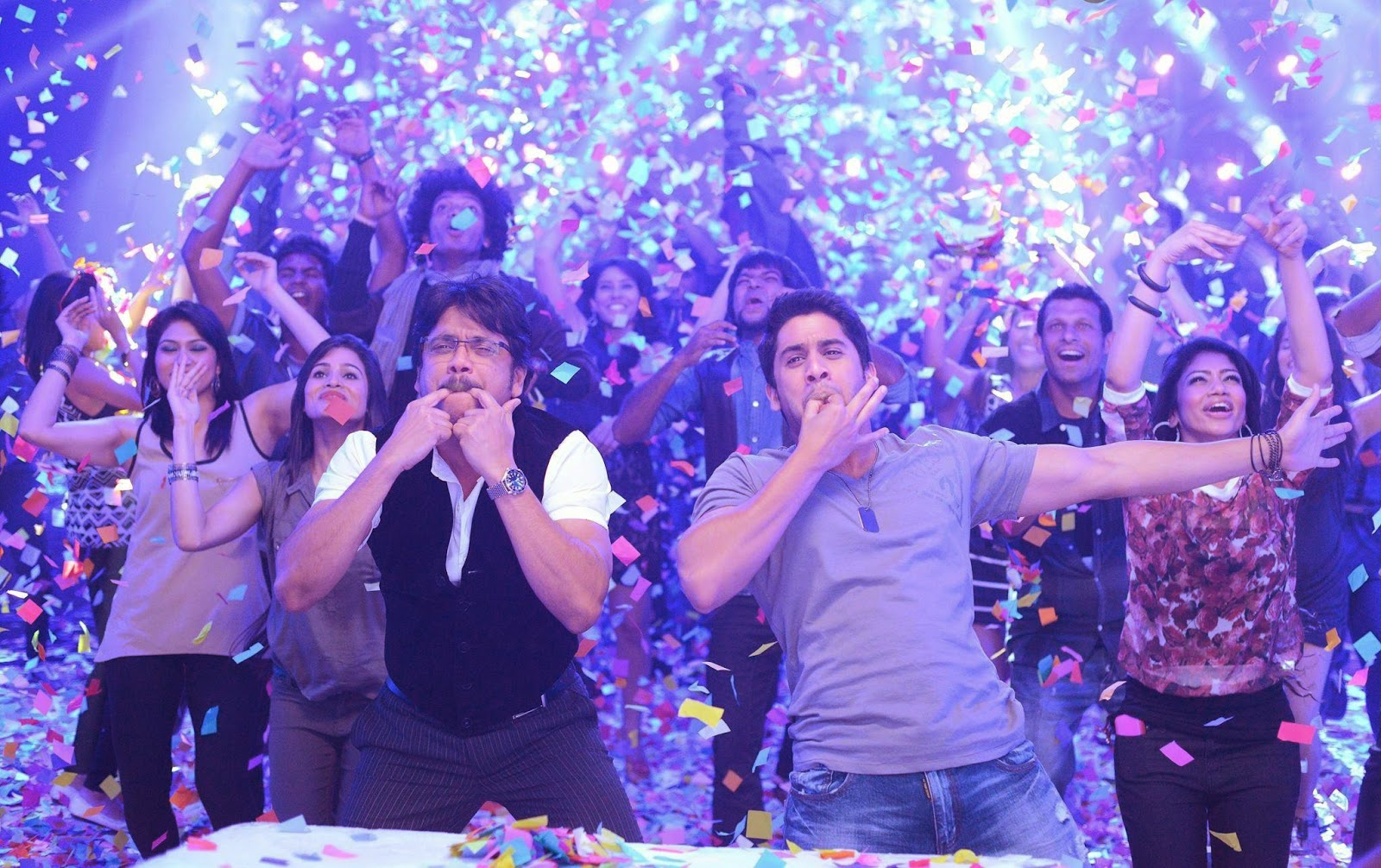
Nagarjuna and Shriya also share good chemistry together, which is sadly conspicuously absent in the romance between Samantha and Chaitanya, although to be fair the script really doesn’t ever let them develop much sparkage except in the way of confrontation.  Despite the lack of passion with Chaitanya, Samantha shines as Priya / Krishna.  She sparkles in her songs, and is full of bubbly enthusiasm as she meets Nageshwara, but her pain at her perceived husband’s betrayal is obvious as is her contempt of Chaitanya’s Nagarjuna.  Chaitanya is also better than usual, although that may be because his role mainly requires him to play a drunk and obnoxious college student which he seems to fit well.  The usual suspects pop up as various mothers, fathers, cousins etc, but do watch out for the brief cameo appearance of Amitabh Bachchan which garnered plenty of cheers from the audience.
Manam

It’s not all perfect though – the inclusion of Ali as a dance teacher is unnecessary and M.S. Narayana’s role is too obvious and crude to fit with the rest of the characterisation.  However Brahmi is good as Nagashwara’s assistant and without any misogynistic humour, he manages a restrained performance that proves he can act perfectly well when required.

Manam benefits from a sweet and  simple telling of a relatively convoluted story.  There are no exciting car chases, no big fight scenes and no cliff-hangers (even though the last few minutes attempt to raise the dramatic tension), but overall it’s an entertaining and watchable film.  All praise must go to Akkineni Nageswara Rao and Nagarjuna for their exemplary performances, but the younger generation hold their own, with even Chaitanya showing that he learnt something from the rest of his family while on set.  Definitely recommended viewing and a last performance to savour from one of the legends of Telugu cinema.

Kabhi Khushi Kabhie Gham (2001)

Kabhi Khushi Kabhi Gham

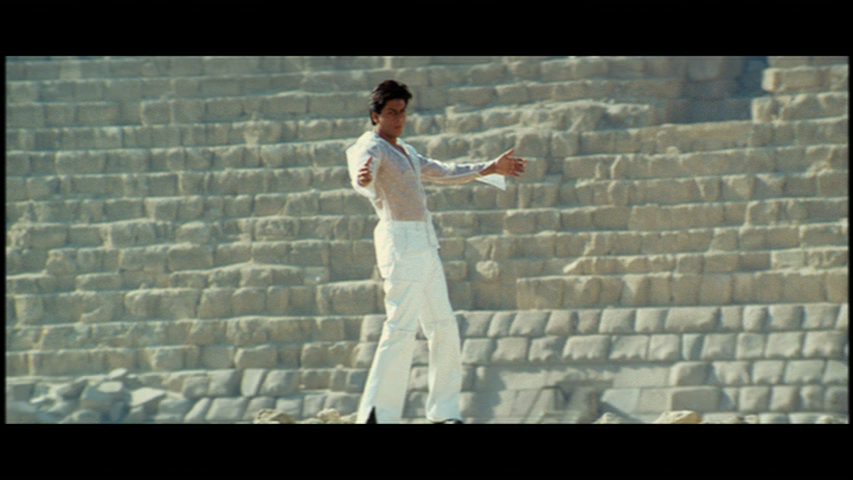
K3G is an indulgence that I only allow myself to luxuriate in occasionally.  While I love the first half of this film, despite all its flaws and typical Karan Johar extravagances, I just wish that the second half came anywhere close to the emotional appeal of the opening melodrama.  Considering the stellar cast it’s particularly disappointing that the whole doesn’t live up to the promise of its parts, but at 3 ½ hours maybe only watching the first half isn’t such an issue.  It also contains my all-time favourite Shah Rukh song with plenty of shots featuring SRK in those lacy see-through shirts, which is probably enough of an explanation for my love of this film, but K3G also brings back memories of learning Hindi and actually starting to understand dialogue without subtitles.  Special for a few reasons then, but this song is still the best part of the film.

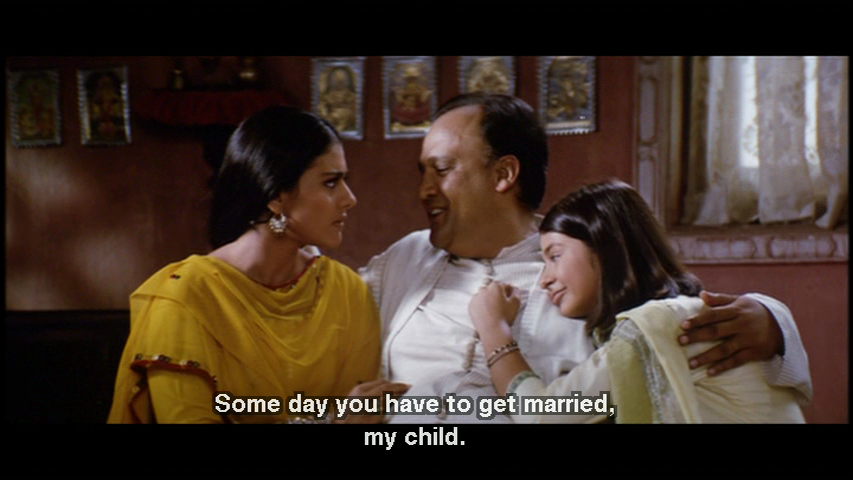
For those who haven’t seen K3G, it’s a fairly routine story of your basic multimillionaire family and the ups and downs of their domestic relationships.  The Raichand’s live in a large ostentatious stately home which seems as far removed from India as it is possible to get despite the fact that it’s supposed to be relatively close to a lively market in Chandni Chowk.  It’s the kind of family where running late means having to hop on the helicopter to get home in time for Diwali celebrations, but despite all the lavishness of their lifestyle, it’s a family where there is a lot of love.  This is emphasised in the opening credits as Nandini Raichand (Jaya Bachchan) plays with her young adopted son, but it’s also obvious in the interactions between Rahul (naturally this can only be Shah Rukh Khan) and his father Yashvardhan Raichand (Amitabh Bachchan) as well as in the later scenes with his mother and younger brother Rohan (Kavish Majmudar).

Kabhi Khushi Kabhi GhamKabhi Khushi Kabhi GhamKabhi Khushi Kabhi GhamKabhi Khushi Kabhi Gham


Problems arise when Yash decides that Rahul will marry Naina (Rani Mukerjee) who seems ideal for the position of rich man’s wife entrusted with carrying on the family traditions.  However Rahul has other ideas as he has fallen in love with Anjali Sharma (Kajol), the daughter of a local shopkeeper in Chandni Chowk. Just to keep things in the family, Anjali is the niece of Rohan’s nurse Daijan (Farida Jalal) and has a younger sister Pooja who is roughly the same age as Rohan.  This helps later on in the story, although initially it just seems another way of emphasising the gap between the two families.

Kabhi Khushi Kabhi GhamKabhi Khushi Kabhi GhamKabhi Khushi Kabhi GhamKabhi Khushi Kabhi Gham


The first half of the film sparkles with the romance between SRK and Kajol while the various family relationships add depth and interest to the story.  The two grandmothers, Achala Sachdev and Sushma Seth, ensure a typical Indian family feel despite the Anglicised mansion, while the glaring discrepancies between the Raichand’s home and the (somewhat sanitised) streets of Chandni Chowk are used to good effect.

Kajol is lively and boisterous as Anjali, while SRK is more retrained and less dramatically emotional which helps keep things under control.  There is a smattering of comedy in the romance too, which both SRK and Kajol handle effortlessly, and the appearance of Johnny Lever in comedy uncle mode is thankfully kept to a minimum and doesn’t disrupt the story.  The other characters all fit in too – the young Rohan is petulant and spoilt, just as a rich kid should be, while Anjali’s younger sister Pooja (Malvika Raaj) is bratty and approaching obnoxious at times, which does actually tie in reasonably well with her later persona.

Kabhi Khushi Kabhi GhamKabhi Khushi Kabhi GhamKabhi Khushi Kabhi GhamKabhi Khushi Kabhi Gham


Naturally Rahul chooses love over duty and ends up cast out of the bosom of his family, although he does have Anjali and her sister Pooja as compensation.  Of course, this is a Karan Johar film, so it’s no surprise when we reconnect with Anjali and Rahul ten years later to find that they are living in a large and opulent home somewhere in London, despite the fact that Rahul left with nothing – pretty impressive work!

Kabhi Khushi Kabhi GhamKabhi Khushi Kabhi Gham


But things start to fall to pieces once Kareena Kapoor enters the picture.  This was the first time I’d seen her in a film and it was also the last for a very long time – based solely on this dreadful performance. Hrithik Roshan as the grown up Rohan is also sufficiently unimpressive, seemingly unable to decide between the role of hot and macho student running amok in ridiculously expensive cars, or emotional wreck searching for his brother.  The two completely derail the romance and it’s hard to come up with any reason why Pooja has to dress like a call girl and act like a complete airhead.  The film also dives deep into overindulgent farce as Anjali complains about her son becoming too English (hmm, could this be because they’re living in England and he’s attending an English school?) while Rohan decides that staying with his brother while pretending to be someone else would be a good way to reconcile his father and brother.  Because that would definitely work.

If you can ignore all the self-indulgent weeping from Rohan and the insufferable unpleasantness of Pooja, the rest of the film is endurable, although unbelievably long and drawn out with a ridiculously contrived ending.  Karan Johar goes overboard trying to tug on his target NRI audience’s heartstrings with a rendition of the Indian National Anthem which seems totally out of place, and there are far too many references to ‘loving your parents’.  Even apparently when they don’t love you and repeatedly tell you so.  There are a few moments where the easy flow of the first half is almost recovered, but overall the second half is disappointing at best, particularly after such a good beginning.

Thankfully though there is still SRK, who is as charismatic as always, and the Shah Rukh and Kajol jodi works even while the story around them falls to pieces. If only the whole Kareena Kapoor and Hrithik Roshan storyline had been cut, this would have been a much more enjoyable film, although still not perfect.  Still, I do recommend watching right up until the interval – after that it’s at your own risk!   4 stars for the first half, but only 1 for the second.

Bombay Talkies (2013)

Bombay-Talkies-Poster

Apologies – this post is brimful of spoilers. Mind you, no one who edited the trailer or the geeks writing for Wiki or reviewers for some major papers seems to give a toss about giving away details.

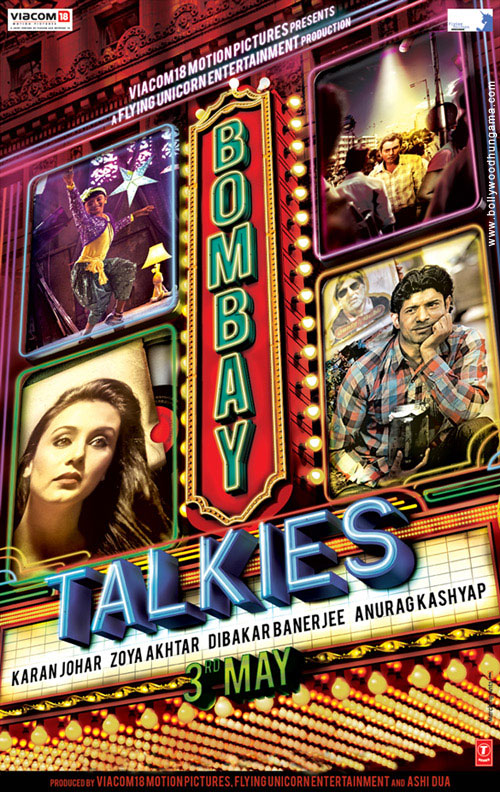
Bombay Talkies sounded like an odd but potentially brilliant project. Four directors, four stories with the only connection being an homage to the Indian film industry. And I liked it a lot. Not all the stories are equally strong but they each have something that has stuck with me since seeing the film last week.

Continue reading