Julayi

Trivikram films tend to focus as much on the dialogue as on the action, so it was inevitable that I missed the comedy that had the rest of the audience laughing and cheering through most of Julayi. Not that it really mattered. There was still plenty of great dancing, excellent action scenes, ample screen time for my favourite actor Allu Arjun, and a relatively easy to follow (if somewhat unbelievable) plot giving another enjoyable ‘adventure without subtitles’.

Ravi (Allu Arjun) starts as many a Telugu hero seems to do, by having an argument with his father (Tanikella Bharani in his customary role). Taking a cue from Chiru’s ‘money is easy to make’ speech from Challenge on a TV in the background, the argument seems to be based around Ravi’s lack of commitment to the conventional way to earn a living and ends with Ravi heading out to a gambling club. Since it’s raining heavily he cadges a lift, which just happens to be with a gang on their way to rob a bank. Because stopping to give someone a lift on the way to commit a major crime doesn’t seem like a risky thing to do at all – right?

Luckily for Ravi they seem happy to drop him off on a corner but that is their first big mistake. Ravi has awesome intuition, amazing powers of observation and a seemingly photographic memory and is able to lead the police to the site of the bank theft in time to partially foil the robbers’ escape. Head gangster Bittu (Sonu Sood) has already decimated his own gang, presumably to ensure a larger slice of the money, and Ravi helps lower the number still further by taking out one of Bittu’s trusted gang members (Shafi in a very brief appearance). This seems to spell war between the two, although the apparent destruction of the money and ensuring that Bittu is arrested and his plan foiled are also key contenders for the ensuing rivalry between Bittu and Ravi.

The bank heist is an odd mixture of some excellent ideas, such as the smooth way the robbers disable the cameras as they move through the building, and some gaping plot holes which just don’t make sense. This lack of logic reoccurs throughout the film where there is never any explanation for Ravi’s astounding ability to apparently read Bittu’s mind and predict how, where and when he will strike next. The police are also very ready to fall in with Ravi’s plans and have no objections any time he kills one of the gang. I was almost expecting that Ravi would be revealed as some sort of super-agent which might have explained the nonchalance towards his ever increasing body count and the willingness of everyone to follow his lead. But no, nothing quite so logical is allowed to intrude into the plot, or at least not that I could understand.

Sonu Sood is his usual impressive self as the villain Bittu, although he has a tendency to start cold and menacing but then over-do it just a tad and become almost comic. He too has amazing powers since he is able to interpret the sign language of his deaf henchwoman without even looking at what she is signing. It’s a talent she seems to share since she rarely looks at his replies either but at least she has better survival skills than the rest of the gang. To add some further complications, Bittu is collaborating with local MLA Kota Srinivasa Rao, who’s done some dodgy deal to cheat his investors and seems to be in it for the money. It’s the same crooked statesman role that Kota plays so well that now I don’t ever expect to see him without there being some dodgy deal involved.

The action moves to Hyderabad when Ravi is sent to ACP Sitaram (Rajendra Prasad) as part of a witness protection scheme. Ravi falls in love with a girl he sees at the bus-stop which results in a succession of songs, in fact almost the entire soundtrack one after the other, as Ravi attempts to win Madhu’s heart. Ileana started off well as Madhu and I liked her glasses and general look, but after Ravi takes her shopping and persuades her into contact lenses and Western clothes she just looks too thin and out of proportion. Although none of her outfits are terrible, the majority aren’t very flattering either and the curse of the Telugu film shoe designer strikes once again with a terrible pair of black boots.

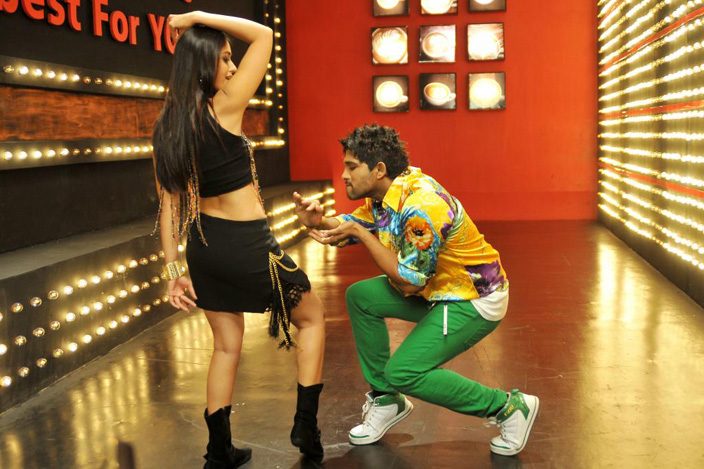
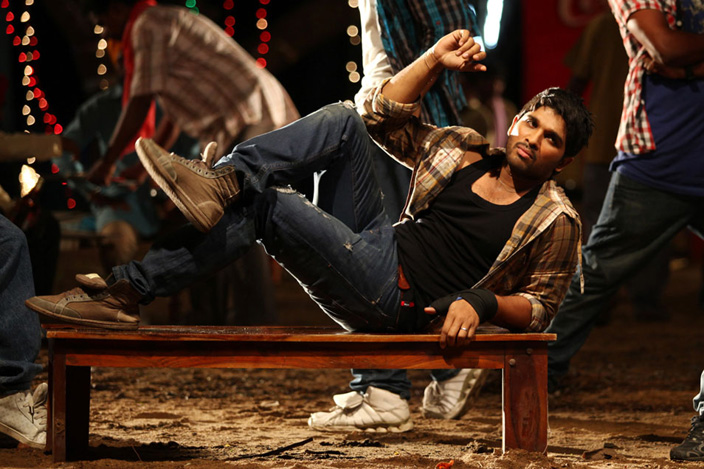
Bunny and Ileana have very little chemistry together and although there are some better moments in the songs, the romance never really takes off. The songs by Devi Sri Prasad are mainly pictured on Bunny who is energetic and wonderful to watch in better than usual choreography. For a change there are no special ‘feature moves’ – no sign of ‘the worm’ – and Bunny is given free rein to do what he does so well and just dance.  He also shows commitment to shiny multicoloured shirts which I did appreciate.
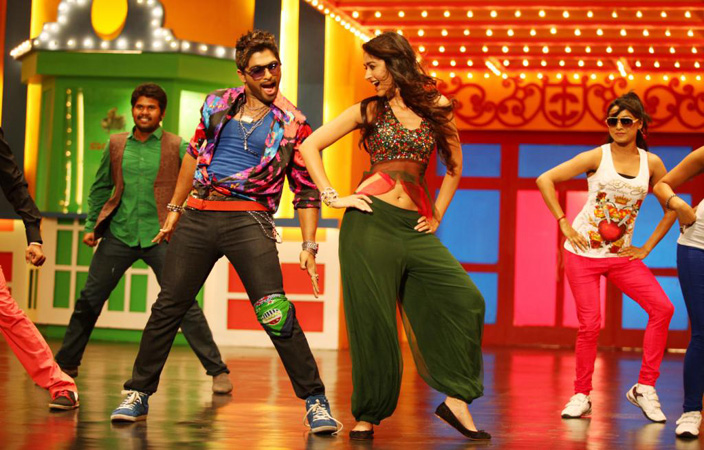
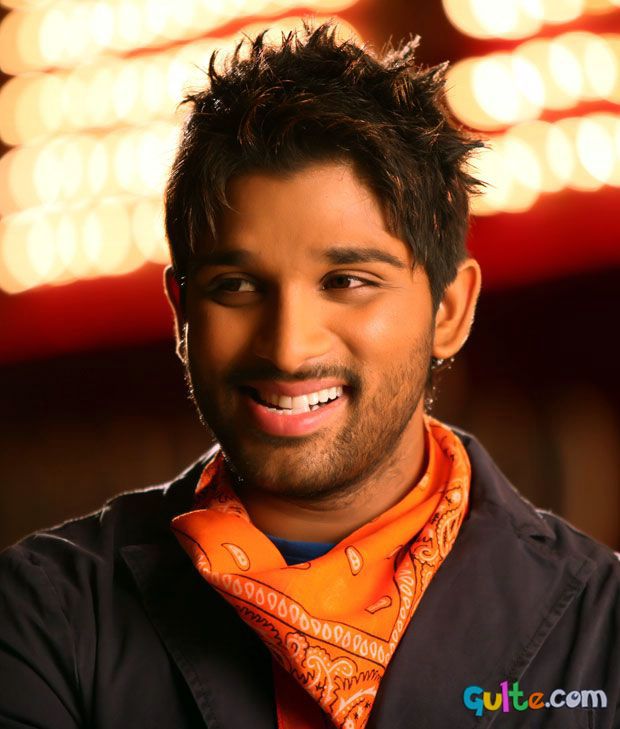
Every single possible comedy uncle turns up but thankfully their comedy is well integrated into the main plot and kept to a minimum. Trivikram seems to use most of the humour in snappy dialogues between  Bunny and Rajendra Prasad which were well appreciated by the audience. There is plenty of ‘action’ Bunny but a lot more ‘funny’ Bunny and both Allu Arjun and Rajendra Prasad work well together in these scenes. In fact the only major fail is Bunny’s hair which varies from OK in the frequent rain scenes (because it is flat and plastered to his head!) to really quite terrible with spikes at the back and flattened matting at the front. There is no hair continuity either and it becomes quite a distraction in a number of scenes as the number and position of the spikes varies – or perhaps I’m just becoming a little too obsessed. There is also the matter of his coloured contact lenses, but I’ll leave that rant for another time!
The film does look great, with some good use of locations in Dubai and reasonable special effects. The sets are also well dressed although Temple and I did have a discussion about the large assortment of really ugly ornaments that appeared on every desk. But there was commitment to family photographs and I did like the large picture of Michael Jackson in Ravi’s room. I liked the soundtrack before I saw the film and although it doesn’t sound too different from previous DSP soundtracks the music fits in with the general feel of the film. The songs could have been better paced though as there did seem to be a lot in the first half – not that I’m really complaining as watching Bunny dance is always worthwhile.

Julayi has plenty of action and strong performances from most of the cast which helps keep attention away from all the plot holes. Its slick and well filmed to make the most of Peter Hein’s excellently choreographed fight scenes. Definitely worth catching on the big screen if you can although I think this is a film that I will appreciate more with subtitles. Hopefully this doesn’t disappear into the same DVD black hole as Khaaleja and we do see a DVD release soon.
Vijetha

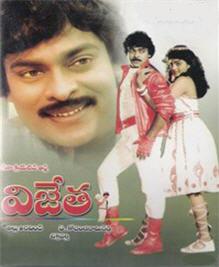
Just to whet everyone’s appetite for the Mega Birthday celebrations and get the party started, Vijetha is  more than just another cheesy masala film from the eighties. In reading about this film on imdb I discovered that Vijetha was just one of the eight films Chiranjeevi released in 1985. I think that this is an amazing number of film releases, but more so when you consider he had even more films released the preceding year, and just as many the following year. Thankfully this means that there are just so many more Chiru films to watch!

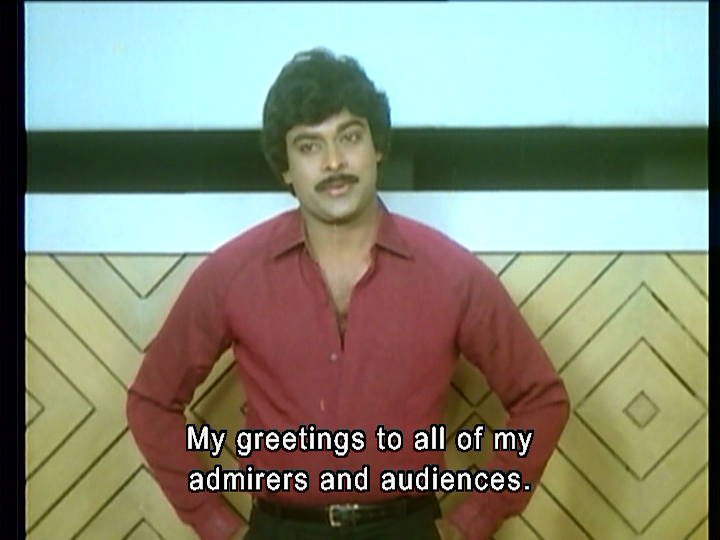
Chiranjeevi won his third Filmfare award for his performance in Vijetha and it’s a departure from his more usual action film. In fact, the movie opens with a message from Chiranjeevi to his fans explaining that the story is about a ‘boy next door’ character rather than an action hero, and it makes a great introduction to the story.

Vijetha tells the story of Madhusudhan Rao (Chiranjeevi), commonly known as Chinnababu, and his rather close-knit, but at times acrimonious family. With the death of his close friend, Chinnababu’s father Narasimham (Somayajulu J. V.) realises that the squabbling which occurs at the funeral may also happen at his own death. He decides to try to finalise the marriage of his youngest daughter Lakshmi as soon as possible, and to that end arranges a marriage with Sri Rangarao’s son Mohan, a doctor in Chicago. Mohan is planning to marry quickly and head back to the USA and it seems like an ideal match for Lakshmi considering her father’s wishes. The problem however, is that Narasimham cannot afford the required dowry, and so he appeals to his sons for help. But apart from his eldest son’s wife Saraswathi, the others are all disinclined to give any money for a marriage which they don’t see as being as important to them as their own comforts. There is much talk of duty and responsibilities but in the end Narasimham sees no other choice but to sell the family home. Finally after various attempts by the brothers to get the house for themselves, Chinnababu manages to save the day by taking a rather unusual and fairly drastic step to get the required funds and ensures his sister’s marriage goes ahead.

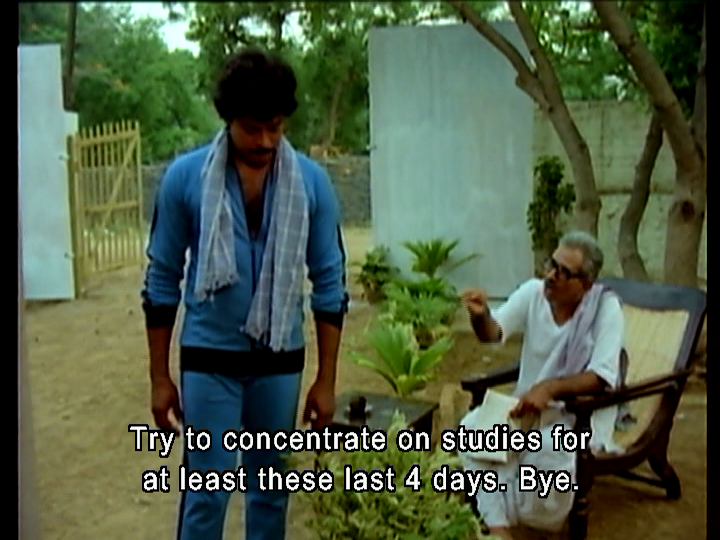
The film feels more like a modern-day soap-opera at times as it focuses on the interactions between the different family members and day-to-day life. Chinnababu is a student and aspiring football star, although his father despairs of him ever getting a job as he prefers playing his sport to studying. His eldest brother’s wife Saraswathi has practically raised both Chinnababu and his sister Lakshmi, and she keeps the peace between father and son. Although he’s perhaps a little deficient in studying, in other ways Chinnababu is a dutiful son – running errands for the other members of the family and supporting his father as much as possible.

Chiranjeevi does an excellent job of capturing the good-hearted if slightly naïve character of Chinnababu and does manage to portray a more normal slice of life rather than his more usual ‘over the top’ heroics. Although we do get some of those as well when Chinnababu comes to the rescue of Priyadarshini and her friends when they are harassed by some youths, and later on when a gang of thugs attempt to rob him. Bhanupriya plays the love interest Priyadarshini and in another departure from the norm, she stalks Chinnababu rather than the other way around. She lies in wait for him, goes to his football practice and is generally irritating in her shrill and persistent attempts to get his notice. In fact Priyadarshini’s character is incredibly annoying in the first part of the film, and the first time I actually liked her was when she encouraged Chinnababu to play football with the thugs (using them as the football) rather than trying to negotiate with them. Chinnababu initially has little time for her and seems appalled when she moves in to the neighbourhood.  However it turns out that a song with some strategically placed cutouts and a large number of cushions is the way to his heart – who knew it would be that simple?

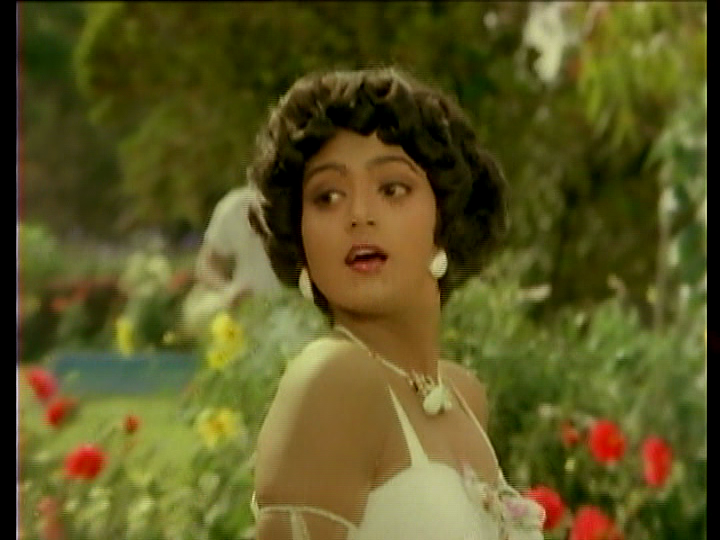
After this, Chinnababu seems to be resigned to his fate (maybe it was the gold pants that did it) and Priyadarshini becomes much more tolerable once she finally has Chinnababu’s attention. Bhanupriya is lovely despite some of her very questionable outfits, and she can at least match Chiranjeevi’s dancing. She must have really annoyed someone in wardrobe though as she has a particularly bad selection of wigs to wear too!

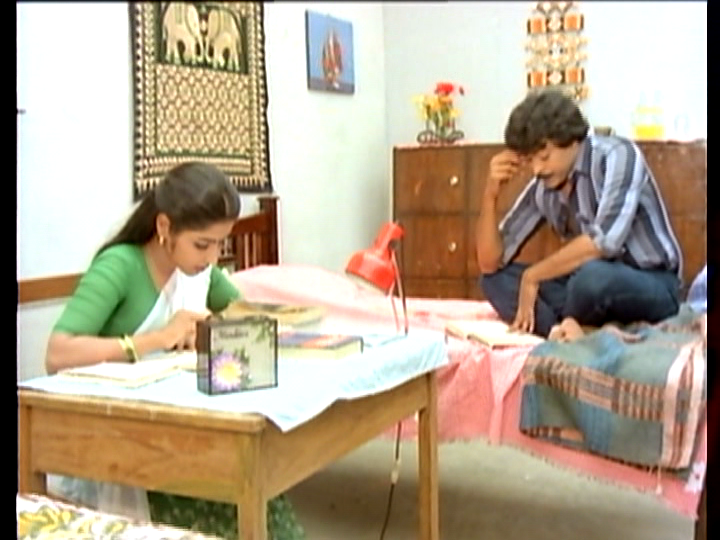
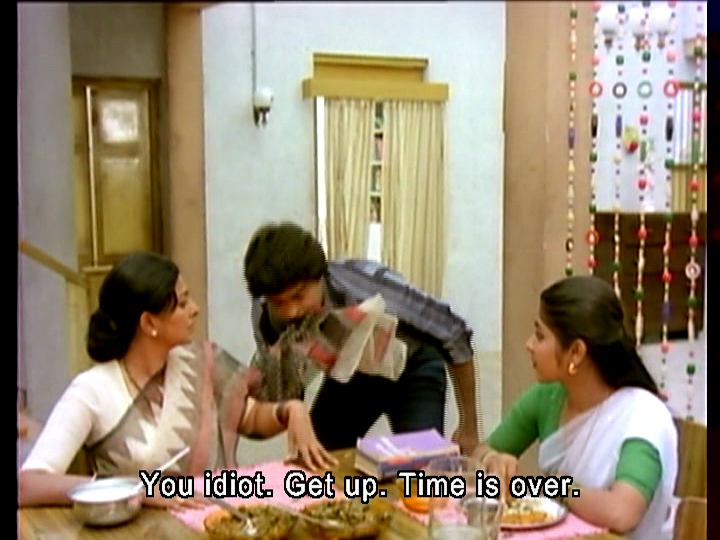
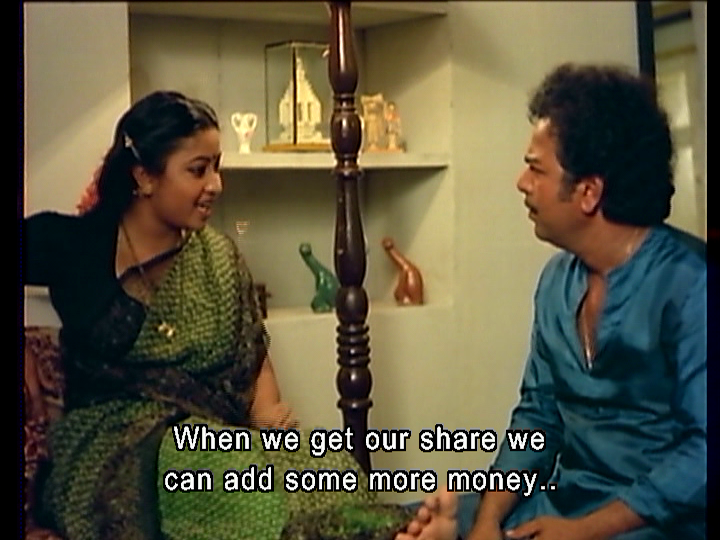
Sharada plays the eldest wife Saraswathi with real grace and poise. Her character works very well as the peacekeeper in the family and her level headedness is very much needed as everyone gangs up on Chinnababu as the only non-worker in the family. There is a classic moment early on in the film where Chinnababu uses her sari to wipe his mouth, and it just goes to show how much she thinks of him as she doesn’t react at all! I also love the set dressing in the film which adds to the ‘family at home’ atmosphere. There are plenty of ornaments, great pictures on the walls and even a medical model later in the film.  I would love to know what the brown and green ornaments behind the couple here are supposed to represent.

The three brothers show different but equally selfish characteristics and are ably aided and abetted by their various wives. The eldest brother (Ranganath) seems to be far removed from the petty squabbles of his siblings and is able to ignore the pleas of his father despite his wife’s more charitable views. The other two brothers are totally ruled by their wives who are wonderfully self-centred and money grabbing. Most of the comedy comes from their antics although veteran comedic actor Allu Ramalingaiah also turns up as a taxi driver who has some humorous dealings with second son and lawyer Narayana Rao (Nutan Prasad). Allu Arvind was the producer for Vijetha and it seems as if he got the whole family involved since his eldest son Bobby is credited as playing the son of Narayana Rao. There seems to be some confusion in some reviews as this film also marks Allu Arjun’s screen debut, but since he was only 2 years old in 1985 I think he actually appears as married sister Shanti’s son. The confusion is likely because of the very stylish sunglasses worn by Bobby below which do seem to be something Bunny would be likely to wear.

The film leans heavily towards family duty and respect but despite these heavy topics it doesn’t drag and keeps a light-hearted tone until near the end. Even then the self-sacrifice of Chinnababu isn’t dwelt on overly much and there is an appropriately happy ending. Director A. Kodandarami Reddy keeps a light touch and stops the film descending into too much sentimentality.  The best parts of the film are the songs by K. Chakravarthy and as ever Chiranjeevi is excellent in a seemingly never ending array of tight lycra outfits. This is my favourite and it seems to serve no other purpose other than letting Chiru strut his stuff – I totally approve!

Although the themes in Vijetha are of duty, responsibility and self-sacrifice, it’s still a fun watch and if nothing else there is the chance to see Chiru in shorts playing football. Some great songs and a very heart-felt performance from Chiranjeevi make it well worth the lack of fast paced action. 3 1/2 stars (it would have been more but Priyadarshini is just too annoying!)

Temple says:

I don’t quite see the opening statement quite the same way Heather did. To me it’s not so much that Chiru is playing a boy next door, as lots of his hero roles are those boys at heart, but he is playing a guy who struggles to assert himself and isn’t really a success at anything despite his potential. I think it is that perceived weakness that Chiru wanted his fans to identify with, and he challenged his detractors who may have thought he was a one trick pony. Mind you, Chinna is heroic in his own way. The short shorts and long socks is a difficult look, especially in yellow which I find is an unforgiving colour, but he manages.

There is some nice social observation tucked in amongst the fluffy filmi fun. This is a family where women have started to work outside the home and their behaviour towards Saraswati is quite masculine in some respects. The father is challenged by his children who have an overwhelming sense of entitlement. Work is hard to come by for the academically average, but class barriers also get in the way – Chinna wasn’t allowed to work as a peon in his brother’s office because it would look bad. Chinna is the product of Saraswati’s intelligent and emotionally supportive upbringing and his father’s strong morality. There is a lot of affection in the family – the father loves Chinna, and had a great time sneaking in to see him play a big match, but the pressure is on to see everyone settled in his lifetime. The question is when do offspring have to take up some family responsibility. It’s similar to, but much less dreary and vomit inducing than, Baghban (one of my most hated films) as the family starts to tear itself apart over money. And nicely symbolic as Chinna and his dad unwittingly compete with each other to save the family finances.

I don’t mind Bhanupriya’s character. Priya is supposed to be a ‘modern’ (i.e. badly dressed, persistent and opportunistic) girl who goes for what she wants. I think her attempts to win Chinna and impress his family are not as funny as they are meant to be, but generally played for laughs and she has good rapport with Chiru. Chinna has the closest relationship with the females in the family, there are lovely scenes as they discuss their hopes and fears together, and Chiranjeevi played Chinna in a natural and low key style. He had a few masala breakouts which I enjoyed immensely, and his flair for comedy is evident. I was so delighted when I recognised the Six O’clock song as I could enjoy it with better dancing (and outfits) and without the accompanying fear of Anil Kapoor from the Hindi version.

As romantic musical sports themed family dramas go, this is one of my favourites. 3 ½ stars.

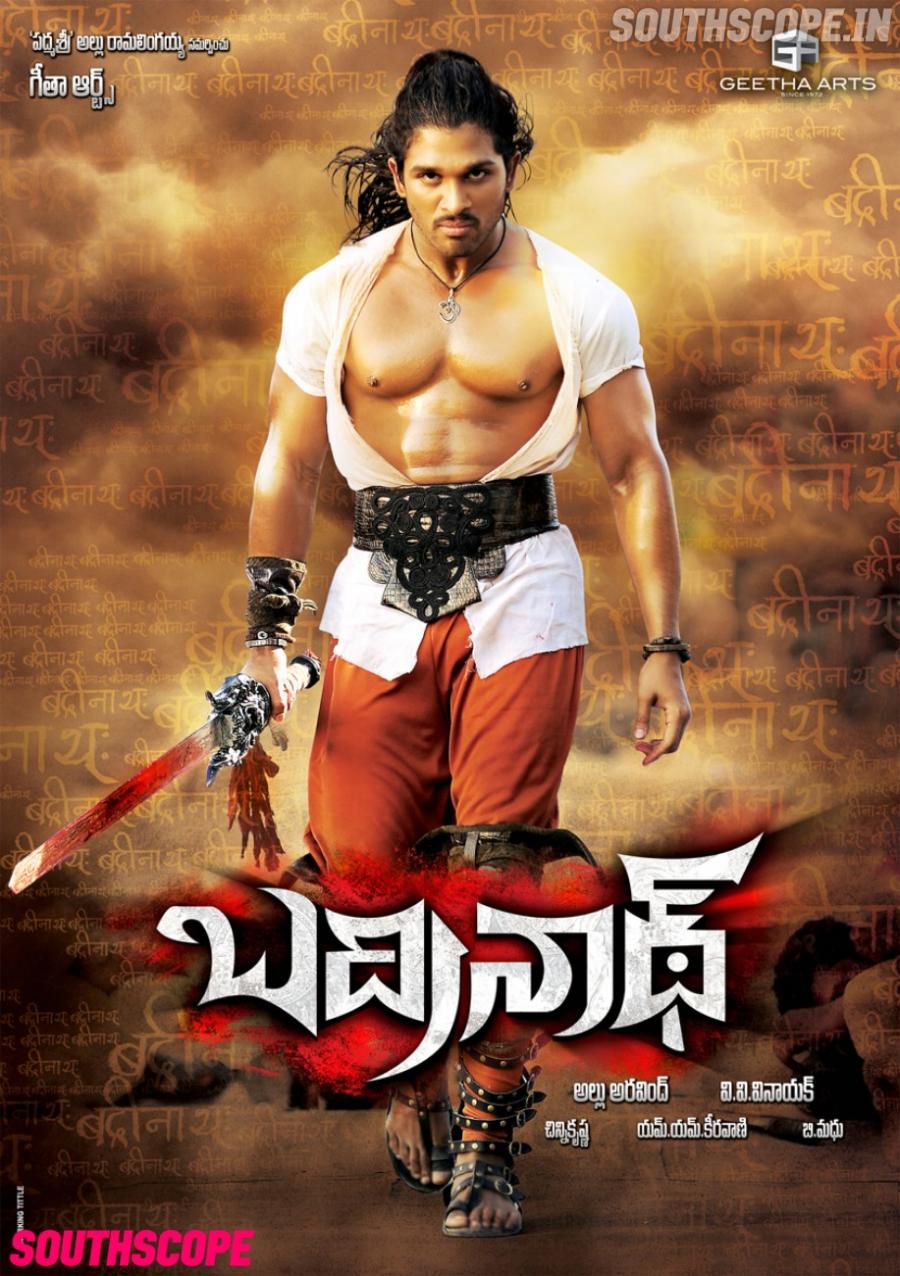
Badrinath

The great thing about an Adventure without Subtitles when Allu Arjun stars is knowing that no matter what, the dancing will be awesome.  But there is so much more to enjoy in Badrinath, and we had a great time.

The plot, for what it’s worth, can be summed up as follows. Prakash Raj is a guru who trains young boys to defend temples in the major holy cities of India. His school is located high in the mountains, and the scenery and the sets are nothing short of spectacular. Allu Arjun is Badri, who is assigned to protect Badrinath. Badri has a special relationship with the place, amazing sword and fighting skills, a strong faith in god and his guru, and is earmarked to take over the training camp. Tamanna is Alaknanda, a very pretty atheist who lost her faith after seeing her parents accidentally catch fire and die at a pooja. Badri and Alaknanda eventually fall in love, then the bad guys turn up to kidnap her. Will Badri desert his post, anger his guru and rescue his love? So much drama!

This is a vehicle for Bunny and, as expected, he excels in the dancing and fighting scenes. We had questioned the efficacy of an Indian Samurai when pitted against men with guns, but that question was put to rest. You need arms attached to your body to pull a trigger. Swords win! The fight scenes were cool, and it looked like someone may have been inspired by games where each set of bad guys has a particular set of weapons. So once the guys with sickles are defeated, the next batch has axes and so on. It isn’t all gore and anger though; there is room for what our friend calls Funny Bunny and he is joyful in the dances. He does an excellent wet shirt, and even wears a Chiranjeevi inspired silver cape in one song! This pleased us greatly.

Tamanna is a beautiful girl, and she can act and dance. She more or less keeps up with Bunny, and her facial expressions when she dances are great. Alaknanda is rarely more than a sketch, a pretty face on the sidelines, and sadly it seems that she discovers faith and love only after Badri slaps her. She also discovers more appropriate clothing. (And she had been spectacularly rude and stupid in the lead up to the slap). There is a fun moment when she keeps pretending to slip so she can fling herself on Badri’s manly chest and cop a feel. That seemed perfectly sensible so we decided we liked her a lot. Her subplot involving abduction by evil relatives and an attempt at forcing her to marry could have been cut back without diminishing the idea of the damsel in distress. Tamanna was very good in 100% Love, and lovely in Badrinath, so we hope more substantial roles come her way.

Alaknanda had the best imagination. Most of the songs were her dreams and she spared no effort in dressing Bunny up and giving every single backing dancer the most amazing outfits as well.

On the subject of wardrobe, this is what Badri wore as his going into town outfit so there are arguments for and against him choosing his own clothes.

Prakash Raj is excellent as the guru. He gets to do pretend martial artsy stuff, levitate, growl at people and also use his misty eyes of love. His character is the cause of Badri’s conflict as he demands the young man be sworn in as his replacement, and thus swear off marriage and women. He probably should have thought that through a bit more.  But we could rely on him to do the right thing when it counted and all was well between the master and disciple.

The Comedy Sideplot was over represented by MS Narayana, Venu Madhav , Master Bharath and Brahmi among others. Too many! And took up at least 30 minutes that could have been condensed or cut. Brahmi was fun, and the crowd went wild for him, but it was basically the same fleecing the pilgrims shtick he did in Indra. We guess that was a deliberate reference. The supporting cast was full of familiar faces, all of whom do the thing they do so well. We think the Allu family pug made an appearance too so if Ice’s agent is reading this, please confirm? But in an unsubtitled film we tend not to give the support artists their full dues as we have to concentrate on the main action. And yes, there were compelling visuals adding to the distractions. We totally appreciated the backing dancers for their enthusiasm, their dancing and the way they rocked the purple and gold glittery outfits.

We did have to notice the evil family as they showed dedication to the bulk purchase of coloured contact lenses, and the matriarch wore some excellent saris.

The evil henchmen deserve a shout out. From the Pick n Mix Assorted Terrorist Stereotype Brigade to the Ninjas in Hoodies, they gave it their best, and Peter Hein and team really made them work for their money. He knows how to make chaos look elegant.

There are massive plot holes, but they aren’t an impediment to enjoying the story. There is no pretence at realism so questions of why there are never any police around or how Badri could survive the latest incident just didn’t matter. We were far more interested in why people wore some of the crazy outfits. The soundtrack is effective and enjoyable, and the songs are well placed. How well they stand up without the supporting visuals is another question.

This is an out and out entertainer that succeeds, and the audience last night certainly enjoyed it. The balance of action and ridiculous stunts with beautiful visuals and fantastic dancing is just about right. See it on a big screen if you can!