Kasturi Nivasa

Kasturi_Nivasa

I keep an eye out for any early Dr Rajkumar films with subtitles, and was lucky enough to find this 1971 classic on DVD. It’s a simple story, but one that’s beautifully told with mesmerising performances from the main leads. The film was written and directed by Dorairaj and Bhagawan, who were also responsible for the excellent CID 999 films, Operation Jackpot Nalli and Operation Diamond Racket, also with Dr Rajkumar. Although quite dissimilar in terms of content, Kasturi Nivasa has the same attention to detail as these movies, with creative cinematography and memorable songs and music from G.K. Venkatesh. The film was re-released in colour in 2014 and is available (but without subtitles) on YouTube in both versions.

Kasturi Nivasa is the ancestral home of Ravi Varma (Rajkumar), an industrialist who runs a successful match factory. Ravi is a widower whose only daughter also died in an accident, which has left him alone in the large house except for his servant Ramaiah (K.S. Ashwath). At the factory, Ravi notices new employee Chandru (Rajashankar) because he doesn’t laugh at Ravi’s jokes. Appreciating his honesty, Ravi makes Chandru the Chief Foreman and decides to send him to America for further training. But Chandru is also a widower and has a young daughter, so he is reluctant to make the trip and leave Rani behind. However, Chandru’s situation is so similar to Ravi’s that he offers to look after Rani until Chandru returns.

The early part of the film sets up the character of Ravi as a rich but philanthropic businessman. He has inherited wealth and knows that his place in society is to function as a role model while also helping others who are less fortunate. Ravi is very aware of his lofty status but attempts to bridge the gap between himself and his workers by telling jokes and by generally treating them well, although he still seems himself as being of a higher class than his workers. In contrast Bhojarajaiah (Balakrishna) is a terrible owner and suffers financial loss due to his poor treatment of his workers. While that sounds potentially revolutionary and egalitarian, Balakrishna forms part of the comedy track, so his loss of money and face is more about his poor attitude rather than any real concern about workers’ rights – although to be fair, at least there is acknowledgement that everyone deserves a living wage.

Bhojarajaiah also tries to set Ravi up with his daughter Prabhu, but she prefers Bhojarajaiah’s brother-in-law Sampath (Narasimharaju) and the various contortions the couple go through to avoid Bhojarajaiah make up the rest of the comedy track. While Balakrishna and Narasimharaju are acknowledged comedic actors, their performances here seem somewhat flat in comparison to other films I’ve seen, while the comedy track doesn’t fit well with the rest of the narrative. I’m guessing that it was added because there ‘has’ to be a comedy track, since otherwise there seems to be added value to the characters of Bhojarajaiah and Sampath.

Ravi looks after Rani and recruits his secretary Neela (Jayanthi) to be a substitute mother for the little girl. (My subtitles say Leela, but Ravi seems to be saying Neela which is the name given on most character lists that I’ve seen.) The child actress here is excellent and very sweet, although she’s a fair way towards being spoiled given that Ravi caters to her every whim. Neela too sets Rani up as the sole purpose for her existence, so it’s hardly surprising that Rani throws tantrums when she doesn’t get what she wishes. When Chandru comes back, Rani is so used to Neela as her mother that she insists Chandru and Neela sleep with her together in their bed. This leads to Neela and Chandru getting married, which devastates Ravi as he was in love with Neela, but never actually approached her about his feelings.

Things continue to go wrong for Ravi as he loses business when Chandru starts up his own factory using more modern manufacturing methods. As Ravi’s situation deteriorates further, Chandru buys Kasturi Nivasa and to his credit tries to help his former boss. However, Ravi’s pride leads him to refuse all offers of help, which in turn seriously affects Neela who still has feelings for her ‘boss’. Jayanthi looks stunning and she does a fantastic job of portraying Neela’s conflicting emotions and loyalties as she is torn between her former employer and her husband. The situation leads to problems between Chandru and Neela, and eventually Ravi succumbs to a suitably dramatic and tragic end, symbolising the end of an era.

Dr Rajkumar is simply wonderful here and imbues his character with dignity and charm that suits his rather old-fashioned persona. Ravi is wealthy and generous, seeing himself as a benefactor for the poor and as someone who upholds traditional values. Chandru in contrast is more modern and practical, and Rajashankar plays him as intelligent and hard-working but impatient with the old order. Chandru is the one who sees the potential in upgrading the factory and on moving with the times, ending up successful as a result of his own hard work. Both actors excel in their roles and work well together to accentuate these differences which lie at the heart of the story. Ravi is old money and the class system, Chandru is equality and success based on personal achievement. Kasturi Nivasa then is a lament for the old order, for rich landlords who looked after their poor tenants and for an opulent lifestyle that few can continue to afford. It charts the rise of the new order– modern manufacturing techniques, the loss of a class divide as workers rise up to become equal with their former bosses, but with an associated loss of morals, seen here by Chandru’s addiction to alcohol and his violent behaviour.

What I find most interesting here is the large amount of symbolism used throughout to convey the message. The way Ravi and Chandru are contrasted with each other is also cleverly done to enhance the story. Both men run match factories and believe in treating their workers well, but while Ravi sells Dove matches, Chandru has branded his product with an Eagle, presumably to signify his more aggressive nature. As Chandru comes up in the world he starts wearing suits like Ravi, while Ravi wears the same suit for long enough that it starts to develop visible holes. The transfer of power is seen by their appearance as well as by the changes in the living standards of the two men, but it’s also interesting how they are both affected by having money and prestige. Dorairaj and Bhagawan seem to be suggesting that you need to be born with money to know how to use it properly – wealth corrupts those who come into money later in life.

The songs too continue the symbolism, particularly this one about a doll that always gets back up and cannot be knocked down. Sadly for Ravi, although this may have been his philosophy, he appeared to be getting less able to get back up again after each successive set-back

Kasturi Nivasa is deservedly called a classic, with stirring dialogue and the captivating and powerful combination of Rajkumar, Rajashankar and Jayanthi. G.K. Venkatesh’s songs are wonderful and beautifully pictured, while there is a socially important message underlying the excellent screenplay. Although I watched the black and white version, the richness of the house comes thought well, and the contrast between Kasturi Nivasa and Chandru’s house is perfectly set out. Although the concepts addressed here are rather dated and some of the beliefs now seem quaint and old-fashioned, there is still a powerful message here, and regardless of the date, the film has an ageless quality due in part to the spellbinding performance from Dr Rajkumar. Highly recommended, this is one of those films that should be on everyone’s checklist – 5 stars.
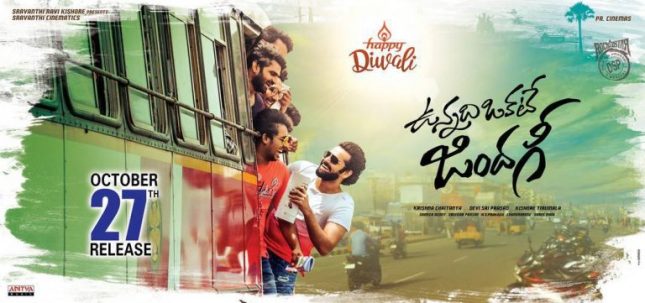
Vunnadhi Okate Zindagi (2017)

Vunnadhi Okate Zindagi

Vunnadhi Okate Zindagi is a film about friendship that starts off well but unfortunately falls apart in the second half. Anupama Parameswaran is excellent as the love interest for both Abhi (Ram Pothineni) and Vasu (Sree Vishnu), but as soon as she disappears the film loses its way and heads deep into cliché territory before finally backtracking and ruining the most interesting development from the first half. The story starts with a good idea, but there’s simply not enough depth for a full 2 ½ hours of screenplay and by the time the film ends, the story has been stretched so thin, there are holes all over the place. The actors are good, the songs and dance sequences enjoyable and the scenery spectacular, but without any real substance to the story, Vunnadhi Okate Zindagi sadly doesn’t make a lasting impression.

The bromance here is between Abhi (Ram Pothineni) and Vasu (Sree Vishnu), and for the most part their relationship is dealt with well, although the final conclusion does appear rather more artificial and forced. Abhi and Vasu are both likeable characters and their friendship has a solid basis, starting from their time together in school. A young Vasu is able to break through Abhi’s misery on the anniversary of his mother’s death and as a result the two friends become inseparable despite the difference in their social status. They remain friends throughout college although the group broadens to include Sathish (Priyadarshi Pulikonda), Kishore (Kireeti Damaraju) and Sai. But by the time Sathish, Kishore and Sai are getting together to discuss Kishore’s wedding, Abhi and Vasu are nowhere to be seen. Abhi has been missing for 4 years and the friends haven’t spoken to Vasu for 2 years, so naturally there is a flashback sequence to see where it all went wrong.

It turns out that Abhi and Vasu both fell in love with the same girl, aspiring doctor Maha (Anupama Parameshwaran). Initially they approach this problem with the same levelheadedness they have shown all along and come up with a plan to let Maha know how they both feel – and then leave it up to her to decide. This seems a radical departure for a Telugu film, where female characters rarely seem to be allowed a mind of their own, but Kishore Tirumala allows Maha to have an opinion and make a choice based on what she knows about the two men.

Abhi has stayed in Vizag after college and spends his time playing guitar with his band and chilling with friends. He’s relaxed and fairly carefree while waiting for the results of his final exams which is a total contrast to Maha. She’s driven to succeed by her parents expectations and is completing her medical degree because it is what they expect her to do. What she really wants to do is sing, and since Abhi plays in a band what could be simpler than the two getting together?  At the same time, Vasu has gone back to his family who are friends with Maha’s parents. When Vasu meets and falls in love with Maha, it seems to be the perfect match for the two families, and even Maha seems fairly happy with the prospect.

Up to this point the film is good, if perhaps a little slow. And I liked the idea that the girl would get to choose, without any undue influence from either the two guys, their families or even her friends. But it’s after Maha makes her choice and Abhi and Vasu part company that the story starts to fizzle.

The second half sees the introduction of Maggie (Lavanya Tripathi) a ditzy and completely inept wedding planner. It’s amazing that she’s managed to get the guests together and book a venue given her financial woes, tendency to get drunk and general unawareness of what is going on. I think Maggie was supposed to be ‘fun’ and ‘modern’ to make her a contrast to Maha, but she’s simply not either of these, and ends up as a clichéd filmi airhead. This characterisation is incredibly frustrating after Kishore Tirumala starts with better realised characters and a more mature approach with Abhi, Vasu and Maha. It’s literally teeth gritting stuff to watch Maggie lurch from manufactured disaster to contrived mistake while her employee helpfully points out where she’s going wrong. The stand-off between Abhi and Vasu also veers more into rather more immature territory, but that is more plausible, since many quarrels do appear ridiculous and childish from the outside.

Ram is good as Abhi, although not even he can really make a man-band look appealing! Ram looks considerably younger in the second half when he sheds his heavy beard, but otherwise the somewhat subdued rock-star look suits him well. I like Abhi’s casual approach to life and his relaxed attitude combined with a genuinely caring persona, which makes for an interesting romance between Abhi and Maha. Ram and Anupama have good chemistry together too, and the romance, although slow to develop does feel genuine. Sree Vishnu is also good as the more serious of the two friends, although sensible Vasu really only appears once the friends have finished college. His character does work better earlier in the film when Vasu is less reserved and but overall the friendship is a believable relationship, and there is a genuine warmth between Abhi and Vasu. Sree does fade more into the background in the second half, but in compensation the other friends get more screen time which provides some desperately needed relief from the irritating Maggie! Lavanya Tripathi doesn’t get much chance to be anything other than annoying, but Anupama Parameswaran is lovely as Maha and does a good job at portraying the two quite different relationships.

The music from Devi Dri Prasad works well in the film, and the songs are well pictured with some excellent choreography, but the real stand-out is the excellent cinematography. Sameer Reddy beautifully captures the seascapes of Vizag and the lush scenery of Ooty which provide the main backdrops for the action.

Vunnadhi Okate Zindagi is the story of a reasonable and pleasant friendship between two reasonable and pleasant men that hits a few snags but is ultimately resolved in a reasonable and pleasant way. Despite the theme of conflict between best buddies, there is no real angst here which may be part of the problem, particularly as the film ends up drifting along to the inevitable conclusion. Good characters and an interesting idea are one thing, but Kishore Tirumala needed a sharper screenplay and a better way for his characters to solve their problems than a ditzy wedding planner. The friendship portrayed by Ram and Sree makes this one worth watching but be prepared for the irritating second half.

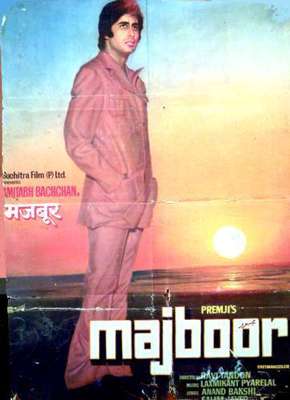
Majboor (1974)

I watched this after reading Anu’s review, and am so glad I did. Majboor is a low key thriller, and apart from a couple of minor missteps, is both suspenseful and makes sense.

Ravi Khanna (Amitabh Bachchan) is a smart young man, working as a travel agent. One rainy night he deals with his last client Mr Surendra Sinha (Rehman), and accepts a lift from the man as there are no taxis around. Some time later the police (Iftekhar and Jagdish Rai) come to interview him as Mr Sinha was abducted that night, and found dead in a gutter. Ravi is innocent, but nervous as the police are taking a keen interest in him as the last known person to see Sinha. The stress seems to be triggering severe headaches, and he goes to the doctor. The diagnosis is far more serious than tension. Ravi has a brain tumour that must be removed. But the doctor scares him with a range of possible outcomes from paralysis to blindness or maybe being right as rain so he leaves without making a decision. Ravi has a widowed mother (Sulochana), a sister in a wheelchair (Farida Jalal), and little brother Billoo (Master Alankar). He is the sole provider and can’t contemplate a life where he becomes a dependant. Believing he is probably going to die either from the tumour or the surgery, he hatches a scheme to frame himself as the killer and collect the reward money for his family. But once in prison, he faints again and is taken to the hospital and operated on. He has a perfect recovery and then has to deal with the other death sentence. Ravi regrets his choice now he can live, and he escapes to go in search of the real killer.

Amitabh is perfectly cast. Ravi is educated, has a decent job, takes good care of his Ma and siblings, likes a lairy outfit or two, and has a pretty and very modern girlfriend in Neela (Parveen Babi). When Ravi is first questioned about the dead man he seems collected, but later goes to see his friend who is a lawyer. He knows how things can turn out when the police start paying attention to a person. When the headaches kick in, Amitabh does some excellent faces (see a small selection here).

Generally he plays Ravi as a down to earth guy with no superhero stuff. At least, not until the final scenes where Ravi is out for justice. When he realises he has escaped one death sentence but still has another looming he acts decisively and within the realms of what he can reasonably achieve. I liked his problem solving approach which was to ask questions and think about the answers, using force when needed but not at all if he could just look tall and threatening. Amitabh adds some little reactions and expressions that show Ravi can be spiteful or calculating too, and he really made the character feel solid and believable. Except for his bright red suede “on the run” outfit. What was Ravi thinking?

Parveen Babi got very little to do, and lots of spare hair to carry around while she did it. The 70s presented a few fashion challenges and I can’t say I like the micro-ruffled vesty thing she had to wear, nor the ear-blocking flowers. Neela was supportive of Ravi and he involved her in his plans in the same way luggage can be considered part of a trip. The film would be no worse off if her role hadn’t been written which is sad. And in the final scenes I had to wonder why Ravi left Neela to hold the fort when it would have made so much more sense for him to stay and her to go. Or you know, both of them tie the bad guy up. Anyway. As you can see, I haven’t much to say about Neela.

As Ravi investigates a significant ring that could lead back to the killer, he has some lucky breaks and benefits from his own logical procedural thinking. One very lucky break for him, and for the audience, is the arrival of Michael (Pran!). Michael is a thief, fencing his wares through Prakash (Mac Mohan). He is also the only witness to who killed Sinha. Pran rocks up committing a robbery then bouncing straight into the excellent Daru Ki Botal Mein. What a talented multi-instrumentalist Michael is.

Pran is flamboyant, theatrical and loads of fun. Michael is who he is, and is so comfortable in his own skin. Pran gets some excellent dialogue and makes the most of every moment without being obnoxiously OTT. And Michael is pivotal to the story. He wants to do well for himself but he made Ravi a promise. Will he sell Ravi out to the killer?

Ravi’s family mean the world to him. Ma (Sulochana) is quietly spoken and shy, but mustered up her courage to go and ask Narendra Sinha (Satyendra Kapoor) not to demand the death penalty. Renu (Farida Jalal) is in a wheelchair and the reason is never explained, there is no great drama about operations for her, she is just Renu who tries to make the best of things. Farida plays her with a veneer of manic happiness that can easily turn to tears but Renu is also quick witted. I liked that neither woman was required to have a tragic flash back or do anything other than be themselves. It was just a nice middle class family with sensible aspirations. Master Alankar is quite good as little Billoo, although when he started singing the dreary Dekh Sakhta Hoon in place of Ravi I began to hope for another kidnapping.

The supporting cast is chock full of quality actors. There’s Iftekhar and Jagdish Rai as the competent and sensible police officers, Satyendra Kapoor as the brother hell-bent on seeing Ravi hang, D.K Sapru as Neela’s understanding and non-judgemental dad, Mac Mohan as a squeaky voiced dealer in objets of dubious provenance, and the list goes on. All of their characters seems to be a good fit for their milieu, acting in ways that are consistent with their positions. It is nice to see a thriller stay grounded through the minor characters and how they go about things.

Ravi Tandon keeps the tension up and Salim-Jhaved’s screenplay weaves all the characters into a convincing world for this story. There are a couple of things I question in the final confrontation but I suppose if you pay for a leading lady like Parveen you may as well drag her along for the ride. The soundtrack (Laxmikant Pyarelal) is more effective in the background than in the songs, but the songs are well integrated and part of the action.

Amitabh is at his peak, and this is a ripping story told in a more realistic style than many of his hits. See it for the super cast, and enjoy the suspenseful story. 4 stars!