Ittefaq (2017)

Ittefaq poster

In this 2017 version of Ittefaq, Abhay Chopra takes elements from the 1969 original and spins them into a police procedural that ticks most of the boxes. There are two conflicting stories that police detective Dev (Akshaye Khanna) has to unravel to find the identity of the killer, but he only has three days to solve the puzzle before he has to let his main suspect walk free. There is a good amount of suspense in this stylish thriller and a better than average story, but it’s Akshaye Khanna as the determined detective that makes Ittefaq worth watching on the big screen.

The film starts with a car chase as famous UK writer Vikram Sethi (Sidharth Malhotra) attempts to escape the Colaba police force, who want to bring him in for questioning over the suspicious death of his wife. They finally catch him in an apartment belonging to a lawyer, Shekhar and his wife Maya (Sonakshi Sinha), but when the police arrive they find Shekhar has been murdered and Vikram is standing over the body. Dev (Akshaye Khanna) is called in to investigate the death of Vikram’s wife Katherine (Kimberley Louisa McBeath) and Shekhar’s murder, with Vikram the prime suspect.

Vikram and Maya both have quite different stories of what happened in the apartment and each version is shown in Rashomon style flashback as Dev asks the relevant questions. Maya tells a story of being held in her apartment by a violent and agitated Vikram before her husband arrived, saving her but ultimately being murdered by Vikram. Vikram on the other hand explains how he was injured after his car crashed and was looking for help, but Maya acted suspiciously from the start. It’s an interesting puzzle that relies on the credibility of each witness and how believable their respective stories appear.

The first half builds suspense as Vikram and Maya recount their version of events while the police search for the truth. For a change, the police aren’t the usual vicious thugs or bumbling incompetents, although there is some comedy relating to the police officers who are first on scene at the murder. However, the comedy here is well thought out and gives the subordinates personality that ultimately makes the film more interesting – making tea at a crime scene, snacking on soaked almonds and joking about a guard dog are all relatively normal activities that contrast with the strange events of the crime.  While Dev barks out questions and mulls over the evidence with the forensics technician, his police officers are changing the light bulb in Vikram’s cell and discussing their views on the murders – which all helps to cloud the truth. The various red herrings and clues scattered through the dialogue work well to further deepen the mystery and the addition of a suicide potentially linked to Vikram and his wife add more potential suspects that Dev has to investigate.

After a good first half, the second has a few more issues as a number of holes start to appear in the narrative. Dev’s piecemeal questioning of Vikram and Maya over the three days doesn’t stand-up to expected police procedure while a possible witness in Maya’s maid seems to go nowhere, but despite these shortcomings, the final outcome remains in doubt right up to the climax and big reveal. Part of this is due to the excellent poker faces from Siddharth and Sonakshi whenever they are interviewed by Dev. Both seem equally credible, and the switch between the two respective views in the flashbacks muddies the waters further. Sonakshi appears furtive and ill at ease during Vikram’s account, while in her own flashback sequences she is every bit the terrified woman held hostage in her apartment. Siddharth too is excellent as he switches between violent intruder and frantic victim while appearing completely sincere and totally devastated by his wife’s death during his interrogation. Of the two, Sonakshi’s character has less dialogue and isn’t as well developed, but both actors are good in their respective roles and manage to make their characters a believable witness and a plausible suspect depending on the viewpoint.

Akshaye Khanna is wonderful as Dev, playing the character fairly straight but with the intensity that’s expected from any fictional detective. Abhay Chopra gives him some background too by adding in a few crucial moments between Dev and his wife (Mandira Bedi) that allow a more human side to his character and lighten the mood when the drama threatens to get too repetitive. Akshaye also gets some of the best dialogue which works to ensure Dev appears as a detective who is smart enough to solve the crime despite the dual handicaps of his less than stellar associates and the restricted time he has to work on the case. It’s great to see Akshaye back in a role that plays to his strengths and he is charismatic and convincing as Dev, while ensuring that the focus is on the investigation, rather than simply the character.

Michal Luka helps create atmosphere by some excellent use of lighting, both in the flashback sequences and during the investigation, while the background music from Tanishk Bagchi adds to the mood without being intrusive. The running time is fairly short too at only 107 minutes, which means Abhay Chopra has to move the story along and establish the characters quickly, all of which helps to add tension although ultimately not quite as much as the story needs. The end too isn’t quite as satisfying as expected, although it is surprising with a clever break in the case that comes from a more unexpected direction. Overall Ittefaq does keep you guessing and although you may not be on the edge of your seat throughout, it’s still a respectable enough thriller with solid performances and good twists. Worth watching as a reminder of just how good Akshaye Khanna can be and then wonder why on Earth we don’t get to see him more often!

Kasturi Nivasa

Kasturi_Nivasa

I keep an eye out for any early Dr Rajkumar films with subtitles, and was lucky enough to find this 1971 classic on DVD. It’s a simple story, but one that’s beautifully told with mesmerising performances from the main leads. The film was written and directed by Dorairaj and Bhagawan, who were also responsible for the excellent CID 999 films, Operation Jackpot Nalli and Operation Diamond Racket, also with Dr Rajkumar. Although quite dissimilar in terms of content, Kasturi Nivasa has the same attention to detail as these movies, with creative cinematography and memorable songs and music from G.K. Venkatesh. The film was re-released in colour in 2014 and is available (but without subtitles) on YouTube in both versions.

Kasturi Nivasa is the ancestral home of Ravi Varma (Rajkumar), an industrialist who runs a successful match factory. Ravi is a widower whose only daughter also died in an accident, which has left him alone in the large house except for his servant Ramaiah (K.S. Ashwath). At the factory, Ravi notices new employee Chandru (Rajashankar) because he doesn’t laugh at Ravi’s jokes. Appreciating his honesty, Ravi makes Chandru the Chief Foreman and decides to send him to America for further training. But Chandru is also a widower and has a young daughter, so he is reluctant to make the trip and leave Rani behind. However, Chandru’s situation is so similar to Ravi’s that he offers to look after Rani until Chandru returns.

The early part of the film sets up the character of Ravi as a rich but philanthropic businessman. He has inherited wealth and knows that his place in society is to function as a role model while also helping others who are less fortunate. Ravi is very aware of his lofty status but attempts to bridge the gap between himself and his workers by telling jokes and by generally treating them well, although he still seems himself as being of a higher class than his workers. In contrast Bhojarajaiah (Balakrishna) is a terrible owner and suffers financial loss due to his poor treatment of his workers. While that sounds potentially revolutionary and egalitarian, Balakrishna forms part of the comedy track, so his loss of money and face is more about his poor attitude rather than any real concern about workers’ rights – although to be fair, at least there is acknowledgement that everyone deserves a living wage.

Bhojarajaiah also tries to set Ravi up with his daughter Prabhu, but she prefers Bhojarajaiah’s brother-in-law Sampath (Narasimharaju) and the various contortions the couple go through to avoid Bhojarajaiah make up the rest of the comedy track. While Balakrishna and Narasimharaju are acknowledged comedic actors, their performances here seem somewhat flat in comparison to other films I’ve seen, while the comedy track doesn’t fit well with the rest of the narrative. I’m guessing that it was added because there ‘has’ to be a comedy track, since otherwise there seems to be added value to the characters of Bhojarajaiah and Sampath.

Ravi looks after Rani and recruits his secretary Neela (Jayanthi) to be a substitute mother for the little girl. (My subtitles say Leela, but Ravi seems to be saying Neela which is the name given on most character lists that I’ve seen.) The child actress here is excellent and very sweet, although she’s a fair way towards being spoiled given that Ravi caters to her every whim. Neela too sets Rani up as the sole purpose for her existence, so it’s hardly surprising that Rani throws tantrums when she doesn’t get what she wishes. When Chandru comes back, Rani is so used to Neela as her mother that she insists Chandru and Neela sleep with her together in their bed. This leads to Neela and Chandru getting married, which devastates Ravi as he was in love with Neela, but never actually approached her about his feelings.

Things continue to go wrong for Ravi as he loses business when Chandru starts up his own factory using more modern manufacturing methods. As Ravi’s situation deteriorates further, Chandru buys Kasturi Nivasa and to his credit tries to help his former boss. However, Ravi’s pride leads him to refuse all offers of help, which in turn seriously affects Neela who still has feelings for her ‘boss’. Jayanthi looks stunning and she does a fantastic job of portraying Neela’s conflicting emotions and loyalties as she is torn between her former employer and her husband. The situation leads to problems between Chandru and Neela, and eventually Ravi succumbs to a suitably dramatic and tragic end, symbolising the end of an era.

Dr Rajkumar is simply wonderful here and imbues his character with dignity and charm that suits his rather old-fashioned persona. Ravi is wealthy and generous, seeing himself as a benefactor for the poor and as someone who upholds traditional values. Chandru in contrast is more modern and practical, and Rajashankar plays him as intelligent and hard-working but impatient with the old order. Chandru is the one who sees the potential in upgrading the factory and on moving with the times, ending up successful as a result of his own hard work. Both actors excel in their roles and work well together to accentuate these differences which lie at the heart of the story. Ravi is old money and the class system, Chandru is equality and success based on personal achievement. Kasturi Nivasa then is a lament for the old order, for rich landlords who looked after their poor tenants and for an opulent lifestyle that few can continue to afford. It charts the rise of the new order– modern manufacturing techniques, the loss of a class divide as workers rise up to become equal with their former bosses, but with an associated loss of morals, seen here by Chandru’s addiction to alcohol and his violent behaviour.

What I find most interesting here is the large amount of symbolism used throughout to convey the message. The way Ravi and Chandru are contrasted with each other is also cleverly done to enhance the story. Both men run match factories and believe in treating their workers well, but while Ravi sells Dove matches, Chandru has branded his product with an Eagle, presumably to signify his more aggressive nature. As Chandru comes up in the world he starts wearing suits like Ravi, while Ravi wears the same suit for long enough that it starts to develop visible holes. The transfer of power is seen by their appearance as well as by the changes in the living standards of the two men, but it’s also interesting how they are both affected by having money and prestige. Dorairaj and Bhagawan seem to be suggesting that you need to be born with money to know how to use it properly – wealth corrupts those who come into money later in life.

The songs too continue the symbolism, particularly this one about a doll that always gets back up and cannot be knocked down. Sadly for Ravi, although this may have been his philosophy, he appeared to be getting less able to get back up again after each successive set-back

Kasturi Nivasa is deservedly called a classic, with stirring dialogue and the captivating and powerful combination of Rajkumar, Rajashankar and Jayanthi. G.K. Venkatesh’s songs are wonderful and beautifully pictured, while there is a socially important message underlying the excellent screenplay. Although I watched the black and white version, the richness of the house comes thought well, and the contrast between Kasturi Nivasa and Chandru’s house is perfectly set out. Although the concepts addressed here are rather dated and some of the beliefs now seem quaint and old-fashioned, there is still a powerful message here, and regardless of the date, the film has an ageless quality due in part to the spellbinding performance from Dr Rajkumar. Highly recommended, this is one of those films that should be on everyone’s checklist – 5 stars.

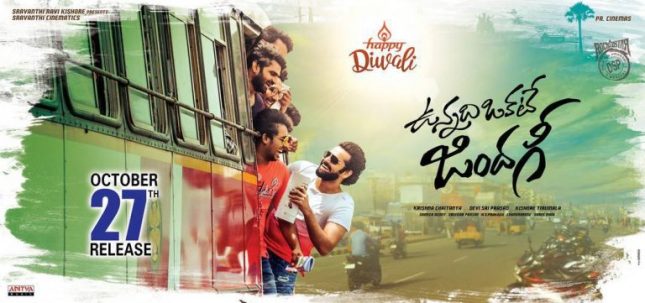
Vunnadhi Okate Zindagi (2017)

Vunnadhi Okate Zindagi

Vunnadhi Okate Zindagi is a film about friendship that starts off well but unfortunately falls apart in the second half. Anupama Parameswaran is excellent as the love interest for both Abhi (Ram Pothineni) and Vasu (Sree Vishnu), but as soon as she disappears the film loses its way and heads deep into cliché territory before finally backtracking and ruining the most interesting development from the first half. The story starts with a good idea, but there’s simply not enough depth for a full 2 ½ hours of screenplay and by the time the film ends, the story has been stretched so thin, there are holes all over the place. The actors are good, the songs and dance sequences enjoyable and the scenery spectacular, but without any real substance to the story, Vunnadhi Okate Zindagi sadly doesn’t make a lasting impression.

The bromance here is between Abhi (Ram Pothineni) and Vasu (Sree Vishnu), and for the most part their relationship is dealt with well, although the final conclusion does appear rather more artificial and forced. Abhi and Vasu are both likeable characters and their friendship has a solid basis, starting from their time together in school. A young Vasu is able to break through Abhi’s misery on the anniversary of his mother’s death and as a result the two friends become inseparable despite the difference in their social status. They remain friends throughout college although the group broadens to include Sathish (Priyadarshi Pulikonda), Kishore (Kireeti Damaraju) and Sai. But by the time Sathish, Kishore and Sai are getting together to discuss Kishore’s wedding, Abhi and Vasu are nowhere to be seen. Abhi has been missing for 4 years and the friends haven’t spoken to Vasu for 2 years, so naturally there is a flashback sequence to see where it all went wrong.

It turns out that Abhi and Vasu both fell in love with the same girl, aspiring doctor Maha (Anupama Parameshwaran). Initially they approach this problem with the same levelheadedness they have shown all along and come up with a plan to let Maha know how they both feel – and then leave it up to her to decide. This seems a radical departure for a Telugu film, where female characters rarely seem to be allowed a mind of their own, but Kishore Tirumala allows Maha to have an opinion and make a choice based on what she knows about the two men.

Abhi has stayed in Vizag after college and spends his time playing guitar with his band and chilling with friends. He’s relaxed and fairly carefree while waiting for the results of his final exams which is a total contrast to Maha. She’s driven to succeed by her parents expectations and is completing her medical degree because it is what they expect her to do. What she really wants to do is sing, and since Abhi plays in a band what could be simpler than the two getting together?  At the same time, Vasu has gone back to his family who are friends with Maha’s parents. When Vasu meets and falls in love with Maha, it seems to be the perfect match for the two families, and even Maha seems fairly happy with the prospect.

Up to this point the film is good, if perhaps a little slow. And I liked the idea that the girl would get to choose, without any undue influence from either the two guys, their families or even her friends. But it’s after Maha makes her choice and Abhi and Vasu part company that the story starts to fizzle.

The second half sees the introduction of Maggie (Lavanya Tripathi) a ditzy and completely inept wedding planner. It’s amazing that she’s managed to get the guests together and book a venue given her financial woes, tendency to get drunk and general unawareness of what is going on. I think Maggie was supposed to be ‘fun’ and ‘modern’ to make her a contrast to Maha, but she’s simply not either of these, and ends up as a clichéd filmi airhead. This characterisation is incredibly frustrating after Kishore Tirumala starts with better realised characters and a more mature approach with Abhi, Vasu and Maha. It’s literally teeth gritting stuff to watch Maggie lurch from manufactured disaster to contrived mistake while her employee helpfully points out where she’s going wrong. The stand-off between Abhi and Vasu also veers more into rather more immature territory, but that is more plausible, since many quarrels do appear ridiculous and childish from the outside.

Ram is good as Abhi, although not even he can really make a man-band look appealing! Ram looks considerably younger in the second half when he sheds his heavy beard, but otherwise the somewhat subdued rock-star look suits him well. I like Abhi’s casual approach to life and his relaxed attitude combined with a genuinely caring persona, which makes for an interesting romance between Abhi and Maha. Ram and Anupama have good chemistry together too, and the romance, although slow to develop does feel genuine. Sree Vishnu is also good as the more serious of the two friends, although sensible Vasu really only appears once the friends have finished college. His character does work better earlier in the film when Vasu is less reserved and but overall the friendship is a believable relationship, and there is a genuine warmth between Abhi and Vasu. Sree does fade more into the background in the second half, but in compensation the other friends get more screen time which provides some desperately needed relief from the irritating Maggie! Lavanya Tripathi doesn’t get much chance to be anything other than annoying, but Anupama Parameswaran is lovely as Maha and does a good job at portraying the two quite different relationships.

The music from Devi Dri Prasad works well in the film, and the songs are well pictured with some excellent choreography, but the real stand-out is the excellent cinematography. Sameer Reddy beautifully captures the seascapes of Vizag and the lush scenery of Ooty which provide the main backdrops for the action.

Vunnadhi Okate Zindagi is the story of a reasonable and pleasant friendship between two reasonable and pleasant men that hits a few snags but is ultimately resolved in a reasonable and pleasant way. Despite the theme of conflict between best buddies, there is no real angst here which may be part of the problem, particularly as the film ends up drifting along to the inevitable conclusion. Good characters and an interesting idea are one thing, but Kishore Tirumala needed a sharper screenplay and a better way for his characters to solve their problems than a ditzy wedding planner. The friendship portrayed by Ram and Sree makes this one worth watching but be prepared for the irritating second half.