Game Over

Game Over

I’m not usually a fan of horror movies, and prefer to watch anything scary at home where I can take a break or turn the lights up. However Game Over sounded a bit different from the usual horror film, and it turned out to be a good decision to go and watch it on screen. There are plenty of the usual horror film tropes; the stalker who breathes as if he has terminal bronchitis, excessive violence towards women and a few jump scares, but there is also a lot here that is different. Game Over isn’t an easy film to watch, nor to classify, but it does have a number of themes which encourage a deeper level of thought than a run-of-the-mill slasher flick. What exactly is going on is never 100% clear, and the audience is free to make their own interpretation of what occurs on screen – and that’s the main reason why I liked this film more than I expected. For me the final message was one of empowerment and overcoming fears, but I can see that this won’t be the case for everyone. Regardless, Taapsee Pannu and Vinodhini Vaidyanathan are excellent and if you are a fan of the genre this is definitely one to add to your list of must-watch films.

The first half is mostly setting up the events for the second part of the film. The opening scenes are immediately terrifying and horrific, showing a young woman’s violent death by a stalker who invades her house. The audience sees everything via the stalker’s viewpoint, ensuring that he (presumably) is never seen, although his breathing is loud and laboured. The film then moves on to introduce Swapna (Taapsee Pannu), a video game developer who lives in a large house with her maid, Kalamma (Vinodhini Vaidyanathan). It’s clear that Swapna has a lot of problems. Her house has a guard outside, she seems hyper-vigilant and she has security cameras everywhere. She’s also terrified of the dark and has a number of odd habits, preferring to sleep on her sofa and asking her maid not to move anything from its usual spot. Via a number of flashback’s we gradually learn that Swapna was seriously assaulted on New Year’s Eve a year ago and has PTSD as a result. After a very convincing breakdown at the door to a dark storeroom prompts a return to her psychiatrist (Anish Kuruvilla), Swapna discovers that she is likely to become more anxious and depressed as the anniversary of her assault approaches. She doesn’t want to follow her specialist’s advice to seek outside support during this time and after a sequence of events challenges her fragile mental state even further, she finally tries to take her own life. But this simply leaves her confined to a wheelchair with her legs in casts as the anniversary date comes around.

During the first half, good writing and convincing behaviour from Taapsee Pannu powerfully illustrate the effect of the assault on Swapna. The combination of Swapna’s mannerisms, repetitive habits and fear of the dark show the extent of her mental disturbance and inability to return to normal life. It’s all very realistic and unfortunately accurately represents the reality that many women are living with. One particular scene that hit home for me was Swapna’s reaction when Kalamma tries to reassure her that her attacker is behind bars. Her response is one I’ve heard repeated in real life, persuasive evidence for me that writers Ashwin Saravanan and Kaavya Ramkumar have done their homework here. Also excellent is the use of remembered conversations to illustrate how not to respond to someone who has suffered a serious assault. But even here the writers leave it open to the audience to decide if these are true memories of victim blaming from her family or instead, Swapna’s own feelings of guilt and remorse surfacing, despite none of it being her fault.

The second half of the film switches gears after a sentimental scene explains memorial tattoos, and a TV news item revisits the unsolved murder seen in the opening scenes. Suddenly Swapna is under attack in her own home and the question becomes one of survival given the odds stacked against her. Here there are the typical horror themes, odd noises, heavy breathing and a faceless serial killer with a sword and apparent grudge against women.  Some of this is genuinely terrifying, particularly since most of the suspense is built up by what isn’t seen, rather than by what is. However once the premise of the second half is revealed, the film does veer more into typical slasher territory, albeit with some good jump scares, but there is an overall drop in the level of tension.

Ashwin Saravanan has crafted a different style of horror film that deals with psychological disturbances and Swapna’s own fears, ultimately becoming an allegory about fighting personal demons and coming to terms with the effects of violent crime. I love the ambiguity that swirls around almost every frame of the film, ensuring it’s difficult to decide just what is real, and what is only in Swapna’s head. Keeping the action mainly to one room in Swapna’s house accentuates the claustrophobic feeling of helplessness, just as everything Swapna does is a clear attempt to have some kind of control over at least one aspect of her life. Taapsee Pannu is good at looking grim and she’s convincing in her doggedly determined efforts to fight off a serial killer in the later half of the film. Where she really excels though is in the portrayal of a young woman with a fragile mental state, particularly realistic with regards to the circumstances that have led to her careful and carefully ordered existence. Vinodhini Vaidyanathan is the perfect contrast. She’s down to earth and pragmatic, but still empathetic and more than just Swapna’s domestic help. Vinodhini adds realism that helps ground the film and includes reactions that perfectly suit her character in each situation. The contrast between the two characters helps give the film some depth, especially since so little background is given while Kalamma’s support for Swapna is a key component in making the story more interesting.

This isn’t a film where there are songs or diversions from the main storyline, and at just over 100 minutes there is little wasted space. The diversion to explain the significance of the first murder is a bit of a stretch, but not a totally impossible one, and I didn’t mind the touch of sentimentality after such a bleak first half of the film. It was good to see Anish Kuruvilla briefly onscreen exuding the quiet confidence that we’d all like to see in a psychiatrist, and Sanchana Natarajan, Ramya Subramanian and Parvathi T are all good in their brief support roles. Although none of the ideas here are totally new in themselves, the combination all together isn’t one I’ve seen before, and the almost entirely female cast is also something of a novelty in Indian cinema. I was also impressed by the film releasing in Tamil and Telugu (I watched the Tamil version) and also in a dubbed Hindi version which hopefully will avoid the watered-down remake that seems to inevitably follow every successful SI film. Game Over is more than a horror film, and not just a psychological thriller either, but rather something in between. Scary, empowering and almost hopeful by the end, this is a film that has a lot to say despite the minimal dialogue.
Orange Mittai

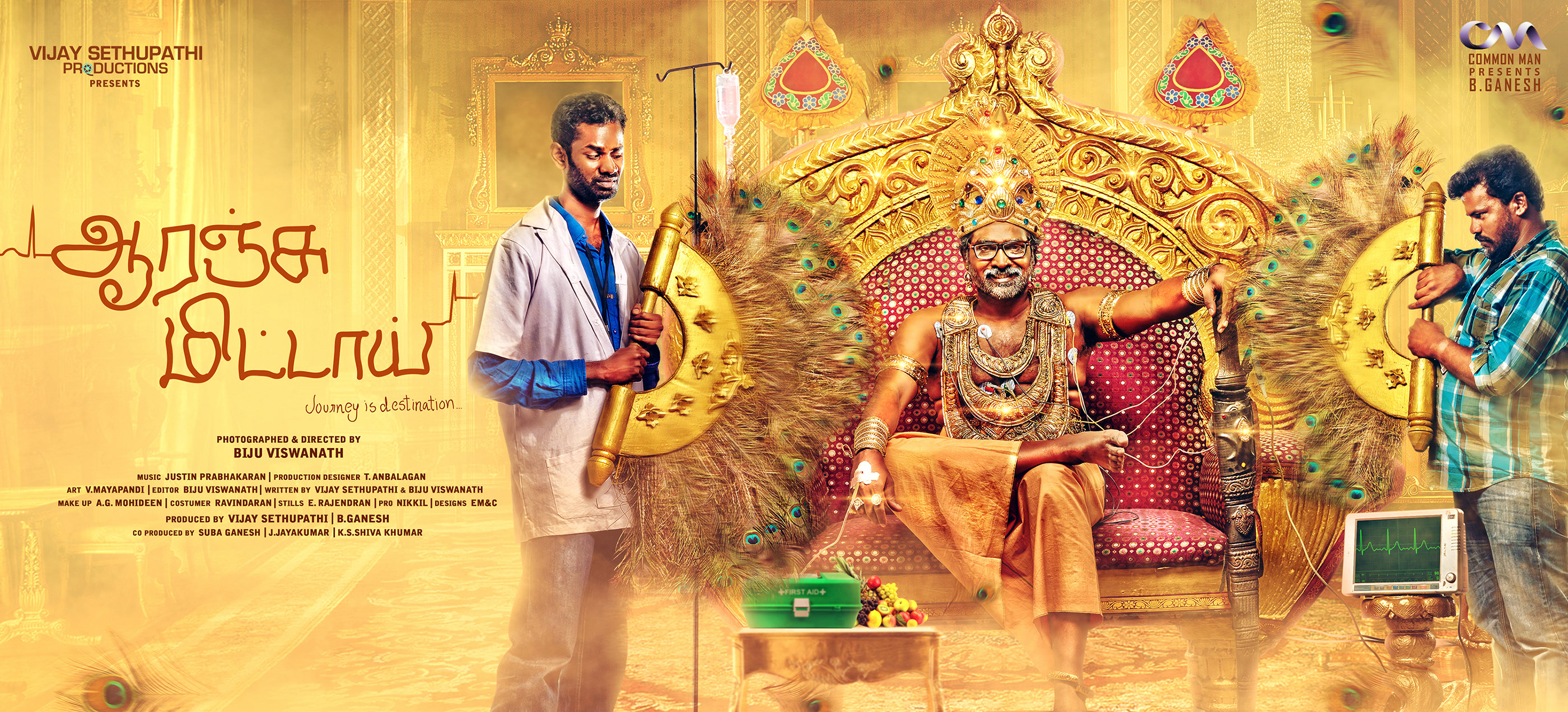
Essentially Orange Mittai is a road movie, but this isn’t a typical journey. Here, the vehicle is an ambulance and the trip one to a hospital taken by a cantankerous patient with heart problems who enjoys riling the ambulance driver and EMT. And while the story is about the journey both physically and metaphorically, it’s also a story about fathers and sons, about loneliness and even to some extent about failings within the health system in rural India. Biju Viswanath gently infuses comedy throughout the tale and allows the story to focus on the developing relationship between the EMT Sathya (Ramesh Thilak) and patient Kailasam (Vijay Sethupathi). Along with the gorgeous cinematography, it’s the simplicity of the story and the genuine view of isolation portrayed that make this such a great watch.

The film starts with EMT Sathya and his ambulance driver Arumugam (Arumughan Bala) attending the scene of a car accident. The driver is drunk, and after delivering him to the hospital, the dialogue between Sathya and Arumugam quickly establishes their individual characters and the ongoing tone of the film. Sathya is concerned about the driver and lets us know by a quick conversation with the nurse that he has informed the patient’s family, who are on their way. He also stops Arumugam thieving money and other valuables from their hapless patient in a scene that demonstrates his innate honesty and compassion, but Biju Viswanath also uses this to illustrate the friendship between the two men, despite their widely differing morals and work ethic. It’s a lovely beginning that quickly sets up their relationship, followed by similar brief conversations that give more background to Sathya. His father died a year ago, and when Sathya is praying, Arumugam comments that he could have shown his father this sort of respect when he was alive. It’s a throwaway line in an early scene but it resonates throughout the film, as Sathya ends up dealing with another older man who has issues with his own son.

Keeping to the theme of fathers, early on there is meeting between Sathya and his potential father-in-law (Trichy Manivannan) to begin discussing marriage with Kavya (Aashritha). Initially it appears as if Kavya’s father disapproves of Sathya, but despite misgivings he gives his permission to the marriage, as long as Sathya gives up working as an EMT and comes to work in his business instead. But that’s not what Sathya wants. He’s happy enough with Kavya, but his job means more to him than just his salary, and he’s not prepared to give it up just to appease his father-in-law. He doesn’t argue or explain his motivations, just simply asks for a day to think about it, which exemplifies his conciliatory approach to conflict seen throughout the rest of the film.

Sathya is given the job of collecting a heart attack patient from a remote location and taking him to the hospital. When Arumugam and Sathya finally make their way to the house (it’s inaccessible by ambulance) there is tense music and tilted camera shots through the gate railings and underside of a cart. It all seems to be pointing towards some supernatural event or violent shock, but the reality is rather less dramatic. The house is big, and there are faded pictures on the walls hinting at a past glory, while the rest of the house seems to be slowly decaying. When they finally find him, the man they have come to help is alone and has a grumpy and unconciliatory attitude making him prickly and difficult to deal with. He expects much but is not at all grateful, which alienates both Sathya and Arumugam right away. However Sathya is an expert in dealing with such disrespect – he deals with it every day from his supervisor and the hospital doctors, so he’s able to cope with Kailasam’s orders and quirks, eventually getting him into the ambulance and on his way to the hospital.

Naturally the journey doesn’t go smoothly and there are various interruptions along the way. Throughout it all, Kailasam is difficult, demanding and a typical grumpy old man. Vijay Sethupathi doesn’t quite look old enough for the character despite colouring his hair grey, but he does get the mannerisms spot on. In particular, his nosiness about Sathyam’s relationship is brilliantly written and seems completely natural, as does his general dissatisfaction with the world at large. As the journey unfolds it’s clear that Kailasam has a fractured relationship with his son, and since Sathya is dealing with issues related to his own father, the expectation is that the two will develop a father-son style relationship. To some extent this does occur, but not until later – after Sathya has come to realise it’s easier to feel compassion towards someone he’s not related to, and begins to understand that loneliness is behind Kailasam’s difficult persona.

Ramesh Thilak frequently appears in Tamil films as the friend or sidekick, often in a comedy role, but here he plays the central character which allows him to show a more serious side. Sathya is basically a decent person who just wants to be able to help people, and Ramesh does an excellent job of blending understanding and compassion with frustration, exasperation but also acceptance as Sathya deals with Kailasam, his demanding supervisor and a hospital doctor who has no respect for his skills. He also hits the right note with his girlfriend, even giving her some good advice as he finally tells her what he really wants in his life and that it’s up to her to decide what she really wants too. Unusually, the romance is merely a side note to the film rather than a central plot point –  it’s why Sathya is distracted at work and gives Kailasam an opportunity to give out some advice, but there are no odd duets or long involved romantic scenes. This is a much more down-to-earth film that doesn’t need any of this kind of drama, and the story works much better as a result.

The comedy in the film also seems to flow naturally, with Ramesh and Arumughan Bala working together beautifully to produce the laughs. Arumughan is the typical hapless idiot who will always do or say the wrong thing, but his relationship with Sathya has more to it than just these comedy interactions, which makes for a more interesting journey.

Although there are a few misses, for the most part the story gently builds a relationship between Sathya and Kailasam, even though the latter is resilient almost to the end. With Kailasam’s estrangement from his son, the friendship that develops with Sathya is bittersweet, which may be why the film is titled Orange Mittai, also referencing the bitter orange sweets Kailasam eats on his journey to the hospital. Interestingly, Vijay Sethupathi is credited as co-writing the film with Biju Viswanath, who is responsible for the stunning camera work and for editing the film as well as directing. This depth of involvement is perhaps why Orange Mittai at times seems indulgent, for example when Sathya stops to let an exuberant Kailasam dance in the moonlight, but this is only a minor point since overall the story is told simply and with care and attention to detail. I enjoyed the slow development of an unusual friendship and the meandering journey from hospital to hospital with a patient who really just wanted a day out and a break in routine. One to savour and enjoy as a simple reflection on the complexity of human relationships. 4 stars.

Orange Mittai

Virus (2019)

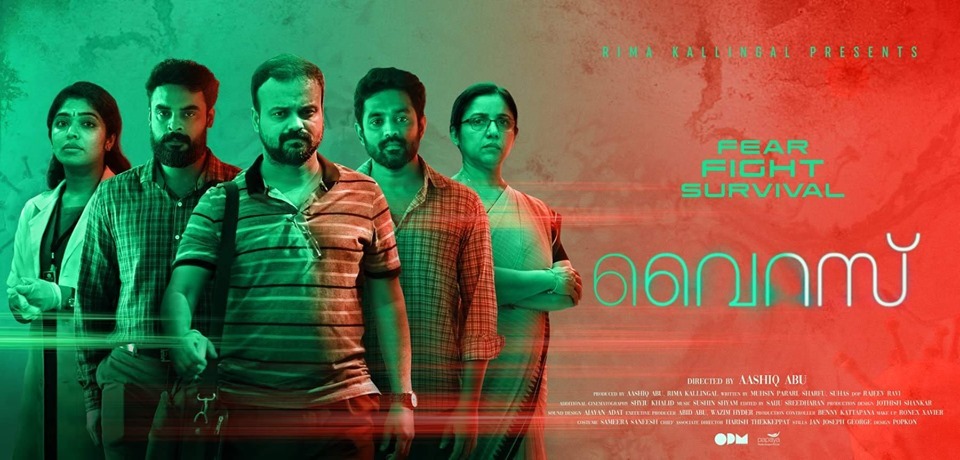
Based on a true story, writers Muhsin Parari, Sharfu and Suhas have taken the subject of the 2018 Nipah outbreak in Kerala and delivered a tense and suspenseful drama that is all the more powerful for its basis in fact. Although at times the effort to appear like a Hollywood disaster movie makes some of the screenplay seem a tad forced, for the most part this is a solid delivery of a fascinating story. The attempts to control the outbreak and the forensic analysis to discover the source of the virus are cleverly written to demonstrate the dedication and compassion of all involved, and it’s the realism and depth of detail that make this such an engrossing watch. Director Aashiq Abu has an all-star cast, but what really shines through is the story and ultimately the response of the hospital and government staff at the time who did such an amazing job of containing the infection and preventing mass exposure.

As someone who works in a hospital in Australia, the opening scenes in the casualty department of the hospital in Kozhikode appear completely shambolic with doctors and nurses struggling just to get near a patient let alone treat their problems.  But over the years I’ve worked in a number of hospitals in India myself and I recognise that the apparent chaos is actually all under control despite appearances to the contrary, and that somehow the doctors and nurses manage to see every single patient over the course of the day. In Kozhikode, as junior doctor Abid Rahman (Sreenath Bhasi) is starting his shift, the patients seem the usual collection of injuries, illnesses and infection cases, but then there is a young man admitted suffering seizures, hallucinations and who is rapidly getting worse. One of the nurses, Akhila (Rima Kallingal) tries to take care of the patient, Zachariah (Zakariya Mohammed) but her efforts and those of the medical team are in vain, and just as Zachariah’s condition deteriorates further, more patients start to appear with similar symptoms.

It takes some time for the pieces to start to come together. The cases are spread across two districts so the similarities between patients’ symptoms are not immediately recognised, but when Akhila herself becomes ill the situation suddenly escalates to a full-blown emergency with the main objective being to control the spread of the disease. The story from here unfolds gradually, following the medical staff as they treat patients and Kozhikode Distric Collector Paul Abraham (Tovino Thomas) and Health Minister Prameela (Revathi) as they start the search for the source. But we also see the hospital orderlies and cleaners who are willing to risk their lives to try and help stop the spread of the disease, and the impact these decisions have on their families too. Dr Suresh Rajan (Kunchacko Boban) confirms that the patients have contracted Nipah, which has no treatment, no vaccination and a 75% fatality rate, with the only option being containment and quarantine. For those who already have the disease there is little hope. Paul starts the process of tracking down the “Index patient’, aided by Dr Annu (Parvathy) and as each patient is admitted there are flashbacks to possible contamination moments which highlight the relentless spread of the disease through close encounters with possible carriers.

Nothing is omitted – the struggles to calm the fears of medical students and hospital staff are here as well as descriptions of the difficulties of disposing of the bodies of the deceased. These are still infectious and need to be incinerated safely which causes further distress to grieving families who aren’t even allowed the dignity of a funeral for their loved ones. There is a conspiracy theory thrown around that this could be a form of terrorist attack by germ warfare, but mostly the tension comes from a combination of the race to find the cause, and the plight of the patients and the doctors trying desperately to save them.

The film works so well because it is incredibly realistic and down to earth. The reactions are all natural and even the attempts to increase tension with the conspiracy theory and sensational TV interviews could all be plausibly grounded in fact. Every single character is beautifully drawn with each actor perfectly cast for their role, so that Virus often seems more like a documentary than a film. Taking each character and giving them plausible background is inspired – like hospital porter Babu (Joju George), initially seen negotiating for wages which have not been paid and whose wife and children are stigmatised while he is away. These details, even down to a broken strap on his backpack give authenticity to the story and draw the audience deeper into what is happening onscreen. There are so many excellent but fleeting performances. Soubin Shahir is good as a patient whose infection initially baffles the doctors as he seems to have had no contact with any of the confirmed cases, while Madonna Sebastian appears even more briefly as a junior doctor who contracts the virus. Poornima Indrajith, Asif Ali, and Sharafudheen all appear in critical roles while Savithri Sreedharan, who was so good in Sudani from Nigeria is brilliant in her few short scenes as the mother of the index patient. Zakariya Mohammed brings so much humanity to his role as the first identified case of the virus with an incredibly poignant closing scene delivering the perfect finale to a film that really is all about compassion and caring.

This is a brilliant depiction of real-life events and I found it compelling but chilling to realise that this outbreak actually happened. The film unfolds as if watching the events in real time and I was awed by the immediacy of the hospital and government response and impressed by the success of their quarantine. Aashiq Abu has done an amazing job with bringing this story to life onscreen and while Virus may be a factual telling of the story, it’s the characters that are most memorable and have the biggest impact. Highly recommended.