Murari

One day our friend Indiequill asked for film recommendations, specifying that she wanted to see Mahesh Babu as something other than a baby faced killer. Murari was a popular pick amongst friends on Twitter, and for that reason as well as our commitment to research and possibly a bit of persuasion by The Mahesh Fan, we watched it too. And it wasn’t bad. There is nothing really out of the ordinary in the story, the jokes or the material so the film had to rely heavily on the appeal of the cast and the production design to keep us engaged.

The film opens with a bonus appearance by Prakash Raj in a wig (according to Liz he may have been channelling Jackie Shroff in this avatar) and it was obvious he was No Good. After insulting the deity at a local temple, he is promptly despatched by a green CGI monster and leaves a curse attached to family.

Goodbye and thanks for coming Prakash Raj.

The film skips forward several generations and we learn that every 48 years a member of the family dies to fulfil the requirements of the curse. Why 48 years is never explained, at least in our subtitles, and it really doesn’t seem to matter except as a device to show a few grisly deaths.  When we see Mahesh Babu leap onto the screen it is not only obvious he is the hero, but we were also sure that he is marked for death. He plays Murari, a bit of a too good to be true type who defends the defenceless and all that, but is saved from being a total prig by his good natured pranks and teasing. These were actually pretty funny and captured the adolescent nature of our hero.

This was apparently Peter Hein’s first film as a fight director, and certainly there are several heroic scuffles with bad guys thrown through the air like so much sweaty confetti. And one interesting fight scene in the water. But no baby faced killer.

Murari is from a feuding family. During one attempt to bring the two sides back together he meets his cousin Vasundhara, played by Sonali Bendre. Sparks and insults begin to fly as instant dislike signals the love story to come. Romance blossoms over pranks and practical jokes, as does some more dodgy CGI work.

In order to facilitate the growing relationship, Murari is intent on resolving the family schism as his grandmother Sabari is equally intent on removing the curse. Murari is blissfully unaware of the danger he is in, but the gods seem to like Mahesh Babu and his elephant Ganesh keeps a watchful eye on his owner. There are lots of close calls, and we know Murari is drawing closer to his death a long time before the family priest bothers to check the horoscopes.

Murari’s family approve of him marrying Vasundhara, hers are eventually persuaded and then grandmother puts the veto on this union. She is obsessed with saving Murari (who was named for her husband who was a previous victim of the curse), and keeping Vasundhara from being left a widow. In the midst of all the domestic drama, death is lurking and only an arduous and lengthy ritual can save Murari. Since the angry deity in question is Durga, the price for absolution had to be blood; and that is spilled in abundance before the film ends. Although the climax was powerful in its visual impact  the outcome was rather predictable as Sabari had always known what was needed to lift the curse. Along with all that blood of course. Why she held off on taking action until this particular generation is never adequately explained.

Mahesh Babu seems to be the actor who explains basic concepts in Telugu film, and we thank him for that. In Athadu he laid out the rules for killing and in Murari he explains the rules of obsessive filmi love. Apparently if he was thinking of Vasundhara, he needn’t worry about whether she loved him before going to politely kidnap her and bring her back to the family home. The reason he was thinking of her was that she was thinking of him. So his father told Murari there was no need for boring talking about feelings and plans and all that. She wanted him! It was all her fault! Just go grab her! Another filmi mystery solved!

It was interesting to see Mahesh Babu playing a young man who wasn’t a homicidal loner. This is also before maxi-layer Mahesh became quite so multilayered and developed his signature style. Although his favoured T-shirt and shirt combo make plenty of appearances there are quite a few scenes where only a single T-shirt was in evidence and nary a scarf in sight. We enjoyed his comedic flair in Khaaleja and he certainly milked the laughs from some of his scenes with Sonali. He did all the standard heroic stuff but this was much more character driven than action centred and relied on dialogue.  Sonali and Mahesh had some fun and flirty scenes that helped give the romance a bit more spark. Sonali is beautiful to look at and seemed to enjoy playing her more extrovert character in this.  She really excels at frustrated screams, and her performance appeared very genuine and heartfelt particularly in the latter half of the film.

Murari’s mother Gopamma was played by Lakshmi who did a great job of giving this teary filmi Ma some real character. She was very believable in her confrontational scenes when visiting her brother and family, and emanated a warm and loving personality in scenes with Mahesh Babu. The rest of the supporting cast were all OK without being exceptional. It’s often comforting seeing so many familiar faces in amongst all the cousins, uncles, aunts and servants but it does mean we tend to overlook them as they usually perform the same role over and over. The sets for the family homes were lovely and looked really lived in.

There were lots of knick-knacks and paintings scattered around to catch the eye and each house had a different feel that reflected the occupants’ tastes. The elephant fountain was fabulous and so was the actual elephant.

The music was forgettable, and so was most of the dancing although it was rather exuberant at times. See this film if you’re interested in watching one of the biggest stars in the industry before he adopted the cool calm killer persona and if you like a bit of domestic drama.

Temple says: This is an entertaining if unexceptional film. I like Mahesh Babu as an actor, and he did well in this romantic comedy hero style. It is kind of fun to see him playing such a young and flirty boy rather than the brooding loner role he has put his stamp on of late. Having seen Khaaleja recently, I am now surprised at how shocked everyone seemed to be at his ability to do comedy in that, as he had that under his belt in this film (along with snake wrangling skills). I particularly liked the teasing flirty interludes with Sonali as they each had their moments of triumph and of discomfort and the scenes flowed really well. I even tolerated the dreaded Filmi Child Actors as they were kept well under control and wore a pleasing array of stripey shirts. Speaking of costumes, Mahesh Babu in a lungi is always memorable (I’m thinking of you Jenni). It’s a shame the DVD copy is so bad as the visual design of the film is very nice, and it was a pleasure to watch – certainly these screencaps do it no justice. I don’t know that I would hurry to watch this again, but I did enjoy it for what it is – a romantic comedy with a bit of gore, a bit of divine intervention and excellent use of elephants. I give it 3 stars.

Heather Says: I liked Murari, but then it’s a romance and I’m a sucker for love stories. It also has elephants (an instant win), snakes (also a win), and the goddess revenge drama does spice up the storyline nicely. I enjoyed the way the two characters played it true to their supposed ages in the story and the little touches that were very typical of a guy trying to be macho and impress the girl. The teasing between Murari and Vasundhara appeared very natural and Mahesh showed that he has a natural flair for comedy. It was great to see him in a role where he wasn’t just a cool and competent killing machine, but had so much warmth and feeling. There seemed to have been quite a lot of thought put into the interactions between the various members of the two families as well, and I liked the way that they all had different characteristics within their roles in the family. Even the kids were ably utilised in this film, and the elephants weren’t just there for decoration.

My only complaint, apart from the terrible DVD quality, was that the ending dragged a little. The lead up to the climax was great, but then it seemed to take forever to actually get there. There were also perhaps a few too many near misses for Murari, especially since at least one appeared very contrived. However the rest of the film was fun and overall its an entertaining watch. I vote for more elephants and snakes in all movies! 3 ½ stars from me.
Gundamma Katha


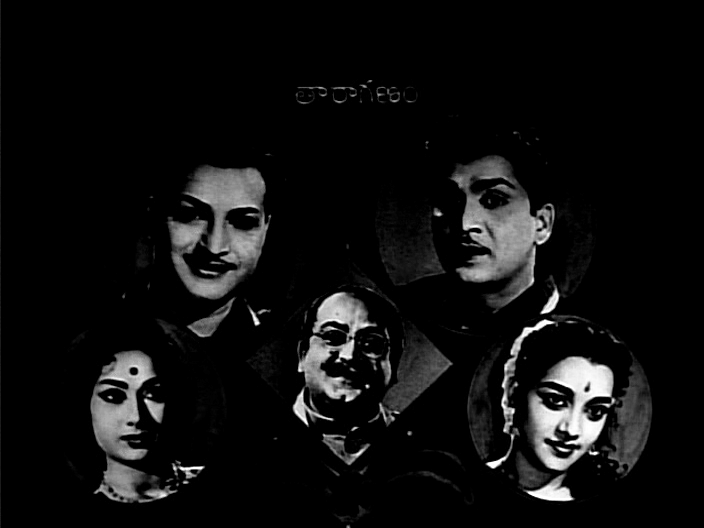
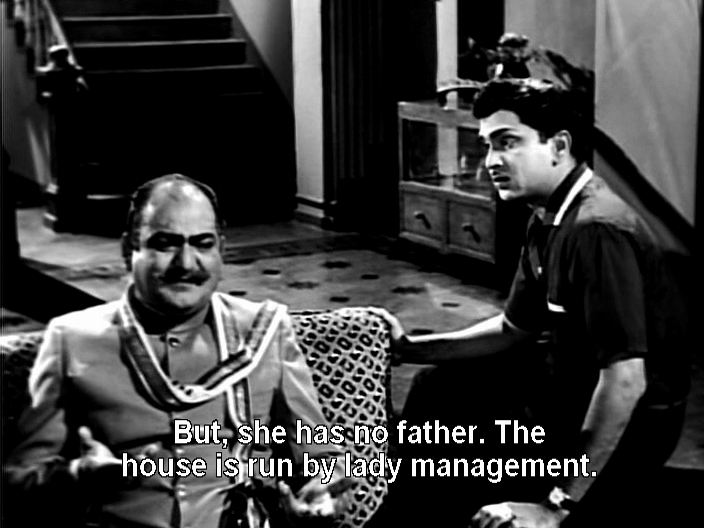
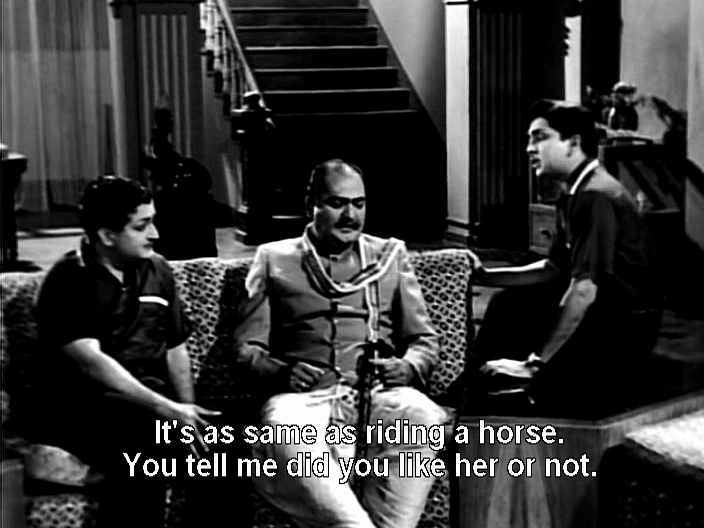
Gundamma Katha is a classic film from 1962 and is considered to be one of the last great films to be produced by B. Nagi Reddy and Chakrapani under the Vijaya Studios banner, which also gave us Mayabazar. It features an all-star cast, lovely production design and  a lyrical score by Ghantasala.  Sadly the Shalimar DVD has really ordinary subtitles which detract from what is supposedly a well written story.

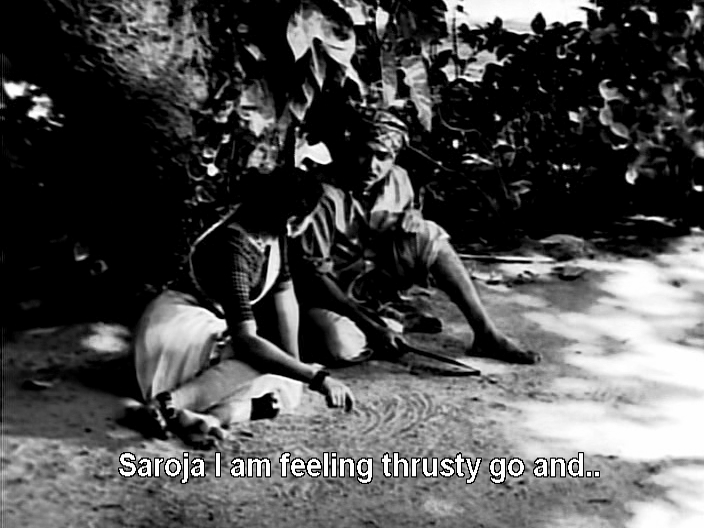
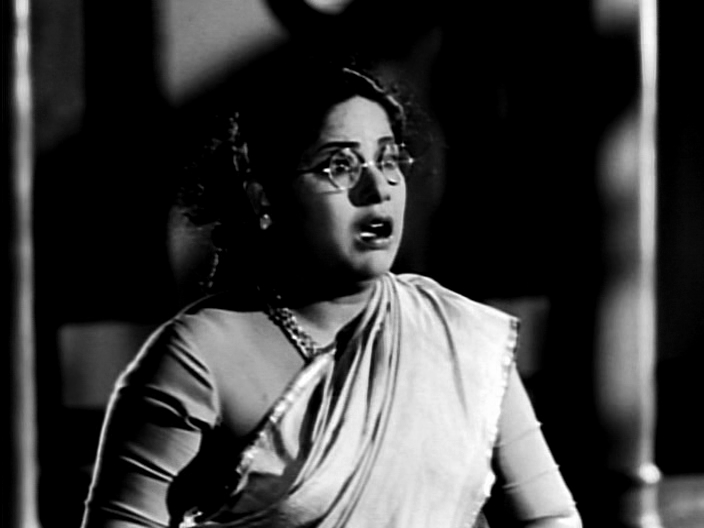
Perhaps they meant thirsty? Who knows.

The story revolves around Gundamma, a wealthy widow who has one spoilt and indulged daughter, one Cinderella like step-daughter from her husband’s first marriage and one largely absent son. Gundamma rules the household with an iron fist and her reputation as a termagant is well known in the village. She wants to make an advantageous match for her daughter Saroja but her wastrel brother Gantayya throws a spanner into the works every time. As Gundamma casts her matrimonial nets wider she contacts wealthy Ram Bhadrayya, a friend of her deceased husband, who has two eligible sons. While Ram Bhadrayya wants to help his former friend’s family, he is concerned about the values and character of the girls and decides to put them to the test.

NTR plays Anjaneya or Anji and it is decided that Laxmi (Savitri) is the best match for him. Since Laxmi is effectively a servant in the household, he poses as a labourer in order to get closer to her, and to appear to Gundamma as an appropriate suitor.  This part of the deception seems very typically filmi and almost justified, since Laxmi does deserve better than the life she has. NTR is charismatic as the exuberant Anji, and Savitri is beautiful as Laxmi. Their relationship develops over conversations and teasing, and they develop a true appreciation for each other. With a jaunty song Anji points out to Laxmi that women can do whatever they want to do in the world, and she should have no fear in letting herself be more than an unpaid servant to her step-mother. Sadly this enlightened attitude turns out to be lip service as the story progresses, but the partnership of Laxmi and Anji does seem to be a happy and balanced one.

Ram Bhadrayya’s second son Raja (ANR) woos the privileged and spoiled Saroja (Jamuna) and finally marries her. Playing out a drama concocted by his father and Anji, Raja tells Saroja that everything was a lie and that he is not even Ram Bhadrayya’s son.  After some more drama Saroja is forced to choose between her home and comforts or leaving to an unknown future with her drunk and possibly criminal husband. This deception is all to ensure that Saroja has a proper wifely attitude and will look after her husband in the manner he feels appropriate. Saroja doesn’t seem to deserve all of the heartache she is put through, as her attitude already appears quite appropriate for the wife of a wealthy man. It doesn’t seem likely that she will have to clean pots and pans, plough fields and cook once she is established in her new household but she is forced to learn as she lives in near poverty with her husband. Why her father-in-law feels this trickery is necessary for her to become a better wife is not apparent to us. She actually seemed to be mellowing and becoming more empathetic as her romance blossomed with Raja. It certainly wasn’t a palatable part of the plot and made the second half of the film much less enjoyable.

Throughout all of the drama, ANR manages to instil the character of Raja with enough charisma that Saroja’s devotion to him is understandable to some degree, although her behaviour is clearly driven as much by wifely duty and the expectations of society as anything else. Jamuna is excellent in her early scenes as the lazy daughter and also as the bewildered wife whose world rapidly falls apart. Despite this couple’s rather dubious story there are some lovely duets which are beautifully depicted and in these scenes the two actors have great  rapport with each other.  The growing closeness is illustrated by the proximity of their sleeping mats – initially on opposite sides of the room, by the time ANR decides to reveal the truth they are happily snuggled up next to each other.

The cinematographer Marcus Bartley has a reputation for creating beautiful moonlit lighting effects, shown to great effect here and in Mayabazar.  The costumes are lovely, and very much serve to illustrate the status of each character. A simple change in clothing is all it takes to make a prince a pauper and back again. Initially Laxmi wears cotton saris and simple blouses while Saroja gleams in silk and jewels. As the sisters’ fortunes change, so do their wardrobes.

The film excels in the story of Gundamma, played by Suryakantham (who apparently made her career out of playing wicked stepmother type characters).  Gundamma’s scenes with the argumentative and shifty Durgamma (Chayadevi) are well written and enough to make anyone duck for cover when the two start fighting. Her clashes with the various members of her family are realistic and energetic.  Her final humiliation, which eventually results in her reconciliation with Laxmi, is a nice twist to the story and a suitably sentimental resolution to the melodrama.

The lead actors were all at their peak when Gundamma Katha was made and they seem to share an easy rapport. In particular the many wordless exchanges between the two brothers are great to watch as they convey so much through their posture and gestures alone. Savithri and Jamuna are beautiful and show distinct personalities without ever falling into caricature. The sisters’ relationship is not as friendly as the boys’, but they exhibit familial love and loyalty regardless of their difference in status. Once again, the comedy track is hit and miss and we have different opinions as to what succeeded.

The film does end in a rushed few scenes of everyone reconciling. We were disappointed by this as it seemed a bit under-written and hasty, and also because there was never any sense of owing the ladies any explanation for what had been done to them. Granted, Gundamma, Laxmi and Saroja were none the worse off in a material sense at the end of the story, but they had been lied to and manipulated and that was hard to swallow. Certainly we expected more anger or argument between the couples. Setting up three strong and intelligent women and having them turn into doormats by the end of the film was a major let down.

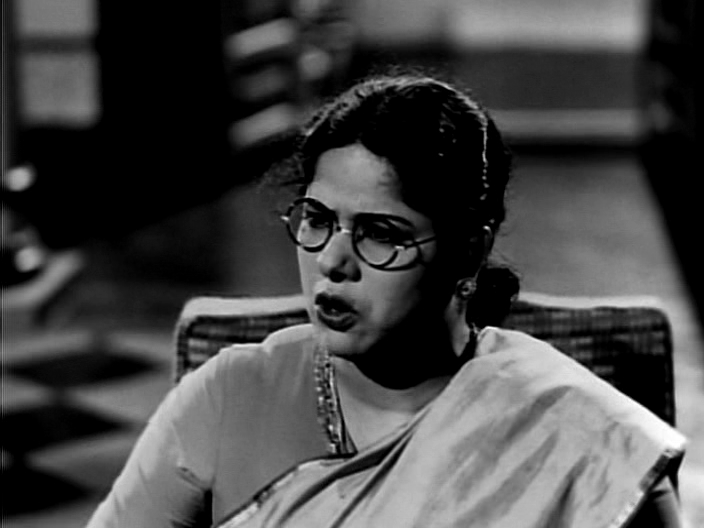
We haven’t really mentioned the lovely L Vijayalakshmi who played the boys’ cousin Padma.  She was actually the sensible and sane one who married the man she wanted (Gundamma’s son) and stood up for what she wanted. Apart from looking lovely and putting Gundamma back in her box, she also performed a very pretty classical dance which was a highlight in this largely non-dancing film.

The music is very melodic and the songs seem to suit the characters and the situation. We were amused to recognise the opening titles music, also used in that L Vijayalakshmi dance, as the riff from recent Hindi hit Pe Pe Pepein from Chance Pe Dance!

Temple says: I liked a lot about this film – the cast, the production design, the music and the cinematography. I strongly disliked the story. The message seems to be ‘be strong, intelligent, independent…until your husband tells you to stop’. In addition to my issues with that, the character of Saroja just wasn’t written as someone eligible for Taming of the Shrew type behaviour modification and so the treatment meted out to her seems harsh, unnecessary and not in keeping with her actions in the film. The acting style has really dated, especially that of the male cast members. ANR and NTR do have oodles of charisma, which makes the stomping and scenery chewing much more entertaining than it might have been. But the acting honours go to all the ladies – which is ironic in a film that certainly isn’t about girl power – with Savitri the stand-out performer. She is beautifully expressive without ever being over the top. The minor supporting cast didn’t make much of a contribution other than to add the alleged comedy (regular readers will know I suffer from Comic Sideplot Intolerance). It seemed a waste to have Allu Ramalingaiah as the hotel owner as he had so little to do. I really found Ramana Reddy as Gantayya (Gundamma’s dodgy brother) annoying and hammy and I fast-forwarded through many of his scenes just so I could get through the film.  Actually, I think the fast forward button was essential to me getting through this – I was bored by the over-acting and repelled by the story so this wasn’t the pleasure to watch I had hoped for. Time hasn’t been kind to this classic. I give it 3 and 1/2 stars, just for the stars.

Heather says: This is a film which both looks and sounds very beautiful and from this point of view is an absolute winner. The story of Gundamma and her two daughters had a lot of potential, and it’s a shame that the writer D.V.Narasa Raju decided to turn the two sisters such perfect and therefore perfectly dull wives by the end. Both Laxmi and Saroja had plenty of personality at the start of the film and eradicating this in the quest to make them the ideal wives just made them rather less interesting to watch. The lack of a reaction from Saroja when she discovers the deception was particularly irritating considering she had just been put through absolute misery by the man proclaiming to love her. It was also a little odd that the start of the film featured a song all about women’s rights and then proceeded to firmly walk all over them. I suppose that in 1962 it was more important to adhere to conventional principles rather than allow a strong-minded woman to succeed. However, despite these issues with the storyline, I did enjoy the romance between Anji and Laxmi. Their songs, as well as the duets between Saroja and Raja, were really lovely.

The characters of Gundamma, her perpetually scheming and whining brother and the very shady Durgamma were much more entertaining. The interactions between them all were much more believable and seemed to be better written, although this could just be due to the subtitles. I found the comedy scenes with Ramana Reddy and Allu Ramalingaiah in the restaurant to be really funny, as were his scenes with NTR. What can I say? I’m Irish and it reminded me so much of similar scenes I’ve seen at home! The comedy track here worked well for me, and was much more enjoyable than the unsettling story of Saroja and Raja. ANR and NTR were excellent together and their relationship as brothers was very well portrayed. I also liked the minor characters and the way their individual stories were worked into the plot. The standout performance though was that of Gundamma, and for that alone this film deserves to be a classic. Without the Raja and Saroja storyline it would have been even better, but overall I enjoyed this film and it gets 3 ½ stars from me.

Surakksha

As a suitable end to silly season, we sat through one of the most ridiculous films we have found in recent times. While we have to conclude that it was immensely silly, it was also quite fab!

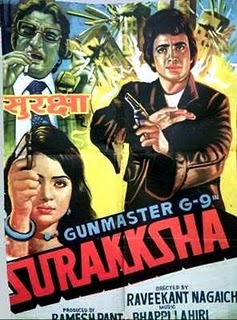
Surakksha features the exploits of Agent Gopi aka Gunmaster G9, (Mithun Chakraborty) a Bond inspired character with a memorable theme song.

There is a plot, but it hardly seems relevant as the director/producer Raveekant Nagaich and writer Ramesh Pant seem to take their favourite scenes from a number of Bond movies (as well as a few other classics) and string them together in no particular sequence. These random episodes are glued together with some outlandish effects (more on those later) and usually showcase Mithun in the tightest whitest flares he can squeeze himself into.

While we’re talking about the pants,  they did inspire some lengthy discussion. Not only are they incredibly tight, they also have the largest bell bottoms we have seen. Surely this must make sneaking into buildings, cemeteries, warehouses and various other assorted locations difficult – not to mention the problems caused when dancing on the beach. And we suspect a constant flapping noise from the enormous flares would have undermined his attempts at stealth, even if the yards of fabric remained unseen. However Mithun seems unconcerned by this choice of clothing, while we feel it may explain some of the dance moves. Or then again, maybe not. We concluded that Amitabh is a man who can wear tight white flares and actually carry them off. Mithun can’t.

In fact, generally the outfits were rather wonderful with an abundance of pleather in various shades and some nifty pantsuits. We owe this bounty to Bhanu Athaiya and their team! Mithun also seems to be either waxed to within an inch of his life, or perhaps is just not a particularly hairy man. For whatever reason he really was quite shiny in his (fairly frequent) shirtless scenes. Since we didn’t have to keep track of the plot (the writers hadn’t so why would we?), we had time for this philosophical pondering.

Other highlights of the film are the amazing leaping animals and their sound effects. Who knew that sharks can both sound like dolphins and growl (well OK, other than anyone who has seen Chatrapathi) as they leap from the water in search of their prey. There is also a diminutive snake that manages to make impressively athletic lunges at Mithun as he ably fends it off with a dish lid.  Sadly the snake doesn’t growl, but does manage to leave considerable damage in the plasterboard thanks to its amazing leaping skills and velocity. It was sad to see the snake dispatched by means of a pillow and a toilet – that snake deserved better than being flushed.

We don’t think ‘enjoyed’ is the right word to describe our reaction, but the nightclub dance number featuring Aruna Irani and some fabulous decor is very memorable.


Overall the effects are spectacularly bad with any number of toy cars and trucks being employed to demonstrate the amazing properties of Gunmaster G9’s chosen mode of transport, the talents of the design team and the effects of combustion.

Although G9’s car is small, and rather impractical considering the number of women he attempts to fit in at the beginning of the film, it does boast the usual accoutrements essential for any spy about town. There are pop-up guns, a device to pour oil on the road, one to squirt soapy water on a pursuers windscreen, and of course a parachute for those moments when you find yourself driving off the edge of a cliff because you haven’t been looking where you are going. Doctor Who fans will also be delighted by the appearance of what looks like a sonic screwdriver (but sounds like a jackhammer), a particularly useful device if you find yourself interred in a polystyrene grave.

There were also a couple of toy boats that looked Significant, but we never did learn their fate as we had a few technical difficulties. Despite the best efforts of the DVD player and computer to spare us the full film, we managed to soldier on. With two copies of the DVD and Temple’s technical skills we were not going to be beaten by some inanimate electronic equipment!  The copies we had also suffered from being a VCD with no subtitles, but as we mentioned, the plot really didn’t seem to be the point of this film anyway. It did lead us to discover that Mithun mumbles – he was really very hard to make out, while the other actors were much clearer although still never really made any sense.

Iftekhar plays the head of the organisation Mithun works for and checks in periodically to see what his spy is up to; generally warning him to stay away from women, and fretting when he doesn’t call on time. Mithun’s love interest is ably played by Ranjeeta Kaur who does a good job of keeping a straight face throughout the more bizarre of Mithun’s dance moves. At times we did wonder what the choreographer’s direction could possibly have been!

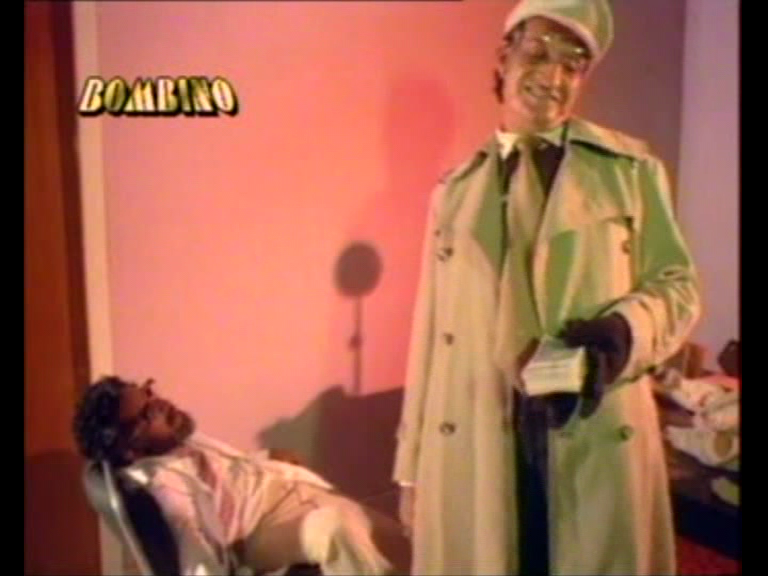
The story involves the hunt for G9’s colleague, Jackson, kidnapped by the nefarious Hiralal (Jeevan obviously enjoying himself as the villain and bearing a resemblance to Dick Dastardly in this screencap) and his glamorous sidekick Neelam (Mala Jaggi). These two are mere lackeys of the real bad guy – the mad scientist Dr Shiva (?) who lives in an underwater lair seemingly surrounded by giant goldfish. The lair is very well appointed, complete with a robot controlled by the buttons on Dr Shiva’s metal hand and amazingly ineffectual female guards armed with red plastic guns (or hairdryers).

To ensure everyone turns up for the final showdown, Jackson’s wife and son have been kidnapped along with Mithun’s trusty sidekick Kabari (Jagdeep as the comedy relief). We have yet more action as air ducts are explored (children do have their uses) and crutches are reassembled into a ‘machine gun’ (hello Day of the Jackal!) – although it looked much more like a shotgun to us but what do we know. We are not the Gunmaster G9. Like any well schooled villain Dr Shiva pontificates about his plans for world domination using his death ray thingy that appears to be able to cause gigantic waves. Or something. It really doesn’t matter because we know that Gunmaster G9 will save the day, get the woman and exasperate his boss.

Everyone spends a really long time explaining their secret plans to anyone who will listen, before a dance off between G9 and Hiralal to settle the question of…well, we don’t know for sure, but we do know Jeevan lost. Mithun then has to fight several champions in several fighting styles (hello Bruce Lee!) although no one seemed particularly committed to the biffo.

The music is by Bappi Lahiri and is really quite terrible although often unforgettable as we tried to work out which song he had copied so badly. This was such a terrible film we have decided we absolutely must have a better copy with subtitles to really be able to get the full effect and to fully appreciate our favourites, the snake and the shark. And we both love a good lair and a death ray thingy contraption:

Many thanks to the people who inspired us to watch this masterpiece: take a bow Shalini Akhil and Memsaab! An absolute classic of the So Bad Its Good variety!

Temple says: I can’t think how I have gone so long without seeing this. Really – it has everything and more, and yet sort of adds up to so much less. I love the film makers determination to make a Bond film with no Bond, no budget and no idea how to replicate the style, and it really is very entertaining. I am a fan of Bond, and could happily pick out scenes lifted from Goldfinger, You Only Live Twice and Live and Let Die to name a few.  Heather had to put up with me cheerfully predicting what was to happen and I have to give this to Ramesh Pant – he knows his Bond too. Iftekhar was excellent as the equivalent of M and Jeevan excelled as the evil flunky.  There is something delightfully optimistic about a death ray thingy made mostly from tin foil and tupperware and that just makes me happy. Unfortunately the VCD we had didn’t allow for good screencaps so we can’t show you the real magnificence of the set design and the ‘special’ effects. I think you’ll just have to watch this for yourself! 3 stars from me, maybe 3 and 1/2 if I’d had a glass or several of wine.

Heather says: This was a fabulous fun film for all the best reasons. There were super sets and seventies decor, amazing outfits, dreadful choreography and the worst special effects I have seen for a very long time. I really loved some of the lights and lamps, and at one point there were exactly the same tiles as my parents had in their bathroom back in the seventies – just fab! I’m not such a big Bond fan as Temple – I do like the movies but the last time I watched most of them was years ago –  but to me, apart from the lack of cocktails, this film had every bit of 007 squeezed in. A bit like Mithun and those pants – no more could possibly fit! There were time bombs, listening devices, a machine that spat out strips of paper for no apparent reason and of course the end-of-the-world-death-ray-wave-maker machine. This film really deserves no stars whatsoever – it actually is that bad, but I give it 4 stars for the whole experience. One to watch with friends who can appreciate the finer details!