Shock

Ravi Teja has a dedicated fan following and I’ve read good things about his films so I decided it was about time I watched one of his movies. I bought this film on my last trip to Chennai on the recommendation of a friend, and since the blurb on the DVD suggested it would be more of a thriller than the typical mass masala fare it sounded more to my taste than some of the comedic roles he has played. And I did enjoy it, well mostly, at least up until the last 30 minutes anyway.

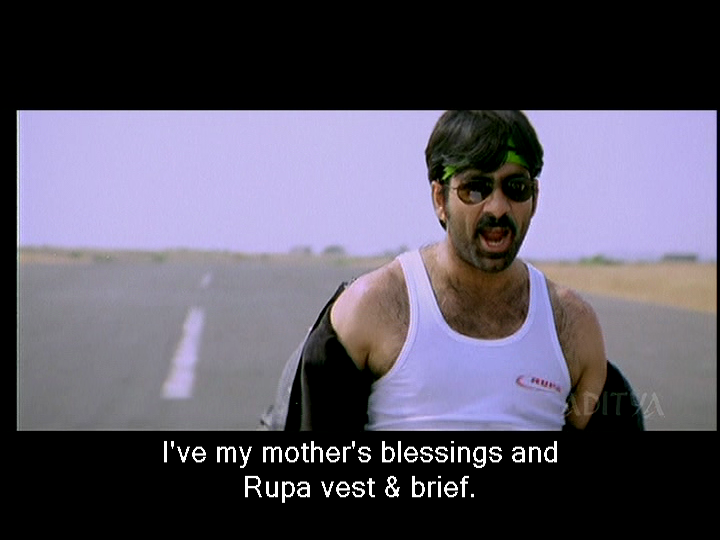
Ravi Teja plays an advertising agent Sekhar, although a look at his pitch for Rupa underwear suggests that perhaps it’s not his true calling.

He’s happily married to another advertising agent in his office, Madhurima (Jyothika). She has to take a back seat to her more ebullient husband who is clearly the office favourite. Brahmi makes a brief and understated appearance as Sekhar’s boss but for a change there isn’t much comedy in his role. There is some humour in these scenes but it mainly arises from situations with Sekhar and his wife and generally is well placed and actually quite funny.

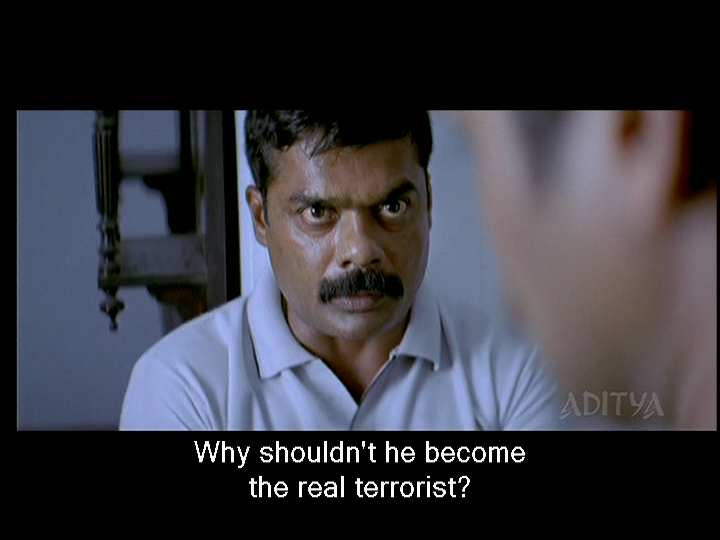
The relationship between Sekhar and Madhurima is convincingly portrayed and they seem to have a strong and loving partnership. I could do with less of Ravi Teja’s back hair on view to demonstrate this, but other than that I think writer/director Harish Shankar is accurate in his portrayal of a working couple.They live in a block of flats where the lift never functions and there are constant disruptions from the neighbours and their children. When Madhurima becomes pregnant, they decide to relocate and quickly find a recently vacated house. However just as they move in, two men burst through the door and shoot Sekhar. He wakes up handcuffed to the bed in hospital and is immediately interrogated about his terrorist connections. He learns he has been mistaken for a Maoist by two encounter specialist police officers, Nagesh and Divaker. Although the pair realise their mistake almost immediately, they decide not to take responsibility for what has happened and instead salt Sekhar’s house with evidence to make sure that their error is not discovered.
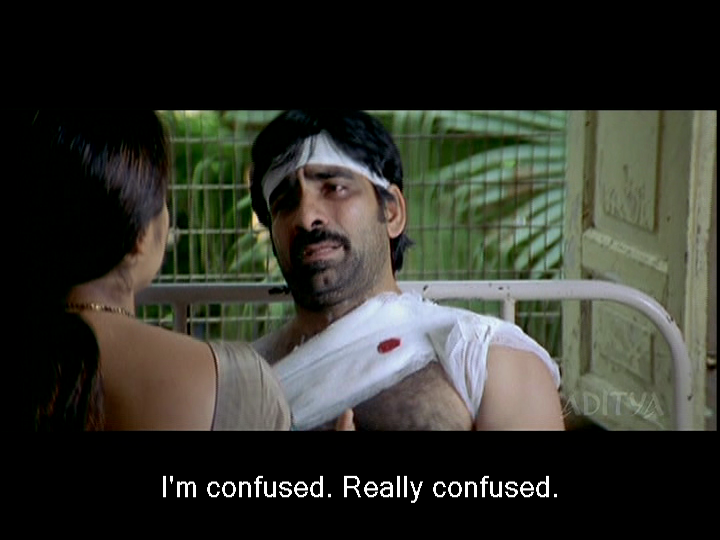
In the meantime Madhurima protests Sekhar’s arrest and manages to hire a lawyer. By the time of the trial however, the lawyer has been paid off by the two cops and has convinced Sekhar to plead guilty, telling him he will get a short sentence and that will be the end of it. Of course this is not the case and Sekhar is sentenced to 8 years in jail. Madhurima immediately vows to get him released and is aided by Geeta, a journalist interested in the case.
There are various moments of drama in the prison: Sekhar is fortuitously sharing a cell with an inmate Tilak who has certain rights and privileges with the guards but he is also menaced by the self styled boss of the jail, Syed. This is all conveyed without recourse to cliché, or over the top drama and serves to give an idea of Sekhar’s true character as well as set up subsequent events in the jail. Madhu’s struggles are also convincingly portrayed. Geeta doesn’t take over the defence or engage in unrealistic methods to help Madhurima find justice, but instead advises her of which organisations to contact. This is all very plausible and fills out the background of the story well.

But just when you think this is going to be a battle played out in the courts and among informers in the back streets, there is more drama as Madhurima is threatened and Sekhar escapes from jail. Up until this point the film is very good; a slightly different story, well paced and told with good performances from the cast. But from here the film starts to rely on violence and bloodshed and the storyline becomes more predictable and clichéd as Sekhar plans his revenge. There are some unpleasant torture scenes and the realism that was built up so very well in the first half of the film is lost as Sekhar suddenly becomes able to fight his way out of any situation. However there is still a very ‘Hollywood’ feel to the action, and the slickness of the production carries through right to the rather unsatisfactory end. There seems to be an obsession in the Telugu film industry with making sure there is a happy ending (of sorts at any rate), and in this case I would have preferred to see something more in the way of consequences for everyone’s actions.

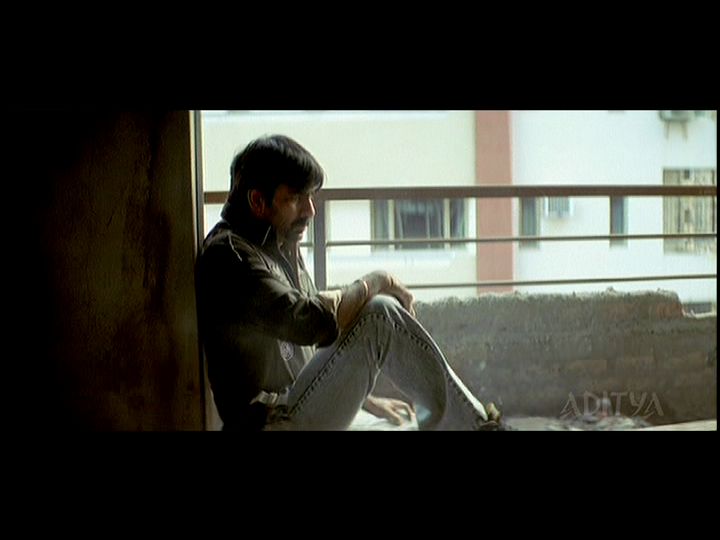
Despite the collapse of the plot in the second half, the film sets up the basic story well and the leads are all excellent in their roles. Sekhar’s confusion and distress at the situation he finds himself in is well portrayed by Ravi Teja. I was very impressed by the vulnerability he was able to convey as the injured and baffled victim in hospital and then as the somewhat shell-shocked and stunned prisoner in jail. He was even reasonably convincing in the action roles up until he had to take on a number of much more muscled and bigger extras. I know he is the hero but there is a limit to what I can believe!

Jyothika has a much more developed role than is usual for the heroine in Telugu films and I really thought she was excellent as Madhurima. Her relationship with her husband is very realistically drawn and the romance is sweet without being cloying. Her distress at her husband’s situation is perfectly depicted as is the change in her character as she first breaks down and then becomes a driven and determined woman out to get justice for her husband. The only scenes which didn’t fit were when the story of the couple’s initial meeting was shown as a flashback scene later in the film. This felt misplaced and disrupted the story just when it really needed to be tighter. Although it does mean we get another good song from Ajay-Atul. Although this is out of place in the film it is nicely pictured – I cannot explain the gloves in the opening shots though!

Apart from the two main leads there are a number of the usual suspects in the film who all play their roles with their usual competence. Kota Srinivasa Rao is a perfect fit as the corrupt lawyer and both Subbaraju and Ravi Kale were fine as the deceitful cops. Raghu Babu shows up in a familiar role as a nasty warden in the jail along with Raja Ravindra as the useful Tilak. It’s a little surprising that the small role of Geeta is played by Tabu and it does seem a waste to have such a good actress only on screen for a few short scenes. But it’s always a pleasure to watch her even if it is only in a few scenes. There is some attempt at comedy in the second half with the CBI officer Surendra Kumar (Nagendra Babu) and his incompetent assistant Bapanna (Ram Jagan) but this falls very flat and thankfully the Harish Shankar seems to have realised it wasn’t appropriate fairly quickly.


I would have found it this a much more interesting and appealing story if the film had dealt more with Madhurima’s fight for justice and Sekhar’s struggles in jail rather than going for the straight hero driven revenge drama. But then again that probably wouldn’t have been as popular at the box office. As it is, the second half of the film is a disappointment after the excellent build-up in the first half, and the attempt at a happy ending particularly jarring. I am favourably impressed with Ravi Teja though and Jyothika was fantastic. For those two excellent performances, and a good first half, this film gets 3 stars.
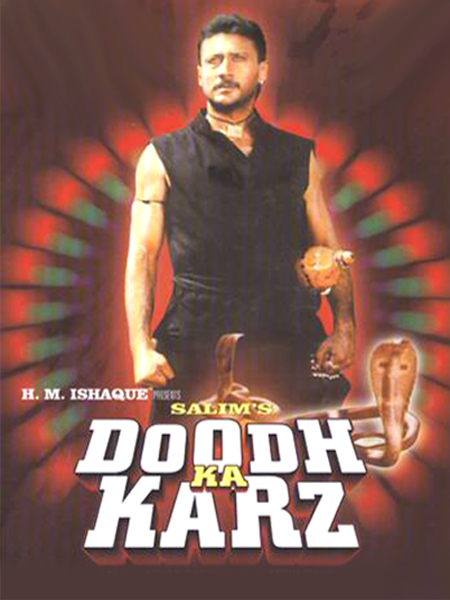
Doodh Ka Karz

I wanted to write something about the late Bob Christo as he was my first ‘That guy again!’ in Hindi films. He seemed to be in everything, often trying to kill Mithun which was considerate of him, and generally being menacing. I think I first noticed him as he was one of the small number of white guys that turned up over and over in a huge array of films. But later I started noticing the gleam in his eye as he flung himself around the set, pretending to be beaten half to death by the hero, and I enjoyed his apparent glee at being the baddest baddie. He played his villainous henchman roles with great enthusiasm and I always look out for his shiny bald head when the main villain appears.

Good friend and snake film aficionado jenni enthusiastically recommended this film. Several times. Her summary on BollyWhat was so persuasive. And now I ask myself – why did I wait so long? I can’t explain the story any better than jenni did, so with her kind permission I quote:

“OK.  The story goes something like this.  A snake charmer, who treats his snake as a son, witnesses the plunder of the local snake temple jewels.  He is then framed by the thieves (local thakurs one of whom is played by Amrish Puri of course) and is beaten to death.  The beating is witnessed by his wife (Aruna Irani), infant son and loyal snake.  It is left to the widow to build a pyre and perform the funerary rites as she contemplates her future as a destitute widow.  Loyal snake has accompanied them to the cremation and when the widow realises she is unable to care for him, along with herself and infant, she feeds him some breast milk, sings a song about him repaying the debt of her milk, then sends him away.  This part is really sad and the snake actually looks sad and lost and grief stricken as he leaves (and I cried).  Not a woman of forgiveness, the snake charmer’s wife then sets about avenging the death of her husband.   And she is still on task 25 years later.

By then, the boy has grown up to be Jackie Shroff (Suraj) and he falls in love with (you guessed it), the evil Thakur’s daughter (Neelam).  Loyal snake has returned to both protect (his family) avenge (his enemy), and pay the debt of the milk, just like his (human) mother would have hoped.  There is parental opposition (both sides) and romantic complication (both sides).  Also a corrupt priest who is handy with snake lore himself.  And Bob Christo in a smooth talking, double dealing,  diamond smuggling minor role.  And let’s not forget, the THRILLING SNAKE FILLED CLIMAX”

The Snake represents all that is good and moral and he is the hero of this film, regardless of what Jackie Shroff might think. Sadly, he was never named which seems remiss considering his important role. The Snake is loyal and protective, has sound family values and judging by the number of friends and relatives who turn up for the final showdown, he must have been a nice snake.


There was genuine emotion in some of The Snake’s scenes and I have to say the editing was outstanding in making it seem that The Snake was reacting to the drama around him. I also have a mental picture of some poor sod standing just out of shot, dangling a mouse or other tasty treat to get The Snake’s attention. And who knew that snakes could emote?

There are always concerns about animals in films but I think the instructions to the snake wranglers went along the lines of ‘Chuck ‘em in and stand back’.  I am hoping that some fake snakery went on in a couple of scenes.  And the mongooses seemed quite chipper in their special appearance. Certainly more enthused than the mongoose wranglers were! I know I wouldn’t have lasted long as an extra on this film.

The human actors go about their supporting roles quite successfully, and I did find the story very engaging.  Aruna Irani nails the vengeful widow role and raises her human son to be as strong as iron, although takes her time in telling him why. The scene when snake and widow separated was quite moving, although I didn’t cry. Perhaps I was too startled seeing breast milk expressed on screen and in close-up. I did find myself singing along with the recurring title track though. Goga Kapoor and Raza Murad make an impression in their smallish roles.  Amrish Puri as the Thakur didn’t put up much of a fight before he was persuaded to turn to crime, and was a villain of the weak and greedy type rather than a creatively dressed megalomaniac. But the allure of the jewels was just too much for him as was the notion of taking the easy way out of his self created problems. And he is backed up by Prem Chopra so you just know how that’s going to work out.


My mind did wander a bit during the songs though as the only thing that seemed to happen was Jackie pawing at Neelam. And it’s a snake film so it’s mostly snake music and that can get a tad monotonous. Meanwhile The Snake was slithering the countryside in search of his father’s killer who he would recognise by a distinctive necklace. That’s something to think about before borrowing jewellery.


When Neelam is bitten by the vengeful loner, she faints gracefully and is spared the sight of Jackie sucking her toes to extract the venom. Dear reader, you will not be so lucky.


Bob Christo has a small yet pivotal role as a venal Englishman who represents all that is bad and stupid. He is a diamond smuggler called Angrezi Master so maybe the script writers had just given up on character names and it wasn’t an anti-snake thing. Bob wants the stolen temple jewels but is afraid of the snake that is reputed to protect the temple, and demands to be shown its corpse. Oh Bob. So many films and still messing with the gods…Finally, Bob has to decide what is more important to him.


The snake gave him a choice, and Bob chose wrong. I also learned that when white people are bitten by snakes, we turn green. This should be a very helpful diagnostic tool in future.


The snake filled climax is really filled with snakes. Bucketloads of snakes. The Snake may not have been wandering the woods alone for all those years. Here’s a little taste of the mayhem, with Bob doing some very fine acting:

I have to say, I really enjoyed Doodh ka Karz. I like a good snake revenge film, and this is very snake-centric and vengeful. Ashok Gaikwad kept the story and editing pacey and there is stuff happening all over the place so there is never a dull moment. There is pathos in the snake charmer family scenes, and Aruna Irana is excellent. The only thing missing was a proper snake dance. This is a great ripping yarn, and a fun way to remember Bob Christo. 3 and ½ stars!

Edited to add: Here is a link to Beth’s round-up of ‘Bob’s Your Uncle’ posts. Go have a look!

http://bethlovesbollywood.blogspot.com/2011/04/bobs-your-uncle-late-great-bob-christo.html

Dum Maaro Dum

Maybe it was the relief of seeing something interesting, or the after effects of emergency dental surgery, but I really liked Dum Maaro Dum. It’s a standard cops and gangsters story, with bit of Pulp Fiction flavour (right down to a character called Vincent Vega). It’s a film to see for what happens and how, although there are few significant surprises and too many contrivances that deflate the second half. Ultimately the straight up thriller isn’t blended so well with the masala elements so it’s not as satisfying as it could have been, but it’s still good fun.

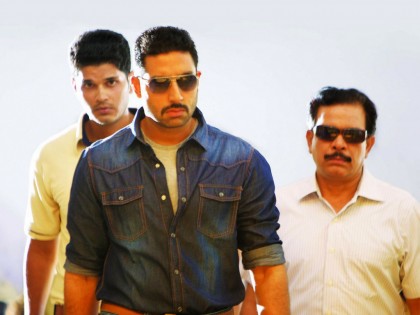
Abhishek Bachchan is the reformed corrupt cop ACP Vishnu Kamath, sent to Goa to deal with the drug issue. I’m not always a fan of his, but I really liked this performance. His entrance was fabulous and exploded in a sparkly manga style. Kamath’s character is established by exposition so Abhishek has less to work with as it isn’t a development the viewer is involved in. But I could totally buy his conversion from corrupt cop to crusader. He was confronted with the consequences of being on the take and he made a decision. For the most he plays it straight as an officer with a past and on a mission.

I’m not sure whether I like what seems to be a constant need to pay homage to his father, as I then see Abhishek as someone doing an impression of his dad rather than successfully portraying a character. It works here as he was great with the one-liners and it is quite 70s dishoom stuff–and the Kaike Paan scene was very amusing!

Lorry (Prateik) is a drug mule, seduced by a woman in a sequinned bikini mere hours after the love of his life departed for the US. Yes. He is supposed to be 17 but even so, he was an idiot. He took the drug gig to get the money for college despite knowing better. And he is an athlete so we know they never make stupid decisions about drugs!

Prateik certainly does well in being irritating. I was so annoyed at the way he lashed out at his girlfriend when she won a scholarship he wanted. There wasn’t much character development in Lorry. I got no sense that he would be much the wiser after the drama played out as his life seemed destined to pick up where it left off. Prateik hammed it up in some of his post-arrest scenes and I thought he was OK without being great; but that may just be because I dislike his character so in fact he may have given the performance of a lifetime. The camera certainly loves him.

Joki (Rana Daggubati) is a musician, and for most of the film he is the moral compass of the story. I wonder why Rohan Sippy didn’t give Joki a back story to deal with the accent instead of dubbing. It’s not like he didn’t know who he was casting. Joki is in some respects the junior version of Kamath. He stood by and let the underworld taint the lives of people around him, and is forced to decide whether he will continue to turn a blind eye.

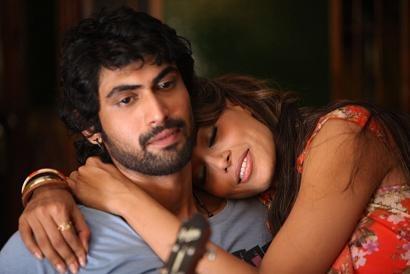
His journey to the same tipping point as Kamath forms a lot of the story, although Joki is rarely centre stage. He has to connect with several of the characters as well as explain bits of plot, and I thought Rana was convincing and appropriately low key in most scenes. The dialogue sometimes sounded slightly flat, so I am judging more on expression and reactions and I thought he was good. The writing lets Joki down as his motivations aren’t always well articulated, and later things take a turn for the WTF. I like an abundance of pleasing visuals and Rana features heavily in those moments. He looked great and I have to say the wardrobe team aced Joki’s style, the slightly hippy muso look but not too try-hard.

Bipasha Basu is Zoe, Joki’s old flame and currently in the possession of Biscuit (Aditya Pancholi in a creepy sleazy caricature). She is another of the characters having to deal with the consequences of bad decisions, and is more clear sighted than some about human behaviour.

I did have an eyeroll moment when her character was introduced as half English. ‘Aha’ I thought, ‘That’s how they justify her sleeping with men she is not married to and all the drug taking etc. She’s a skanky half white girl.’ Bipasha impressed me with Zoe’s transition from light-hearted to darker emotions. I didn’t get any sizzling chemistry between her and Rana, they seemed a couple who had been together for a while and were completely comfortable with each other.

There are a few things I found hard to swallow. The methods by which Kamath and Joki arrived at what they each knew were just too sketchily written and didn’t hold up. The villain Barbossa was a cipher not a character and failed to create real menace. All the characters were a bit underwritten so everything relied on being swept up in the story. When the other story elements dropped away in the hunt for Barbossa, the lack of tension undid the energy of the first half.

Things I enjoyed perhaps more than I should have included Abhishek stirring up a drug cocktail as though he was mixing paint, Mercy for his name and his fab satin shirts (I suspect I know why he was Goa’s oldest virgin just based on the pink ruffly number) and the very useful electric crematorium. Identifying an unknown suspect’s nationality by the label in their sequinned underwear seemed slightly improbable. On that basis, today I am Italian and yesterday was Chinese/Australian. Identifying said suspect at the airport by her sparkly undies was hopefully intentionally funny!

I didn’t hate Deepika’s item number. Given this is a film about the drug trade, it actually worked well as one of the few scenes that showed the drug culture that sustains the business. The song and the choreography were dire but I think it was successful in giving the rave and party context and Deepika did what she was asked to do – stand around and look good.

The Abhishek Thayn Thayn ‘song’ was dire. He raps like my dad would if we let him. I really don’t know what they were thinking, and the timing of this interlude was all wrong. Bipasha’s last song was sad as it was almost a mirror image of her first song with Rana, but a reflection that became a horrible parody of her earlier happiness. The rest of the songs were unnecessary although I don’t dislike them at all. The background score was apt but it’s not memorable either.

The cinematography is excellent and the film looks great. The camera often creates a disorientation and fractured sense of time that suits the story. The second half drags, the ending is too pat and the closing visuals are overly sentimental, but it’s also satisfactory as I like a good comeuppance. Perhaps I laughed more than I should have (I’ll blame the painkillers…oh wait…wasn’t there a message about drugs?), but I was highly entertained.

Heather Says: For me, Dum Maaro Dum tries to mix the Usual Suspects with Dirty Harry and fails to quite hit the mark on either front. But I think it’s an entertaining watch with good performances from the core cast.

While the story is overall good, there are some gaping plot holes and the ever increasing body count ensures that the number of possible candidates for Barbossa grows ever smaller, not helping plot development. I found the dubbed voice for Rana to be particularly grating and doesn’t suit him at all, although this may purely be due to seeing his previous film Leader. Abhishek Bachchan is good in his role as the reformed cop but tends to ham it up a little too much in the scenes with his wife. He is convincing in his ruthlessness although some of the torture scenes were too over the top and ended up as amusing rather than gruesome. This may have been the intention though as they were really silly. Some of the best scenes and dialogue are with Kamath and his partners, Mercy and Rane. I loved Mercy’s collection of ‘date-night’ shirts which are the most lurid I have ever seen and perhaps explain why he is the oldest virgin inGoa.

Bipasha Basu is excellent as Zoe and I thought her transformation from happy fiancée to drug-addicted mistress is well shown – although she does perhaps look a bit too healthy. She does manage to convey her mental deterioration and distress at her situation and there is some definite onscreen chemistry between her and Rana. The development of their relationship shown by the photographs on the fridge is a clever idea and one I really liked. Rana is less convincing as Joki, and his relationship with Lorry is too contrived. But his character is better in his own story loop and I liked him much more in the second half when he was on the trail of Barbossa. Overall though Joki is the leasat satisfying character in the story and I would have liked to see more of his background. He wasn’t quite the free-wheeling spirit he was supposed to be.  This is the third film I’ve seen with Prateik, and he continues to be very impressive. His portrayal of Lorry is convincing and just naïve enough to be a believable character. The romance with his girlfriend was good, and he was excellent as the scared kid in jail trying to just survive.

The second half of the film starts to drag as it becomes obvious where the story is going to end and there are just too many diversions as the writers try to be clever and insert far too many twists and ‘surprises’ into the plot. None of which are vey twisty or surprising. The soundtrack has been a topic of conversation online, but it wasn’t very memorable and overall the songs were badly pictured, apart from Te Amo with Bipasha and Rana which was pleasant but not spectacular. The item song with Deepika Padukone was absolutely terrible with no choreography to speak of, and looked much more like a cheap MTV video for a wannabe Christina Aguilera. I really didn’t like it at all – and neither did the audience who were laughing!

There was a lot to like about this film. The comradeship between the three police officers works well and their raids are dramatic with some light-hearted moments to even up the blood-shed. Dum Maaro Dum is a watchable film and strong performances almost make up for the weaknesses of the story. A better climax would have helped immensely but there is enough in the story to make it one of the better Hindi releases this year so far.