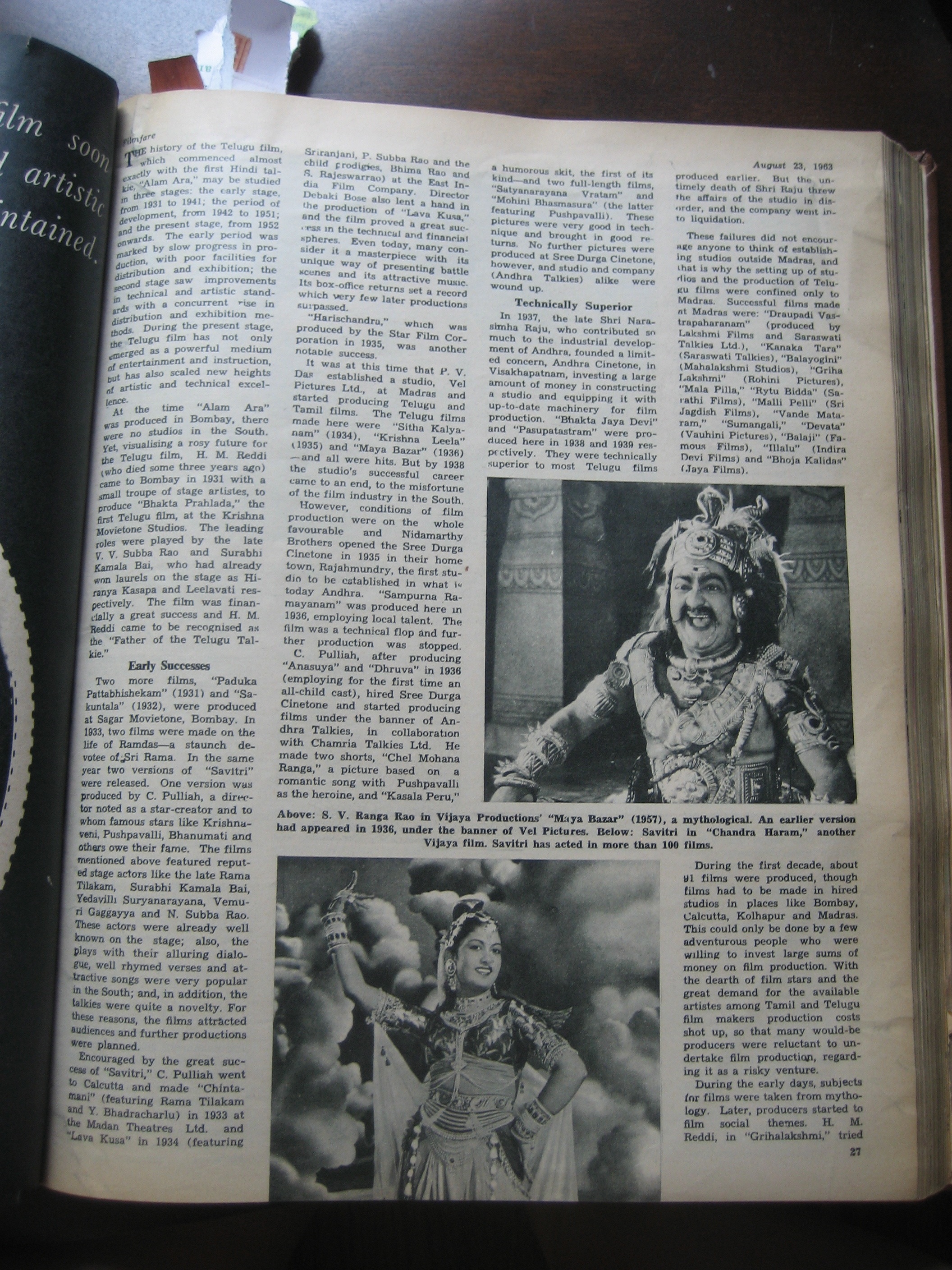
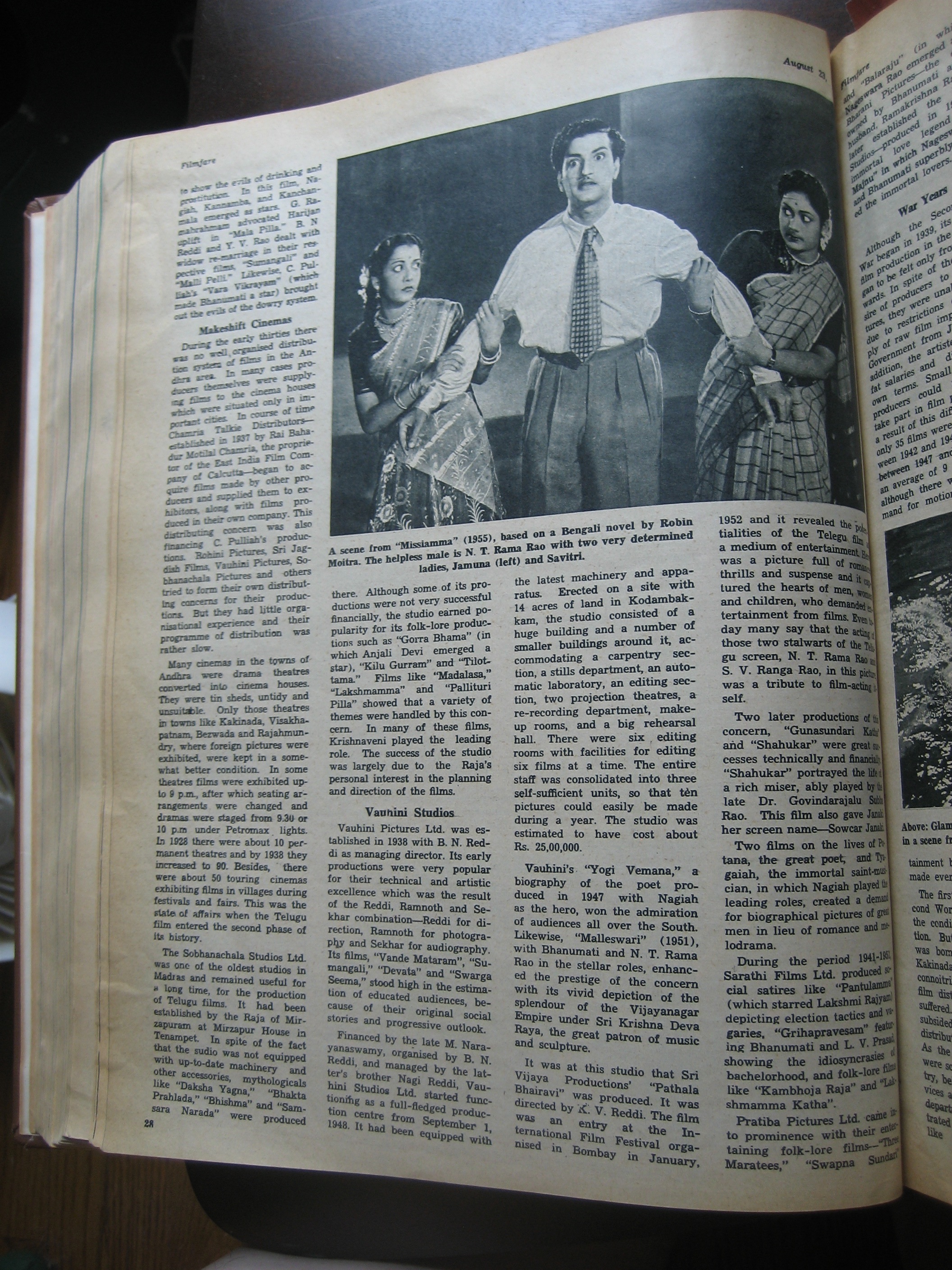
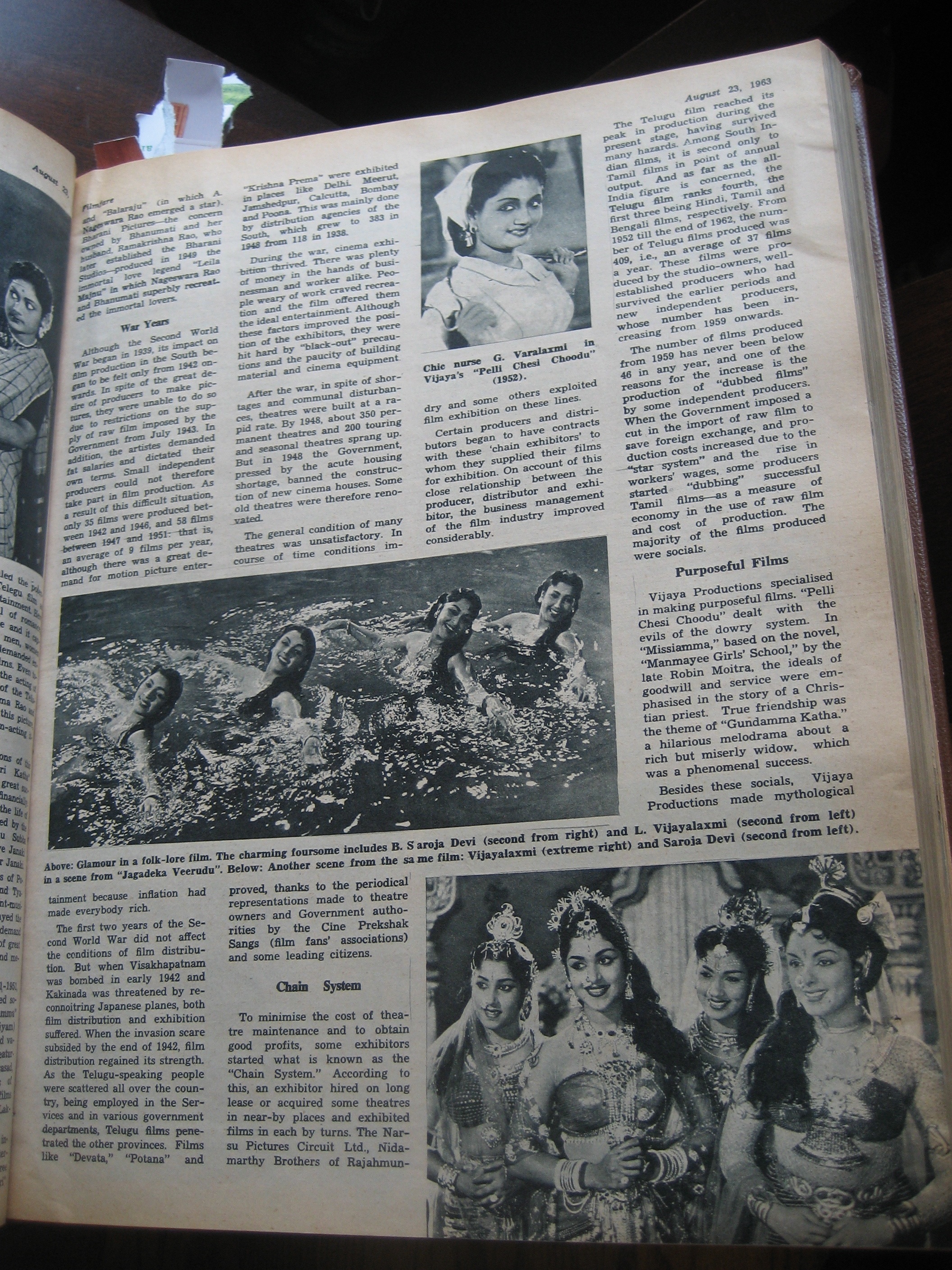
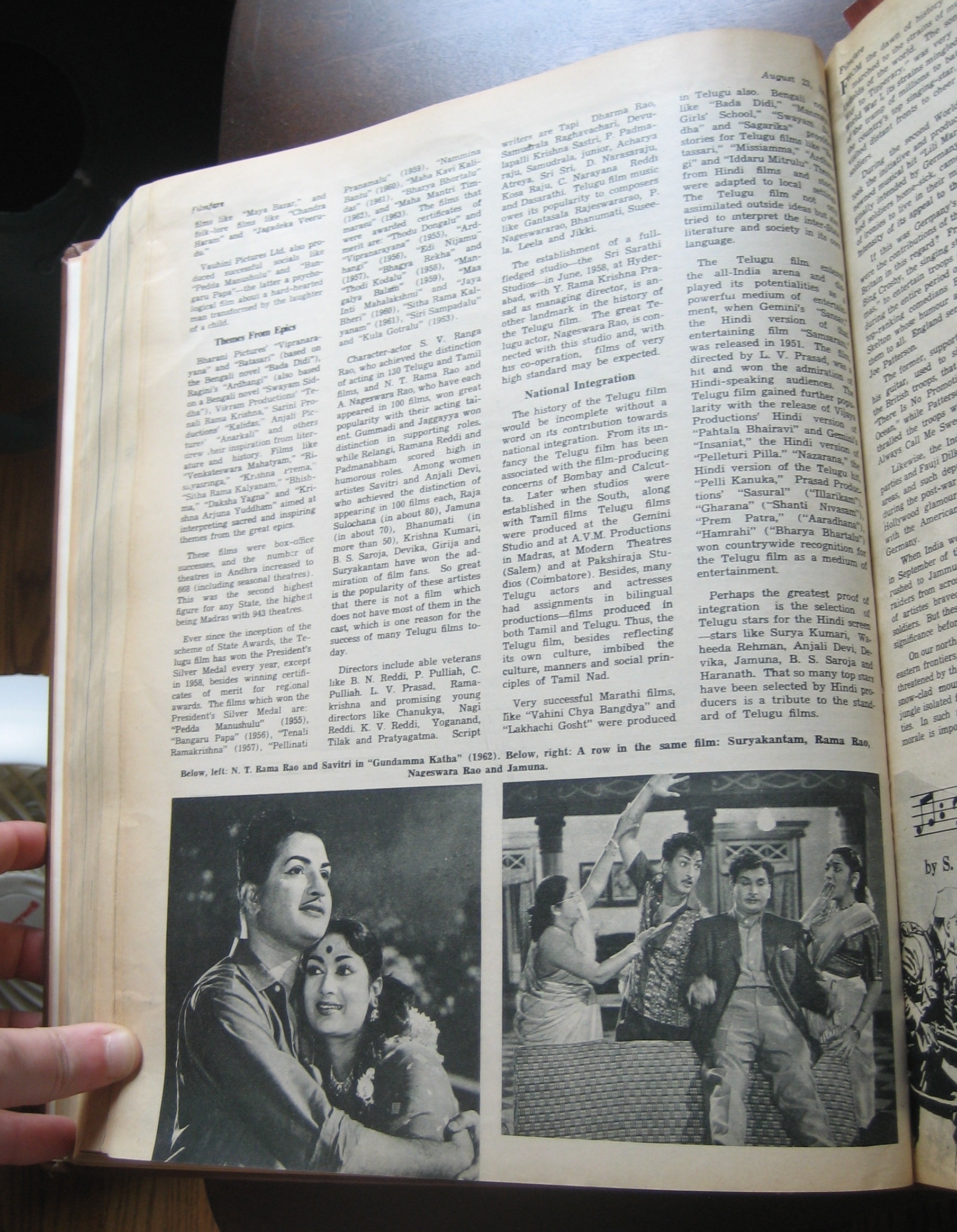
A kind reader with excellent research skills sent these photographs of a Filmfare article from 1963. If you click on the pictures below you should be able to see the full sized version and zoom in to read about the early years of this wonderful industry. If you’re observant you will spot a hand that may belong to our film historian/spy. The story starts in 1931 with ‘Bhakta Prahlada’, made by H.M Reddi and a troupe of Telugu stage artists who travelled to Bombay as there were no studios in the South. It also covers Vauhini Pictures and Vijaya Productions who made classics including Mayabazar and Missamma and provides some detail of the classical and mythological inspiration behind many successful films. I loved reading about the early cinemas and the ingenuity of film makers in an era before fancy technology. If you still need persuasion to see some vintage Telugu cinema, this may do the trick: “Telugu film has not only emerged as a powerful medium of entertainment and instruction, but has also scaled new heights of artistic and technical excellence.” Or you can just enjoy some lovely stills of favourites NTR, Savitri, ANR, Jamuna, SV Ranga Rao and L Vijayalakshmi, among others.
Junglee is quite simply my favourite Shammi Kapoor film. It was a big hit when first released in 1961, and featured not only Shammi but also Saira Banu in her debut performance. In fact she netted a Best Actress Filmfare award for her role in the film. Junglee features some great performances, an engaging story, beautiful scenery, fantastic songs and even a snippet of Helen – just perfect!
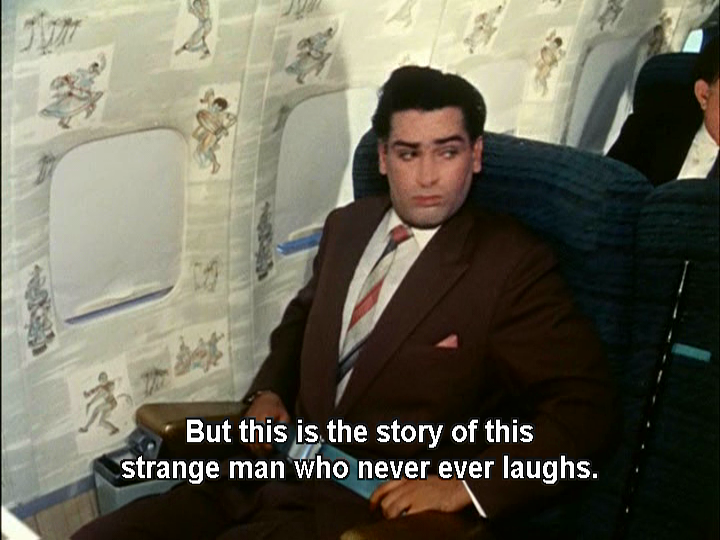
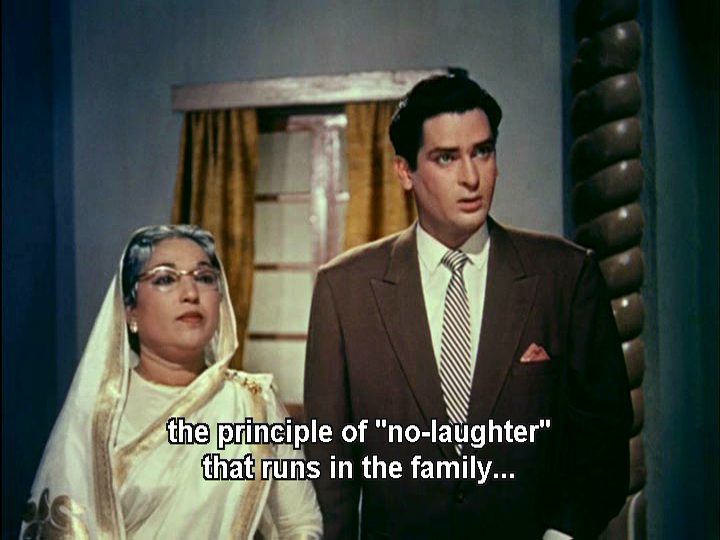
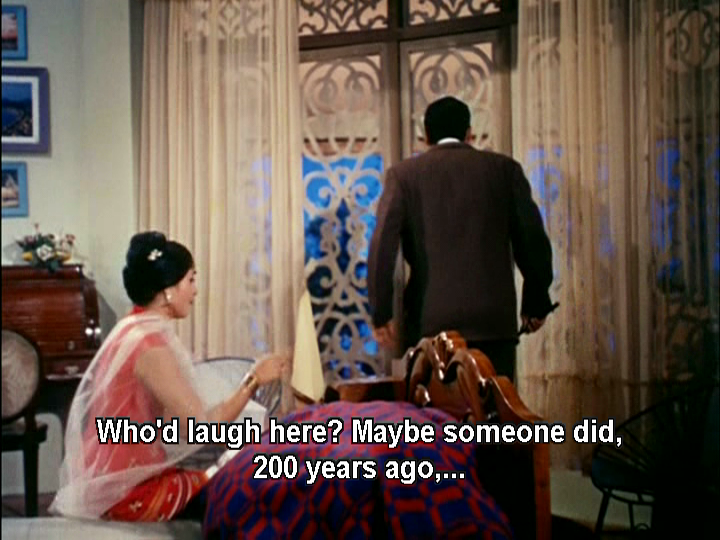
The film opens with Chandra Shekhar (Shammi) returning home after 3 years overseas in a wonderfully decorated plane. Via a voice over and a series of scowls and grimaces from Shekhar and his mother, we learn that the family disapproves of laughter and believes that it is something only indulged in by the lower classes.
While Shekhar and his mother seem to firmly believe in these sober and unsmiling principles, Shekhar’s sister Mala (Shashikala) has somehow managed to escape the family affliction. She is in love with Jeevan, the son of the family’s business manager and is quite the rebel. She smuggles her lover into the house, successfully hiding him from both her mother and Shekhar, although she doesn’t seem quite as adept at smuggling herself out.
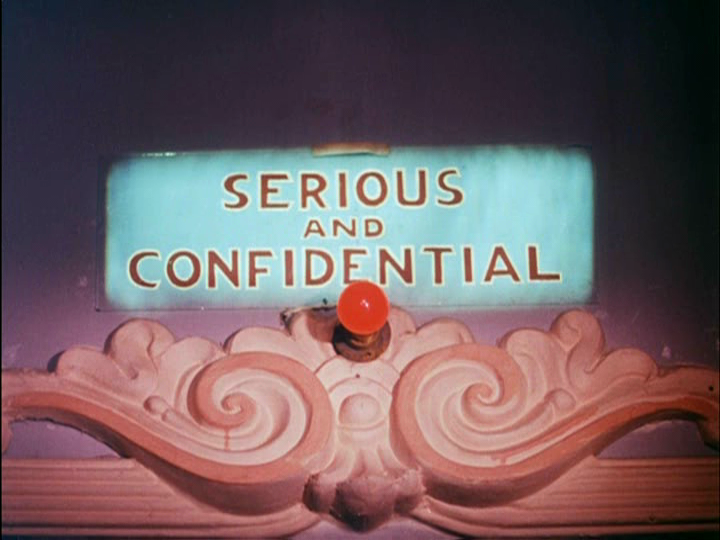
In due course, Mala and Jeevan’s secret affair is discovered, quite appropriately in secret and confidential discussions. We can tell this as there is a helpful sign with accompanying illuminated red light to let us know that there is a top-secret meeting going on and for extra top-secret authenticity, the room is red-lit .
Luckily for his father and Jeevan, his identity is not disclosed and to resolve the problem Shekhar is ordered by his mother to take Mala with him to Kashmir on his business trip. Shekhar has his own romantic issues to deal with as his mother has arranged his marriage to a Princess. However she is not aware that the royal family are impoverished and are banking on the marriage to ease their monetary woes, waiting only for Shekhar’s return to Bombayto go ahead and tie the knot.
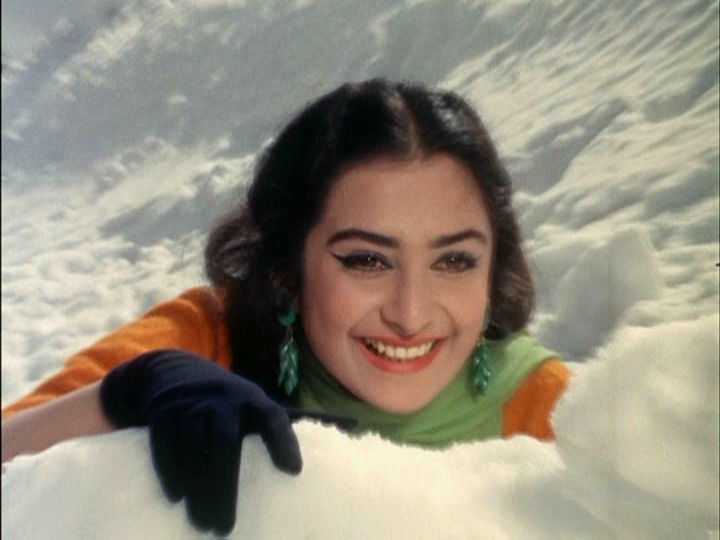
Needless to say Shekahr’s cantankerous disposition is not improved at all by his relocation and he just becomes grumpy in the snow instead of grumpy in the city. He meets the charming Rajkumari (Saira Banu) who delights in tormenting Shekhar just because she can.
Rajkumari’s father is the local doctor who soon diagnoses Mala’s sudden ‘illness’ as pregnancy. Knowing what Shekhar’s likely reaction will be, Rajkumari hatches a plot to lure him away until after the baby is born. However Shekhar discovers the deception and the two end up marooned in a cottage as a violent snow storm isolates then for an undisclosed amount of time. Long enough however for Shekhar to fall in love with Rajkumari and inspired by the transformed snowy landscape and his own evolution he bursts out with an exuberant Yahoo!
This is probably the most famous song from this film and deservedly so – Shammi’s high spirited cavorting around in the snow is brilliant and it’s a song always guaranteed to make me smile even after the worst day at work. There is so much energy and enthusiasm, and it’s a great contrast to the previous scenes where the two are stuck in close proximity in a small cabin.
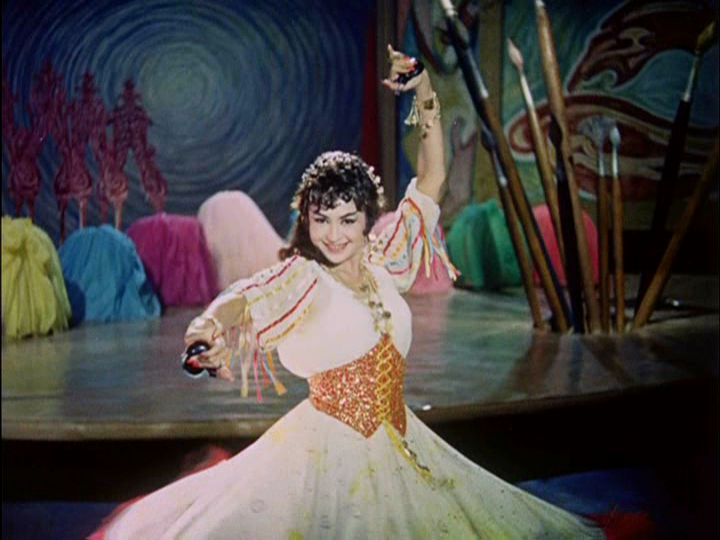
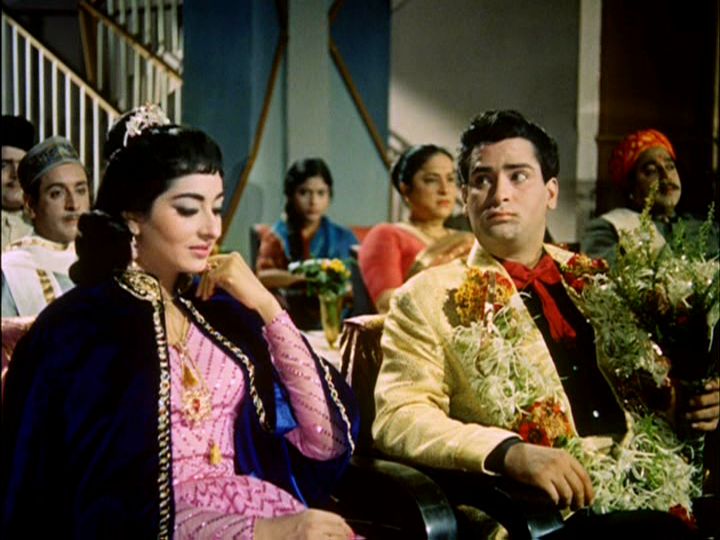
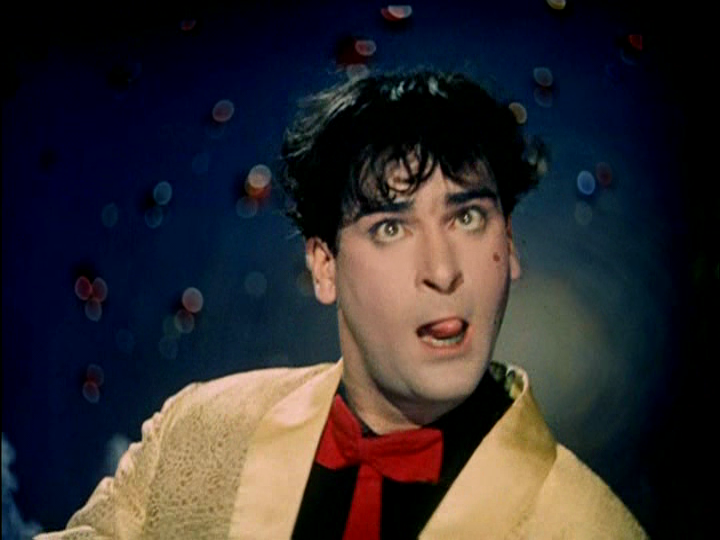
Now that Shekhar is in love he wants to marry his Rajkumari and heads back to Mumbai with his sister. But he still has to get rid of the other Rajkumari, the Princess he is betrothed to and there is also the dilemma of Mala’s baby to resolve. And Shekhar has to win his mother’s approval of his new happy personality which is probably the biggest challenge of all. He falls back on the favourite Bollywood excuse of insanity, which gives Shammi the chance to ham it up and make full use of his range of facial expressions. A visit to the princess and her family gives us a wonderful dance with Helen complete with giant-sized artist palette backdrop.
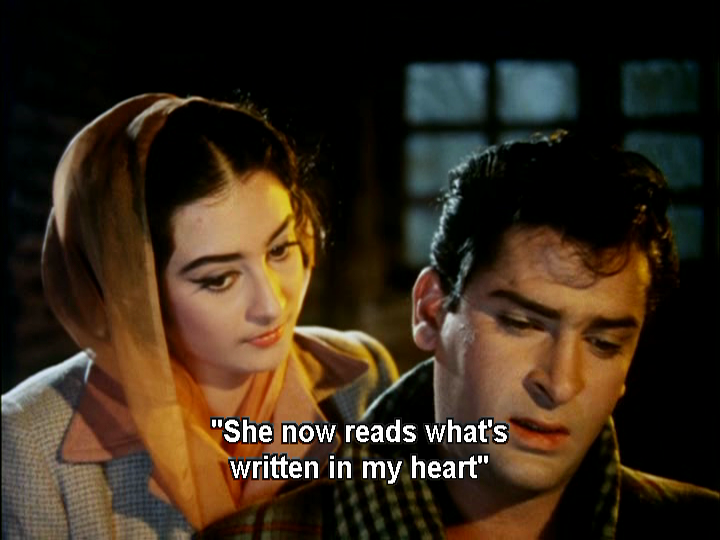
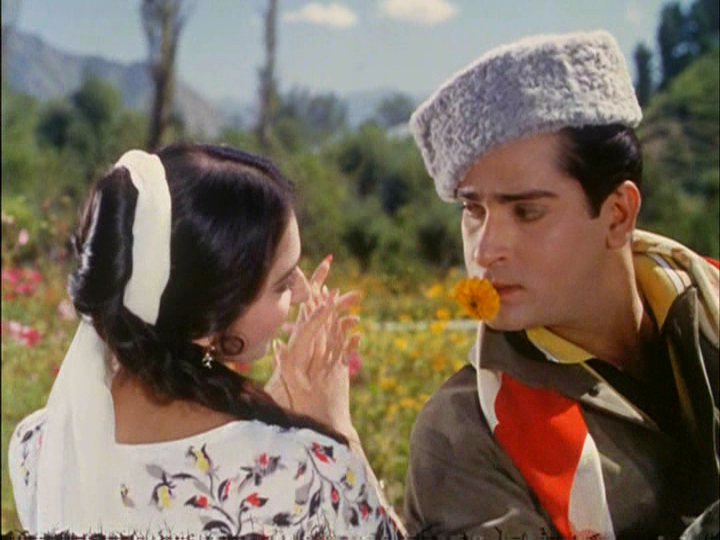
There is plenty more drama as Rajkumari and her father arrive with Mala’s baby and the brother of the ‘real’ princess gets more and more desperate before a suitably heroic ending. It’s not all about Shammi’s antics pretending to be crazy though as there are a number of beautifully romantic scenes as well. This is my favourite song from the film and I find Shammi totally adorable in this.
I love the many faces of Shammi in this. His mad twitches and grimaces are limited to when he is pretending to be crazy and in the rest of the film he is much more restrained.
The character of Rajkumari is also well developed and shows a gradual transition from her initial childish persona to a young women determined to do what is right. Saira Banu displays charming innocence and naivety and it’s clear to see that she was only 17 when she made this film.
Junglee has some of the most romantic scenes I have seen with Shammi and he is at his absolute best in these. He can be guilty of some scenery chewing at times, but here he is restrained and convincing as a man in his first throes of love. His eyes are very expressive and he does have some excellent chemistry with Saira Banu. The song Din Sara Guzara is another gem which is beautifully pictured. In fact, all of the songs are excellent and both Lata Mangeshkar and Mohammad Rafi do excellent justice to the music by Jaikishan and Shankar. The beautiful Ja Ja Ja Mere Bachpan is wonderful as well, and it really is worth checking both of these songs out.
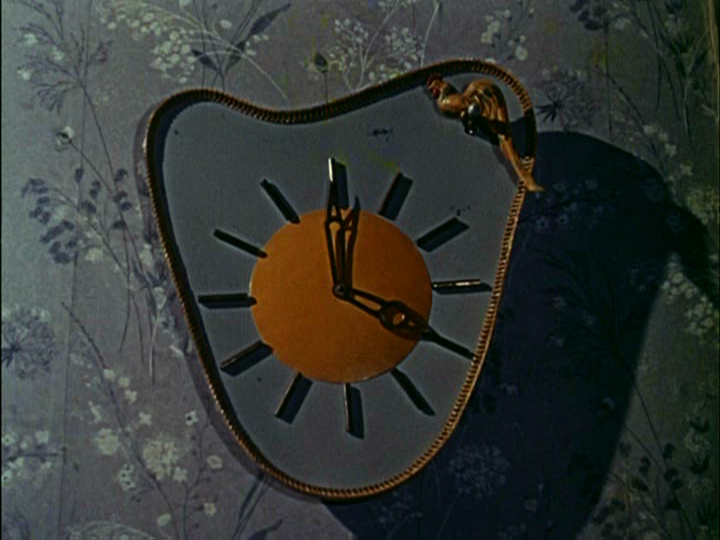
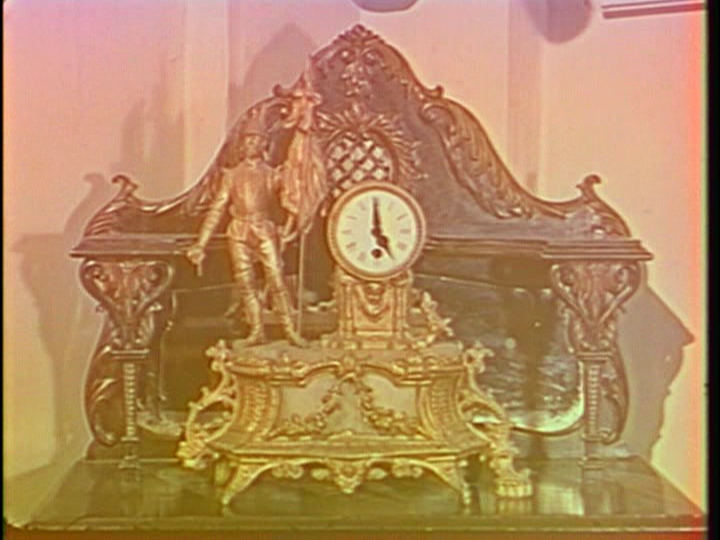
Although the story starts with a rather ridiculous premise, Lalita Pawar makes the character of the inflexible family matriarch strong enough to keep the idea of a woman bound by her duty to her late husband credible. While the ‘no laughter’ idea may not be very realistic, it is easy to believe in Shekhar as a man bound to rigid work principles who is uncompromising and ill-tempered. The mood lightens considerably when we get to Kashmir – not the least because of N. V. Srinivas excellent cinematography. The hills and flowers are beautifully shot and the songs make the most of the scenery. There are also some wonderful sixties décor on the sets. I particularly like the clocks and it’s a shame that my copy of this film has suffered from colour degradation with aging.
The support actors are all good in their roles too. Anoop Kumar provides some light relief as Jeevan and although Mala and her lover are only a peripheral part of the story, they both make an impact when they need to. While I do end up feeling a little sorry for the rejected princess, her brother and father aren’t quite evil enough to be convincing villains and I think they appear more pitiful and desperate.
Junglee is at heart a love story and as such it works really well. Excellent performances and fabulous songs plus Shammi at his best make this a 5 star film for me.
This 1963 classic has an exceptional cast, featuring NTR, Savitri and SV Ranga Rao, under the lively direction of Kamalakara Kameshwara Rao. Narthanasala renders a chapter of the Mahabharata in an accessible and highly entertaining style. The story as shown concentrates on the Pandavas efforts to serve out the 13th year of their exile, and how they deal with their tribulations. I’m sure there are many versions of this tale and this screenplay no doubt varies from those in some ways. My knowledge of the Mahabharata is basic, but all the information you need to know to enjoy Narthanasala is contained within the film, so don’t let that be an obstacle.
Arjuna is honoured by Indra, but manages to tick off Urvashi (Padmini Priyadarshini) when he rejects her advances. She curses him to become a eunuch. I cannot blame her for being mislead after watching him watching her in this dance:
And she looks furious!
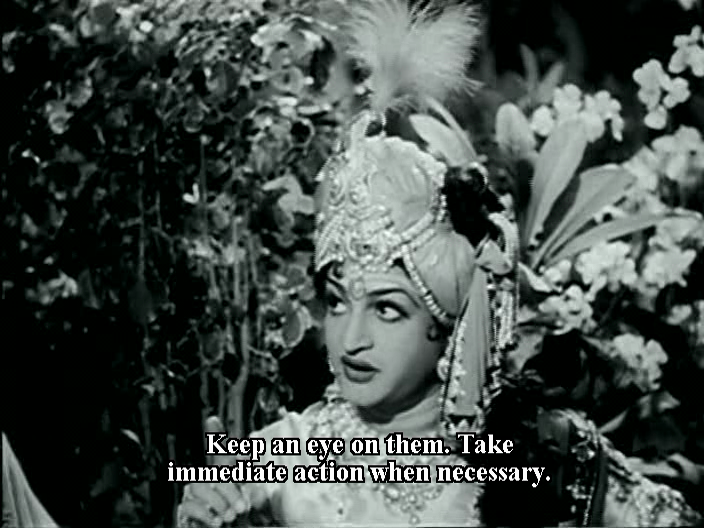
The curse is mitigated somewhat by a time limitation granted in recognition of Arjuna’s essential manly goodness. This coincides with the 13th year of exile when the Pandavas must take refuge in a kingdom and remain anonymous for that final year. The set up of the characters and how they would conceal their identities was simply done in a conversation that pretty much spells out who’s who. There are spies and lures set to draw the Pandavas into the open, and the cat and mouse game with Duryodhana adds an edge of tension to the waiting game.
Dharmaraju (Mikkilineni Radhakrishna Murthy) is occupied as an advisor to King Viraat, and has little free time to spend with his brothers and wife. The twins Nakula and Sahadeva work with the livestock and are absent most of the time. This leaves Draupadi (Savitri), Arjuna (NTR) and Bhima (Olympic wrestler Dandamudi Rajagopal) on centre stage.
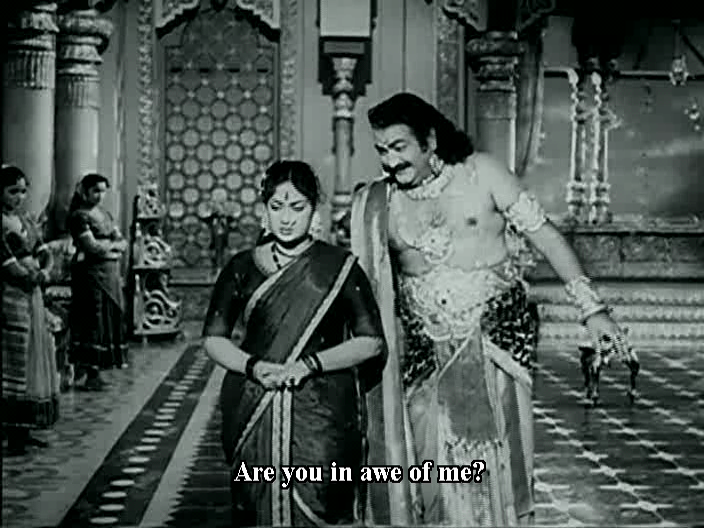
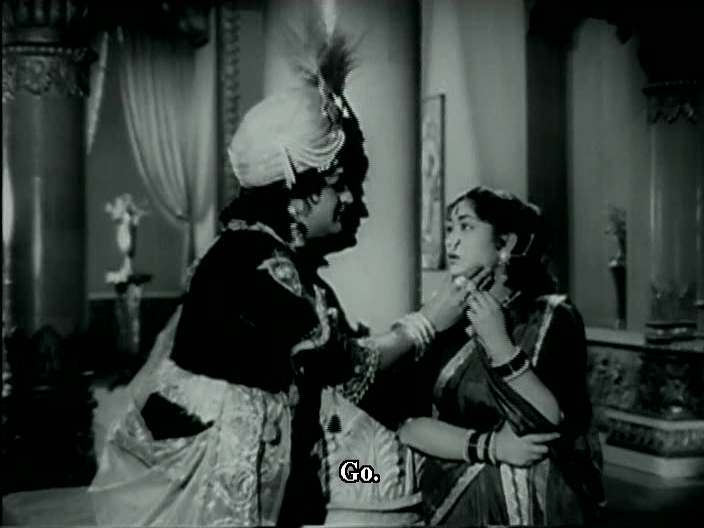
Draupadi is beautiful and deceptively delicate looking. Her husbands make a big deal of her having to undertake manual labour, but she is more resilient than they are in some respects. Although usually deferential to her husbands, when she needs to stand up for herself she leaves no doubt as to the consequences of drawing her anger. Calling herself Malini she goes to work as a ladies maid and beautician for Queen Sudheshna (Sandhya). She pleads with the queen that she be protected from tasks such as being sent off to entertain strange men and serve in other households, and Sudheshna agrees. Draupadi’s awareness of her vulnerability is clear, and despite her efforts she does attract unwanted attention.
How she attempts to deflect and ultimately stop this harassment is the main focus of the drama, and she tries many approaches before demanding her husbands step in. Krishna intervenes when called upon, but the solution lies with the human characters. Draupadi’s affection for Arjuna gives their complex life a strong emotional core, and their scenes had an element of romance that her interactions with the other husbands didn’t. She has a rare laugh when talking to him about their son. Savitri is, as I have come to expect, excellent in a role that demands both high emotion and restraint.
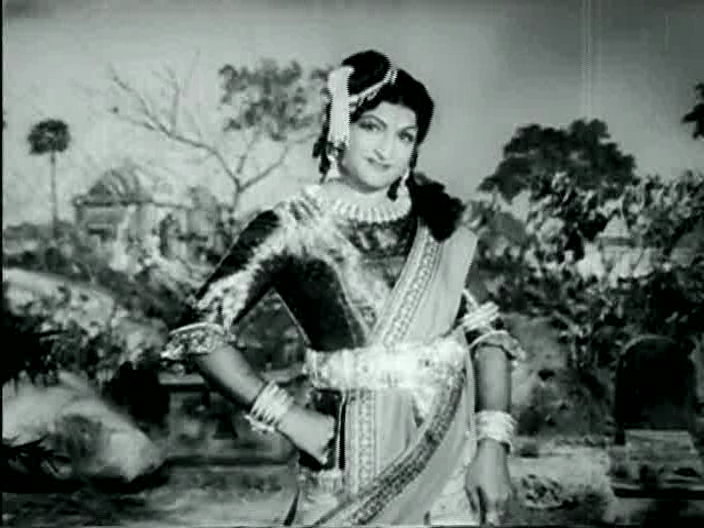
Arjuna is transformed into Bruhannala. He takes up the position as dance teacher to Uttara (L Vijayalakshmi) and embraces accessorising. He should have had those dance lessons as while Bruhannala’s expressions are flawless, his dance steps are not quite as graceful.
NTR looked knowing and effeminate as the eunuch, always slyly amused at fooling everyone around him. It falls to him to come up with the scheme to keep Draupadi from harm and to keep the Pandavas safe until the end of their exile.
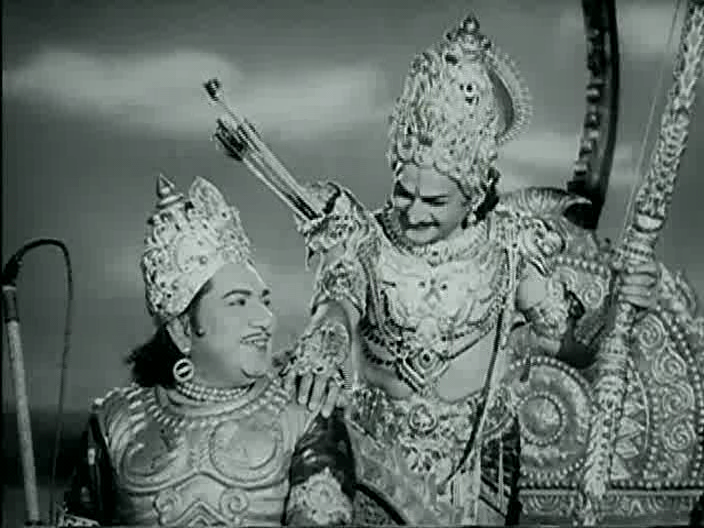
The stolen conversations between him and Draupadi have an undertone of longing. When they touch there is chemistry; Arjuna, the husband missing his wife, is suddenly visible despite the fripperies of Bruhannala. When NTR re-appears as Arjuna he is quite regal although maintains the air of amusement. His scenes with Uttarakumar in the chariot are fun and he enjoys the consternation caused by his transition from Bruhannala back to Arjuna. It’s a warm, appealing performance, and the knowing looks to camera drew me into the asides and secrets.
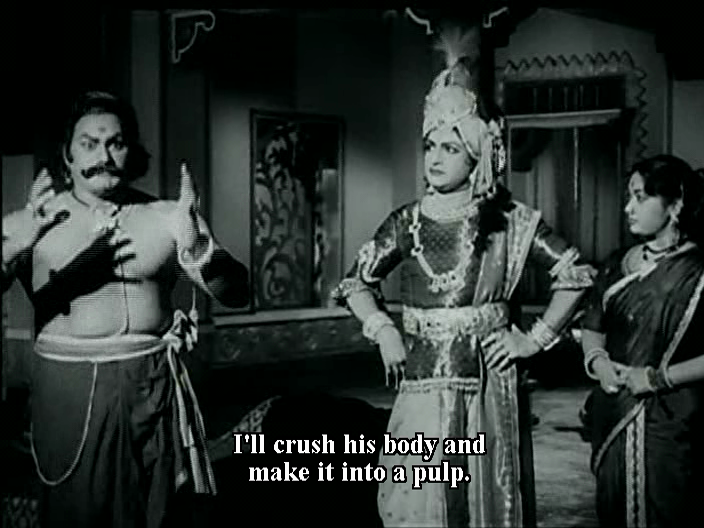
Arjuna is more philosophical about Draupadi’s situation and is prepared to manage each crisis as it happens. Bhima cannot contain his fury; he just wants to tear Keechaka apart.
He knows his own flaws and is guided by the more calculating Arjuna and Dharmaraju’s sense of justice. His powerful physique is an asset to the family but may also be the thing that gives them away. There wasn’t a lot of subtlety needed for this performance, but it wasn’t just posturing and roaring.
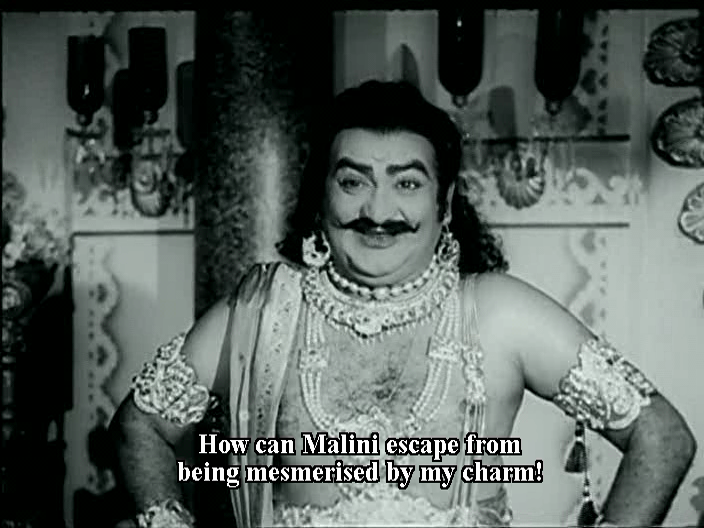
SV Ranga Rao is Keechaka, the queen’s larger than life brother, a jovial bully. His inability to control his lust does more than threaten Draupadi. It also jeopardises the safety of all the Pandavas who may not maintain their disguises under such insult, and threatens the kingdom as he forces the queen to give Malini over to him. He is literally blinded by desire.
How else could he mistake Bhima for Draupadi? His performance is excellent as he manages to be likeable and hateful. I was cheering when he got his just deserts.
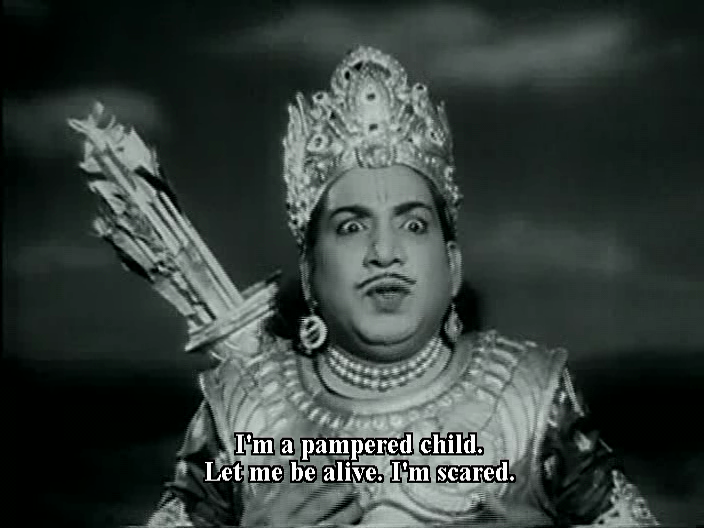
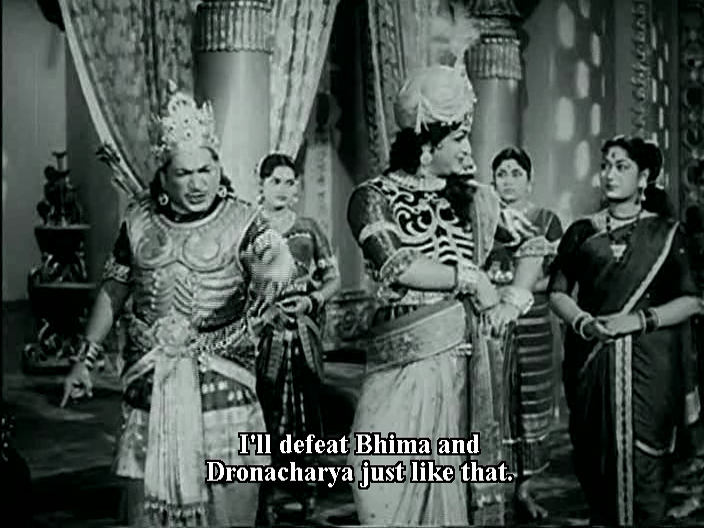
Relangi Venkata Ramaiah (a.k.a the ‘Clap Your Hands Behind Your Back guy’ from Mayabazar) is lots of fun as the pompous, cowardly but endearing Uttarakumar. He has delusions of being a great warrior and leader, and his preening and posturing amuses me as much as it does the Pandavas. He is followed around by his attendants, one of whom is Allu Ramalingaiah with perfect but unobtrusive comic timing. Uttarakumar is nice to his sister, and never gets angry or mean with the cooks despite their unfortunate comedic tendencies, so I like him.
L Vijayalakshmi is perfect as his sister Uttara. I really enjoy watching her dance and she has a sprightly, flirty, quality that enhances the role. She and Abhimanyu have a romantic subplot but really her purpose seems to be dancing and being decorative. This is only the third film I have seen her in, and I hope to find a few more.
The songs (original music by Susarla Dakshinamurthi) blend into the story and I wish they had been subtitled, as often they are used for exposition or introductions. The dancing is lovely, and the sets and costumes are opulent. The decorations are extravagant and yet allow the performers to be the focal point. It’s also a ripping good story, and the pace of the direction matches the tempo of the drama to perfection. It’s just gorgeous.
4 ½ stars! (a small deduction for too many squeaky comedy cooks in the kitchen)
Heather says: Narthanasala is just delightful to watch. The film’s all star cast are excellent and the sets and costumes are fabulous. Since I’m not very sure about all the characters in this part of the Mahabharata, I really appreciate the opening scenes where everyone introduces themselves and explains who they are, the alias they are going to assume and what they are going to do for their time in exile. Very helpful.
The stand out performance for me is by NTR. He is excellent as Arjuna in the film’s opening scenes and his transformation into the eunuch dancing teacher Bruhannala is brilliant. It’s not just the delivery of his lines or his posture, but his whole demeanour which changes, and he is wonderfully feminine. He also has the best costumes and totally awesome eyelashes! This looked like such a fun role to play and NTR had the right amount of playfulness and hauteur to make it work.
Savitri is as beautiful as ever although I was a little confused about her character as Malini. Since they were supposed to be in hiding it seemed rather odd that she would say that she had 5 husbands and needed shelter for a year. Surely that gave the game away as to who she really was? It didn’t seem to be a requirement of their exile since none of the other characters seemed to reveal quite as much about their identity. However, I only have a very limited knowledge of the Mahabharata, so this could just be an essential part of the original. The film drags a little in the middle while waiting for Draupadi’s rescue from the funeral pyre, but the previous scene with Bhima in drag pretending to be Malini was excellent. Dandamudi Rajagopal is very good in his portrayal of Bhima/Valala and as a professional wrestler he certainly looks the part. Unlike Temple, I love the minions in his kitchen who I think are really very funny, always fighting and squabbling and behaving more like troublesome children. The comedy with Uttarakumar is very well done as well, in particular the scenes with Arjuna when he goes out to fight the Kauravas
The dancing is lovely and although the fight scenes were quite stylised they are enjoyable to watch. I loved this line from the battle between the Kauravas and Arjuna towards the end “He greets the elders with his arrows. That is what makes him so adorable!” And NTR was! I really enjoyed this film – 4 ½ stars.








 Cinema Chaat