Rab Ne Bana Di Jodi

Rab Ne Bana Di Jodi requires some determined suspension of disbelief. A prematurely middle aged man marries a bright, lovely young girl immediately after she experiences a family tragedy. He loves her on sight, she doesn’t see him at all. He changes himself to become a man she could love. But he does it in an extreme way. He masquerades as another man, utterly different from his everyday self, and starts to woo her. What happens if she recognises him? What if she prefers the ‘other man’? How can he get himself out of this situation? And who will win the big dance competition?

I’m not telling.

I really like this film. It has excellent acting by Shah Rukh Khan and Anushka Sharma, and characters I could empathise with or understand, even when I didn’t agree. I know some people object to the premise that she doesn’t recognise her husband immediately. Personally, I think that if you suspect every man who looks vaguely like your husband or boyfriend is him in disguise, you probably have bigger issues than the film does. Aditya Chopra hits some false notes including a ridiculous sumo wrestling interlude, but it’s really a story about people not gimmicks so I can turn a blind eye. There is ample entertainment in the romance, humour (please note I am not using the C word), dancing and music.
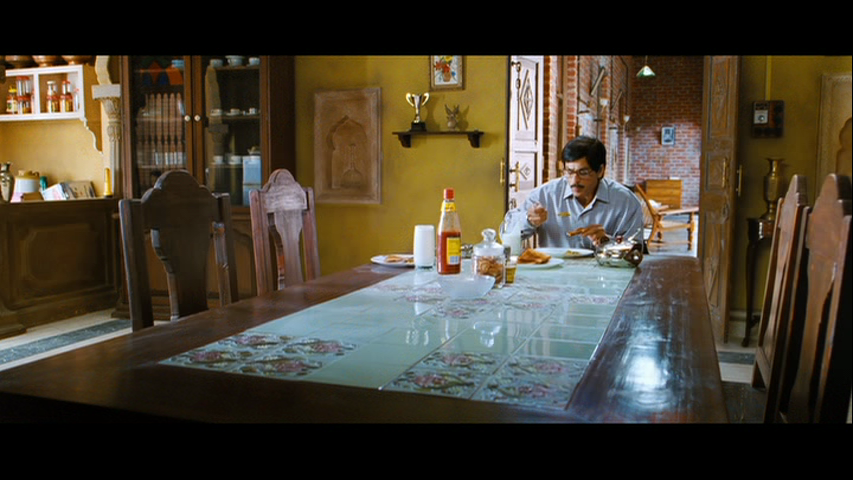
Surinder Sahni works at Punjab Power (motto: Lighting Up Your Life) and lives all alone in his family home, a huge ornate house. He is an unassuming man who has fallen into a rut. Until he falls for Taani. Seeing her disappointment on top of her grief he wants to do something to make her happy, or at least stop her from giving up on happiness. Surinder is considerate as well as shy and doesn’t presume on his new wife. He sleeps in the attic room and calls her Taani-ji, so painfully polite. Suri doesn’t do macho or overbearing – he is atypical for a romantic lead. In his own beige way he tries to show his feelings, hoping his actions will speak for him. He sees her laugh watching movies and tries to understand the appeal of filmi heroes but he is worlds away from that flashy style. This is one of my favourite Shah Rukh performances. He plays Suri as mostly subdued, with a shy romantic streak blooming as he dares to dream.

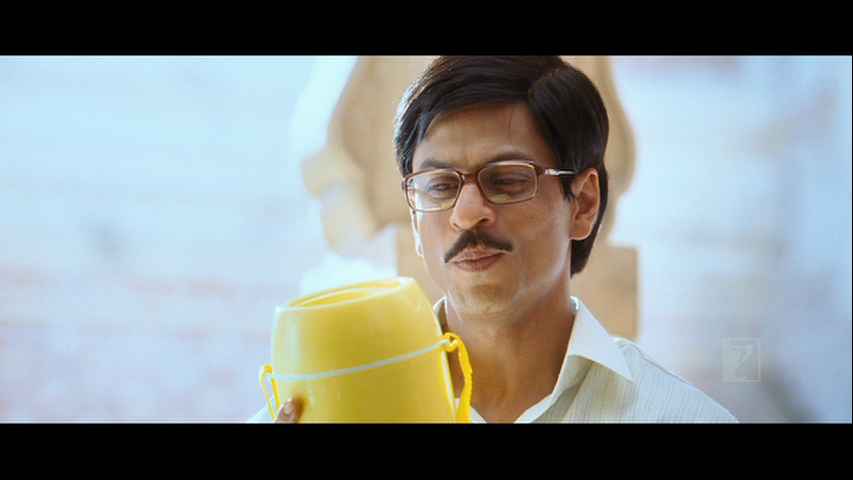
The expression on his face when he sees the tiffin Taani has prepared for him is priceless. Shah Rukh strikes the right blend of physical comedy and heartstring tugging pathos as Suri.


Suri’s flamboyant hairdresser friend Bobby (Vinay Pathak in excellent form) helps with a makeover. The idea is Suri will go watch Taani at her new dance class, and then surprise her with the new look. But he can’t stop himself from trying to get closer to her. And so Raj is born; vulgar, extrovert, inappropriate Raj Kapoor who can say and do things that Suri won’t.

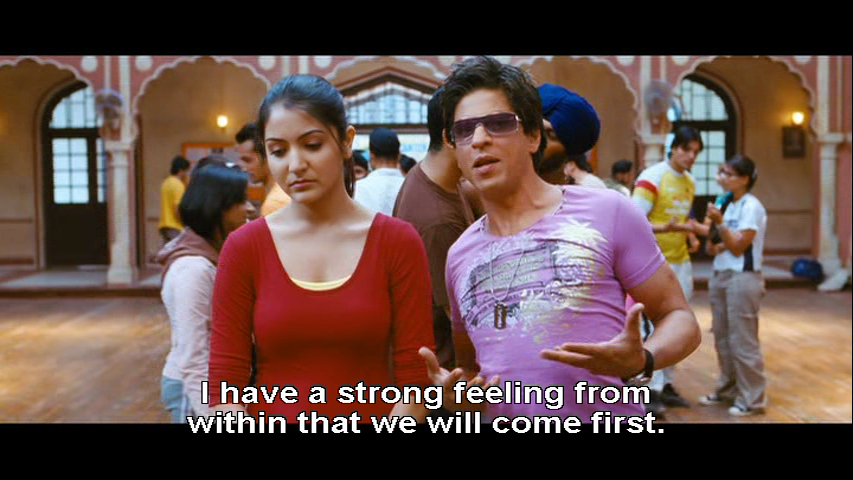
Shah Rukh doesn’t play Raj as cool – he is a nerd’s idea of a cool dude and always that bit off key. I’m not surprised Taani didn’t recognise him. He has terrible fashion sense and constantly over-accessorises (thanks to Aki Narula). There are some delightful moments of Raj getting cocky, only to have Suri’s panic leak through when he doesn’t know what to do next. Raj becomes Taani’s dance partner for a competition – another touch of fate or divine intervention. The relationship has a rocky start but Taani can’t help eventually responding to Raj’s simple warmth.
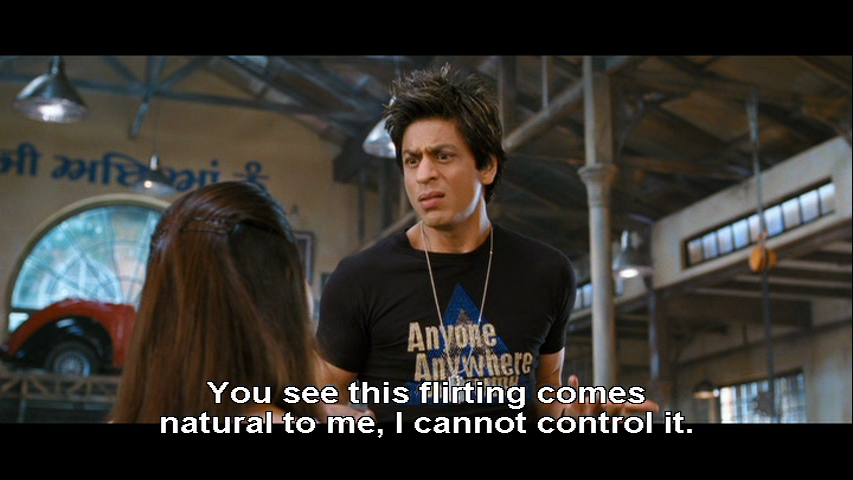
He helps her reconnect with life in a way that Suri’s patient hands-off approach doesn’t. Shah Rukh portrays two quite distinct characters, and I could see Raj growing and becoming more of a second skin over time.
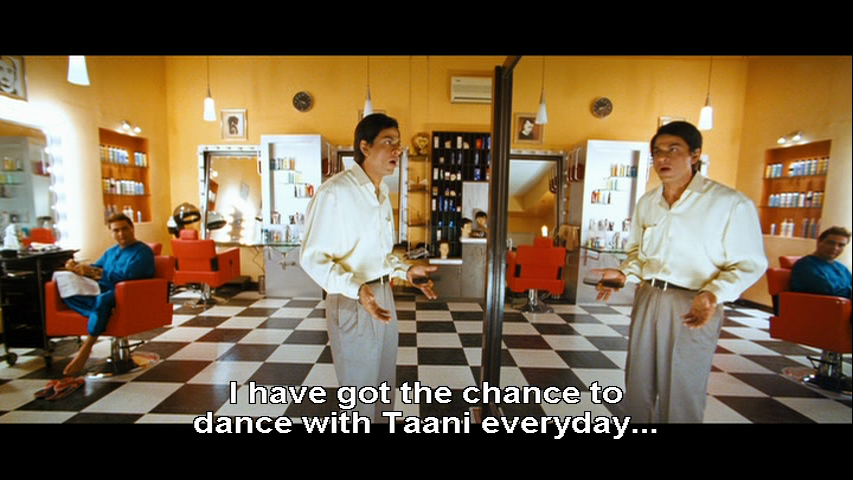
Raj is a drug that Suri cannot kick. When Bobby challenges him, Suri admits he can’t stop. The deception escalates and as Raj he taunts himself over his failure. This dark tone of self awareness and self delusion made Suri’s deception seem more real.
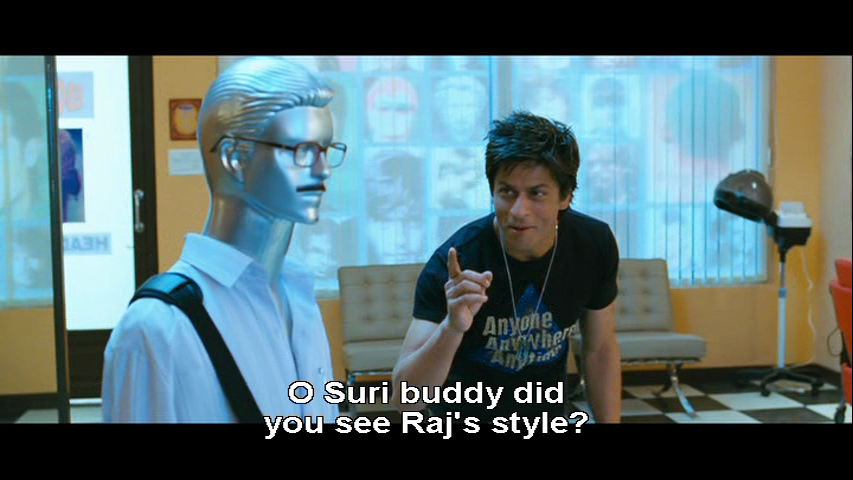
He created a mask and resented being trapped behind it. As Suri he wants Taani to see the real Suri, and fall in love with him as he is. As Raj, he is spontaneous and affectionate. But what happens to Suri if Raj succeeds in winning Taani’s love? And if Suri kills off Raj, what will that mean to Taani?

Taani is the apple of her father’s eye, and about to marry the man she loves. A few tragic minutes later she is married to Suri and relocated to Amritsar. At that time she may not have cared much for her future as she was traumatised and grieving. Anushka has a natural and happy quality, but she can turn that off in an instant, and she portrayed the conflicting emotions and loyalties very well.  Taani rarely looks at her husband, and certainly doesn’t see him so I could believe she didn’t recognise him in disguise. The more Suri tries to engage her, the more she blocks him out. She’s not a crying whinging wet dishrag though – Taani is a spirited woman and even does a Dhoom style motorbike stunt. She really comes to life when she forgets herself in things that had been her pleasures in her old life, especially dancing.

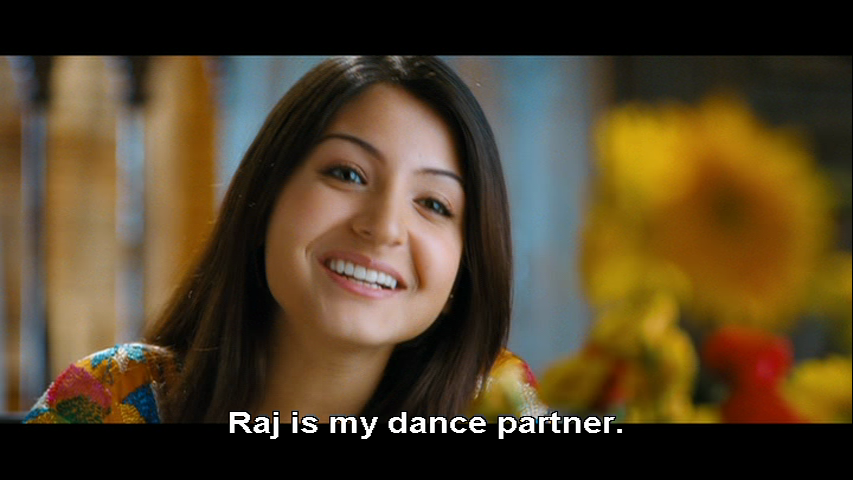
She resents feeling indebted to Suri even as she appreciates his generosity, but is making the best of things. Taani doesn’t have friends in Amritsar apart from Raj, who refuses to not be allowed to be her friend, so he is her only confidant. She comes to a crisis point, and I think it was as much about wanting to actively live again as her attraction to Raj.

Taani finally allows herself to love and to reconnect with life. While Anushka is very pretty she seems real, not a plastic beauty, and I found her convincing and appealing. I also had severe wardrobe envy when I saw Taani’s clothes, especially her lovely embroidered dupattas.

The theme of a couple brought together by God is always present. The presence of religious observance and ritual in their lives helps give that more resonance as it seems like a genuine belief not just a dramatic conceit. The gold of the temple at Amritsar is picked out in  Taani’s dress, the yellow tiffin, Suri’s car, the new bedsheets and flowers Taani leaves in his room. For him, Taani is divine love and she is lighting up his life.  The corny picturisation of Tujh Mein Rab Dikhta Hai can’t detract from the message of seeing an aspect of divinity in the one you love, or who loves you.

I really like that it shows Suri seeing himself as Suri, but Taani sees only Raj. The tension in the bizarre love triangle is well maintained even in lighter moments. I think that the inherent acknowledgement that some characters were not always behaving well made it more palatable and less WTF, so the resolution is oddly satisfying. My eye-rolling muscles barely got warmed up, I just went with it and enjoyed the unravelling.

Whether it is the bustle of Amritsar, Suri’s majestic old house, Taani’s clothes, the framing or the use of colour, Ravi K Chandran makes it look stunning and it’s a total pleasure to watch. This traditional sounding song is over the opening titles but not on the soundtrack, and it is a beautiful start to the film.

The Salim-Sulaiman soundtrack is mostly excellent and Jaideep Sahni’s lyrics seem to match the story very well. Haule Haule is beautiful, and the choreography is perfect uncle-in-love style. Retro tributes are now old hat, but the clever lyrics made up of film songs and titles and the vocal by Sonu Nigam lift Phir Milenge Chalte Chalte. Shah Rukh really gets the style of the Hindi film greats he mimics, particularly in the Rishi Kapoor segment. Lara Dutta is miscast as Helen, but Rani as Neetu more than makes up for that. I much prefer the songs Vaibhavi Merchant choreographed. Shiamak’s style is too reminiscent of 80s TV variety shows and I’ve seen enough of that to last me. Dance Pe Chance and the dance competition numbers are not memorable, although I appreciated Anushka and Shah Rukh maintaining their characters in the dances so they worked as drama rather than as songs. But so much colour and movement can’t be a bad thing.

See this for an unusual romance, good songs, beautiful visual design and of course the lovely performances by Shah Rukh and Anushka. Just remember to suspend that disbelief! 4 stars!

Heather says: I am quite ambivalent about this film. On one hand I do really like Shahrukh’s ebullient Raj and most of the time I like his characterisation of the more reserved and introverted Suri. But on the other hand there is much of the story that I don’t like, and I’m not very impressed with the character of Taani despite Anushka Sharma’s best efforts.  Taani seems a very superficial character and the few personality traits she is allowed to display switch on and off depending on how much comedy Aditya Chopra wants to include in the scene. When she is allowed to be cheery and feisty I quite like her, but most of the time she is too one dimensional and is only there as a reason for Shahrukh to play dress-up.

As far as the story goes, I don’t like the way that Taani is pressured into marriage with Suri at such a difficult time in her life. However even worse is the direction the story moves in later on, when Suri decides to make his wife choose between Raj and himself. It’s manipulative, very unfair and just plain wrong. I don’t see how such a plan can possibly demonstrate true love and I think Taani would be much better to leave Suri and Raj altogether!

What I do like though is the character of Bobby Khosla and I think that Vinay Pathak did a great job with his role as Suri’s friend. There are a few scenes near the beginning where the character of Suri is initially developed that are also quite sweet and hold a lot of promise but unfortunately I don’t think the film ever delivers on these. While both Shahrukh and Anushka bring everything they can to their roles, ultimately it’s the story that lets it all down in the end. The songs are great and I love Phir Milenge Chalte Chalte, but for the rest, it’s not a film I particularly enjoy. I think it’s worth watching for Shahrukh, who does have some excellent comedy moments and he at least seems to be enjoying himself. The rest is disappointing. 3 stars.

Manichitrathazhu

I love this film! It was probably the very first SI film I ever bought back in the days before I had any idea about the industry. I watched Bhool Bhulaiyaa in the cinema and then read that the dancing was better in the original movie, so immediately hunted down a copy. And really, it’s not only the dancing that is better! Manichitrathazhu was released in 1993 and has since been remade in a number of different versions but of the three I have seen, the original is definitely the best.

In contrast to the more comedy orientated Bhool Bhulaiyaa, Manichitrathazhu actually works well as a ghost story with some genuinely eerie scenes and unexplained happenings to set up the story. Nakulan (Suresh Gopi) and his wife Ganga(Shobana) move in to his ancestral home, Madampilli house to live for a few months while Nakulan works in the area.

The house is reputedly haunted by the vengeful ghost of a Tamil dancer Nagavalli and that of her murderer, the rich nobleman Sankaran Thampi. Their spirits are said to be held in a room of the mansion and the door is locked shut with the ‘ornate lock’ of the title. Ganga and Nakulan both disbelieve totally in such fanciful ideas, but Ganga is fascinated by the story of the doomed dancer and with the help of Nakulan’s cousin Alli (Rudra) she contrives to open the room. To my disappointment, and possibly hers as well, no vengeful spirits rush out, and she only finds the dust of ages and a box of Nagavalli’s jewellery.

Once the door is opened however there are a number of strange happenings around the mansion. Various articles catch fire and the sound of ghungroos and music are heard at night.  The head of the family Thampi (Nedumudi Venu) and his bumbling brother Unnithan (Innocent) move their families into the house to try to protect the couple as well as attempt to confine the spirits back to their room.

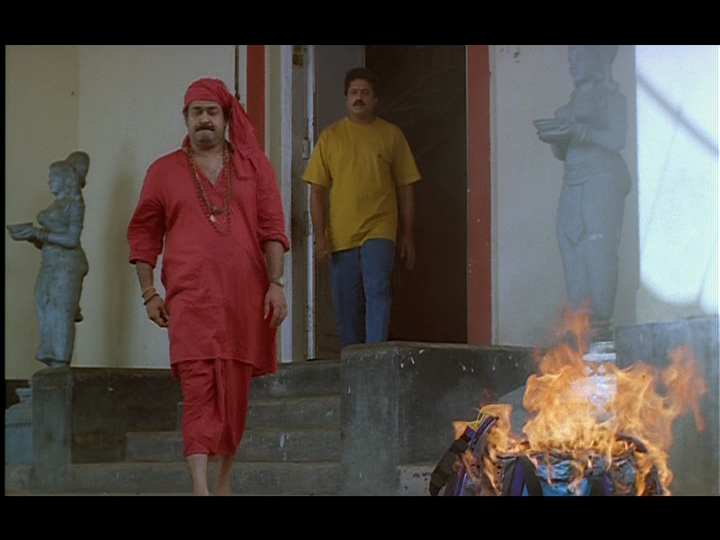
This part of the film is captivating with the juxtaposition between science and superstition and the various ways the family deals with the apparent ghostly manifestations. On the one hand Thampi and his family tie charms to ward off evil spirits, employ priests to hold ceremonies and engage a tantric expert to pacify the spirits, while Nakulan steadfastly refuses to believe in any supernatural entity and calls in his friend and renowned psychiatrist Dr Sunny Joseph (Mohanlal). Although from Dr Joseph’s introduction it’s hard to know which of the two methods is the better choice.

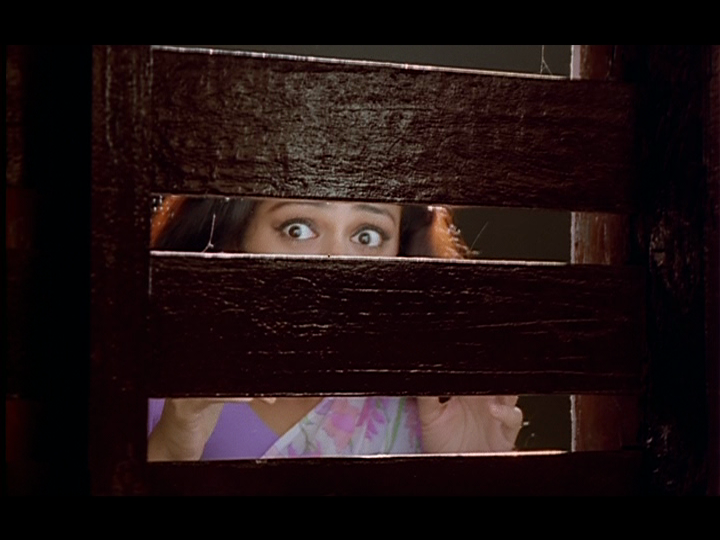
Nakulan suspects his ex-fiancée, Thampi’s eldest daughter Sreedevi, of causing all the incidents around the house. Sreedevi is a quiet and withdrawn girl who apparently has an unfortunate horoscope and who also seems to turn up at the wrong place every time something strange happens. With the arrival of Dr Joseph the story shifts from the supernatural into more of a psychological thriller as the psychiatrist does not believe in the existence of a supernatural entity either and decides that there is a mentally disturbed human agency behind the disruptions. Dr Joseph goes about tracking down the culprit with his unique methods, and then has to deal with the consequences of his discovery.

The only thing I don’t like about this film is the character of Dr Joseph despite Mohanlal’s best efforts and terrible shirts. I find that the over-the-top comedy aspect detracts from the more serious side of the story when it starts to delve into the issues of mental illness, and a lot of the antics Dr Joseph engages in are just irritating. However it’s not supposed to be an exploration of mental illness and I don’t find the attitudes of the other characters annoying in the same way. The patronising and condescending manner of Dr Joseph in his ‘comedy moments’ is horrible though and I don’t like way his character sleazily tries to woo Sreedevi at the same time as’ accusing’ her of mental illness. And yet, when the action takes over and the jokes stop, Dr Joseph is much more likeable and I wish that Mohanlal had played him as a straighter character for the whole film.

Shobana on the other hand is amazing as Ganga. She plays the character so well and thoroughly deserved the awards she won for her performance. Vinaya Prasad as Sreedevi doesn’t get as much screen time but she plays the quiet and unassuming character with the appropriate dignity and reserve. The two uncles Thampi and Unnithan together form a ‘comedy-light’ track and it’s generally well done and fits into the story without detracting from the main action. However the comedy track involving the tantric expert Brahmadattan Nampoothirippadu (Thilakan) is a little too slapstick for my taste and just isn’t very funny. Suresh Gopi is fine as the rather utilitarian husband dealing with the unexplained happenings in his ancestral home, but he is frequently overshadowed by Shobana and Mohanlal. The other minor characters are all good in their roles and I really like the actress who plays Unnithan’s wife. She had some great comedy moments and was very natural in her role.

I haven’t said much about the dancing which was the whole point of watching this film initially, but the highlight is the final climax song. It does give away the identity of Nagavalli though so skip it if you don’t want to know. Otherwise click here for the best depiction of Nagavalli I’ve seen.  The whole sound track by M. G. Radhakrishnan is lovely too and this is another beautiful and moving song from the film.

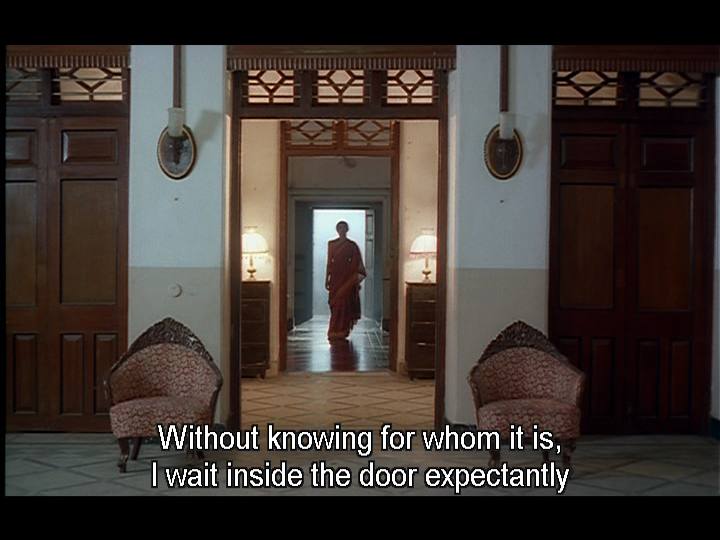
As seems to be the case with most Malayalam films, no matter what the subject matter, the film looks beautiful. The house used for the shoot appears to be a labyrinth and the various characters often have to run up and down stairs, along corridors and through innumerable doors to get to the scene of the action. Nothing ever seems to be shot against a blank wall, but instead is filmed against doorways, windows or beautiful shots of the country side. While no actual ghost is seen, there are shadows and suggestions all made more chilling by the use of claustrophobic corridors and shapes glimpsed through far doorways. The décor of the house is also well thought out with the couple’s room having the feel of one where the occupants are only there for a short time. And of course I also noticed the clocks.

I love the music and the whole feel of the film. It’s a great story by Madhu Muttam and Fazil has done an excellent job with his direction to bring it to life. My only complaint is with Mohanlal’s overly jocular psychiatrist and I can manage to live with that since the rest of the film is so well presented. No matter how many times I watch it I still get totally involved in the story again and eagerly wait for that wonderful dance. 4 ½ stars

Temple says:

I really like ghost stories, and Indian cinema has some good examples of spooky, understated and haunting (ha!) films. I like a lot about Manichitrathazhu, and totally agree with Heather on the beauty of the house and location that add so much to the atmosphere, and the excellent dancing in the denouement. Shobana is a compelling and beautiful heroine, and gives Ganga a great deal of emotional depth and energy. There is much more to Ganga than the dutiful wife who mutely follows her husband’s lead, and Shobana brings her to life. But Mohanlal really spoils it for me. I disliked his characteriation of Sunny Joseph on first sight and thought he failed miserably to balance the unconventional prankster with the more serious practitioner and friend. Watching it again, and knowing how it ends, there is no suspense left to distract from the shortcomings of how things happen. This may be considered sacrilege but if I could play mix’n’match, I would replace Mohanlal with Rajnikanth (in the Tamil version, Chandramukhi) who at least has enough charisma to overcome a fairly silly character. And I would probably want Vidya Balan (Bhool Bulaiyaa) or Anushka Shetty (Nagavalli, the Telugu sequel to Chandramukhi) in the supporting cast with Vinaya Prasad as long as they left the dancing to Shobana! I initially watched the film on the strength of one dance sequence and that is still the most memorable element for me. The songs from the Tamil and Hindi versions are also worth a look even if you don’t fancy the whole film, especially the final classical styled songs that feature Vineeth.

Manichitrathazhu is a pretty looking film, has some excellent atmospheric scenes (although it never caused me the slightest goosebump), and the soundtrack is pleasant. I recommend watching it, but unlike Heather I don’t think it stands repeat viewings unless you have a serious interior design fetish, a very poor memory or a very high tolerance for Dr Sunny.  3 1/2 stars.

The Dirty Picture

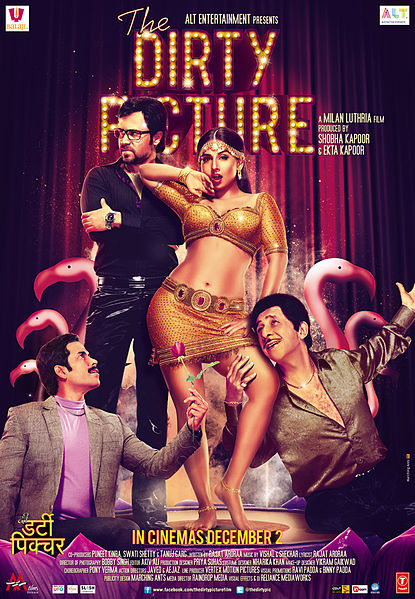
Even without knowing the now denied Silk Smitha association The Dirty Picture is a road well travelled. A young girl runs away to become a star and fame changes her life, not always for the better. Vidya Balan delivers a sensational performance in every meaning of the word. I can’t imagine any other current day actress in the role. She gives Silk a robust earthiness that is a delight to watch and her performance rescues the film from the danger of being a mere ode to sleaze.

Vidya doesn’t rely on just hip thrusting and heaving her ample chest. Despite being lightly sketched as a character, Silk grows and changes and the subtle nuances that illustrate this are all in the acting. Silk starts off Reshma, a quick witted attention seeker who doesn’t care how she gets noticed as long as she gets into the movies. She is outrageous in a ridiculous attempt at being sexy, using lewd tongue gestures and whip fondling to show she is a very bad girl. Her performances in the films within the film become more realistic and practiced as her off screen relationships develop. Silk becomes a real vamp as she delivers what men want but does it in her own style, on and off screen. Through it all, she rarely loses her joyous smile and the wicked sparkle in her eyes. She keeps her cheerfully smutty humour intact, simulating an orgasm and then winking at the director as they joke like schoolboys about who she was imagining. When her story takes the inevitable turn for the tragic, Vidya has a maturity and subtlety that makes the resolution genuinely moving. She shows Silk’s heartbreak, anger and her resignation.

So I have to mention Vidya’s boobs. Yes, they are front and centre for a lot of her screen time. When Silk is performing a dance or scene, putting herself on display, the camera crawls over her body in a voyeuristic way. But if Silk is at home or not on show, the focus is usually more on her face or a full body shot. I was pleased to see that distinction from the unadulterated sleaze of the films Silk was making. She has no false modesty about why men look at her, and she happily uses her body to make an impression.  Silk doesn’t just fall into bed with anyone, but she doesn’t see any reason not to when she is interested. Vidya has the ample curves of a 70s item bombshell and exudes confidence. She also shows the physical changes of a woman aging and paying the price for some riotous living, and that helps make Silk more sympathetic.

Naseruddin Shah is ‘Smashing’ Surya, a parody of aging 1970s Tamil film heroes. He is a narcissist and sleazebag, wanting this fresh piece of meat but turning on her when Silk’s notoriety starts to eclipse his fame. His performance is very good but he has played this kind of aging womaniser so often that I felt it was a bit stale, silly cowboy hats notwithstanding.

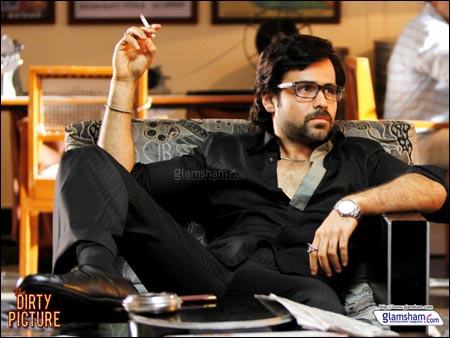
Emraan Hashmi is director Abraham. He narrates a lot of the film in a voiceover that sounds bored and it was unsubtitled at times which annoyed me. Abraham represents the arty side of film making and professes to hate Silk. His character is so vague that his motivations are muddled or not evident. When he and Silk eventually bury the hatchet, he does seem more relatable but I don’t think Emraan added anything to the film.

Tusshar Kapoor is also in a thankless role as Surya’s spineless skivvy-wearing younger brother Ramakant. He completes a love triangle but again a weakly written character and a so-so performance left the element of tension lacking. Tusshar did have a fun scene when he cut loose and danced to Silk’s signature song but that was about it for him.

These men represent different attitudes to Silk – the predatory, the judgemental and the romantic. She is the subject of desire, hatred and gossip but is blissfully unaware for ages as she only looks at pictures of herself and never reads the scathing articles. Silk is a huge fan of Silk. When Surya says she has no place in a home only in someone’s bed, that is how she is seen by ‘society’. It is only when Silk’s relationship with Surya ends that she starts to think about the implications of being notorious. That breakup is the catalyst for a downward spiral into drinking and wild behaviour as her career falters. She is surrounded by men who want her, but none who really like her. That’s what made me sad.

The story is the traditional rags to riches, and the exploitation of a woman providing an embodiment of sexual fantasy is not really surprising either. There are some really interesting bits as the movie industry is critiqued, and the script has some funny one-liners. Even though Rajat Arora has some zingers in the dialogue, the main characters lack depth and the way the story is told is quite stilted. There isn’t quite enough tension between the three men and Silk, although the brothers have some good scenes as Ramakant is forced to bow to his older superstar sibling. I’ve mentioned the voiceover by Abraham and director Milan Luthria uses other narrative devices that made me feel distanced. Nayla, a gossip columnist, often appears to make prophetic statements about Silk but rarely interacts with the scandalous actress. Sometimes it works, but sometimes it really doesn’t fit to have this Greek chorus of one pop up and comment. I really liked Anju Mahendru in the role of Nayla. She made the gossip queen a strong and vivid presence, a woman who had seen it all before and only cared as much as it contributed to her next headline.  Maybe it is a characterisation drawn from her experiences?

The retro style music by Vishal-Shekhar is lots of fun as it is mostly used for Silk’s item numbers.  I don’t think there are any future classics in the soundtrack but I loved seeing the cheesy picturisation to the Bappi Lahiri and Shreya Ghoshal duet on Ooh La La. Ishq Sufiana is quite lovely but I don’t think it was necessary to have the 80s style picturisation complete with Emraan in a see through shirt. It felt like an afterthought. Nakka Mukka is used as a recurring theme for Silk, and it encapsulates her energy and physicality. The art direction is great, and the costumes are straight out of films from the 70s and 80s. There are lots of references to famous dances or scenes, and I had a great time trying to place the original. Alas, there was no Chiranjeevi-esque dashing lycra clad hero for this Silk.

When I heard about this film and that Vidya had been cast I did wonder about the dancing as I’ve never found her to be terribly good. That question is neatly dealt with when an assistant director criticises her for missing a beat and his producer says ‘Never mind the beat, look at that heat’.

Silk said it best – Audiences want three things; entertainment, entertainment, entertainment. And Vidya as Silk is entertainment.