Jal Bin Machhli Nritya Bin Bijli

jal bin machhli

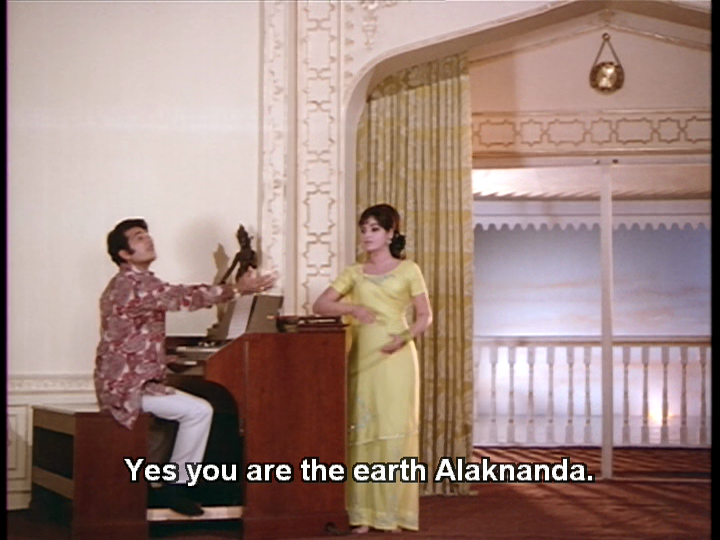
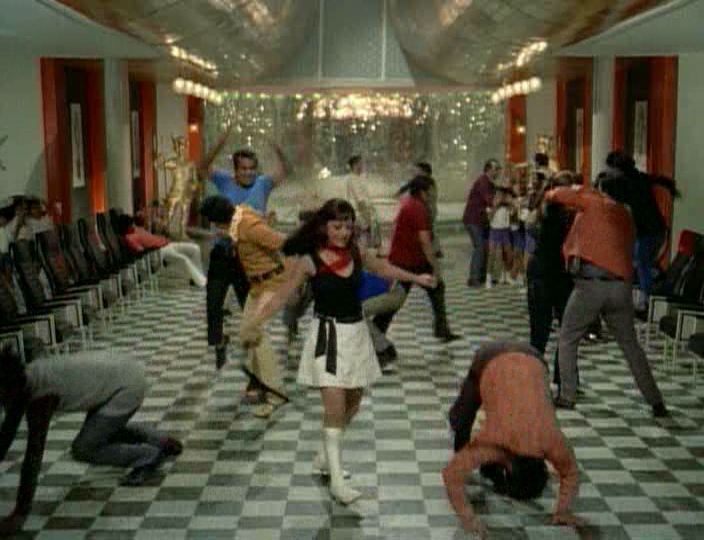
Back at the beginning of my Bollywood obsession, Temple lent me a double DVD of V. Shantaram films.  The first was the classic Jhanak Jhanak Payal Baaje which is still one of my favourite dance-based films and definitely well worth watching.  However the second film on the DVD was even more special – Jal Bin Machhli, Nritya Bin Bijli – a mix of interpretative dance, groovy sixties fabrics and more melodrama than I ever thought possible, even in Bollywood!  It’s one to watch for the dancing, décor and drama, rather than dwell too much on the rather ridiculous plot which allows almost everyone to declare their willingness to sacrifice themselves for love, or for dance, or for the love of dance.  In fact it’s amazing we get to the end without losing anyone, given how prone everyone is to explanatory declarations of their imminent demise.  But eventually, after dealing with treachery, betrayal, sacrifice and Hammond organ music, there is indeed a happy ending – or (and probably a better idea) just watch it for the songs!

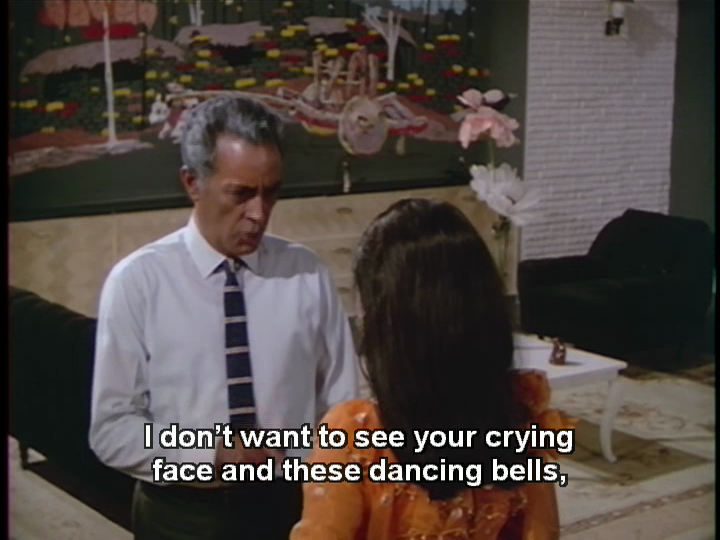
The film opens with Alaknanda (Sandhya) attempting to follow in her dead mother’s footsteps and learn how to dance.  However her autocratic father Dr Verma (Iftekhar) has no time for such frivolous nonsense and bans her from dancing until she marries, presumably because it then will be her husband who has to listen to the incessant jangling of bells rather than him.
Jal Bin MachhliJal bin machhli


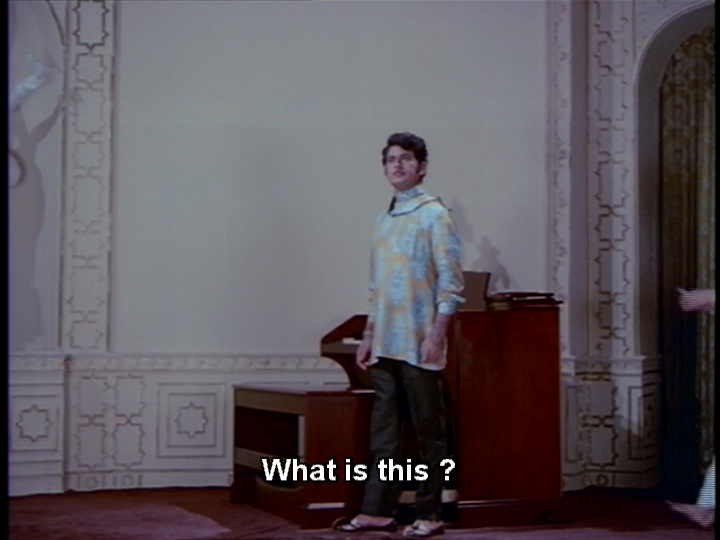
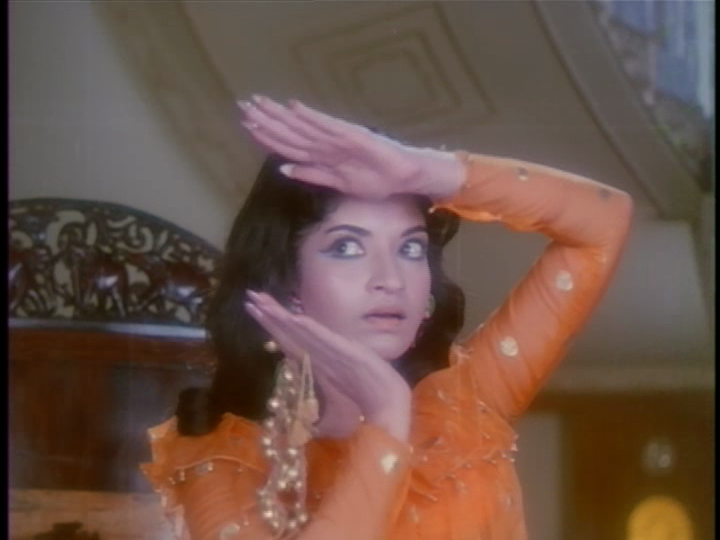
Unfortunately for her father, the family lives right next door to a huge mansion where Prince Kailash (Abhijeet) spends his days playing his Hammond organ and composing music for his resident dance troupe.  Despite an initial chilly reception, Alaknanda gets Kailash on her side by impersonating a dying fish she has rather callously flipped out of the water.  This song is an absolute must-watch as the spectacle of Alaknanda impersonating the fish out of water from the title really does have to be seen to be believed.  I could have done without all the shots of a fish in distress (or more likely a number of fish, as it’s rather a long song), so avoid if you prefer to see fish in their natural habitat.

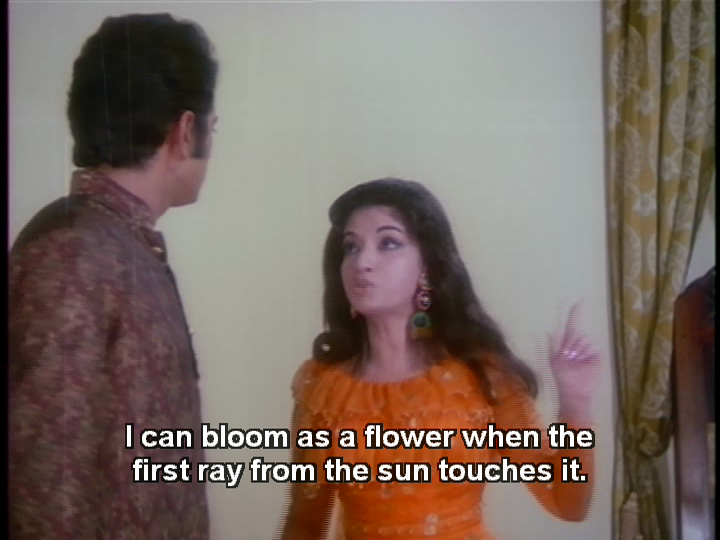
After such a performance, the prince is completely won over and his sceptical dancers welcome Alaknanda with open arms.  I suspect because she seems just as crazy as Kailash and lets them all off the hook by possibly understanding what he is trying to convey in his choreography sessions.  At least she has no compunction in throwing her arms and lashing her hair around to a number of his compositions, immediately endearing her to the prince who realises that he has just found his latest muse.  Lord help us all!
jal bin machhliJal bin machhliJal Bin MachhliJal bin machhli


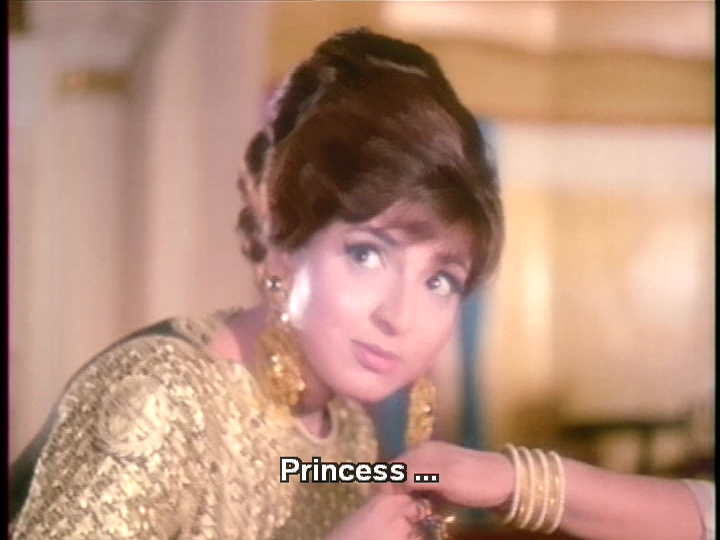
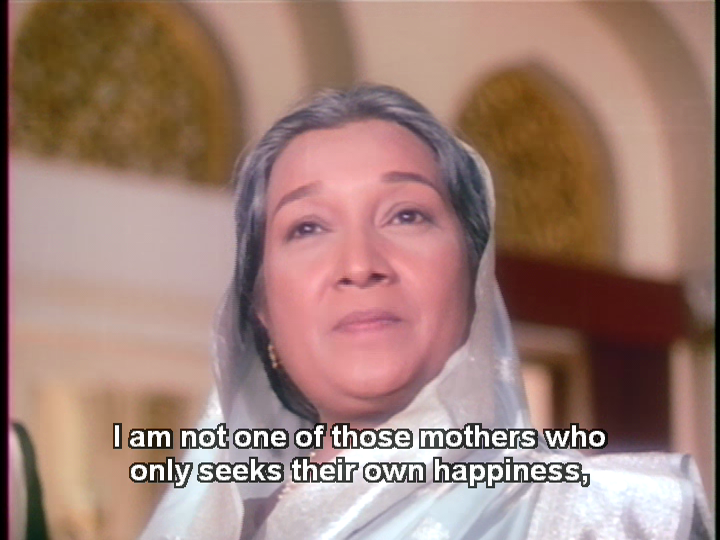
There are added complications when Dr Verma tries to arrange Alaknanda’s marriage, and Kailash’s mother Rajmata (Dina Pathak) attempts to match make between her son and Princess Roopmati (Minal).  The latter is a bigger problem since Roopmati and her uncle Chaman Rai  (Raja Paranjpe) are staying in the palace, giving Rajmata plenty of opportunity to throw the two together.  I really liked Minal as the scheming ‘other woman’ and I wonder why she doesn’t seem to have made any other films.  She’s truculent, bratty and petulant – all some of my favourite qualities in Hindi villainess and not at all reluctant to mow down everyone else in her path.
Jal bin machhliJal bin machhli


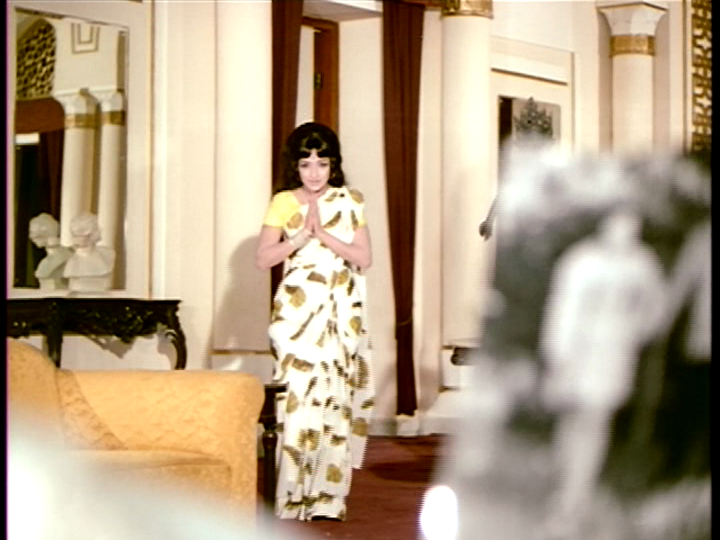
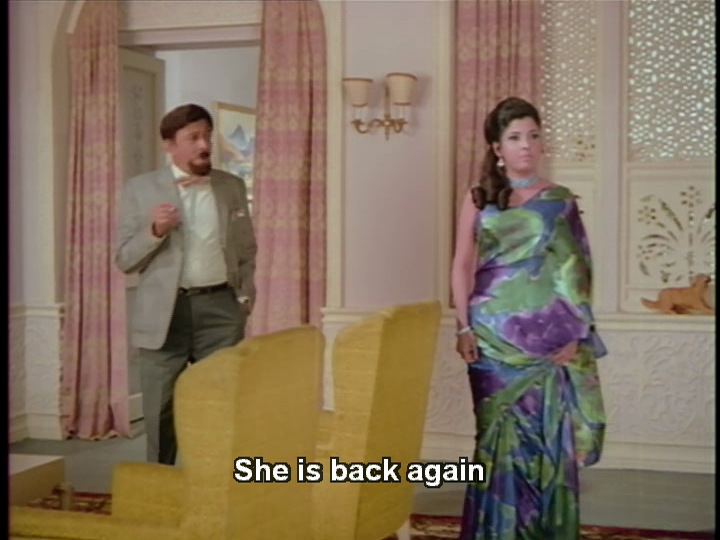
As Roopmati, Minal gets to wear some very groovy saris while pandering to Rajmata’s traditional ideas by wearing transparent robes over her trendy Parisian outfits.  She also has a tendency to break out into petulant dance moves when crossed, although her rocking out to records is definitely not the type of dance the prince admires. Naturally she doesn’t understand Kailash’s obsession with his music and is even less enamoured of his obsession with his Alaknanda. Her initial attempts to separate the two however backfire when she proposes a trip tiger hunting.  I can think of no rational explanation for this in a movie all about dance but then again there is no explanation, rational or otherwise for the rest of the story either!  The point of the trip is for Alaknanda to save Kailash from a tiger, upstaging Roopmati in the process and therefore setting the stage for Roopmati’s revenge.

After such excitement, naturally Alaknanda turns to dance and performs a wonderful snake vs. peacock number in a glitzy snake costume with authentic snake coloured hair.

The drama gets more intense as Roopmati and Chaman Rai sabotage Alaknanda’s performance leaving her crippled and unable to dance.  There are more complications as Kailash proposes, Alaknanda refuses him and our heroine escapes to live in a bandit camp and ponder her future.  Indeed, Alaknanda has to face more challenges than usual for a filmi heroine and she meets them all with a distinct lack of composure and plenty of head tossing and brow beating. Sandhya’s histrionics make it difficult to feel any sympathy at all for Alaknanda’s ever worsening plight and her petulant cries of preferring to die rather than live without dance are wearying.  Luckily there are plenty more songs thrown in to provide relief from the exaggerated and theatrical affliction, and the various misfortunes are all brightened up by some inspired costuming.

Jal bin machhliJal bin machhlijal bin machhliJal bin machhliJal bin machhliJal bin machhli


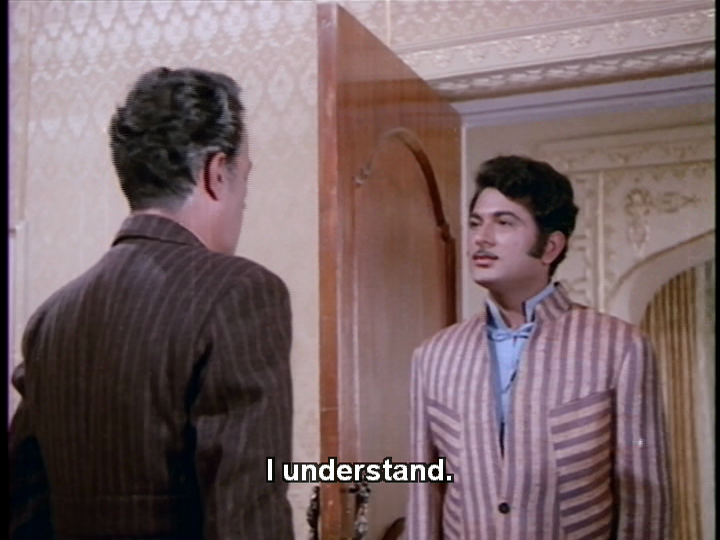
While Sandhya’s Alaknanda is irritatingly anguished, Abhijeet is fairly wimpy as Kailash and seems to deserve everything he gets with Alaknanda, although he does partially redeem himself with his bedside proposal of marriage.  His response to rejection is to shoot the heads off statues in his rehearsal room and then sob at the feet of a picture of his mother which seems to sum him up pretty well.  At least Dina Pathak and Iftekhar provide some much-needed class into the proceedings, but even they have a tendency to indulge in scenery chewing as the drama unfolds.
jal bin machhli

Jal bin machhli


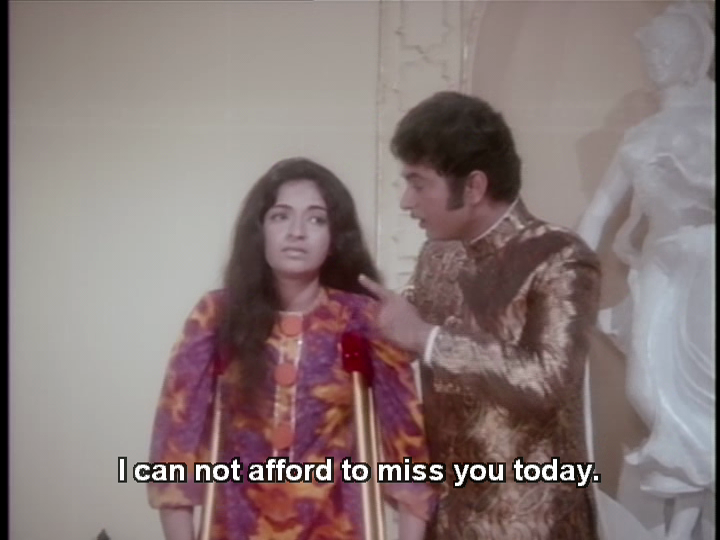
V Shantaram seems to want to explore the passion of dance, but in Jal Bin Machhli he never gets beyond overblown and theatrical drama.  Alaknanda’s obsession for her mother’s dancing bells doesn’t translate into a believable hunger for the art itself, and seems to be derived more from an urge to flout her father.  Without that fervour, the focus is on the melodrama and while that is entertaining it’s not quite the film I wanted.  However there is still plenty to enjoy in the outlandish choreography by Praveen Kumar, including such delights as Sandhya dancing frenetically on a plate while balancing her way up a steep incline and demonstrating just how to dance while on crutches.  Just as good are the songs by Laxmikant Pyarelal who manage to incorporate the theme music from the Good the Bad and the Ugly into the stunning Taron Mein Sajkeh Apneh.  Despite all the drama and the totally bizarre plot, I still love this film for all the posturing and sheer silliness of the two lead characters and the sometimes bewildered support cast.  Worth a watch for the amazing songs and to really appreciate the Bollywood definition of melodrama, even if nothing else! 3 ½ stars.

Jal bin machhli

Kodama Simham

kodama-simham

Chiru as a cowboy! Hidden treasure! Radha as a jungle warrior princess!

While I love a lot about Kodama Simham I am going to begin with a caveat. There are some horse stunts that turned my stomach.  If that would worry you, have the fast forward button at the ready. In a couple of scenes it did look like the horse that went down got up and ran past the camera so maybe I am overestimating the likely damage. But it is something that makes me wary of this genre, no matter what industry made the film. And it seems a bit rough when it is a horse that saves the hero at a critical point.

Kodama-Simham-Bharath wants justice

Bharath (Chiru) is a gunslinger – the good kind – picking up the bounty on criminal types. Bharath manages to upset the local purveyors of iniquity. His parents are killed, but not before his dad tells Bharath he was adopted and to go look for his biological parents. His father Dharmadev (Satyanarayana Kaikala) hid some treasure to keep it safe, but was forced to go into hiding while Bharath’s Ma was jailed. Bharath must retrieve the treasure, clear his parent’s name, and give the bad guys their comeuppance. Simples!

I’m not sure what time period this film is meant to be set in. There are few reliable fashion indicators.

Horses are the only form of transport although there does seem to be a lit-up fish tank and a jukebox in the saloon.  There are what look to be Native American styled natives, as well as a forest dwelling tribe of non-specific plumage. Plus the (possibly) cannibal cat-people guarding the hidden treasure.

There are hangings and shootings galore, and justice seems to be an individual pursuit. Well, Brahmi is the local police so I can’t blame anyone for deciding to go DYI. Bharath disrupts an auction where young ladies are being sold to men or brothels, sets the captives free with a cheery “All the best” and that seemed to be the end of that. Swapna is chased for the umpteenth time by men of bad intent and runs into the jungle, leaving her girlfriends for dead. Nice. She meets Dharmadev who tells his boys off for their lack of manners and again, that seems to be the end of that. There is a pleasing finality to some of these issues: “You’ve been told, now bugger off and don’t do it again”. “OK”. If only that worked in real life.

While the title cards said K Muralimohana Rao directed, at times I suspected the film was being ghost directed by the Hat Department. Telugu cowboy films always turn it on for the headgear, and this was a corker. Behold!

Chiru’s hero entrance starts, as it should, with his boots before the rest of him swaggers in to view.

Kodama-Simham-The bootsKodama-Simham-the treasure

Unfortunately it is hard to tell on a grainy VCD print, but in one scene if his boots aren’t bulletproof, they come close. He has a laconic style and an extensive collection of guns. But what makes him an unstoppable Hero is his self-belief and righteousness. There is a touch of Clint Eastwood in how Bharath is styled – he wears a poncho with panache (probably all that practice Chiru has twirling capes) but Chiranjeevi puts his own stamp on the role. Bharath is a dancer and a ladies man as well as a capable fighter and filial son. Directors must have count their lucky stars to get a hero who could dance and fling himself around in action scenes and do the horse riding scenes as well as being ladybait. The story builds up to an all-in confrontation, and Bharath does follow a fairly logical path to that conclusion, even if the steps along the way strain the elasticity of my disbelief suspenders.

Could one heroine suffice for such an exemplary hero? No.

Kodama-Simham-SonamKodama-Simham-Swapna and art

Swapna (Sonam ) is the mayor’s daughter. She has a penchant for making bad art and wearing terrible outfits.

Kodama-Simham-the tribeKodama-Simham-Chiru and Radha

Bijli (Radha) could probably be described as a tribal princess. She likes hunting, shooting and wearing bad outfits. There is some common ground for these ladies if only they could see it. It took me a while to place Sonam but then it hit me. The vacant stare, the pout, the head tilted on the side – She was in Ajooba! Maybe her career is worth investigating further…. Radha of course was an established heroine in South films at this time, and Bijli is the more substantial of the female roles. She looks like she had fun playing the kickarse leader and Bijli and Bharath were the main drivers of many of the revengey plans. Sadly for Bijli, Bharath seemed to be drawn to the girl who did enough stupid things that he would be kept fully occupied in saving her.

Kodama-Simham-Pran the villainKodama-Simham-Pran!

Pran is the dastardly Mayor. He is first seen reading a proclamation off a fancy silk scroll before ordering the hanging of an assortment of extras. I was so pleased when I recognised him but somewhat disappointed that he was in such a stereotypical role with little scope for him to really work his villainy. Still, Pran! Always fun to see worlds collide even if he did try and have Chiru’s eyes out with a red hot poker.

Kodama-Simham-MohanbabuKodama-Simham-Sudhakar

Mohanbabu is the pungent Suddigaali – everyone sniffs when he turns up and no one looks pleased with the result. He is a cartoonish villain but his spaced out reactions and bizarre logic made for some entertaining scenes. Sudhakar is the Mayor’s bumbling accomplice and does his usual shtick. Kannada  Prabhakar is a more flamboyant and sociopathic bad guy.

Kodama-Simham-I shall call him Jaws

There is also that guy, who looks like a) Jaws from the Bond films and b) he stole one of Chiru’s costumes. There is a villain for all seasons in this film.

This is one of the films where I wait eagerly for the songs. Every picturisation has its own kind of awesomeness, largely fabric based. Raj-Koti’s songs are fun and Chiranjeevi makes the most of the choreography.  I choose to believe his dancing on the ceiling was a tribute to Fred Astaire rather than Lionel Richie.

Sadly few of these songs are available on YouTube or the like due to the egregious copyright claim shenanigans. I cannot fathom why a company with no apparent interest in promoting or preserving the old films they allegedly own would object to short clips being shared online when they don’t have their own version uploaded. I’d get it if they were worried about loss of ad revenue, but often I am mystified. Unless they’re worried someone will try and buy a copy.

See this, if you can find a copy, for the full tilt tongue-in-cheek mass style transplanted to Cowboy Country and the pleasing commitment to justice and hats. Chiru is in fine fettle and Radha is an excellent foil. The more is more approach means you’ll never have long to wait for the next song, dance, fight, demonstration of how to transport a treasure chest across a gorge or costume change. 4 stars!

Geeta Mera Naam

Geeta-mera-naam

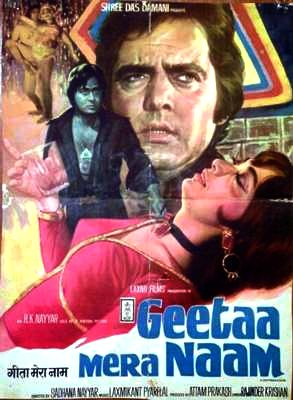
Sadhana’s Geeta Mera Naam is masala with an added dimension of weird.  The cast includes Sadhana, Sunil Dutt and Feroz Khan; all veteran stars with a diverse portfolio of work. Add in the usual suspects like Helen, Rajendranath, Keshto Mukherjee and even Jr Mehmood and you’ve got the ingredients for entertaining excess at your fingertips.

Geeta-Mera-Naam-monkey 1

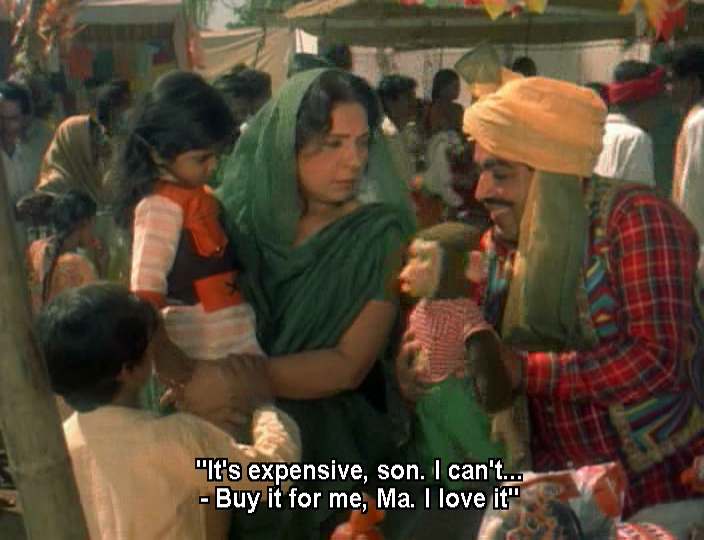
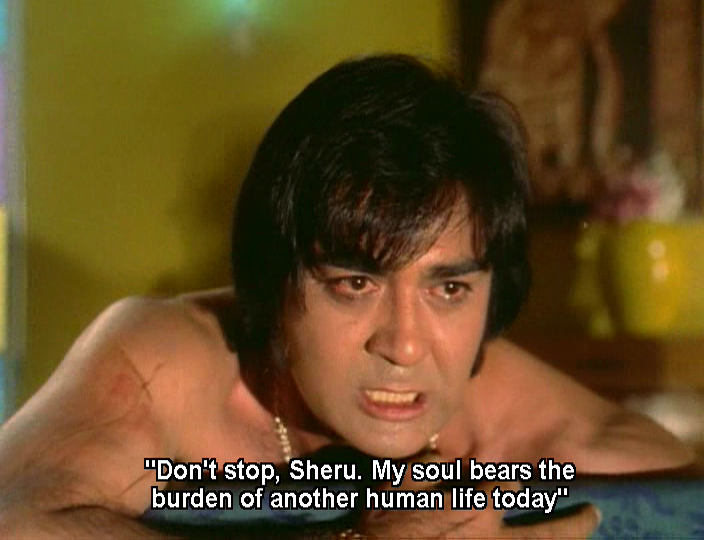
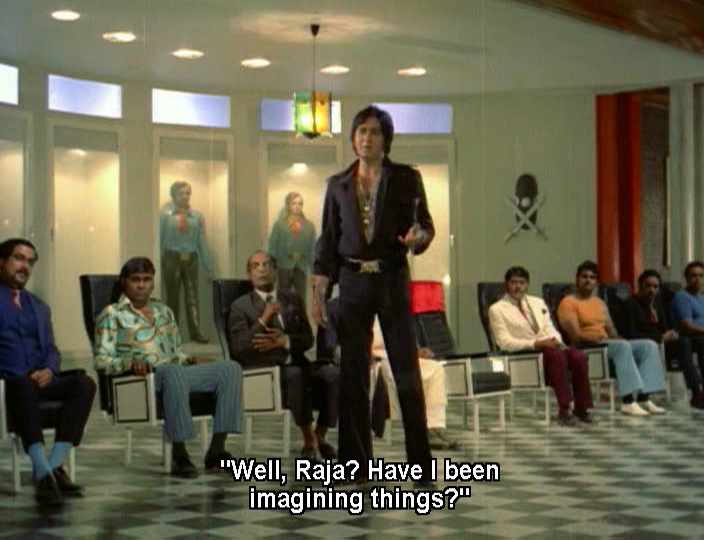
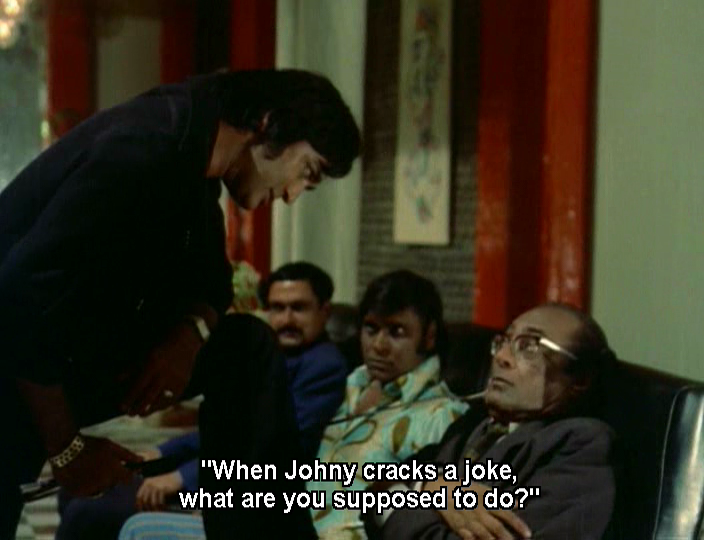
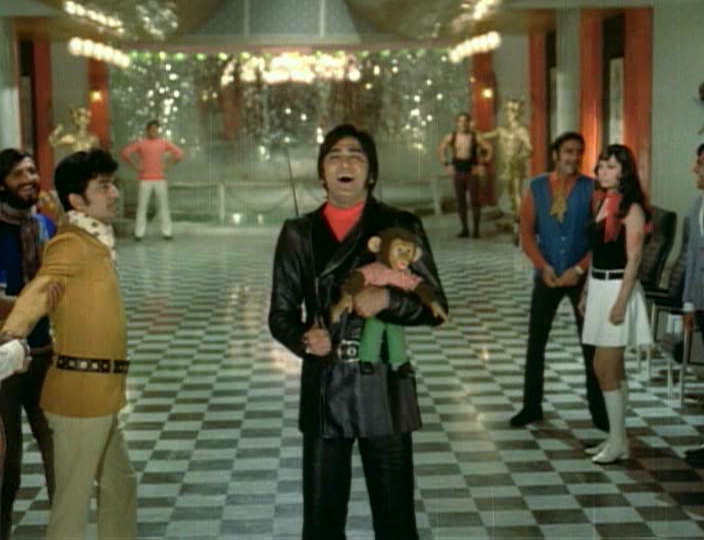
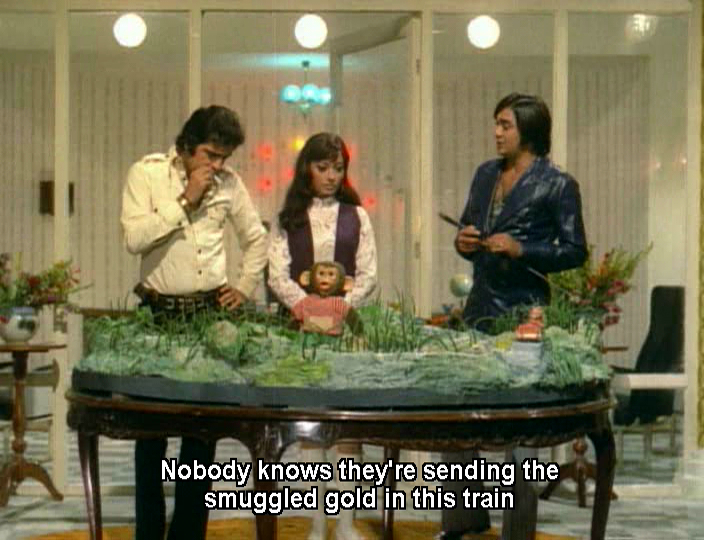
Widowed Ma Saraswati (Achala Sachdev) takes her four children to the fair. Experienced masala watchers know that any visit to any amusement with a child is bound to end in tears and separation. Bandits raid the fair, as they do, and in the ensuing mayhem Saraswati keeps hold of Geeta but loses her twin Kavita. The boys are swept away before their matching tattoos could be completed, leaving Chandu with half a monkey on his forearm. If only some people had worn short sleeves in key scenes. Suraj is taken by the bandit leader as a replacement for his dead son while his brother is adopted locally. Years pass. Geeta (Sadhana) is a petty criminal, in and out of the cells at the police station run by her(unknown to either of them) long lost brother Inspector Chandu (Ramesh Deo). Kavita, now called Nita (also Sadhana), is a nice girl who teaches orphans in her spare time.  Nita’s adoptive parents sell her to Mohanbabu who wants her for a few months, or until he loses interest. Then they can sell her again. As she fights to escape someone kills Mohan. Nita sees a shadowy figure in a hat but the police charge her with the murder. And what of Suraj? Now called Johny (Sunil Dutt) he is a successful smuggler with a gang and a pretty good lair and a masala death trap and … a man called Sheroo who whips him, and a toy monkey, his memento of that day at the fair. Johny’s best friend (other than the monkey) and lieutenant is Raja (Feroz Khan), equally ruthless and pragmatic about the business at hand but with more of an eye for the ladies.

Geeta-Mera-Naam-NitaGeeta-Mera-Naam-Geeta

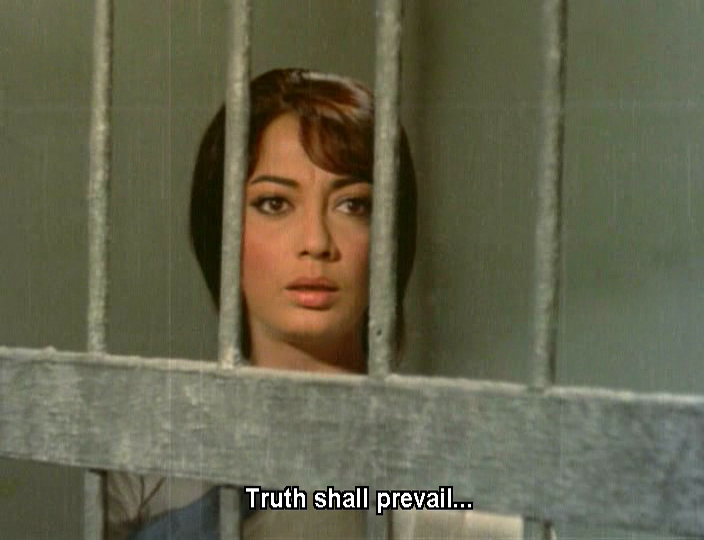
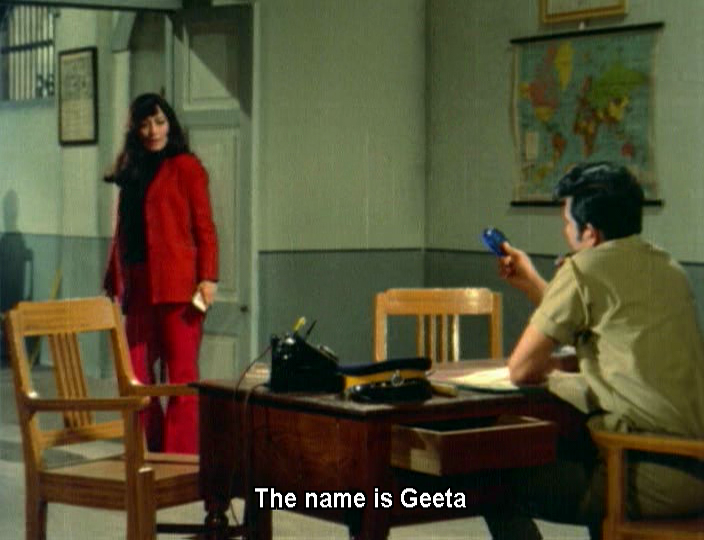
Sadhana didn’t exactly challenge herself with a double role as Nita, the good twin, is only seen for a short time and Geeta does all the heavy lifting. But Geeta is a great character. Feminine but independent and strong, she insists on being seen as an individual not someone who answers to “hey girl”. Sadhana’s clothes as Geeta were quite mid 70s frumpy and not what I expected from such a fashion icon. Geeta discovers her sister Nita in jail and decides to find the real killer. Learning that Johny did the deed, she infiltrates the gang through Raja.

Geeta uses her fearless attitude, kickarse fighting skills and feminine charms to gain his interest and for some reason, her feelings are also engaged, making vengeance a little more complicated.

Sadhana is a very capable actress but I found her direction more interesting than her performance. The film is a bit darker and more low key than the average masala flick, and there is an undercurrent of violence and power. Johny kills with tear filled eyes, then atones for his murders by having Sheroo flog him as penance. He is obsessed with rules and justice and blood in the sense of blood ties. Blood doesn’t recognise blood, but people do recognise their long lost identical twins and significant tattoos and remember where they were lost, all of which is handy. Geeta uses sex or at least the promise of sex to lure men but she has right on her side. She takes a strong stand against Johny partly to save her sister but also because she just doesn’t believe in his rules and why Raja feels bound by them. And his bad jokes should not be encouraged. I’m used to the first view of the heroine being restricted to various body parts, but Sadhana tries to level that playing field by having Sunil Dutt’s butt be his introduction.  Common masala themes of redemption, family, moral righteousness and the law are explored through characters struggles and insights. The standard masala requirements of separated siblings, elaborate death traps, convoluted revenge and audacious yet pointless criminal gangs are all present and accounted for.

Feroz Khan, or Fur-Roz as I mentally called him throughout, plays Raja with minimal facial expression but maximum wardrobe impact. I think there was some kind of battle raging in the costume department as he spends about half the film shirtless and the remaining half in puffy shirts. Raja is Johny’s most loyal friend but of course, once you add in such elements as a gold heist and Helen as the woman scorned, things get tricky. I’m not a fan of Feroz the actor but he did make some interesting films even if I am not always completely on board. Raja is not a very developed character but he does have presence and it is easy to believe in his authority within the gang.

Geeta-Mera-Naam-tormentGeeta-Mera-Naam-Sheroo at work

Geeta-Mera-Naam-Johny and gangGeeta-Mera-Naam-insight

Sunil Dutt turns in a solid performance although I would not say it is his finest moment. His portrayal of Johny is over the top but he does give a sense of the troubled person under the trappings of villainy (and the pleather outfits).

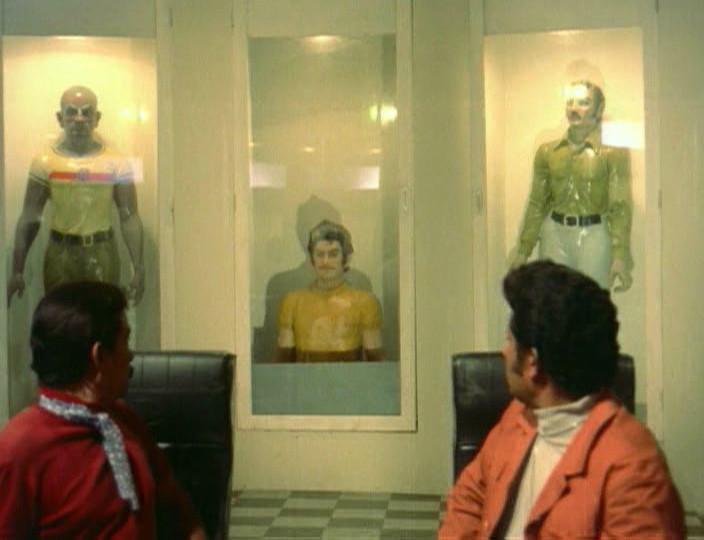
Geeta-Mera-Naam-jokesGeeta-Mera-Naam-lairHe and Feroz are in a race to see who can get their teeth into most of the scenery first but considering Johny disposes of disappointing employees by turning them into his own version of Madame Tussauds, realism was never on the cards. I did like that he didn’t play Johny as obviously crazy.

Geeta-Mera-Naam-evil laughGeeta-Mera-Naam-a cunning planDespite the occasional evil laugh, the peculiar behaviour was shown in a matter of fact way, so Johny seemed like a credible threat. He was capable of friendship despite his inner demons. Sure, the gang must have had rules about things like “Never mention the monkey” and “Don’t ask Sheroo where he buys his corsets”.

The background score is fantastic and I loved the punchy brassy tracks as well as the forays into surf rock and swing. Laxmikant-Pyarelal’s  featured songs are far less interesting although they do further the narrative somewhat. Helen plays Raja’s girlfriend and finds herself dumped for Geeta. She gets one big dance number, the incredibly strange and eyeball searing Mujhe Maar Dala. Geeta intends to sacrifice herself to save Raja who wants to save Geeta as Helen gleefully gyrates in a bubble filled water feature with Oscar, singing about pain, suffering and love.

Poor Oscar. A flesh coloured onesie is difficult for anyone to carry off, and the black belt doesn’t have the slimming effect that may have been intended.

Geeta-Mera-Naam-Helen and OscarGeeta-Mera-Naam-teeth

And I’d like to give Helen a special acting award for the bit where she unzipped Raja’s jacket with her teeth. There was not a flicker of expression on her face to indicate how traumatic it must have been as his fuzzy torso was revealed.

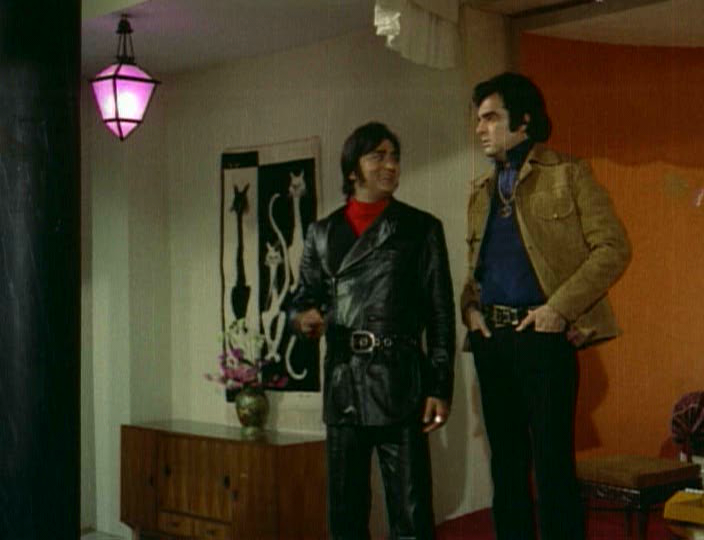
Johny’s lair is part suburban living room, part gallery and part obstacle course.

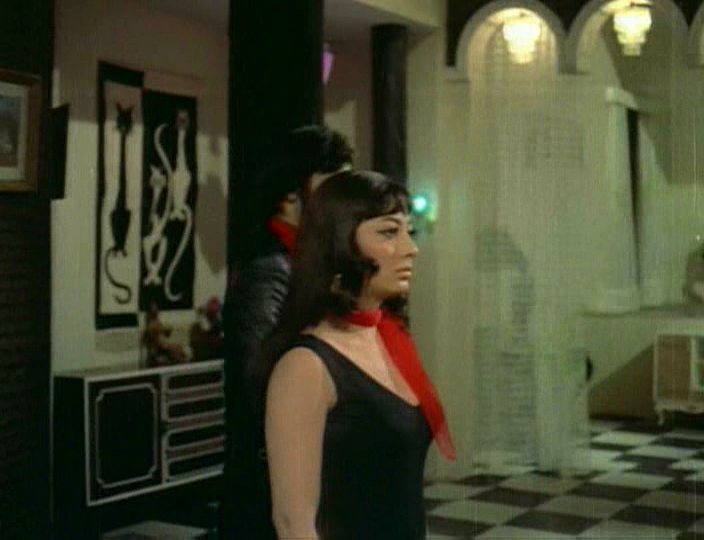
Geeta-Mera-Naam-Feroz and SunilGeeta-Mera-Naam-the other cat wall hangingThe famous Cat Wall Hanging appears. Raja’s apartment is the height of 70s bachelor style, complete with round rotating bed. Johny ends up with a cast of thousands in his relatively modest abode for the grand finish.
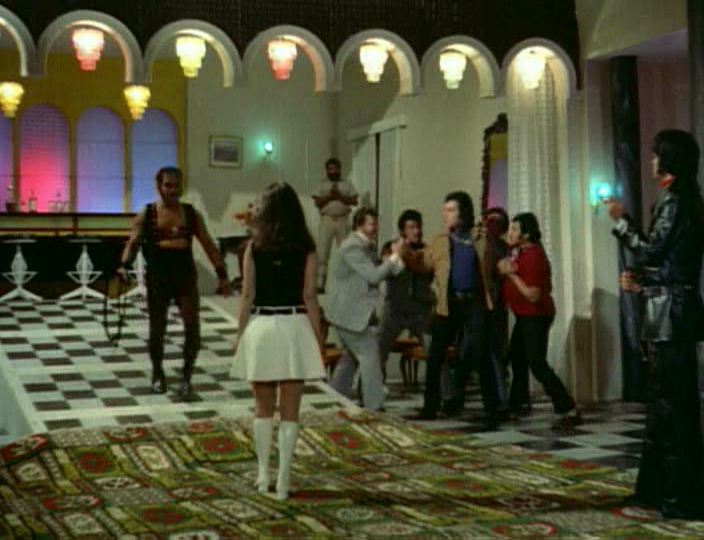
Geeta-Mera-Naam-carpet

I was amused to see some carpet placed over sections of the tiled floor and wondered if it was due to health and safety concerns for the actors, or reflected Johny’s experience of having to get bloodstains off the marble.

This is unlike most other 70s masala in terms of the psychology of the characters and the prominence of the women within the story. Sadhana chose Geeta Mera Naam as both her comeback and a farewell, wanting to go out as a memorable heroine.  I wish she had directed more films as this is highly entertaining and all the elements are well balanced.  3 ½ stars!

Geeta-Mera-Naam-Mayhem