The Hidden Fortress (1958)

the-hidden-fortress-movie-poster-1958-1020506994

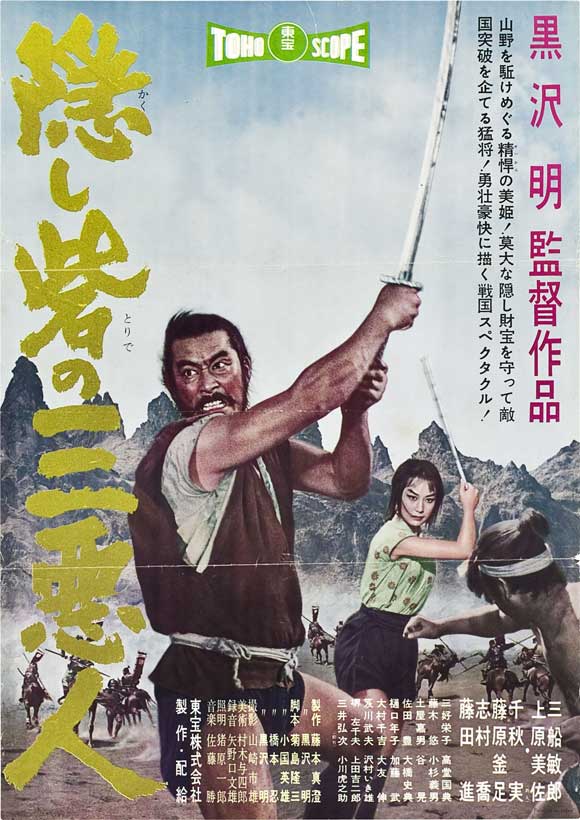
Akira Kurosawa’s story can be summed up simply.  Two greedy peasants are persuaded with the promise of reward to escort a man and woman across the border and smuggle a load of gold hidden inside firewood. However, they do not realize that their companions are actually a princess and her general and that the gold is intended to help Princess Yuki rebuild her clan. There is action and humour, greed meets idealism, relationships are tested and altered, and everyone learns a little along the way.

Hidden Fortress (or Kakushi-toride no san-akunin) is cited as one of the inspirations for Star Wars, and there are numerous comparison reels and articles available online if you want to learn more. While that was one of the reasons I first saw the film some years ago, it isn’t what I remember it for. This is an action packed adventure with great characters, a ripping yarn told with a splash of verve and wit. Just my cup of tea.

Hidden Fortress was also Kurosawa’s first film using the then new widescreen technology and he makes the most of his locations and staging. Using grand outdoor sets to bring a sense of realism to the background, plus Kurosawa’s own exceptional editing skills, this is almost an immersive viewing experience with nothing to break the sense of watching history unfolding. There is something about seeing a vast crowd of extras in a battle scene and knowing they were all real people, not CGI additions. It makes the epic seem even more so. In fact the camera shakes a little in a mass prison break scene, presumably from the vibration of hundreds of men running down the stairs. Kurosawa (and his cinemataographer Kazuo Yamasaki) can swoop from wide expanses and grandeur down to the small personal moments easily overlooked and forgotten.

On another level, the film may also be an ode to Toshiro Mifune’s thighs. Despite wearing the Edo period equivalent of shorty short shorts, General Rokuroto Makabe is an imperious leader of men. He tracks peasants who stumbled over some of the Akizuki clan gold and cons them into helping him. He torments them, seeing them as weak and venal with none of the ideology or purpose befitting a true warrior. But he comes to value their street smarts and knack for self-preservation.  Mifune is a charismatic actor with a robust presence. He turns in a well judged performance in a film that provides a great showcase for his charismatic alpha male persona. His horseback chase and subsequent duel is wildly suspenseful, with the camera barely able to keep up, yet you know Rokuroto will win because he just looks invincible. And seeing the general participate in a fire festival dance with dour determination to pass for a local peasant having fun was amusing.

Misa Uehara is Princess Yuki, a feisty princess in disguise trying to survive and rebuild her family’s domain. For some reason this disguise also involves short shorts but nothing too unladylike. She appears to be unfeeling but is keenly aware of the sacrifices that her people have made and the burden that places on her.  Another character says of her that she is more masculine than she is a girl, and she is certainly more competent and independent than many a movie damsel in distress was ever allowed to be. Although fleeing for her life, Yuki also gets to experience the real world for the first time in her 16 years and she finds it quite enchanting when she can put her cares aside.

She sees good and bad in people, observes poverty and other social woes. She is generally cool and decisive but doesn’t lack empathy so I found her interesting and sympathetic. I wondered whether her decisiveness was a sign of great leadership or just typically teenaged black and white thinking, but generally Yuki does the right thing. Yuki wins people’s loyalty as they believe they can trust in her integrity and not just because she has Rokuroto Makabe and his sword at her disposal.  Uehara’s timing and reactions are excellent, especially in scenes where Yuki is pretending to be a mute. Apart from being limiting to an actor, that also places the character in extra jeopardy as she is limited in her ability to respond without breaking her cover. Her dancing at the festival was an expression of joy and release, an affirmation of the strength that could come if she survived the fire.

The story is largely told through the squabbling peasants Tahei (Minoru Chiaki)and Matashichi (Kamatari Fujiwara). They are repellent and a little endearing by turn.  They roam through the post war landscape complaining bitterly that they didn’t get to make a profit despite all their (alleged) hard work. They seem to have no loyalty or principles beyond making a buck and will turn on each other at the drop of a hat. While these Everymen bring a lot of the comedy to the film they also provide the contrast between rarefied aristocratic living and a more dog eat dog perspective. The first time they see Yuki, they follow thinking a girl alone in the forest would be easy. Later on the journey, despite now knowing her as a travelling companion, they see Yuki asleep and draw lots for who should go for a walk and let the other one rape her first. When the chips are down, they cling to each other and eventually see the bigger picture. Given that most of their dialogue is moaning and crying, both actors do well to give their characters such vivid and distinct personalities. I didn’t mind seeing them suffer, but I would have wielded the editing scissors a little more in their direction.
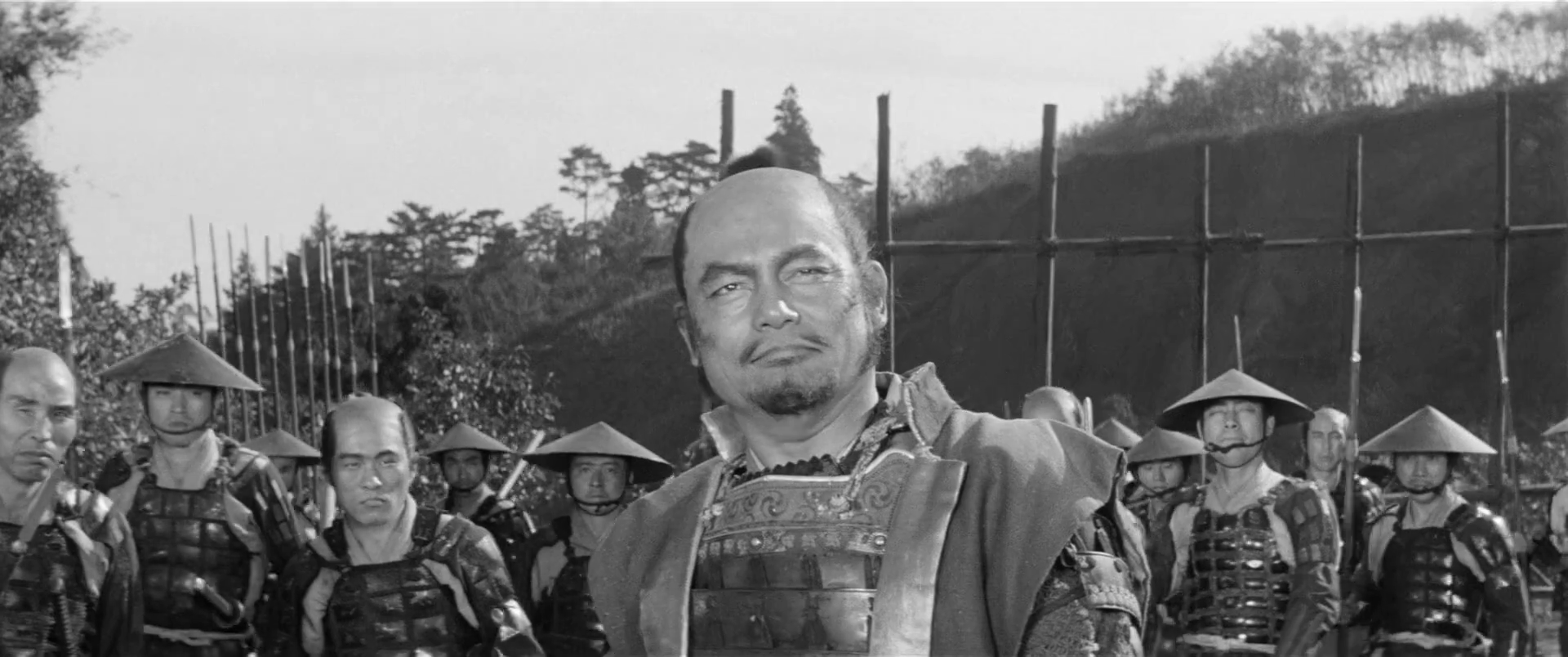
Hidden Fortress-Hyoe Tadokoro

Susumu Fujita has a small but significant role as Hyoe Tadokoro, an old adversary of Rokoruto Makabe. His wry expression conveys volumes as he squares up against a respected foe and tries to face down the blazing indignation of Yuki.

I was thrilled to see this included in ACMI’s recent Samurai Cinema program and to have the opportunity to see it on a big screen for the first time.  It is a tale of derring-do, the grand visuals still place the human element at the forefront and the characters are easy to invest in. Well, maybe not the comedy peasants so much. 4 ½ stars!

Kochadaiiyaan

Kochadaiiyaan Taking Superstar Rajni and turning him into an animated action hero is certainly novel and Soundarya deserves praise for breaching the boundaries of Tamil cinema and attempting something as different as motion capture animation. With Deepika Padukone as the heroine and experienced actors such as Jackie Shroff and Nasser in supporting roles, the potential is certainly there for something amazing but despite all the innovation and obvious hard work, Kochadaiiyaan doesn’t quite deliver.  K.S. Ravikumar’s story isn’t the problem. It’s a swashbuckling period adventure with enough substance to fill a couple of hours comfortably with a few credible twists in the tale.  The dialogue also seems fine, even when subtitled, and the characters are reasonably convincing within the storyline.  It’s more basic than that – the real issue here is that animation is just not as good as the real thing. Kochadaiiyaan The film tells the story of Rana (Rajinikanth), who left the kingdom of Kottaipatinam as a child and ended up as the army commander of rival nation Kalingpuri.  A flashback in the second half explains Rana’s background as the son of legendary warrior Kochadaiiyaan (also Rajinikanth) who was himself betrayed by the King of Kottaipatinam.  In between there are battles, betrayals, social justice as Rana frees slaves, and of course some romance with Princess Vadhana (Deepika Padukone).  Rana is a rather more subdued character for Rajnikanth, despite his heroic looks and charismatic style with Princess Vadhana and the swash and buckling only really starts to take off when Kochadaiiyaan appears in the second half.  Maybe it’s a case of getting more used to the style, but the film is livelier after the interval, and Kochadaiiyaan appears more splendidly heroic than his son. Kochadaiiyaan I have to admit I’m not a fan of this ‘almost life-like’ animation.  I found Polar Express creepy and much prefer my motion capture as a dash of CGI in films such as Lord Of The Rings and Transformers, or as complete fantasy like Shrek and Despicable Me.  While motion capture gives characters a relatively life-like appearance, it’s not real enough to be able to convey emotion convincingly and the lack of facial expression is disturbing, as nothing looks quite ‘right’.  It’s hard to generate any empathy with the characters despite the attempts at laughter and tears, especially when some of the smiles look more like grimaces.  It also doesn’t help that the animation here is variable, with some characters, such as the young Rana and his brother Sena appearing almost unfinished with strangely elongated limbs and disjointed necks, while the horses and elephants appear very clunky when in motion. Kochadaiiyaan Another casualty of the animation process is the dancing, which ends up appearing jerky and awkward much of the time.   It also looks a little odd to have large numbers of dancers completely in sync in the background – rather than looking impressive it just looks strange and almost sinister.   However, on the plus side, the costumes by Neeta Lulla are stunning with amazing attention to detail, which likely would not have been possible in real life.  That also applies to most of the action scenes which just wouldn’t have been possible with real actors and animals.  Peter Hein is credited as the action co-ordinator but his talent with co-ordinating fight scenes doesn’t translate well to animation.  The  scenery is generally spectacular though with  plenty of grand palaces and surreal gardens, although there are a few times when the background just looks  rather bland and unfinished.  I hadn’t heard the film soundtrack before watching the film, but the music by A.R.Rahman, is  one of the highlights and suits the rather grandiose and somewhat sweeping scale of the story.

Kochadaiiyaan

I would have preferred Kochadaiiyaan if the CGI had been limited to the background, enhancing the fight  scenes and sprucing up the scenery, while the actors played their roles instead of  using motion capture animations.  Although the downside would be that quite a number of the scenes would have to be less extravagant, it could have made for a more engaging film. However, setting aside the animation issues  I still did mostly enjoy the film, mainly due to the tale of Kochadaiiyaan and the music. The end of the film leaves a sequel likely and I hope that does happen, although the animation  issues do need to be addressed in any follow-up film.  Kochadaiiyaan is probably best watched by Rajinikanth fans but if you can cope with the animation it may be worth a watch, even if only to see the first complete motion capture Indian animation film.

Manam (2014)

Manam

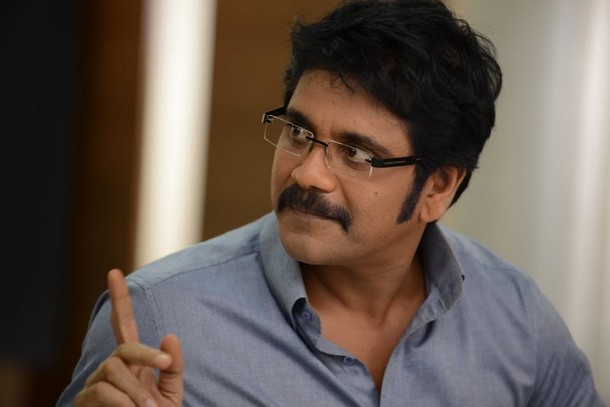
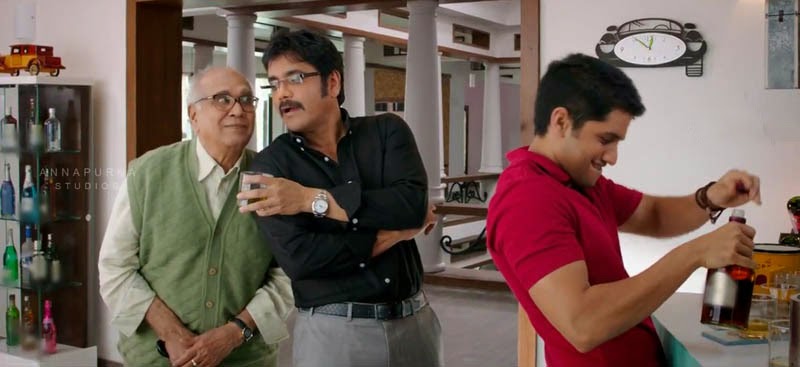
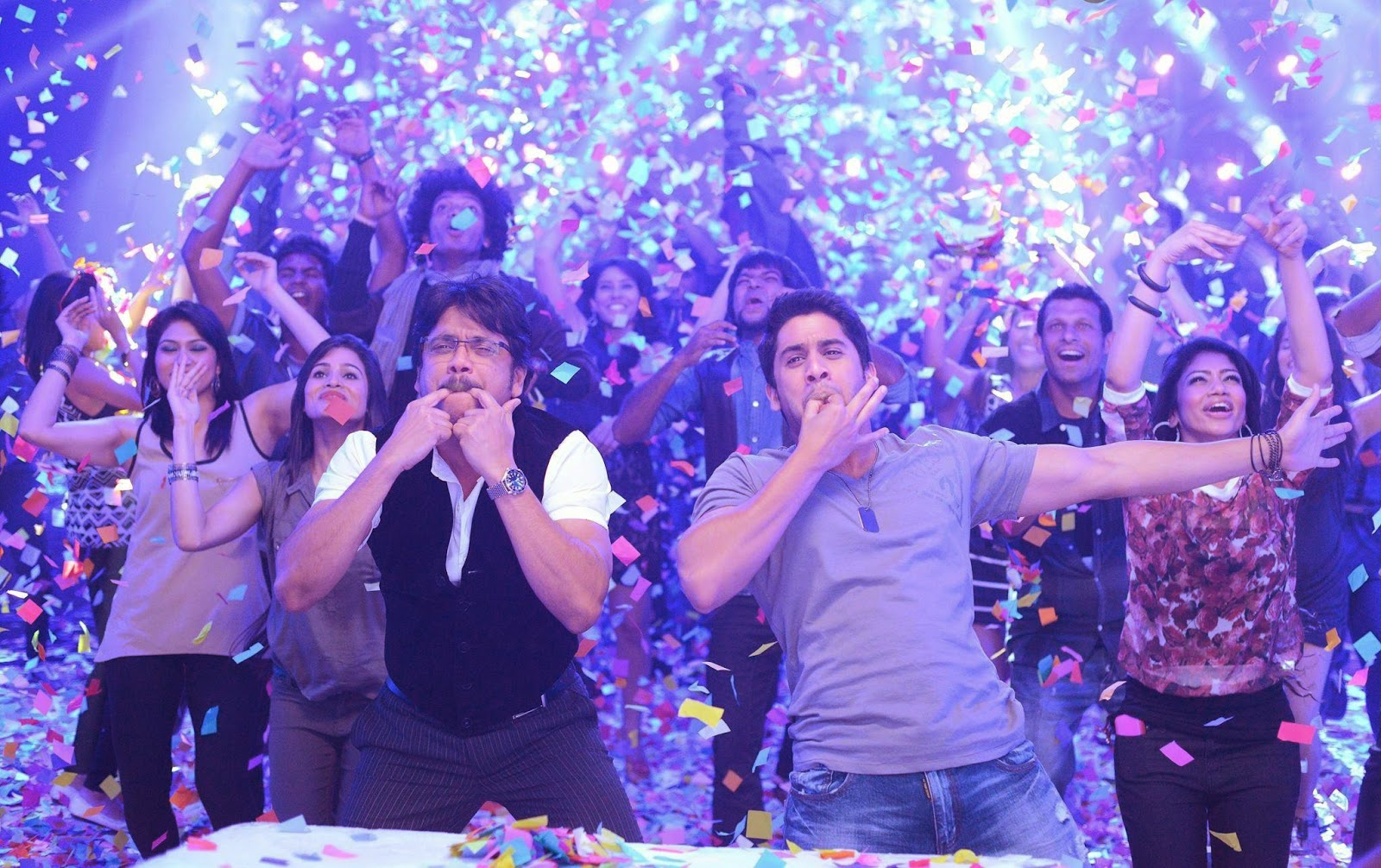
Manam is a beautiful film and a breath of fresh air in an industry usually dominated by beat-‘em-up heroes and the same old innuendo masquerading as comedy.  Featuring three generations of the Akkineni family and Nageswara Rao’s final screen appearance, it could very easily have tipped into trite sentimentality, but Vikram Kumar’s screenplay keeps the film on track with an novel storyline, sweet romances and genuinely funny comedy.  I have to admit that I almost didn’t buy a ticket when I read that Manam was being advertised as a comedy, since without subtitles most of the humour tends to pass me by (even with subtitles in some cases!) but Manam would have been a watchable and entertaining film even without subs.  As it was, being able to understand the jokes and laugh at the same time as the rest of the audience was excellent.  Long may this trend for subtitled Telugu films continue in Melbourne!

Manam Manam

The film starts in the 1980’s with the unhappy marriage of Radha (Naga Chaitanya) and Krishna (Samantha) who bicker and fight even on the occasion of their son’s sixth birthday.  The very next day they are both killed in a car accident, leaving the young Bittu an orphan and his wish to see them happy together unfulfilled.  This doesn’t seem to have held Bittu back however, as the film moves to the present day, and the now grownup Nageshwar Rao (Nagarjuna) is in Mumbai to receive the Businessman of the Year award.  However, on the flight back to Hyderabad, Nageshwar is seated beside a young man who is the image of his late father, and this begins his crusade to bring his ‘parents’ back together again.  Nagarjuna is absolutely perfect here and his child-like wonder at discovering ‘his father’ is brilliantly portrayed.  The scene is well written too, with the just the right amount of comedy to keep it from cloying sentimentality and Vikram Kumar even manages to make the suggestion of such an occurrence seem perfectly plausible.

Samantha and ChaitanyaManamNageshwar reasons that if his father has been reborn, then his mother must be around somewhere too, and to this end he scours the streets of Hyderabad until he tracks down Priya (Samantha) who is the image of his mother and, luckily for Nageshwar and his plans, she immediately feels a connection.  Again Nagarjuna’s determined search is neatly summarised in just a few shots and the obvious unlikely coincidences feel much less contrived than expected.  It help that both Nageshwar and Priya are very likeable characters and Nagarjuna and Samantha ensure their interactions are full of genuine warmth and respect.

ManamNagarjuna

Having found his re-incarnated father and mother, Nageshwar has to find a way to re-ignite their romance.  In the midst of his attempts to bring about true love, Nageshwar finds love himself when Anjali (Shriya) commandeers his car to carry a sick man to hospital.  As it turns out, the older man is Chaitanya (Akkineni Nageswara Rao) who has seen his parents Seetharamudu and Ramalakshmi  reborn as Nageshwar and Anjali.  It’s then his turn to explain the past and try to reunite the lost lovers.

Manam

ANR is the absolute star of the show, and seems to take great delight in playing the octogenarian matchmaker.  He is mesmerising every time he appears, and his facial expressions and reactions to every other character are superb.  For his part, Nagarjuna is quietly competent as Nageshwar Rao with a subtle but effective performance, and his romance with Ramalakshmi in the second half is an absolute delight to watch.  There seems to be something in Temple’s theory that Shriya Saran’s irritation factor is related to the length of her hair, as here she has long hair and is actually pretty good.  Shriya looks beautiful and displays an engaging personality as a 1920’s traditional villager, and she is just as stunning as the cool and efficient Dr Anjali.  I vote Shriya always has long hair in her movies!

Manam

Nagarjuna and Shriya also share good chemistry together, which is sadly conspicuously absent in the romance between Samantha and Chaitanya, although to be fair the script really doesn’t ever let them develop much sparkage except in the way of confrontation.  Despite the lack of passion with Chaitanya, Samantha shines as Priya / Krishna.  She sparkles in her songs, and is full of bubbly enthusiasm as she meets Nageshwara, but her pain at her perceived husband’s betrayal is obvious as is her contempt of Chaitanya’s Nagarjuna.  Chaitanya is also better than usual, although that may be because his role mainly requires him to play a drunk and obnoxious college student which he seems to fit well.  The usual suspects pop up as various mothers, fathers, cousins etc, but do watch out for the brief cameo appearance of Amitabh Bachchan which garnered plenty of cheers from the audience.

Manam

It’s not all perfect though – the inclusion of Ali as a dance teacher is unnecessary and M.S. Narayana’s role is too obvious and crude to fit with the rest of the characterisation.  However Brahmi is good as Nagashwara’s assistant and without any misogynistic humour, he manages a restrained performance that proves he can act perfectly well when required.

Manam benefits from a sweet and  simple telling of a relatively convoluted story.  There are no exciting car chases, no big fight scenes and no cliff-hangers (even though the last few minutes attempt to raise the dramatic tension), but overall it’s an entertaining and watchable film.  All praise must go to Akkineni Nageswara Rao and Nagarjuna for their exemplary performances, but the younger generation hold their own, with even Chaitanya showing that he learnt something from the rest of his family while on set.  Definitely recommended viewing and a last performance to savour from one of the legends of Telugu cinema.