Massu Engira Masilamani (Masss)

Masss

Venkat Prabhu is a man of many ideas – usually very good ideas – which have resulted in a number of successful films. However for his latest release Masss, he tries to cram as many ideas as possible into the first 20 minutes, and then continues to throw in yet more new ideas throughout the rest of the film. Now that’s not necessarily a bad thing, but not all of his ideas work and it’s even difficult to decide if they work or not because the film has already moved on to the next idea! As a result the confusion of the opening scenes feels like trying to cram a year’s work into 10 minutes before the start of an exam. Situations and characters flash by without a chance to work out who is who, what they are doing and how they fit into the story, and if I did have to answer questions on what was going on, I would fail miserably! However it does get better. Suriya is amazing, and his presence holds the film together even through the odd and even more oddly placed songs. The story starts to make sense and the pace slows down to manageable levels with enough comedy and action mixed in to make Masss well worth a watch and much better than the opening sequences would suggest.

Suriya plays Masilamani aka Mass, a con-man and thief who works with his best buddy Jet (Premgi) on a number of overly complicated heists that involve as much theatricality as they do actual thievery. But they make a mistake when they decide to rob a local don who takes exception to their activities. Mass and Jet only just manage to escape, but in doing so they have a serious car crash which has more implications than they first realise.

I had no idea about the story behind Masss and I think it works better when the events that occur are completely unexpected, so I will leave the details of the story there. Up to this point Suriya works his lovable rogue persona well and Premgi is relatively low-key as his best friend. After the first twist (one of many), Premgi takes more of a back seat in the proceedings which is an advantage to the storyline since he doesn’t quite have the acting chops required for such a major role, although his comedy does work well. Suriya takes centre stage and drives the story forwards with an excellent performance and plenty of charisma. There is a double role too, which is perhaps a little clichéd but still works within the format of the story. Plus double Suriya is always a benefit in my opinion (as long as they are not conjoined twins!).

Nayantara pops up as Malini, a love interest for Masss, but she has very little to do and doesn’t even manage a duet with the hero, so her role could have been skipped without too much trouble. She does look beautiful though, if perhaps a little unconvincing as a nurse, but has surprisingly little chemistry with Suriya. However I’m going to mark that down as not having any real opportunity to develop any sparkage due to the briefness of their time spent together rather than any real problem with Nayantara. Vidyullekha Raman makes an appearance as Malini’s friend and actually makes more of an impact than Nayantara, although sadly she too quickly drops out of the story. However they both fare better than Pranitha who appears totally mis-cast, or at least inappropriately dressed with terrible make-up, for her role as flash-back Suriya’s wife.

The film has a huge cast list and there are a large number of good actors who appear as assorted villains or who are part of a group who help Mass later in the film. Brahmi has a brief role as a corrupt doctor in Malini’s hospital, while Samuthirakani has probably the best realised villain role, although even he only appears occasionally. Parthiban manages a little more screen-time as a police officer on the trail of Mass and has some good one-liners while Karunas, Riyaz Khan and many others provide excellent back-up for Suriya. It seems a long time since I’ve seen Rajendran and it’s great to see him here in a small role as a member of the gang helping Mass even if again he only appears briefly.

The second half follows a more linear storyline, even with the flashback portion and the film settles down to an easier pace. What surprises me is that the film received a U certificate given that there is some fairly extreme violence and at times the film is quite frightening for a young audience, although the kids in Melbourne seem to be made of fairly tough stuff and seemed to take it all in their stride.

Masss is a little overlong and the at times it seems that Venkat Prabhu got a little too carried away with his special effect team. There are times when less really is better and there are a few moments here where more restraint would have had a greater effect. In addition, the songs don’t really fit, apart from one during the flash-back sequence and there are perhaps a few too many nods to other films in the screenplay giving the film a more derivative feel than I think it really deserves. However Suriya is excellent and the background score from Yuvan Shankar Raja makes up for any lack in the dance numbers. This is a film to watch for Suriya, the excellent support cast and for Venkat Prabhu’s occasional flashes of brilliance which occur just often enough to give Masss sufficient unexpected twists to entertain.

Bujjigadu

bujjigadu-poster

Puri Jagannadh and Prabhas are a winning combination and while Bujjigaadu lacks the wardrobe excesses of EK Niranjan, it is a fun if ludicrous film.

Little Bujji and Chitti are neighbours in Vizag, inseparable until they have a fight. Bujji always does what Chitti says and she tells him to not speak to her for 12 years, after which she will marry him. He knows he can’t stay without wanting to talk to her so he runs away. Time passes, and Chitti’s family move away. Flash forward and we see our grown hero (Prabhas) beating up goons in Chennai. As evidence of his Tamilification, Bujji is a huge Rajinikanth fan, desperate to get to the FDFS of the Superstar’s latest film. And that leads handily to a corking tribute to the man himself.

Bujji returns to Vizag after 12 years, confident that Chitti will be there waiting. He is distracted and strays into a comedy subplot which results in some jail time. While in jail he is offered 1 crore if he breaks out and kills a man. After a moment of soul searching and confirmation the target was a bad guy, he accepts. After all, he needs money to marry Chitti. Meanwhile she has returned from studying overseas to look for Bujji, only to be sent away by his folks with a flea in her ear.

The pair cross paths, each unaware of the other’s identity. Bujji’s nom de crime is Rajinikanth and apart from knowing Chitti (Trisha) is in Hyderabad, he has few leads to go on. Eventually Bujji discovers that Chitti is the sister of Sivanna (Mohan Babu), the man he was paid to kill but has since befriended. Bujji has been living in her home all along. Sivanna asked Bujji to keep his true name a secret as he knew his little sis would leave home as soon as she found her childhood love. So Bujji agrees, albeit with some conditions.

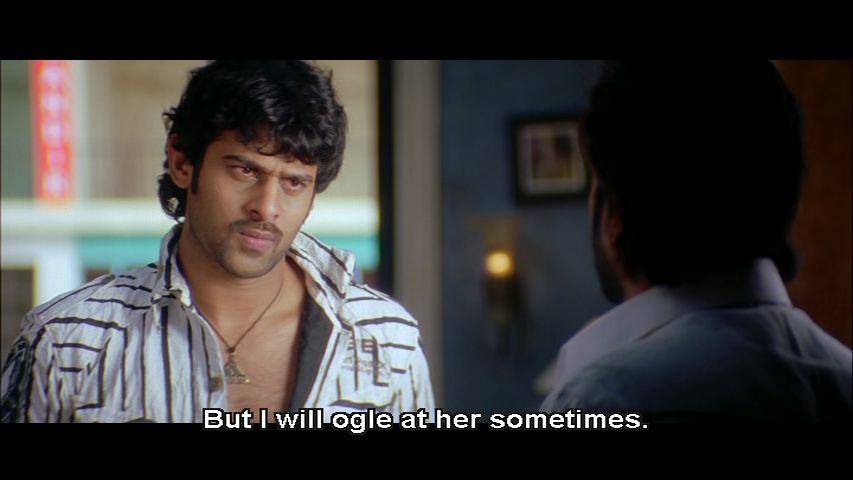
Bujjigaadu-ogle

Hero and heroine under one roof with the erstwhile villain, more villains breathing down their necks, true love and secret identities…What could possibly go wrong?

Bujji and Chitti still imagine each other as they were in childhood, and their adult selves don’t really hit it off. I wondered how long they would last once they had to spend a lot more time together and the idea of a mutual destiny started to wear thin. Trisha plays Chitti as a little stuck-up, vain and intolerant, but still with some likeable characteristics. Good friend The Mahesh Fan once damned Trisha’s acting by saying she always looks a little more in love with herself than with her hero (Mahesh in that instance) and I tend to agree. Trisha and Prabhas do have an easy rapport but it never seems like a sizzling chemistry.  On the other hand, when Trisha looks at herself in a mirror, all bets are off.

Prabhas is immensely likeable, and despite his slightly dorky charm he can muster up a good death stare and punch dialogue when needed. Bujji is fairly easy going but he is a Telugu film hero so there were a few moments of brain melting ‘logic’ and chauvinism. His declaration that if Chitti said she loved him he would have to kill her because she could only ever love him and she didn’t know who him was so clearly would be guilty of cheating and thus deserve to die made me wish again that every film had a Tight Slap Administrator, and that it was me.

Mind you, Prabhas does get props for his Chihuahua wrangling skills.  And I love how much love Bujji has for Sivanna and his constant calling people Darling.

If we define love as mutual respect and affection with a dash of chemistry, then the strongest relationship in this story is between Bujji and Sivanna. Sivanna sits back to watch his goons take Bujji apart, but instead finds himself cradling his bloody opponent, shouting at him not to die because he loves him. Mohan Babu and Prabhas play off each other very well, and their characters seem more complex when they are together as they get down to the truth of things rather than just posturing.

Of the large supporting cast, MS Narayana is a standout as Bujji’s boozy, soft hearted dad. The scene where he recognised his runaway boy was sweet, and I really do like him in roles where he gets to act and not just be the butt of jokes. Sanjana plays Chitti’s sister Kangana and she is pretty and not completely terrible so I suppose she met the brief.

The villains are Machi Reddy (Kota Srinivasa Rao) and his two lions – Ajay and Supreet. House favourite Subbaraju is excellent as hapless third son Venkat , who seems a bit too sensible and not really hard-core enough for his dad. Sunil and Ali provide more than enough pointless comedy. Brahmaji is Sivanna’s hot headed sidekick. And Mumaith Khan does her thing as a welder/item girl.

I liked that she wore professionally appropriate gear for both her day jobs.

The fight scenes are campy and funny, with lots of flexing and posing by Prabhas. Every single breakable thing on set is utilised, and the sound effects team are given full rein on the biffo and squishy stabby noises. The finale took place on an abandoned film set so there were lots of fragile brick walls and stained glass windows, enough for everyone to have a go. Almost all the boys get to fly about either through wires or effects. I kind of love the moment when Bujji sets his foot on fire, all the better to kick the goons with. That’s commitment. I liked that Bujji could pour out his feelings in Tamil to Telugu people and in Telugu to Tamil friends and thus get to wallow in his woe while keeping his secrets. There were some zingy one liners and some mystifying subtitles, and that all adds to the fun.

The costume department made some interesting choices, and I applaud their application to the task of dressing the overseas backing dancers with only the materials commonly found in hotel rooms and budget clothing chains. And Prabhas takes denim in some unexpected directions. The songs are mostly fun (even if just for the outfits) and help you take a breather in between fight scenes.

Bujjigaadu has a hero who knows exactly how to hit all the right spots in a mass potboiler, and a director with a big budget and a sense of fun.  4 stars!

Nandalala

Nandalala

I’m a big fan of Mysskin and have been slowing working my way through his earlier films whenever I can track them down on DVD. However I put Nandalala at the end of the queue, since it’s a change of direction from his more usual crime thrillers and didn’t sound like my cup of tea. But I should have known better. Nandalala is still very much a Mysskin film with a focus on the dark side of human nature, although this time there are some lighter moments scattered among the social commentary of the film. Even better, Mysskin himself makes an appearance in this film as one of the lead characters and does almost as good a job in front of the camera as he does on the other side.

Essentially Nandalala is a road-trip film with a young boy and a mental patient who has escaped from an asylum both searching for their mother, although their reasons for doing so are very different. Aside from their own journeys, both physical and metaphorical, along the way they meet up with an interesting mix of characters that serve to illustrate the joys and the difficulties of life in rural India. Although it does move at a slow pace, perhaps to go along with the walking pace of the journey, Nandalala is a beautiful film with a heartfelt screenplay and is very well worth a watch.

The story opens with Akhilesh, commonly known as Agi (Ashwath Ram), waiting outside his school. There are 15 seconds of silence while other pupils and their parents’ stream past his downcast head, which is an incredibly effective way to describe his isolation and give a general idea of his circumstances. When Agi does walk home, it’s to a greedy servant and his blind grandmother, both of whom need him for their own reasons. While it’s obvious he doesn’t live in abject poverty, there is little affection and no joy in Agi’s life. His most precious possession is a photograph of himself with his mother as a baby and he takes advantage of a school trip to set off on a journey to find her. Agi seems well prepared with his mother’s address, her photograph and a relatively full wallet, but he doesn’t have any real idea about how to find her. Just to make matters worse he is robbed in the local town and left without the means to buy anything let alone a bus ticket to Annaivayal. His journey seems to be over before it has started but he chances to meet up with Bhaskar Mani (Mysskin), a mentally disabled man who has escaped from an asylum and is trying to find his own mother. Bhaskar is searching for answers, wanting to know why his mother abandoned him to the mercies of the hospital staff and has never visited or contacted him. Despite their many differences, they make a good team as they travel together to find their respective mothers.

In many ways Agi is a typical young boy from a small town. He’s had a sheltered existence and his innocence and loving nature colour his approach to everyone he meets on the road. He is accepting of Bhaskar and his mannerisms, but still manages to become exasperated when Bhaskar does something particularly unhelpful, although this doesn’t change the easy partnership the two share. Ashwath Ram is excellent and plays his part perfectly throughout. His eagerness and excitement as he runs around the village searching for his mother is infectious, while his emotional ups and downs are natural and feel very honest. Agi’s guileless approach to life and his innate practicality are perhaps a little unlikely given his upbringing, but they do mirror a similar innocence and matter-of-fact abruptness in his companion.

Mysskin is surprisingly good as Bhaskar, although he does have a tendency to overact and occasionally over-emphasise some of Bhaskar’s obsessive mannerisms. Initially when in the asylum he continually runs his hand along the wall or the bars beside him in a behaviour pattern that fits well with his character’s mental disabilities, but some of his later actions seem more contrived and don’t fit as well with his mental health issues. However, he does an excellent job of portraying a child-like innocence that has an effect on everyone he meets, and if his sudden rationality at some points seems rather opportune, his moments of insanity never become too over-the-top.

The film is at it’s best when it relies on the situations the two companions find themselves in to drive the narrative, ably assisted by Ilayaraaja’s absolutely beautiful background music. There is little dialogue to draw attention away from the body language, which is much more expressive than any long speeches could ever be, and the songs are equally effective in adding depth and emotion to the film. This is a beautifully sad song that contrasts with the happy attitude of Agi and Bhaskar’s mood swings and general instability. Just perfect.

Snigdha Akolkar appears in the second half as a working prostitute whose presence adds rationality to the story. Initially she is understandably annoyed with Bhaskar and Agi when they drive away her paying customer but later events lead to Anjali accompanying the two on their quest. Her presence allows a glimpse of a softer side to Bhaskar, and gives Agi the opportunity to be just a little boy searching for his mother. It’s a powerful role despite the short screen time and Snigdha is excellent, particularly when she allows glimpses of her characters emotional fragility to escape her seemingly strong and confident presence. Nasser and Rohini also appear in small but very effective roles, and the rest of the supporting cast are all uniformly excellent and perfectly understated.

As with most Mysskin films, there are plenty of odd angles and shots of feet. This is very effective during Agi’s desperate search for his mother but also works to draw attention to the journey itself and the miles walked by Agi and Bhaskar. Mahesh Muthuswami adds his expert touch to make the countryside look sumptuous, whether it’s the plants along the roadside, the luscious green fields or the buildings and villages along the route. It is a beautiful part of the countryside, although Mysskin also points out the shady characters and quick violence that lurks amongst the idyllic scenery.

Nandalala is much better than I expected from the brief description on the DVD. It’s difficult to describe just how emotive the film is without revealing too much of the plot, but as it’s a Tamil film it’s probably obvious that there is no happy ending – or at least not completely. However the film is all about the journey and the relationship between Bhaskar and Agi, and from that point of view it is a resounding success. Mysskin excels in adding small details, such as Bhaskar’s stolen shoes that he wears back to front, that add depth and interest to his story and characters. I love this film just as much as his thrillers and am impressed that Bhaskar can turn his hand to such a different style of story so competently. It’s also commendable that he has not only written and directed the film but also acted in a major role without stealing the limelight or making it all about ‘Bhaskar’s story’. It’s probably not for everyone; there is no ‘action’, no comedy track and no big dance number, but the simple emotions and finely nuanced performances make this one for fans of more character driven cinema. 4½ stars.