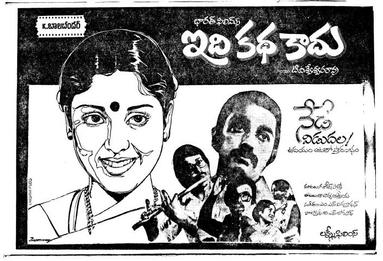
Idi Katha Kaadu (1979)

K Balachander’s 1979 movie is a remake of his own film, Avargal. Jayasudha and Kamal Hassan star and Chiranjeevi plays an important supporting role. It’s a sensitive and even handed look at relationships and standing up for yourself. The film is on YouTube without subtitles so bear with me as I have done my best to interpret what was going on.

Suhasini (Jayasudha) and Bharani (Sarath Babu) fall in love through a montage of the arts – he plays flute and she dances. They have a nice bond, he is laid back and she is very playful. But Bharani leaves town for work and he never replies to her letters. Sugunakar Rao (Chiranjeevi) moves in on Suhasini. He is superficially charming but once they are married he is controlling and abusive. In due course she leaves him and gets a divorce. He is clearly bitter but she leaves town to start her new life with their child. She finds an office job and makes new friends. Her coworker Janardhan/Johnny (Kamal Hassan) is particularly kind and considerate. He’s a ventriloquist so that set some alarm bells off because…just because. But Bharani is still on her mind. And now, he is just across the way as the apartment Johnny helps her find is right near his place. There is definite interest on both sides but she is more cautious and has a child now, and he lacks any sense of urgency and he has his friend Gayatri (Saritha) to consider too. And then Sugunakar Rao is back in the picture as Suhasini’s boss. He wants to reconcile and seems to have reformed. Suhasini has to decide what to do with her life.

I really enjoyed watching Jayasudha’s performance and Suhasini as a character. And on a very shallow note, her print sarees are wonderful too. She’s a lively young woman with a passion for dance and music, but she’s quite happy to get married sensibly because that’s what you do. When Sugunakar turns out to be a total arsehole, she does her best to tolerate him. But when he pushes her too far, she pushes back. In one scene she fantasises about stabbing him in the groin with his darts, and she does tell him to his face what she thinks of his behaviour. When she moves back to Chennai she seems to be accepted and liked in her new circles. Having a child isn’t a barrier to her getting a job and she makes the most of her new start. I got the impression Suhasini is not completely open about her situation but she certainly isn’t hanging on to her past. People, especially women, help each other in both big and small ways. Suhasini acquires a mysterious new maid (Leelavathi), actually her mother-in-law who had never met her.

Chiranjeevi is impressive as the horrible Sugunakar Rao. I think Chiru got on the bad side of the wardrobe team because those pants…He is charming but only as long as he gets his own way. He criticises Suhasini constantly and threatens her, smiling as he throws darts at her head or snarling as he tells her to give up dancing. One thing I always appreciate in these negative roles that Chiru took in his early career is that he doesn’t hold back on showing the full range of emotions, no matter how unlikeable or ugly. He is a fine dramatic actor under all the Megastar trappings. His mother (Leelavathi) finds out from a servant that the marriage was over and that Suhasini and their son were in another city. I couldn’t work out how he managed to keep everyone in the dark but I think he might have told her Suhasini was dead. Anyway, despite the filmi tradition that demands a Ma must support her boy, she is firmly in Team Suhasini and keeps working secretly for her daughter-in-law. That is how bad Sugunakar Rao is. He recognises mild and indecisive Bharani as a threat so he plants a seed that Bharani and Gayatri should marry. He belittles Johnny as he doesn’t compute the nice poor guy could be a rival. When he tries to ingratiate himself with Suhasini again he is almost believable as he clucks over her health and sends her fresh fruits. Almost.

Johnny (Kamal Hassan) has taken a shine to Suhasini too, although she only seems to have eyes for Bharani. Personally I’d pick the one who didn’t have a ventriloqusist dummy as his housemate. But Johnny is sweet and does things to make Suhasini happy without expecting any repayment – he finds her a flat, gets her movie tickets to a house full show, helps with work. He can’t articulate his feelings so he uses Junior to talk about his love. Of course, Suhasini treats it as a joke rather than a heartfelt confession. He’s well liked at work but a lonely soul underneath it all. Kamal Hassan isn’t challenged by the character except that the ventriloquism shtick calls on his physicality and control as he manipulates the doll while appearing to be oblivious to Junior’s shenanigans.

https://www.youtube.com/watch?v=j1pUdOF90b8

That weird clown song is completely unnecessary but when you have Kamal Hassan I suppose you’d be mad not to. And it lets him work off some energy that might have lead to overacting. His farewell scene with Suhasini was also unintentionally funny as he ran beside her train faster and for much longer than seemed possible, speechifying all the while.

Leelavathi and Sarath Babu are both good in their roles. But Bharani is so mild and understanding to the point of not seeming to care that he doesn’t give Suhasini any confidence and he kind of fades compared to Chiru and Kamal Hassan. Leelavathi’s Ma is an interesting woman who is prepared to believe evidence rather than continue to idolise her son. She makes decisions that are about how she wants to live her life and what she thinks is important. She’s a crier, but she gets things done. And she is the one to finally free Suhasini from her connection to her son.

Balachander uses some camera gimmicks and the ping pong analogy, and some shots are a little too composed to be natural, but generally the style of storytelling is low key and credible. Even the final comeuppance. Although I wish I understood the symbolism of the lion mask and the Mona Lisa. Oh well.

See this for some early career Megastar, a pared back and heartfelt performance from Kamal Hassan and a lovely role for Jayasudha. 4 stars!

Dear Comrade

The opening scenes of Dear Comrade hark back to Vijay Deverakonda’s previous film, Arjun Reddy, but as events unfold it turns out that this is a completely different kind of film. Dear Comrade is a romantic drama that starts off with a love story, but ends up tackling sexual harassment, aiming to shed some light on why women may decide against reporting the crime. While this may make the film sound like heavy going, it’s actually quite the opposite as writer/director Bharath Kamma adds plenty of light-hearted moments along with the sad, while Justin Prabhakaran provides an excellent soundtrack that even means we get to see Vijay Deverakonda dance. There is a lot going on in this film and it’s inevitable that it doesn’t all work, but there is still plenty here to both entertain and hopefully to spark some discussion, even if the message is sometimes obscured behind rather more standard Telugu action fare.

The film starts with a drunk and seemingly demented Bobby (Vijay Deverakonda) desperately trying to get in touch with his ex, Lilly (Rashmika Mandanna). It’s a role Vijay has played many times in the past, but before he becomes too much of a caricature, the film moves into flashback to explain Bobby’s history. Moving back to his student days, Bobby is seen as an impulsive and reactive student union leader who firmly believes that you have to fight to get what you want in life. He’s impetuous and hot-headed with a tendency to argue with his fists just as much as with rhetoric, a stance that makes him unpopular with his college principal and the police but a good friend to have on your side. These revolutionary tendencies are apparently due to his grandfather (Charuhasan) who teaches Bobby what it means to be a comrade. Sure, Bobby fights for what he believes is right, but also mainly because it seems to be something he enjoys doing.

Bobby meets Lilly when her family visit the house next door for her cousin Jaya’s (Shruti Ramachandran) wedding. A nice touch comes from Bobby previously having a crush on Jaya when the two were children, which gives a camaraderie between the two that continues through and has an impact in the second half. This time though it’s Lilly that Bobby starts to develop feelings for, and I love how the tables are turned and it’s Bobby who stares wistfully out of a window while Lilly is (almost) completely oblivious to his presence. The romance is slow to develop, but once it does, there is magic in every moment the two spend together, helped by Justin Prabhakaran’s evocative music. It’s not all smooth sailing though as Lilly has reasons for being wary of someone who gets into as many fights as Bobby, while Bobby can’t figure out if Lilly really likes him or just has her own agenda.

There are some very satisfying moments in this first half, such as the way Bobby finds out that Lilly is a State level cricket player and how his group of friends change their attitude from patronising to respectful once they discover she really can play. It’s nicely done to point out the prejudice without ever feeling spiteful or overly feminist. Lilly’s attitude to Bobby is refreshingly honest and the two have wonderful chemistry together that ensures their romance feels plausibly real. When the breakdown occurs between the two characters it develops organically as Lilly finds she cannot cope with someone so angry and violent, while Bobby can’t understand why she won’t stand up and believe in him as much as he believes in her. Vijay Deverakonda and Rashmika Mandanna were excellent in Geetha Govindam, and they work just as well together here, although in the second half the attention moves more to Rashmika as her character has to face some major challenges in her career.

Everything changes after the interval when Bobby heads off to find himself and hopefully lose his memories of Lilly while doing so. As in all Indian films, a journey of discovery means a motorbike and a trip to Ladakh, but that does mean awesome scenery so I’m not going to complain. But while Bobby has been off recording nature and trying to control his impulsive side, Lilly has had major problems in her life. Unfortunately, the film only shows these briefly once Bobby comes back into her life and Bobby’s actions as he literally kidnaps Lilly from the hospital where she has been recovering don’t seem plausible at all. But just when it seems that Bobby may be the cure Lilly needed to recover, the film takes another turn and we learn the reason behind Lilly’s departure from her promising cricket career.

What does work well here is the portrayal of Lilly’s reluctance to pursue any action against the cricket selector Ramesh Rao (Raj Arjun) who sexually, physically and mentally harassed her. The pressures of family, embarrassment and shame are all clearly portrayed as is the inevitable media reaction and appalling treatment received by Lilly and her family as they try to avoid the storm Bobby creates when he learns the truth. Bharath Kamma completely changes the direction of the film and suddenly the focus is on Lilly and her reluctance to bring any of the harassment out into the open. Bobby’s lack of understanding about why Lilly won’t fight and his frustration and anger is perfectly shown here and this is what makes Dear Comrade such an interesting film. There are few Telugu films that show the consequences of reporting harassment so clearly, and even if Lilly’s experience isn’t quite as bad as what can actually happen in real life, it does at least give some idea of the sort of courage that is needed to go ahead with any accusation of this nature.

For me this is Rashmika Mandanna’s film through and through and she is excellent in a role that requires her to be non-confrontational and frightened. Her reactions are mostly what would be expected of anyone from a similar background put into the same situation, and although I really wanted her to fight back, I could totally understand why she wouldn’t even try. She really gets into the heart and soul of the character and I love how she doesn’t see bobby as her salvation, but instead as the person who just makes her miserable with his demands. In a film industry where the hero isn’t allowed to ever be anything other than the perfect partner, it’s so refreshing to see Vijay Deverakonda take backstage and be exactly what Lilly doesn’t need instead.

On one hand this is a film that deals with relationships and the consequences when one partner thrives on violent confrontations while the other tries as hard as possible to avoid conflicts of any kind. On the other hand, Dear Comrade deals with sexual harassment and the routine abuse that women have to deal with day in and day out. It is a rather male slanted view, but perhaps that’s what is needed to reach the people who need to understand the fear and powerlessness that comes with this type of abuse. At least with the presence of Vijay Deverakonda, well-staged fight scenes and a sizzling romance, there is a good chance that more people will be watching. This was so much better than I expected and despite a few mis-steps and missed opportunities, this is one of my favourite Telugu films this year. Highly recommended.

Alluda Majaka

E.V.V Satyanarayana’s Alluda Majaka could have been an excellent film. There’s peak mullet Chiranjeevi, Ramya Krishna and Rambha so you know the dancing is taken care of, a big budget and adventurous designers. But the story by Posani Krishna Murali is uneven and the comedy interludes are sexist and sleazy even by 90s mass standards. However, look for gold and avert your eyes from the dirt and there are some rewards for your time.

The film opens with Seetharam (Chiranjeevi) being taken to his village in police custody so he can attend a religious festival. Then he’s off straight into a big chase and escape from the police, and it is vintage Chiru. But oh those horse stunts churn my stomach, and the infamous horse sliding under a truck stunt doubly so, even with the hopefully fake horse in one shot. But there is a glass bus. Who knew?

Then Seetharam forcibly marries Pappi (Ramya Krishnan) who is at her wedding ready to get hitched to someone else. And then he is back off to jail again. A lawyer (Giribabu) arrives and promptly shoots Seetharam and then himself in the arm, setting his client up for that crime too. The laywer needs to know why Seetharam has ruined a young girl’s life by marrying her against her will and right before he went back to jail. This triggers a long flashback.

Seetharam’s father was the village president and seemed to be benevolent and practical, much loved by the people. Pappi (Ramya) and Bobby (Rambha) arrive in the village to stay with their mother Vasundhara (Lakshmi) and uncle. They stir up all kinds of trouble and see themselves as above the law and certainly above the people. That does not sit well with Seetharam. Another rogue joins the fray when Peddaiah (Kota Srinivasa Rao) arrives with the plan to get one of the rich girls married to his NRI son Chinna (played by the may as well have been non-existent for all the impression he made Siva). Chinna falls for Seetharam’s dialogueless sister Malliswari (Ooha) and they are engaged. Vasundhara wants the groom for Pappi, Seetharam is delighted his sister will be married, and Peddaiah is determined to find a bride based on dowry and gain for himself. When Chinna goes back to the US for a few months, Vasundhara and Peddaiah pull out all the stops to break up the engagement. It is on for young and old and the unmarried young women are the pawns in the game. By the time we stagger to the conclusion, it’s a straight up battle involving an explosives factory and a jetty and if that doesn’t scream Masala Death Trap I don’t know what does.

I am uncomfortable with the value this film places on women being pure and subservient, but the strong women in the story are so horrible I can’t stand them either. It would have been more interesting if they were less insane and more simply independent. Lakshmi as Vasundhara is the true villain here. She is smart, manipulative, and greedy. But what is her greatest crime? Not wanting to live with her husband – the lawyer Sivaramakrishna who is defending Seetharam. Pappi and Bobby are brats and completely lack common sense or empathy. But. Do they deserve to be humiliated by having their bathing suits ripped off them mid swim? Does Pappi deserve to be married against her will to a man who has been sentenced to death? Does Bobby deserve to be humiliated by the accusation that she’d had accidental sex with her brother-in-law?

Does anyone deserve the outfits they wear in the songs?

Much of the comedy is sleazy and gross. Apart from trying to get Ramya and Rambha in compromising positions to teach them a lesson, one track includes Brahmi in drag and a long build up to a tacky rape joke. Then there’s the farcical nuptial night with power outage that leaves the three women uncertain if they’re the one who had relations with Seetharam. And that’s a whole other line of enquiry I prefer not to pursue. I read a review that mentioned Rambha had once said that Chiranjeevi had made the director drop some of the really vulgar scenes planned. My reaction was “Yay for Chiru!” and then a mind boggling moment as I pondered what had been too much considering what had been left in.

Things I did like include that nobody thought Pappi should have to live in a forced marriage (although killing the groom is not cool). Also when Malliswari fell pregnant to her absent fiancé most people, with one notable exception, nobody tried to punish her (except the baddies but that was not on moral grounds). And Vasundhara was a terrible person but she was well written as a villain and had a little bit more going on than most of the men on Team Bad. I quite liked the use of a rainbow slinky as gangster accessory too but that might be a sign I was running out of patience with everything else. And of course, there’s the reason I watched this in the first place. The decor. No!

CHIRU!!!

Thankfully Chiranjeevi is in great form despite the lamentable material. He fights, he speechifies, he emotes so vigorously even his hair is furious, he defies laws of physics and gravity, and he dances like there’s no tomorrow. And he does it all so well. The fight choreo is complex and includes loads of acrobatics which Chiru nails. And he gets to drive lots of different forms of transport which I feel Chiranjeevi enjoyed. He looks quite content trundling around on his tractor, then so devil may care on a jet ski.

Although the stunt dummies lack his panache. As usual Chiru dances like he’s having the time of his life strutting his stuff in some truly eye-searing looks. In an unfortunate plot diversion, Chiru also plays the Mega rich Mr Toyota. Rich, weird, and foreign, he’s a comedy uncle on heat. I’m not sure how his disguise as Mr Toyota was in any way convincing and I am not at all persuaded the film needed him despite the additional scope it gave to the costume team. It is such a shame this film is an over long and undigestable turkey because there is so much peak Megastar stuff.

2 stars. Only for Mega-completists.