Govinda Govinda

Sri Devi is the main reason to watch Ram Gopal Varma’s film. She is wonderful as the plucky and caring Naveena, drawn into a mysterious plot involving religious nutters, dark rituals, and a dodgy taxi driver with anger management issues.

I watched this without subtitles and didn’t have too much difficulty following the plot, but wish I had been able to understand more of the conversations. Maybe things would have seemed more cohesive if I got the “as you know, Naveena” exposition. Or perhaps not.

The film opens with a religious back story to explain the significance of Venkateswara and the Tirumala Venkateswara temple at Tirupathi. And then the RGV factor kicks in and you can safely forget doctrine and logic as you know it. In the present day, an evil tantric commissions Paresh (Paresh Rawal) to steal Venkateswara’s crown from the temple. The relic combined with some human sacrifice will give the tantric ultimate power or something. Naveena (Sridevi) is a Telugu woman living in Bangkok. She returns to India to fetch her grandmother and take her back to Bangkok so they can live together. Seenu (Nagarjuna) is the taxi driver that picks her up from the station and takes her downtown. Seenu’s father, the temple security guard, is implicated in the theft, and little Babu (Master Anilraj), who Seenu calls Boss, is the only witness who can identify the real criminals. When Seenu and Babu go to Bangkok trying to clear the dad’s name, the kid wanders off and ends up on TV as a missing child. Naveena sees him and comes to the rescue, and is reunited with Seenu. Their lives are entwined on a level neither realises. Eventually all the ducks get in a fairly clumsy row, and it is time for Seenu and Naveena to try and thwart the tantric and save the world. It’s lucky for them that Vishnu had been sneakily keeping an eye on them all along.

The film is most alive when Sridevi is on screen. Naveena does a little of the scream-and-run heroine shtick but is largely sensible, thinks first, and tries to do things for herself even if it pushes her out of her comfort zone. Her outfits are a little…odd. I’ve never been a fan of the pedal pusher, and am on the fence when it comes to onesies. It’s hardly the worst character wardrobe Sridevi had to contend with. Perhaps Naveena was just veeeeery fashion forward, or maybe she was soft hearted and didn’t want Seenu to cop all the bad denim. There are some parallels with Kshana Kshanam although the story isn’t as strong. Naveena still has enough range as a character that Sridevi has something to work with. Whether she is being a clueless tourist or running for her life, she makes that moment feel real and with a sense of consequence.

Her cheeky expressions are an excellent distraction from the spectacle of Nag “dancing”, and the comedy is a good fit for her. Rewatching the movie to screencap for this review was so sad. Sridevi was well cast, had a decent and age appropriate costar, and a director who knew she was pure gold. Watching this did cheer me up a bit after reading so many Hindi-centric reviews of her career and best films. I firmly believe she did most of her best work in the South and if people have only seen her Hindi films, they’re missing out.

Nagarjuna is fine as Seenu. He’s probably the 90s hero I have seen the least of, so I don’t have a lot to compare this performance to. [Note: I hate the much vaunted Geethanjali with the fire of a thousand suns. Do not recommend it. Do. Not.] He is likeable as Seenu, lairising around with his highrise mullet, dressed in loud shirts and acid wash. He’s a good hearted guy even if he might be slightly dodgy when it comes to making a buck. Seenu is very close to his family, and seems proud of his father while not wanting to follow in his footsteps. The story is all over the pace and Seenu’s character is pretty flimsy and Nagarjuna does well to make him so engaging. His confusion and determination were equally believable, even when the situations were not. Some of his scenes with Sridevi are lovely as Seenu starts to realise his feelings, and he seemed to have a warm rapport with Master Anilraj who played Babu. His dancing style mostly consists of energetic walking with occasional bursts of pointing at things or people. But he kicks arse in the action sequences.

Paresh Rawal and Kota Srinivasa Rao are the main thieves, augmenting their gang with some dodgy foreigners. The extravagantly bewigged and made-up Dhir is the evil tantric, with a hint of depressed poodle in his styling. They’re all as horrible as you would expect, and overact like there will be no scenery to chew tomorrow. Kallu Chidambaram is an evil looking red herring. Annapurna plays Seenu’s mother and as you would expect, they’re quite sweet and natural with each other. Child actor Anilraj has no dialogue and that may be why I liked him so much.

As I have come to expect from RGV, the background score is loud and percussion driven. It works well to build a sense of urgency in some scenes but in others it is like someone rattling a tin full of buttons. And the Raj-Koti songs are forgettable, apart from the ungainly choreo and peak 90s Fashion and the obligatory item by Silk Smitha. I did like the way the film signals it belongs in a place and time. Characters listen to songs from movies of the day, there are signals that the audience would be immediately familiar with. So while there are exotic foreign locations, other than the sleazy girly bar we don’t do the rounds of tourist attractions. It’s quite grounded and a little bit grubby.

I’ve tried not to spoil the plot too much as there are some nifty set pieces, a few minor surprises along the way, and quite a ripping yarn if you just go with it. When RGV is good, he’s good. And when Sridevi is good she’s brilliant. 4 slightly teary eyed and sentimental stars!
Naa Peru Surya, Naa Illu India (2018)

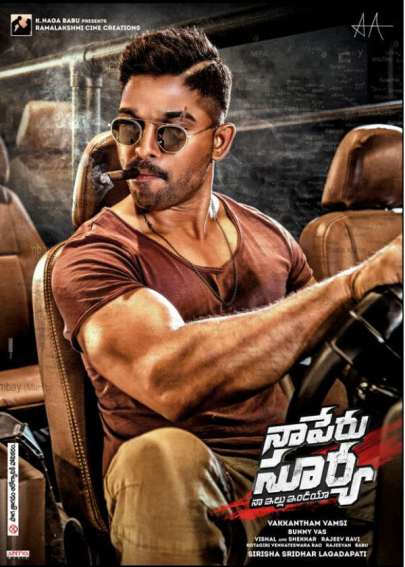
Naa Peru Surya

After writing a couple of hits for Telugu cinema, Vakkantham Vamsi has moved into directing his own screenplay with the release of Naa Peru Surya, Naa Illu India. However, despite an excellent opening scene, the film quickly loses momentum and is let down by poor story development and lack-lustre dialogue, most notably between the hero and his estranged father. The bones of the story are there, but Vamsi tries to mix in too much masala in the form of a dodgy crime boss and a rather limp romance, that dilute down what could have been an excellent coming of age movie. It’s still entertaining though, mainly due to an outstanding performance from Allu Arjun, while there are some excellent action and dance sequences that almost make up for the jumbled storyline.

Bunny is Surya, an army officer with more than a few anger management issues. This leads him into trouble, although to be fair the two incidences where he loses his temper in the opening scene are reasonably justified. It’s more that the magnitude of his response is well above what would be considered ‘normal’ and that’s what ends up being his downfall. After an incident with a terrorist leads to his dismissal from the army, his only shot at redemption is to get a letter signed by eminent psychologist Dr Rama Krishna Raju (Arjun Sarja) certifying that Surya has conquered his anger issues. The problem is that Dr Rama is actually Surya’s father, although the two haven’t spoken since Surya walked out when he was 16 years of age. Surya has been raised and supported by his ‘uncle’ Rao Ramesh, who has sponsored his recruitment into the army and manages to persuade his commander, Colonel Sanjay Shrivastav (Boman Irani) to give Surya one last chance.

There is great potential here, but the basic story of Surya’s road to redemption is almost lost behind the subplot of conflict with gangster Challa (R Sarathkumar) his son (Thakur Anoop Singh) and henchmen, Pradeep Rawat and Harish Uthaman. While these scenes are well filmed with great action sequences, Surya’s anger management plans languish in poorly constructed scenes with his father. Where there should have been crackling tension between Surya and Dr Rama there is instead uncomfortable chat that doesn’t come close to developing any kind of relationship between the two men. Granted the premise is that Dr Rama has completely shut Surya out of his life, and Surya will do absolutely anything to get back into his beloved army, but their interactions are so cold and clumsy that they become meaningless. What I wanted was tension and some level of self-realisation from Dr Rama and Surya, but instead there is just Surya’s anger, represented by discordant background music, and a manufactured conflict between Surya and Challa’s son that he needs to ignore if Surya is to go 21 days without fighting.

Oh yes – that’s the other odd plot point. If Surya can demonstrate no angry outbursts in 21 days he will apparently have conquered his problem. This sounds like a google-based plan of anger management and not the evidence-based behavioural therapy expected from a University based psychology professor, but by this point it’s not one of the most far-fetched ideas in the film.

Also problematical is Surya’s romance with Varsha (Anu Emmanuel). Anyone faced with the kind of anger towards them displayed by Surya would start running and not look back, so Varsha’s continued interest in Surya is hard to fathom, especially when she has zero chemistry with Bunny (and how is this even possible?). The romance makes little sense and doesn’t fit into Surya’s self-inflicted isolation shown in earlier scenes when he single-mindedly pursues his goal to be stationed at the border. Anu Emmanuel has little to do other than look glamorous and ‘stand by her man’ at the appropriate point in proceedings. All of which she does competently but it’s another disappointingly pointless heroine role that adds little to the main story. Another wasted character is Surya’s mother, who doesn’t fit at all well into the narrative and fluctuates between apparently not recognising her son and extreme anger at his absence for all these years.

Despite the shortcomings with the screenplay, what does work here is the character of Surya and his struggles to conform. Surya does manage to control his anger but it’s at the expense of his own self-worth and Bunny gets that inner conflict across perfectly. He shows the enthusiasm and fire that drives Surya to be the best soldier he can be, along with Surya’s passion for his country and makes it seem completely natural. Even better are the later scenes where Surya has to come to terms with the compromises he has made to try and meet his 21 days target. What the dialogue doesn’t manage to get across is plain to see on Surya’s face and in his body language. It really is one of the best performances I’ve seen from Allu Arjun and he completely gets under the skin of his character, dour and driven, with only the songs showing his normal cheeky grin. The support cast are all competent and do as much as they can with their limited roles. Thakur Anoop Singh makes the most impact and is impressive in the action scenes, while Vennela Kishore does manage to sneak in some comedy. It’s great to see Arjun Sarja back onscreen but disappointing that he has so little to do here.

The action sequences are excellent and choreographed to make Surya’s one-man army seem plausible, particularly when intercut with scenes of his army training. Naturally no-one can stop Surya when he’s angry, but the action is well put together and Bunny makes it all look effortless. The songs are generally good too, although the first two have little dancing – which surely is a crime in an Allu Arjun film. However just as I thought that, Lover also, Fighter also started with some great moves and awesome tricks with a cap. Bunny interchanges between ultra-classy and gangsta-wannabe in this song, but when it’s right, no-one does stylish like Allu Arjun!

Vakkantham Vamsi tries to include ideas about the evolution of home-grown terrorists but this is overly simplified and has little impact. I was expecting plenty of patriotism and Naa Peru Surya has a surfeit of flag waving and speeches about a United India that feel contrived, but inevitable in any film that mentions the army. If Vamsi had stuck to a straight-forward story about one man’s redemption this would have been an excellent film. However as it stands, with the additions of a gangster storyline, romance and failed family relationships, Naa Peru Surya has too many threads vying for attention and doesn’t do justice to any of them. Worth watching for Bunny, Arjun Sarja, who does a good job with his limited dialogue, and the dance sequences – just don’t expect too much from the story.

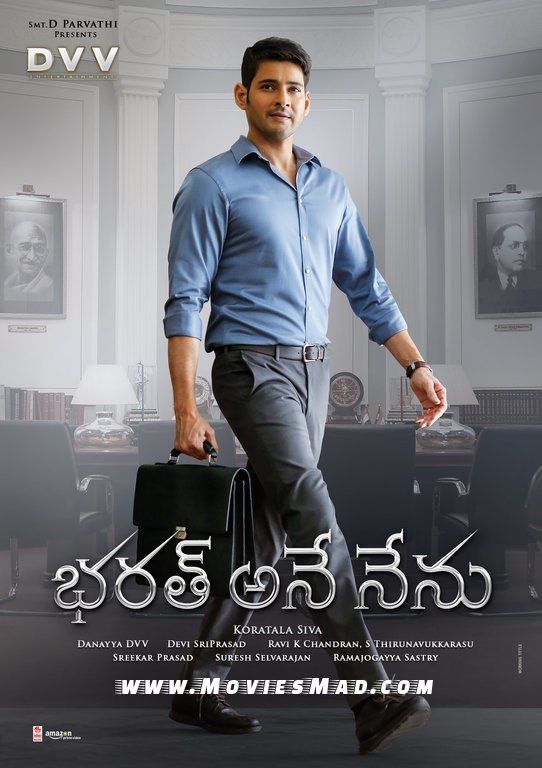
Bharat Ane Nenu

Koratala Siva and Mahesh Babu team up for this smart political thriller. It’s a good looking film with a fairly solid story, but you’ll need to turn your logic-meter off, or even inside out, at times. And not just for the gravity defying action scenes.

Bharat (Mahesh) is a perennial student in a London populated by white people with bizarre accents. He is on his 5th university degree, and has no immediate plans to stop studying. He is smart and curious, but might lack a bit of focus or motivation. Called home after the sudden death of his politician father (R Sarathkumar), Bharat is inveigled into taking up the apparently hereditary role of CM by his dad’s friend and colleague Varadarajulu (Prakash Raj). But while Bharat may be clueless about local Andhra Pradesh issues, he’s very rules driven and task focussed and likes to act decisively. He will bring back the FEAR, RESPONSIBILITY and ACCOUNTABILITY (caps courtesy of the subtitles team) that he thinks society needs. And that sets him on a collision course with pretty much everyone in politics.

There are some odd inconsistencies in Bharat’s logic at times and it felt like there was an often unacknowledged conflict or contradiction in the film between what he stood for and what he did. Bharat left home to go live with friends in the UK when he was just a kid. He stayed away for years, but he still remembers his mother telling him stories about duty and doing the right thing (underscored by her death when he broke a promise so….). He seemed happy to follow his own whims while abroad and had no firm plans. However Hyderabad traffic sets him ablaze with indignation. He’s a true believer, fighting to see his vision brought to life, and at odds with the career politicians who feather their own nests. A benevolent dictator is still a dictator so I found it interesting that apparently I was supposed to see this as democratic representation of the will of the people. He was never elected, just chosen first by calculating party men and then by public acclaim. And the film shows that acclaim can turn very quickly to scorn. I really did like that in what could have been a clichéd scene of people coming to the Hero to rid their village of a problem, he turned the tables and asked why they didn’t save themselves. It’s a tired trope that needs to be retired or examined, and having Bharat say he would support people but they had to get off their butts and do something to help themselves was excellent. He sees a girl at a bus stop every morning and has no qualms about using state resources to get her number, but he does ask for her consent at key junctures so there is that. He asks why the roads have to be closed for his ministerial convoy but again, no issue with taking over an entire restaurant so he can have a coffee date with Vasumathi. There’s a bit of “don’t do as I do, do as I say” in Bharat.

Mahesh is convincing as the driven reformer who wants to remind people of the rule of law, and he can carry off the grand speeches. Bharat starts out using his intelligence and will, but at a point his awesome fighting skillz surface. It’s fitting that at the moment he went from protagonist to Hero, he was surrounded by swirling movie tickets just like the paper thrown by a cinema audience to greet a hero’s entrance. The action scenes are highly stylised, relying on Mahesh’s ability to stare down the camera while sauntering past wearing a baddie as a backpack. I laughed loudly and alone at that visual! Koratala Siva knows exactly what he is doing with the mass tropes and with his actor. I don’t think there is anything in the role that challenged Mahesh’s abilities but he gives a committed and smartly layered performance. For those who rely on me for other insights about layering, yes he wears t-shirts and even flashes his knees. I suspect in one scene that he might have had two white t-shirts stitched together to avoid any hint of transparency. But it’s modern, minimal layer Mahesh in terms of wardrobe.

Kiara Advani is Vassu, the object of the CM’s affections. While Vasumathi is interchangeable with just about every other newbie Telugu film heroine, she is vaguely intelligent and has a life. She obviously likes Bharat, but is nervous because of his position and just because she’s a middle class girl. Her giving him a stick on moustache was a stroke of genius. Seeing Bharat happily at one with the crowds on their low key dates because of his dodgy mo was very funny. Unfortunately after a promising start, Vassu loses all agency as soon as men start on about their own honour. I’m neither here nor there as far as Kiara Advani is concerned. She is fine but there’s so little to the character that I couldn’t say she brought anything unique to the role either. Her outfits were boho student in daily life but the songs are where the costume department run amok.

The Devi Sri Prasad soundtrack is full of tracks that sound like other tracks, and the lyrics are loaded with dubious English rhyming nonsense. Perhaps I am being harsh and Vasumathi likes to be called “my lovely harmonica”! Mahesh’s prime dancing days are a thing of the past, I think, so the choreography was largely of the walking and pointing variety. The big set number Vachadayyo Saami is a standout mostly for the colour and spectacle (which includes the aforementioned knees).

The supporting ensemble is full of competent actors, well cast, and most with a bit of depth or development to their characters. Prakash Raj is excellent as the avuncular Varadarajulu, completely believable as the long time friend and frenemy. Anish Kuruvilla, house favourite occasional director/That Guy, plays a slightly slimy but not unlikeable Chief Secretary caught between the party and the CM. He gets to give his appalled expression a good workout, along with a bit of side eye. Brahmaji is the CMs assistant and like most people dragged along in Bharat’s wake he alternates between flustered and tickled pink at the goings on. Another favourite That Guy, Ajay, has a small but sensible role too. And I was very pleased to see good old Mukhtar (Mukhtar Khan) was not forgotten after one pivotal and quite brutal scene. Bharat might be swept away by the public but the continuity and attention to detail and people was there, as befits his character and this film.

If you like the idea of a well-acted, well directed, and more violent story somewhat along the lines of Mr Smith Goes to Washington but with dodgy subtitles do see Bharat Ane Nenu!