Kirik Party

kirik-party-poster

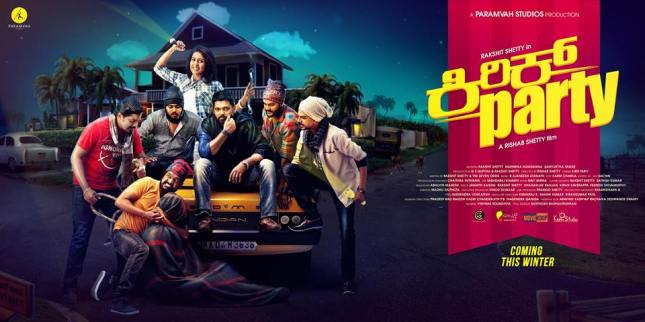
If your only resource was Kirik Party you would think that college in India is a rather different proposition compared to studying in the rest of the world. At Karna’s chosen institution in Hassan there is wide-spread harassment, bullying, plagiarism and various other activities that would see most of the so-called students thrown out after a few weeks if the college was anywhere else. In the happy land of film however, all these excesses are simply high spirits and something to be encouraged while everyone goes home with a qualification despite never appearing to study a day in their lives. I’d hoped for something different in Kirik Party but it follows the same old routine as many other previous campus-based films, even at times coming precariously close to Premam with the back to back romances. However, although many of the situations are clichéd and the students follow the usual template the film itself is reasonably enjoyable. The actors do a good job of creating sympathetic characters and the Kirik Party does manage to touch on some of the unique college experiences that don’t occur at any other time in your life.

Kirik Party begins as Karna (Rakshit Shetty) and his friends start as juniors in college. They’re mainly engineering students with a few studying IT thrown in for variety, but despite their different disciplines they form a tight-knit group of friends. Almost immediately Karna falls for senior student Saanvi Joseph (Rashmika Mandanna) who is surprisingly tolerant of his initial stalking tactics – at least they’re more amusing than usual. Karna enlists his friends as co-conspirators in his pursuit of Saanvi and the romance gradually progresses to the point where Saanvi asks Karna for help to get a pregnant sex-worker to hospital. This seems as if it’s going to be a watershed moment for Karna but at the time he seems to dismiss the incident quickly and it’s not until much later in the film that he starts to think more deeply about the situation. Sadly again this revelation is nothing new, but it’s sympathetically handled and does make Karna a more likeable character. Karna’s interest in popular student Saanvi creates friction with the senior students which allows for some good comedy as the hapless seniors run up against the more organised and ruthless junior students.

The friends indulge in the usual filmi college activities; drinking, skipping class and fighting with the seniors but they do also club together to buy a car which allows them greater freedom and more opportunities for mischief. It also introduces them to a mechanic played by Achyuth Kumar who becomes a permanent fixture in their lives as he is roped in to complete engineering projects for the group. What works best in this half of the film is the easy camaraderie shown between the students who share their love of Upendra films and cool sunglasses. The romance between Karna and Saanvi is also good with a natural progression that makes sense despite their different ages. I like too that she doesn’t immediately fall for the hero, but has to be gradually convinced that there is more to Karna than a superficial glance would suggest. Rakshit Shetty does appear too old to be successful as a junior student but the rest of the group all look suitably youthful and their behaviour is certainly juvenile enough for their supposed ages. Rashmika Bandanna is a real find and is very natural in her role, creating a warm and friendly personality for Saanvi but one who comes across as strong and confident too.

In the second half the group have returned to college as seniors, and I love that this is illustrated by the friends all having grown facial hair. There are signs and posters everywhere in the background proclaiming the desirability of beards since obviously whatever fashion the seniors follow is the only possible trend for the entire college. This is one of the things about life in college that does ring true in the film, as is the complete fixation the students have on small matters while managing to be totally blasé about anything that would imply taking responsibility for their actions. For instance, Karna happily heads off on a road trip, missing weeks of his studies, without any thought of how this will affect his future or that his friends will worry about his absence. In comparison, the outcome of elections for college president is important enough to consume the group for weeks and result in bullying and intimidation tactics to make sure Karna wins.

The tables have turned in the romance stakes too. Now its Karna’s turn to be followed by a junior student who professes her love for him. Samyuktha Hegde is excellent as the happy-go-lucky Aarya who stalks Karna and repeatedly proclaims her love for the now surly and argumentative senior. The events of the first half subtly repeat while in both romances the women are looking for the different side to Karna. Rakshit Shetty is much better in the second half as the older and (possibly) wiser Karna, and he seems to be more comfortable with the characterisation too. The resolution to his own personal dilemma is also well handled and gives Karna an opportunity to mature, just as you’d expect towards the end of college.

There isn’t much time spent on the rest of the friends but they all seem to be a typical bunch of students in film-land, while Raghu Pandeshwar is fine as the college principal. The music from B. Ajaneesh Loknath is excellent and perfectly added to the narrative so that dialogue segues into songs and back into dialogue seamlessly. The songs too are catchy and fit well into the student setting, making Kirik Party more of a true musical rather than simply a film with added song and dance numbers. The action scenes are also well choreographed and apart from one brilliantly called as a cricket game are mostly of the slappy variety that seems more natural for this style of film.

Although the story and the characters don’t break any new ground, overall the film is entertaining with plenty of comedy and enough drama to keep it interesting. I would have liked more realism in the depiction of student life, but that wouldn’t have given Karna and his friends time to indulge in their various vices and ultimately that’s the whole point of the film. Kirin Party is a good, entertaining time-pass, but don’t expect anything more from Rishab Shetty’s foray into student life.
Kiragoorina Gayyaligalu

kiragoorina-gayyaligalu

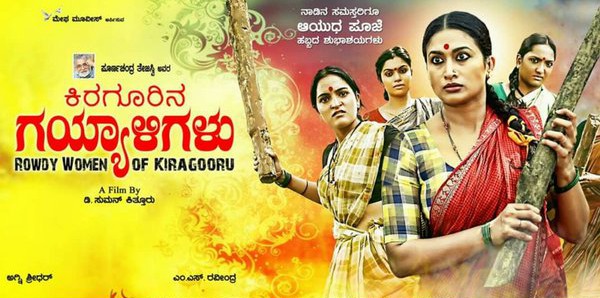
Kiragoorina Gayyaligalu is a beautifully filmed adaptation of a novella by acclaimed Kannada writer Poornachandra Tejaswi. Director Sumana Kittur has teamed up with screenwriter Agni Shridhar (responsible for the excellent Aa Dinagalu) to give a colourful look at village life in rural Karnataka from the recent past. Various small incidents illustrate the relationships between the different groups in the village, but the usual routine is thrown into disorder when there is a plot to con the villagers out of their land. The situation escalates until it’s up to the ‘rowdy women’ of the title to restore order and deal with the corrupt officials behind the scam. I haven’t read the original story but the film is charming with a balanced blend of drama and comedy that still manages to address a number of social issues, albeit in a light-hearted way.

The film starts by showcasing the differences between the men and women of the village. While the women are out working, the men are lounging around the village, playing dice and utilising the services of the village barber. The women from different castes all work together without any issues but it’s a different story for the men of the village who are more inclined to take notice of someone’s place in society. The higher caste Gowdas negotiate the cheapest price they can for any work done for them by the lower caste Kulavadis although the men all congregate to drink together in the village arrack shop at the end of the day. The arrack shop is a point of contention for the women as they feel that this is the reason their husbands have become lazy and argumentative. All in all, Kiragooru seems to be a typical village with the usual colourful characters, petty disputes and plenty of potential for mischief.

Daanamma (Shwetha Srivatsav) is an outsider from a different village who is married to Subbaiah (Rahul Madhav), one of the Gowdas in the village. Despite being a relative newcomer, the other women look to her for support and she’s the one they ask to break up a fight between Kaali (Sukrutha Wagle) and Rudri (Manasa Joshi) when tempers flare. She’s just as competent at home, refusing to let Subbaiah leave when everyone else runs from a police jeep in the village and ensuring the household runs to her satisfaction, although she does seem to have a genuinely happy relationship with her husband. Daanamma also provides support to Nagamma (Sonu Gowda) whose husband Kaale Gowde (Kishore) is abusing her for failing to provide him with children. Kaale is desperate to marry for a second time and has fallen for Bhagya (Karunya Ram), a vegetable seller in the local market but doesn’t tell her the truth about his marriage to Nagamma. Rounding out the village are the Kulavadi farmers who include Maara (Nikhil Manjoo), Kariya (Sampath Kumar) and their families.

Shankrappa (Achyuth Kumar) is the government welfare officer for the village, but he also runs the arrack shop and is plotting with Bhootha Swamy (Sharath Lohitashwa) to con the villagers out of their land. When Daanamma threatens the visiting Tahsildar and runs him out of the village, Shankrappa files a complaint against her with the police that also accuses the Gowdas of cheating the Kulavadis out of their rightful wages. This results in the Gowda men being taken away to the police station where they endure a humiliating experience at the hands of the drunken Inspector. They immediately turn to Bhootha Swamy for help, but he lies and tells the men that it was the Kulavadis who filed the complaint. This widens the divide between the two groups, further fuelled when Bhootha Swamy lies to the Kuavadis too and the Gowdas fan the flames by employing an outsider to chop up the tree. No reconciliation seems possible until Daanamma takes matters into her own hands and enlists the rowdy women of the village to sort out the problem once and for all.

It’s a well told story with plenty of quirky characters, but the appeal of the film lies in the excellent performances from all the actors. No matter if the character is only on screen for a few moments such as the unethical Dr Appanna (S Narayan), everyone seems to fit their role perfectly. Shwetha Srivatsav has most time onscreen and is brilliant as Daanamma with her perfect mix of compassion, bravery and common sense making compelling viewing. This is very different to her role in Simple Agi Ondh Love Story but she again makes excellent use of her facial expressions and both looks and sounds the part of a rural villager. Sukrutha Wagle is appropriately shrill and combative as one of the Kulavadi rowdy women, while Sonu Gowda provides contrast as the silent but still expressive Nagamma. The scenes between the different female characters also ring true with plausible discussions of their routine chores and complaints about their husbands with the occasional small rivalry thrown in to demonstrate how they got their reputation. Their support for each other is also realistically portrayed along with their determined reactions which are a good contrast to the men’s vacillations and indecision when faced with a problem.

The men all suit their various roles too. Rahul Madhav, Sunder and Anathavelu are all good as the overly trusting Gowda men, while Kishore is excellent as the abusive Kaale. Although the character is mainly comedic, there is a serious side in the abuse he deals out to his wife and it’s a credit to the film that this is dealt with sensibly, both highlighting the abuse itself and giving a solution that shows Kaale to be the one at fault rather than his long-suffering wife. The film also raises the issues of drunkenness and caste division and although these are used to some extent for comedy, there is a serious side as these are shown to be real issues for the community. Naturally the women are the ones to solve these issues too with their practicality and common sense winning the day.

Kiragoorina Gayyaligalu is a film where everything just comes together perfectly. Manohar Joshi’s cinematography is complemented by Saadhu Kokila’s music and Sumana Kittur evokes a village atmosphere through colourful dialogue and fantastic attention to detail. The language is often beeped out but the subtitles are hilarious with the women not afraid to air their graphic opinions publicly and loudly! Each scene is complete in itself but also serves to establish and evolve the different characters and situations. Added together they all build up to a captivating story and satisfying finale. One I highly recommend for the excellent performances, well-written screenplay and some of the best female characters I’ve seen in Indian cinema. 4 ½ stars.

Mungaru Male 2

mungaru-male-2

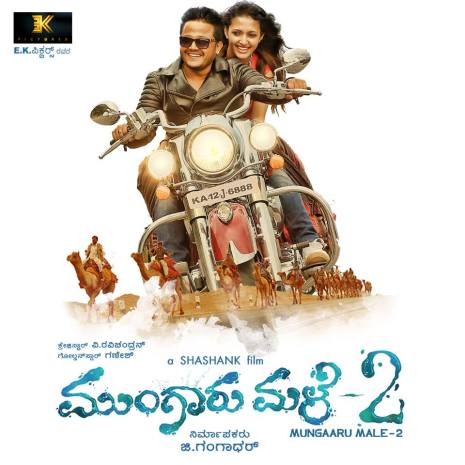
Yogaraj Bhat’s 2006 Mungaru Male was a big hit so it’s not too surprising that the story has been revisited in this 2016 reboot written and directed by Shashank. However, although there is a Preetham and a Nandini, a pre-arranged marriage to disrupt and plenty of rain, Shashank doesn’t quite manage to recapture the magic of the first film. It’s a reasonable enough romance but nowhere near as engaging as the original, and with an unlikeable hero in the first half and a ridiculously over-dramatic and improbable climax it’s newcomer Neha Shetty and the beauty of Rajasthan and Karnataka that make the biggest impressions.

Preetham (Ganesh) is the immature and brattish son of multi-millionaire businessman V. Ravichandran, whose major problem in life is that he is easily bored. The film starts with some dodgy CGI of a helicopter as Preetham pulls out all the stops to impress Shreya (Aindrita Ray), the current object of his desire. However before long Preetham has had enough of his new relationship and unceremoniously dumps Shreya using incredibly juvenile dialogue, while Shreya reacts unrealistically well to being told she is too dull for the spoilt rich kid. Preetham’s childish behaviour continues (although I suspect he’s supposed to look spontaneous and hip), as he runs off on a train trip to Rajasthan. On the train he meets Nandini (Neha Shetty) and the two abandon the tour to experience the colour and vibrancy of Rajasthan by themselves as temporary girlfriend and boyfriend.

This part of the film works as a standard romance, apart from the frequently childish behaviour from Preetham. Nandini also has a tendency to be obnoxious at times, although to a lesser extent, and at least she is never as deliberately cruel as Preetham. Perhaps unthinkingly selfish is the best description as it’s Nandini who decides where to go and what to do. Thankfully Shekar Chandra makes the most of the stunning landscapes and colourful locals, so at least the film looks amazing in these scenes.

Post interval the action moves to rain-drenched Karnataka as Preetham discovers that he has fallen in love with Nandini and finally decides to try and find her. This he does, just in time to learn that she is engaged to a US based doctor who is planning to move back to India and open a charity hospital built by Nandini’s father P. Ravi Shankar. How’s that for perfect matchmaking! To add more drama, there is a family connection behind the marriage which supposedly makes it even more imperative that the marriage goes ahead, but which seemed to me to be more of a good reason why the whole thing should be called off.  Sadhu Kokila adds some humour to the proceedings while V. Ravichandran is good as Preetham’s concerned father.

Shankar tries to add a new twist to the Mungaru Male storyline here and to be fair it works reasonably well up to a point. Ganesh’s Preetham becomes more likeable once he falls in love with Nandini and the two have some better chemistry together in the second half. The songs are also more appropriately placed and generally well visualised while the stunning waterfalls and beautiful scenery in Karnataka add to the romantic atmosphere.  In fact it doesn’t go too pear-shaped until the last 20 minutes when the slow but sweet romance suddenly switches to a crazy action sequence and completely ridiculous ending. There are even matching head bandages and bloodstains for the lead pair as they career around a hospital trying to find each other. It’s so silly that it becomes hilarious, although I suspect that it’s meant to be dramatic and tense instead.

There are a few franchises where sequels have worked well, but more usually they fail to live up to the original, and such is the case here. The best parts of the film are undoubtedly the songs by Arjun Janya and the beautiful cinematography from Shekar Chandra, but that’s not enough to save the film. Ganesh tries hard, but his character is too spoilt and brattish in the first half to allow any empathy for Preetham later on. Neha Shetty is good and does well with this more modern and independent Nandini, although she loses much of her spark once she admits her love for Preetham. Just for once I’d like to see the heroine not become a wet blanket once she falls in love! Sadly Mungaru Male 2 just doesn’t live up to expectations and is probably one for the fans. Or wait to watch on DVD when you can skip forward past Preetham’s bratty behaviour and enjoy the travels through Rajasthan and Karnataka instead.