Salt N Pepper

Salt N Pepper poster

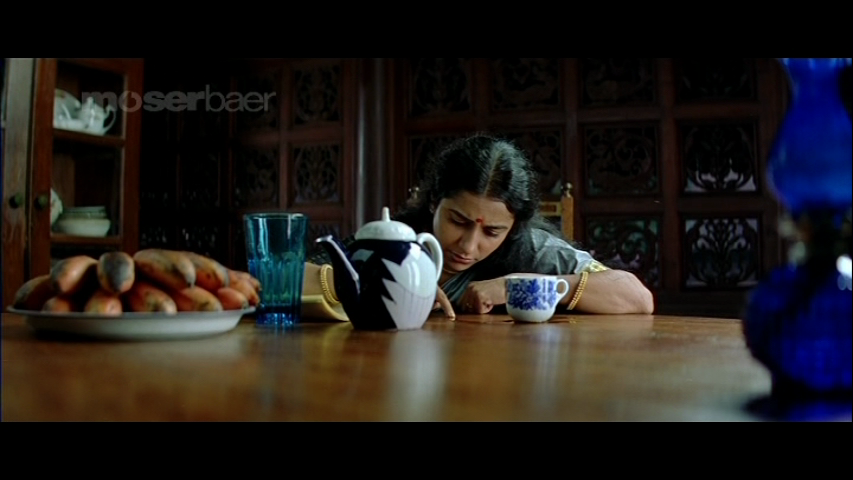
I liked Aashiq Abu’s Salt N Pepper for lots of reasons, many being things the film isn’t. It is a romance but it’s not the usual gorgeous young things plunging into insta-love. People have their emotional baggage but no one is so traumatised by rejection or ill fortune that they have to become vengeful killing machines. People cook, eat, and share what is important in their lives. Friends do the wrong thing sometimes, but might also do the exactly right thing and either way, life goes on.

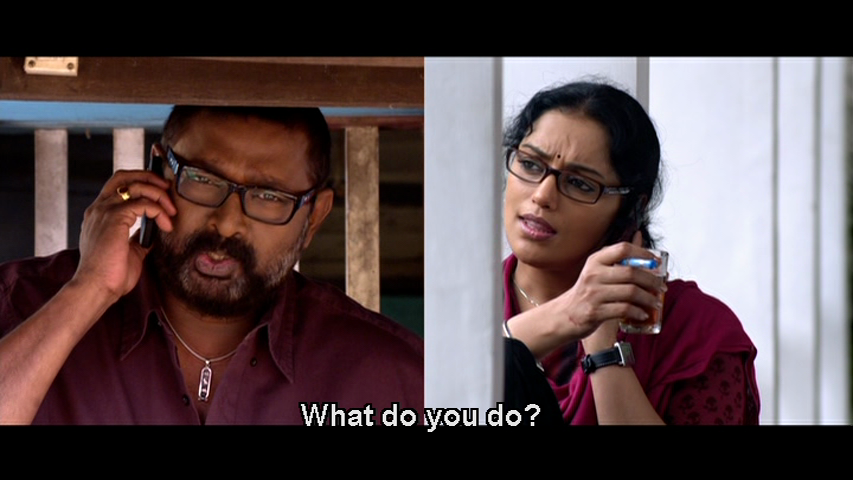
One day Kalidasan (Lal) receives a phone call from Maya (Shweta Menon), who mistakenly thinks she has called a restaurant to order a particular dosa. He cuts the call and when she rings back to chase up her order, he tells her off. Once the rancour settles and the misunderstanding is cleared, Maya and Kalidasan speak often. They are both a little older, have their own lives and careers.  While they each want love and companionship, they lack confidence in their ability to attract and keep a partner.


Salt-n-Pepper-it begins

Both are foodies, and their conversations develop around cooking and local delicacies. Manu (Asif Ali) comes to stay with his uncle Kalidasan. Manu is enthusiastic, likeable and not one to overthink the consequences. Maya’s closest friend is the confident glamour girl Meenakshi (Mythili). When Kalidasan and Maya decide it is time to meet and see if their burgeoning relationship might take off, they both make the same decision, born out of their insecurities. They send stand-ins. Manu and Meenakshi meet, pretending to be Maya and Kalidasan and their chemistry is evident. Manu pursues “Maya” for himself and Meenakshi is keen on him too. So when Maya and Kalidasan each decide to stop the pretence and meet for real, what will happen?

Lal’s performance brings the solitary Kalidasan to life. He is a man who has grown accustomed to his circumstances even though he sometimes wishes there was a bit more to it. Usually a sensible and organised man, his occasional drunken antics range from appealingly silly dances to temper tantrums. Lal puts it all together to add depth and shade to the character, and has bit of teddybear charm behind the growly voice. Kalidasan has some self-awareness and is not afraid to offer a heartfelt apology or reflect on his own behaviour so he remained sympathetic despite, or sometimes because of, his almost adolescent outbursts.  Despite his reserve, Kalidasan has a handful of good friends and he warms to Manu immediately, making him a welcome addition to the household. He seems like a nice, slightly quirky, guy.

Shweta Menon is perfect as Maya, a dubbing artist. Maya cooks partly to connect with her memories of her mother. She connects with Kalidasan when he recounts the story of a cake made to celebrate a soldier’s return to his wife, and they make their own versions. Shweta Menon gives us a heroine who is a woman not a giggling stick insect in minimal clothing. She is articulate, attractive but not glam, and wants love not transient lust. Like Kalidasan she has a few close friends. They sit on the roof terrace and get drunk, telling stories and making plans. Maya usually hides her feelings but sometimes the façade cracks and she is a sensitive, hopeful girl that wants a nice guy to love her as she is. Maya is an independent lady and she navigates the various challenges at her workplace and home every day. She knows she has to do things for herself, even when it seems difficult.

Asif Ali and Mythili are both good in their roles and I liked Manu and Meenakshi despite their occasional selfishness and dimwitted behaviour. I wasn’t as convinced by their relationship developing as I was by Maya and Kalidasan but there was enough substance there to make it seem likely. Maybe my personal preference for not pretending to be someone else and dislike of lying and sneaking around is tinting my view. Manu is a manchild, and Asif Ali had the right blend of innocent enthusiasm and delusions of hotness. I have to say he seems to kiss with the finesse of a St Bernard pup which was a worry. Mythili played up the glam and Meenakshi came across as that girl who had always been pretty and popular and had total confidence. This pair were featured in a romantic duet that not only put them in bed, but also in matching sarees. Or maybe his ‘n’ hers togas.

One of my favourite scenes is Kalidasan going to meet a prospective bride and returning single but with their excellent cook, Babu. Baburaj plays another in that long line of filmi stalwarts, the cook/confidant/general factotum. Babus’ observations give an insight into Kalidasan and while their relationship is often tested by Kalidasan’s demands, the mutual respect and affection shines through. I enjoyed seeing Kalpana as Maya’s landlady Mary. She is one of my favourite filmi aunties and while her role is small, she is expressive and fun to watch. I liked the running jokes that Maya’s moods were a result of the project she had been dubbing for. Apparently family soaps make you child-intolerant. Vijayraghavan plays Kalidasan’s colleague and friend, and doles out some sensible observations at the right time. Everyone has a backstory and enough detail to make them plausible.

There are some refreshingly low key moments. When a director (Dileesh Pothan ) propositions Maya, she makes it clear he is dreaming. He is not a creepy rapey villain, but a guy who likes lairy shirts, fancied a shag, and thought he saw an opportunity. (The subtitles said ‘togetherness’ but my ears heard ‘sex’. I wonder why.) If this was a typical mass film, he would have spent the next hour or so plotting Maya’s downfall, but as it happens he chose a completely different approach.

The film is set in Trivandrum and looks to have been filmed on location. City life permeates the action as Maya and Kalidasan move between the hectic streets and their residences, even unwittingly crossing paths. Kalidasan’s house is gorgeous but fusty, full of family mementoes and old fashioned furniture. His car is a character in her own right (and even gets a credit). Maya has crisp modern textiles and a light airy room, a space she has made for herself. It’s easy to believe in these people and their lives.

I largely enjoyed the humour and the relaxed interplay between characters.  However the whole Mooppan subplot is completely unnecessary and went nowhere. The Joan’s Rainbow cake sequence is one of the few false notes in the film, largely due to the endless simpering by yet another awful European extra. I did like the different cake construction and decorating style that Kalidasan and Maya chose. (If I was judging, Maya’s cake would be the winner.) Ahmed Sidique’s character was annoying and pointless. Considering the film runs under 2 hours, Abu spent too long on these tangents.

There are only a few songs, and they range from the appetising Chembavu which lists food after food, through a few inoffensive ballads (all by Bijibal), to the indescribably naff closing song by Avial. It seems Keralan “alternative rock” is not my thing – although I enjoyed the video for the segments with the actors playing starry versions of themselves.

Director Aashiq Abu has created a film romance that is smart without being too clever, has warmth without excessive histrionics and is populated by likeable people who possess (varying degrees of) common sense. 4 stars!

Chapters (2012)

Chapters poster

Writer/director Sunil Ibrahim’s 2012 début film is an interesting watch despite a slow beginning and a story where the emphasis is more on relationships and friendship rather than fast-paced action.  Chapters uses a multi-linear narrative style to tell three separate stories which are broken down into four separate ‘chapters’ – the source of the film title.  The first and third chapters interconnect as do the second and fourth, although the final chapter is more concerned with tying everything together. It made more sense to me on the second watch through as I picked up more of the connections, possibly due to concentrating too much on the occasionally dodgy subtitle first time round.  The focus is on the ordinary lives of ordinary people and although it’s an admirable attempt to make a different type of film, sadly we don’t learn enough about these ordinary people to make them interesting!  However at just under two hours it’s an easy watch and worth a look at least for the third chapter which is the most engaging.
Chapter 1Chapters

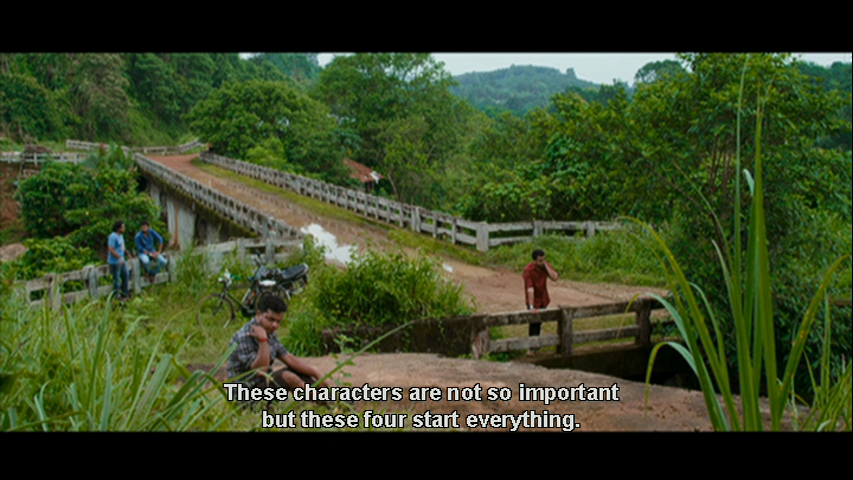
The film starts with a brief preface which sets up the first chapter.  Krishna Kumar (Nivin Pauly) enlists the help of his friends Anwar (Hemanth Menon), Joby (Vijeesh) and Kannan (Dhananjay) to raise some money to help pay for his sister’s wedding.  Rather interestingly his first option is to try for a bank loan, and when that fails the next plan is to try smuggling.  Hm – straight into illegal and criminal activity then without even the possibility of trying to get some work?  Must be the done thing in the Kerala highlands I guess since no-one seems to find this strange at all!  The first chapter deals with the friends attempt to find Nagamanikyam (the legendary snake pearl), to sell and raise money.  This naïve plan isn’t well developed in the narrative and as a result the first chapter feels laboured and unrealistic.  It’s unfortunate as it’s also the longest and the one that sets events in motion for subsequent chapters.  Although the theme of friendship is woven throughout, the individual relationships aren’t explored in any detail either and there never seems to be any reason for Kumar’s friends to sacrifice anything for him.

ChaptersChapters

None of it really makes sense until we get to the final chapter, and although that might work in a film such as Amores Perros, there just isn’t enough action here to justify the lack of character development.  I also found Krishna to be a rather unappealing character who never manages to redeem this initial impression, so perhaps I’m just biased against his story.  The other friends do seem as if they might have more interesting stories, but we don’t ever learn very much about them, and that is the major problem with this chapter.

Chapter 2ChaptersChaptersChapters

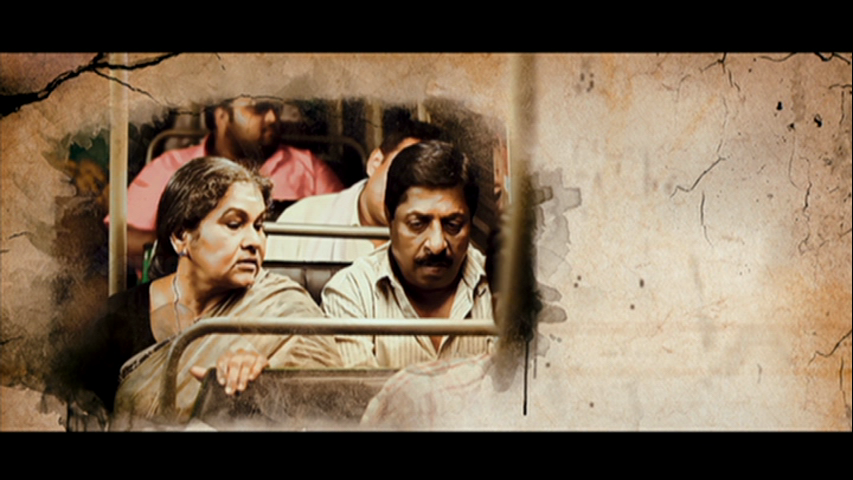
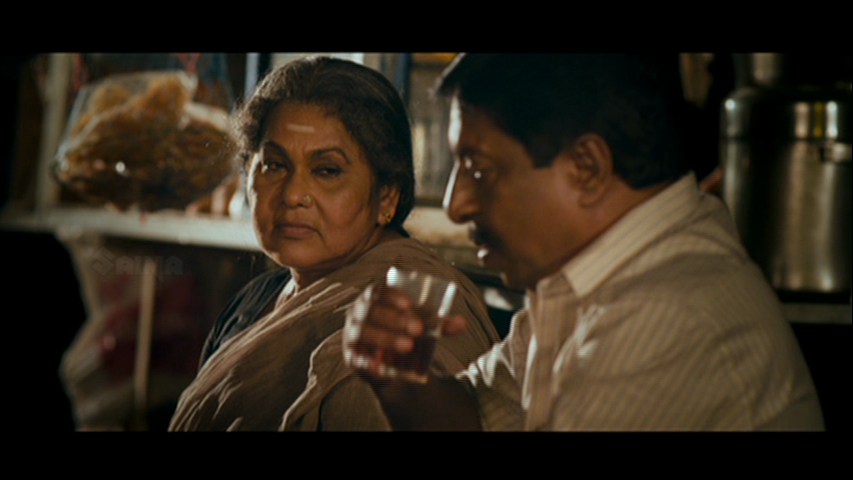
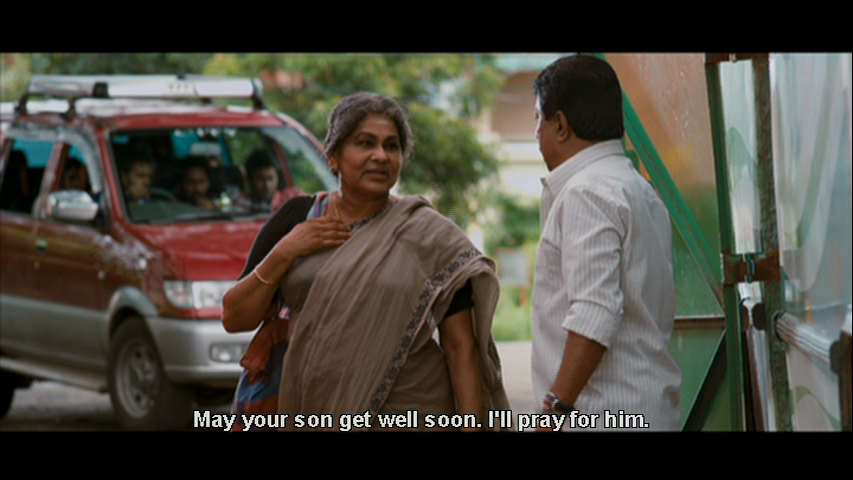
The second chapter tells the story of Sethu (Sreenivasan) and his bus trip to hospital to see his son.  On the way he meets an older woman, played by K.P.A.C. Lalitha, who is also on the way to visit her son, although her story is a little different.  This chapter is short and only seems to provide the background information to set up the last two, however the characters capture interest in their stories and it’s an improvement  after the slow beginning.   We never find out the older lady’s name or anything much else about her, but she is a reminder that there are many stories out there and we only see a small portion of each.  Although not much time is spent with Sethu there is a better sense of his life, his dreams and his problems, which makes his chapter more compelling.  Both Sreenivasan and K.P.A.C.Lalitha are excellent in their roles and as the camera concentrates on their faces while they chat on the bus, more is said by their facial expressions and demeanour than by their words. Maybe it’s a result of these roles being played by more seasoned actors but these characters have more rapport and more of a connection than the others in the story.

Chapter 3Chapters

The third chapter tells of an elopement orchestrated by Arun (Vineeth Kumar), Kaanu (Aju Varghese) and Jincy (Riya Saira) for their friends Priya (Gauthami Nair) and Shyam (Rejith Menon).  Arun brings along his friend Choonda (Shine), whom he introduces as a goonda, just in case they run into difficulties and need some muscle.  This is the most interesting story and there is attention to detail in the narrative, although again it suffers a little from lack of development of the various relationships. The obvious outsider in the group is Choonda and Shiny fits well into the role, while the rapport between the others helps to make later events more shocking.  Most of the action focuses on Arun, Shyam and Choonda, while the others have a more peripheral role in the proceedings.  However this lack of depth works here as the friendship theme is only the background reason for these people to be in a particular place at a particular time, allowing them to interconnect with the other characters in the preceding chapters.  More action and a sense of the different connections also help to make this the most appealing of the stories.  This chapter also has a love song which helps to develop the different relationships and as a bonus it features possibly the oddest pen holder I’ve ever seen!

Chapters

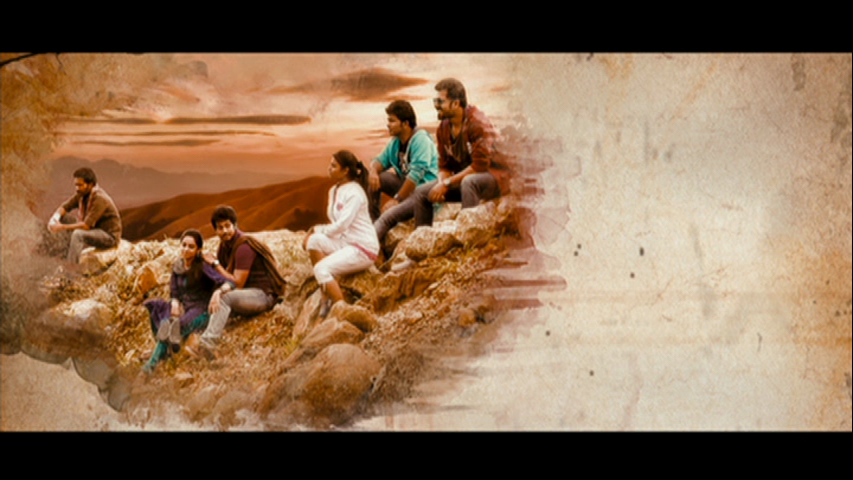
Each chapter recounts two particular days from different points of view, which add up to provide the full story.  There are a number of ways to bring this type of film together – one is by driving interest in one or more of the characters and their interconnecting relationships, but here there isn’t enough detail in most of the characters to feel any real rapport.  Another option is to take a piece of action and split it into the component parts, which is more the emphasis here.  Ibrahim doesn’t quite manage to pull it off though, which is mainly due to the slow beginning which doesn’t engage as much as the later chapters.  However once the story does pick up, there is enough interest generated in Sethu and the friends in the third chapter to make a more engaging and interesting film.  Making the first chapter as detailed as the rest would have definitely made this a better film.  As it is, the lack of consequence for the main character in the first section was somehow disappointing, particularly since everyone else seemed to have learned something from their experiences.  However, the actors are all well cast and feel genuine in their roles.  As in most Malayalam films, the cinematography by Krish Kymal is  excellent and the graphics between each chapter are beautifully done and capture the characters in defining moments.    There are two songs and both are used to develop the story, but I didn’t feel either was necessary and they didn’t really add anything more to the film.  Chapters is an interesting début and certainly merits a watch for a different approach to a multi-linear film and in particular good performances from Sreenivasan and the young actors in the third chapter . 3 ½ stars.

Vanaprastham (1999)

Vanaprastham

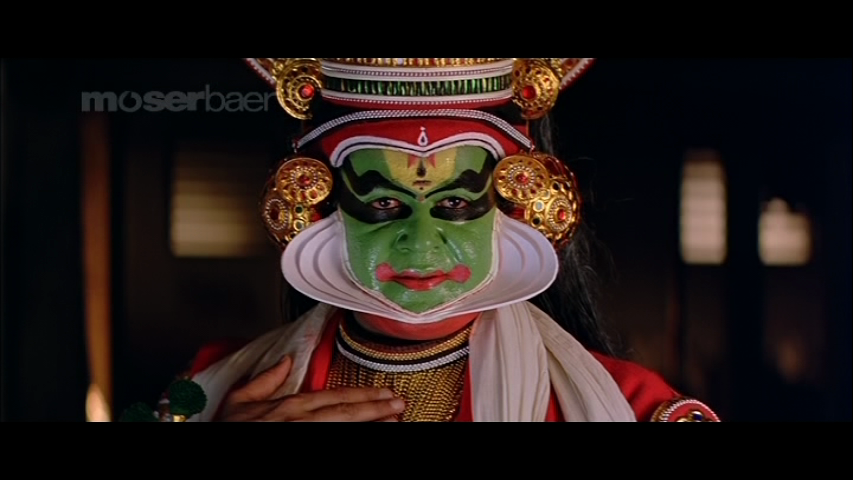
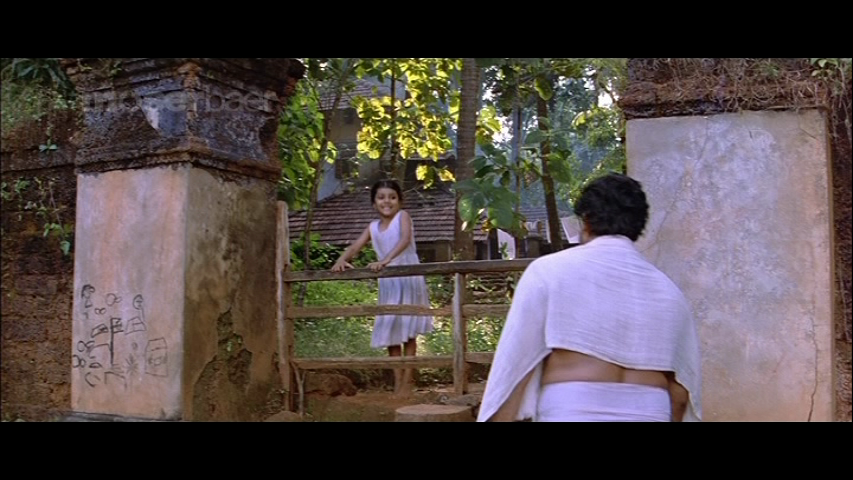
When I asked for recommendations for Mohanlal films some time ago, Vanaprastham was mentioned a number of times, and now I understand why so many people suggested it.  I think this is the best performance by Mohanlal I’ve seen, and it has whetted my appetite for more of his films.  Although Vanaprastham is a simple story about a Kathakali performer set in the middle of the last century, Mohanlal’s performance brings depth and intensity to the role and he is mesmerising.  Presumably due to the fifties era, there is plenty of repressed emotion and the reliance of the Kathakali performer on facial movement transfers directly as Kunhikuttan (Mohanlal) doesn’t say much but rather lets his expressions and in particular his eyes,  speak for him.  It’s a sad film, but it’s beautifully shot with gorgeous costumes and, as ever in Malayalam cinema, stunning cinematography.  Like the previous Shaji Karun directed film I watched (Kutty Srank), there is much about the story that is untold and left to the imagination, although the drama does proceed more linearly here.  Just in case anyone needs any more motivation to watch, Vanaprastham (aka The Last dance or Pilgrimage) screened in the Un Certain Regard section of the Cannes film festival when it was released in 1999, and won accolades at other international festivals as well as a number of National awards.

VanaprasthamVanaprasthamVanaprasthamVanaprastham

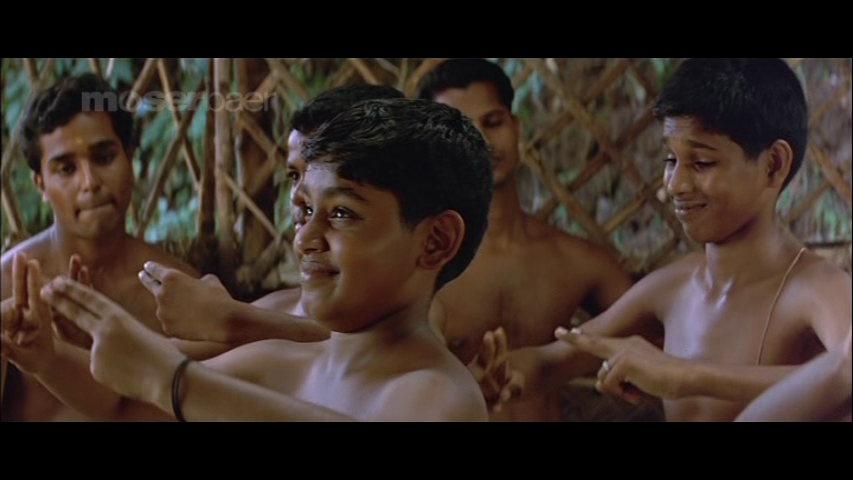
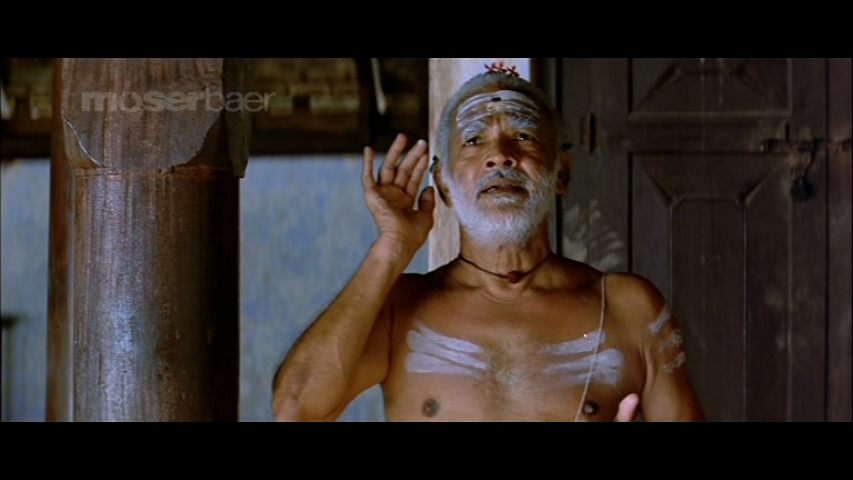
Kunhikuttan is introduced by a series of brief images interspersed between the opening credits which suggest that he is a lazy man who drinks, is looked after by his mother, disliked by his wife and adored by his daughter who is desperately trying to get his attention. And while that does sum him up on a purely superficial level, there is much more to Kunhikuttan.  A flashback shows his acceptance into dance classes as a child in the thirties, and reveals that he has never had any contact with his nobleman father.  This is a loss which he feels throughout his life and it appears to at least partly explain some of his reactions to subsequent events.  There is a lovely connection here between the scenes of the dance school with Kunhikuttan as a child and then again as an adult, where the same background of the temple elephants being dressed in their finery is unchanged despite the changes in Kunhikuttan. I also love the young Kunhikuttan’s expressions as he dances, particularly compared to the more rigid faces of the other boys.

VanaprasthamVanaprasthamVanaprasthamVanaprastham

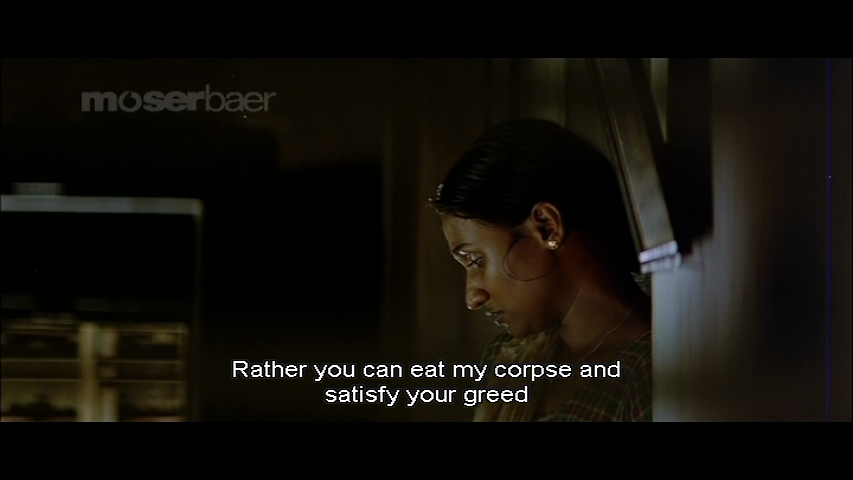
Kunhikuttan has an unhappy arranged marriage and his wife Savithri (Kukku Parameswaran) seems to despise him and his performance career.  Her antipathy towards her husband is one of the ’things that are never explained’, and there didn’t appear to be any obvious reason behind her animosity. Kunhikuttan’s daughter on the other hand adores him, and she is the one bright spot in his life outside of his stage performances.

VanaprasthamVanaprasthamVanaprasthamVanaprastham

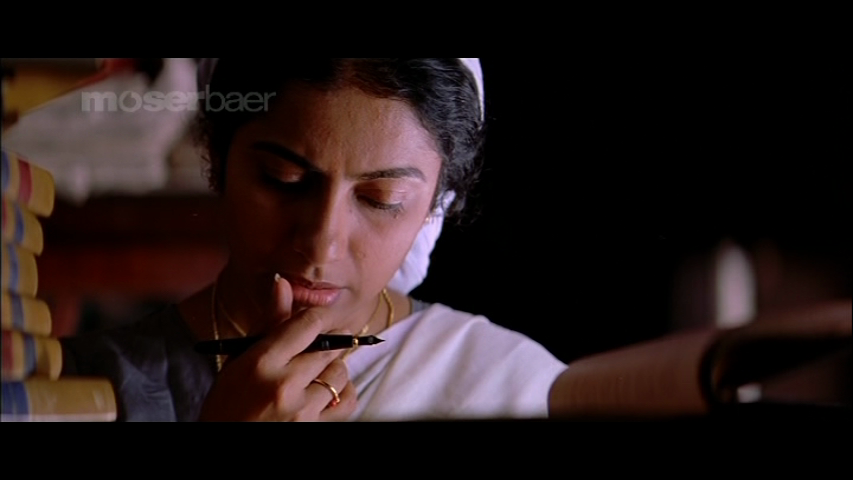
At the start of the film, Kunhikuttan has just reached the point in his career where he is able to play male roles, and he takes on the part of Arjuna in a performance which is seen by the niece of the Diwan, Subhadra (Suhasini).  Her character is at first only glimpsed as a hand at the window of the women’s viewing area, and this seems to be a foretelling that she is a private and somewhat hidden persona. Although one with excellent taste in jewellery.

VanaprasthamVanaprastham

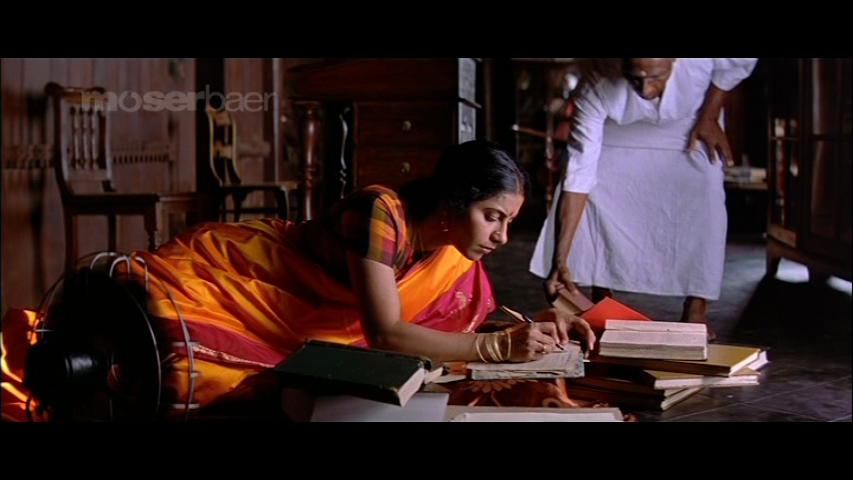
Subhadra is always alone and lives in a large house with only two elderly servants for company. She is mainly depicted as always writing, sometimes even during the performances, and she seems a rather pitiable character who is lost in her own dreams and fills her days with illusions.  She falls in love with Kunhikuttan but it is immediately apparent that she is obsessed with Arjuna the character rather than Kunhikuttan the man.  All her writing is put to good effect though as she writes a version of the Arjuna/ Subhadra story which she persuades Kunhikuttan to perform.

VanaprasthamVanaprasthamVanaprasthamVanaprastham

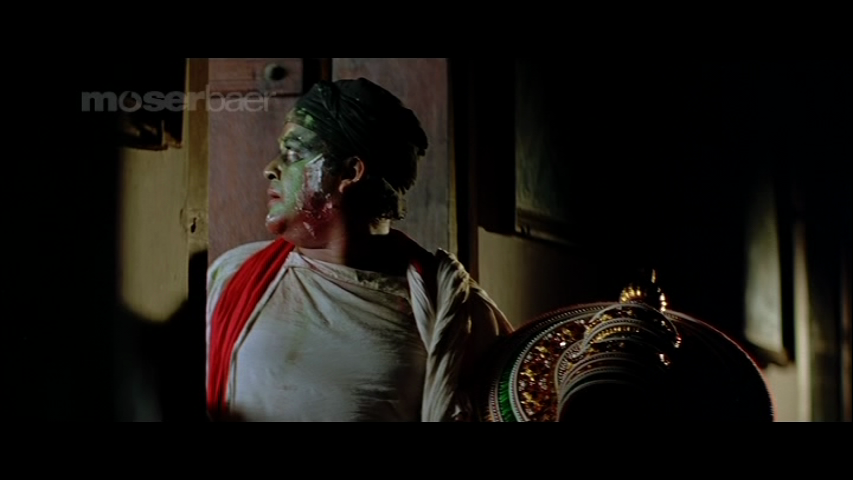
Subhadra’s obsession is clear in the scene after the two have made love.  Subhadra seems to revel in the smears of make-up on her face and looks ecstatic, while Kunhikuttan sneaks out of the room, guiltily carrying his costume and immediately goes to bathe.

VanaprasthamVanaprastham

Subhadra has no time for Kunhikuttan the man and when she has his child she allows him to meet his son briefly and then explains that she will have nothing more to do with him.  Kunhikuttan yearns to be with his son, particularly since he never knew his own father, but he is denied the opportunity to be a part of his son’s life. This is just one more pain for Kunhikuttan to deal with, along with his continual poverty, his unhappy home life and the looming illness of his friend.

VanaprasthamVanaprasthamVanaprasthamVanaprastham

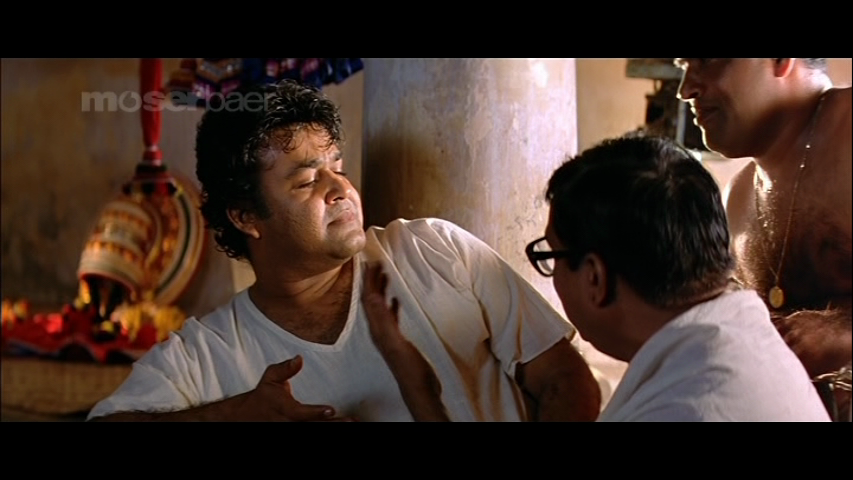
Mohanlal expresses his emotions perfectly, showing restraint and sincerity throughout.  His easy camaraderie with his fellow performers, his obsession with his son and the deteriorating relationship with his wife are all brought clearly to life.  Suhasini is also excellent as Subhadra and is particularly good in her scenes with Mohanlal when she is obsessing about Arjuna.  At times the film does get a little confusing, and the occasionally obtuse nature of the subtitles in my DVD copy didn’t help.  Kunhikuttan’s friend who is one of the singers is called Namboothiri, but I think that Kunhikuttan also uses this term (which I believe means Lord) to refer to his father.  Kunhikuttan goes to Kasi to perform rituals which I thought were for his friend, but later seemed to be for his father.  The ageing effect is also not terribly obvious, and it is only because Kunhikuttan’s daughter grows up that I was able to work out a significant amount of time had passed.

VanaprasthamVanaprasthamVanaprasthamVanaprastham

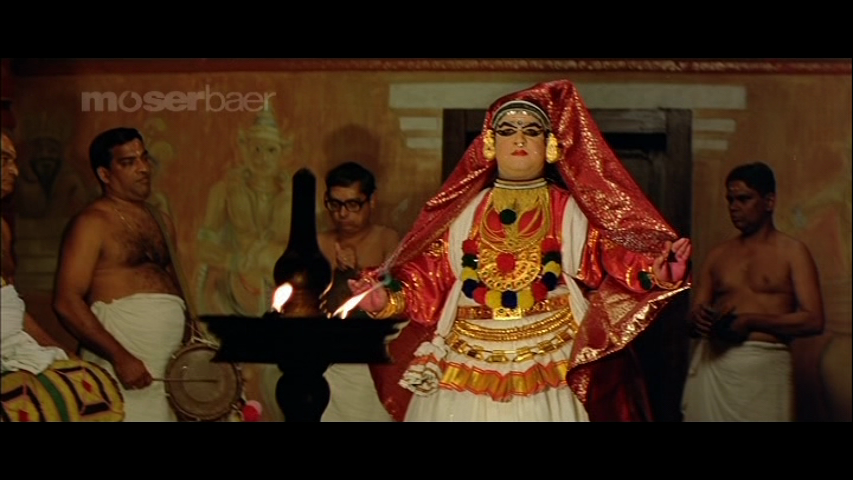
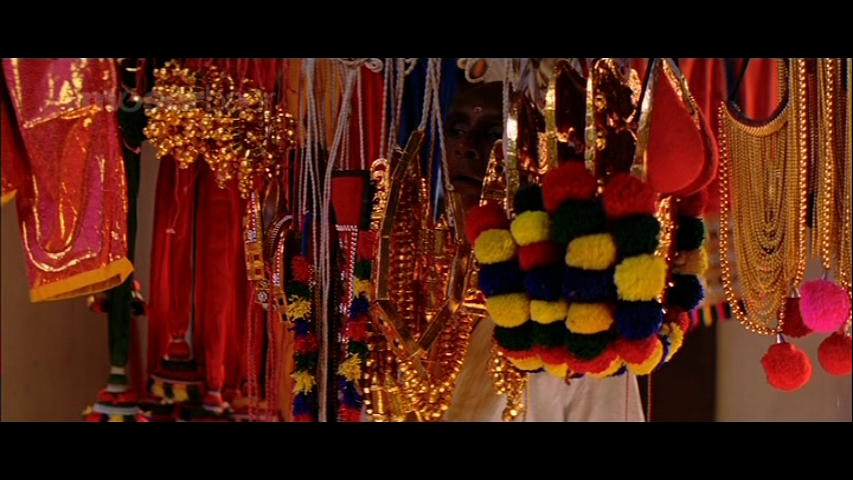
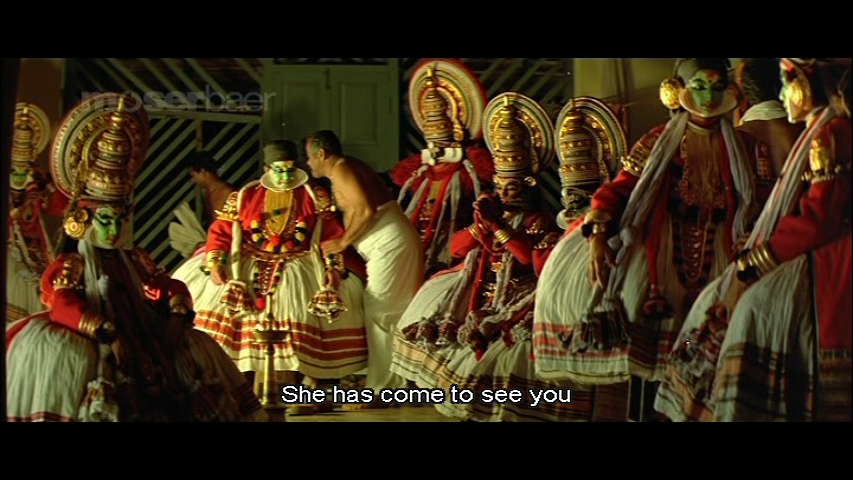
The cinematography by Santosh Sivan and Renato Berta is simply stunning.  The natural world is cleverly contrasted with the artificial world of performing and every image is full of detail.  The art-form of Kathakali is showcased with beautiful images of the performances as well as glimpses into backstage life.  It’s a visual feast and at times I needed to rewind to fully grasp the action as I was distracted from reading the subtitles by the quality of the imagery.

VanaprasthamVanaprasthamVanaprasthamVanaprastham

I was impressed by Mohanlal’s dancing, particularly since he isn’t a classically trained dancer and yet as far as I could tell, he held his own against the professional dancers in the cast.  I found it surprising that the dancers were all living in poverty despite the apparent recognition of their skills and I wonder if this is still the case to-day.  The costumes certainly all look expensive and they must go through truckloads of make up for each performance too!

Vanaprastham is full of symbolism, from the title referring to the stage of life where spiritual concerns take over from the day-to-day responsibilities, to the parallels between the story of Arjuna and Kunhikuttan’s life and I’m sure that there are many more details I missed. The performances are excellent, the background music by Zakir Hussain blends with the traditional songs and the story which seems so simple initially has plenty of complexity and depth.  It’s an absolute must watch and I thoroughly recommend it! A full 5 stars.