Udta Punjab

udta-punjab-poster

After a very wordy anti-drugs and pro-Punjab disclaimer riddled with spelling and grammar errors which may or may not indicate its sincerity, Abhishek Chaubey’s Udta Punjab opens with an intense, crass, loud and proud drug anthem.

Visually strong and often confronting, Rajeev Ravi’s high impact imagery is balanced with scenes of delicate loveliness. The take seems to be that Punjab is turning into a place with the morals of a Mexico or, ahem, Goa. Packages of heroin are making their way across the border nightly, and dubious shipments of pharmaceuticals are waved past by police. We see a young girl, one of many out of state workers coming to labour on farms. The divide between the worlds of privilege and subsistence is evident, and the film doesn’t shy away from the gory, violent, consequences of disrupting the status quo. It’s powerful stuff, and quite gripping. Unfortunately the second half revolves around unnecessary and unconvincing romance just when the main plot should have been in laser sharp focus to bring it all together.

Tommy Singh (Shahid Kapoor) takes the sex, drugs, and rock n roll mantra to heart. Sartaj (Diljit Dosanjh) is a mid-rank cop with flexible morals, happy to overlook the drugs as long as he gets his cut. Dr Preet Sahni (Kareena Kapoor Khan) specialises in treating addicts and wants to cut the problem off at the source. The nameless girl finds a package in the fields, and thinks she can make some fast money. The film shows the close but not quite intersecting paths characters take, passing each other without a blink or occupying the same space at different times. There is definitely a pervasive feeling that some lives are held cheap and existence for many people has become the wait for death. The sense of connection and community, what affects one will affect many, is clearly drawn out.

Sartaj’s brother Balli ODs on the drug that Sartaj had waved through a checkpoint. In the blink of an eye Sartaj becomes a crusader for justice and decides to help Preet take on the system. The girl is forced into prostitution and drug dependency, and one of the men she has to service is Sartaj’s boss. Tommy attempts to get cleaned up but his own friends get him using again, and fans have no interest in a more honest, introspective star. They want their bad boy back. After a near riot, Tommy runs away and encounters the girl, now also a fugitive. Sartaj falls for Preet, Tommy falls for the girl. All for love and love for all. Apparently all you need is a girlfriend and you will immediately develop moral fibre and a resistance to highly addictive substances. Poor Balli is locked in a treatment cell and all but forgotten, with no magical insta-love to rescue him.

I’m sure Shahid wasn’t at a loss for examples for playing a coked up celebrity. Tommy comes across as a very naughty boy, not a complex or dangerous man in the grip of addiction. Is it bad that in one of his meltdowns I found the elaborate toilet lid more compelling than the dialogue? He thinks rapping about his cock is HILARIOUS. When he ends up in jail, two young boys in the cell perform one of his hits before quietly admitting they killed their mother because she wouldn’t give them money for drugs. Shahid shows Tommy’s growing fear and uncertainty as he realises he is in serious trouble and tries to get off the gear. It’s when Shahid reverts to his bunny-teeth boy in love shtick that he seems most comfortable, and yet nothing made much sense. How can such a famous man with a memorably bad haircut travel across country with no money and not be recognised, even when wearing one of his own crew t-shirts? And what about the girl, who we are expected to believe could fully and easily recover from the trauma of being a sex slave and a drug addict just because Tommy likes her. And don’t mention the ballad.

Alia Bhatt’s performance is excellent, and reminded me a little of her role in Highway. She has minimal dialogue as the Bihari farm girl and even less as a sex slave. Her character is smart and strong, but the brutality of her life with the drug barons is overwhelming and Alia lets her expressive eyes go dull. The girl doesn’t ever give up on herself though. It’s a little disappointing that Chaubey seems to think Tommy is the cure for her, and sad for her that she will acquire a manchild for her troubles. And I could have slapped someone for the oh so clever name they reveal at the end of the film. I was half expecting her birthday to be on April 20th.

Kareena’s approach to Preet is less makeup = Serious Lady Doctor, plus coquettish hair tossing and simpering. Unfortunately her lightweight characterisation exposes her weaknesses when compared to the rest of the cast, and then her character turns stupid. In a film about the social cost of drugs, should a scene where Sartaj is accidentally injected with the same drug that nearly killed his brother be turned into comedy? And should Preet and Sartaj be all awkward about the dopey flirting and forget the medical issue of someone having ingested a highly addictive drug made in a shed who knows where with who knows what chemicals and being stuck with a needle that may have had someone else’s blood in it and so exposing the injectee to Hepatitis or HIV? No. Why would a doctor worry about that? It’s a shame as Preet had potential to be interesting and she certainly had the only fully operational moral compass.

I’ve sat through the trailer for Sardarji a few times now so having Diljit Dosanjh actually in the film I had gone to see was almost disorienting. He delivers a competent performance, and tries to generate some one-sided chemistry with Kareena. His character in some ways is the most complex, although the film moves on too quickly from moments of epiphany, self-loathing, and despair in favour of simplistic love and revenge.

The large supporting cast is good but while I recognised some familiar faces, I couldn’t put names to everyone. I took a violent dislike to one of the girl’s captors in particular, and wanted to get my Tight Slap Administrator gloves on with some of Tommy’s cousins. The production values are high, and I can appreciate the effort and care given to the visual design and soundtrack. Amit Trivedi has gone beyond his usual tweedly guitars and tried to extend Tommy’s character through his featured songs.

Maybe if you see the film as an allegory this second half works a little better, to a point. The girl is perhaps a representation of salt of the earth Punjab tempted by easy money and being screwed over by the drug cartels and cops, Tommy is the privileged class who can largely avoid consequences, Sartaj is the system that has neglected its duty to protect the people and uphold the law, and Balli is at the end of the line with no one to pass the blame or damage on to. But Chaubey leaves us with the message that all you need is romantic love. And a gun.

I was disappointed by the direction Udta Punjab took after such a powerful start. But I am happy to regard my ticket as a contribution to supporting and encouraging filmmakers’ freedom of artistic expression after all the ridiculous censorship shenanigans.
Te3n

te3n-poster

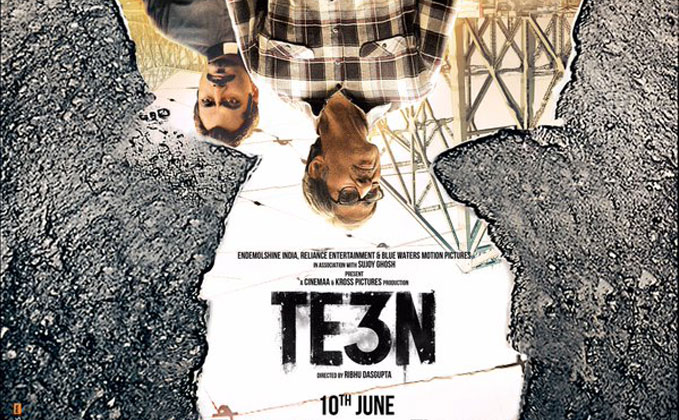
Ribhu Dasgupta’s Te3n is an official fully credited remake of South Korean thriller, Montage (2013, dir Jeong Geun Seop). I’ve seen the original so I was more interested in the how than the who or the what. Te3n is a solid remake of a decent film, so I still enjoyed it despite a couple of changes that I don’t think were at all necessary from a film or narrative perspective.

John Biswas (Amitabh) is an old man haunted by the death of his granddaughter Angela. She was killed in a botched kidnapping 8 years go, and the perpetrator was never caught. He spends his days haunting the police station and has nothing else in his life to sustain him. His wife Nancy (Padmavati Rao) is wheelchair bound and never leaves the house. John seems forgetful and vague, giving no energy to his present day and dwelling on the past. But when another child is kidnapped in exactly the same way, he believes he can catch the criminal and get justice (and revenge) for Angela. Sarita (Vidya Balan) has inherited the Biswas case file, and is leading the investigation into the latest crime. Sarita is smart but unimaginative when it comes to solving a complex problem. She will follow the leads and interpret the evidence in a logical and common sense way, not questioning whether she is being lead down the garden path. Martin Das (Nawazuddin Siddiqui) was the original investigator but he left the police force to become a Christian priest. He feels the guilt of his previous failure and the damage done to the Biswas family, and can’t keep away from the new case when Sarita starts her investigation. Although he used to do a fair job of evading John who only wanted to talk about the old crime. Martin’s zeal is less about John or Angela and more about his own personal guilt and need to atone.

It is almost a shot for shot remake of the original despite the new location, so I can’t really say much about Dasgupta’s directorial style. There were changes made in terms of which character did what. (In Montage, the mother of the first little girl is the one who purses the investigation and the police characters are a little different.) I feel that needed some more solid rewriting which didn’t quite happen. And because the film elevates Amitabh above all else, it ultimately buckles a little under the weight of a Star in what is otherwise a solid thriller.

Amitabh shows the best understanding of his character and the genre. I really liked his performance, and thought he built up the layers in John’s character well. There are scenes where he just becomes an old man, bewildered and a little out of step. As he steps up his own investigation, he sharpens up and seems to come into focus more. Because I knew that the original was slightly different, I was looking closely at the changed characters to see if the alterations were for the better. They really added nothing, except maybe funding, as I suppose it is still easier to get money for your movie if the Big B is your star than if Vidya is. But it also made me ask if women are overlooked in society the same way old people are. Maybe since they were both invisible to the people that mattered it actually did make sense.

I never fully understood why Martin had taken vows or why Sarita was a bit flirty with him, but I didn’t feel I needed to know all the details to appreciate the present circumstances. It felt like they split the original ex detective character a little between Martin and Sarita, and added some more emotional baggage for the sake of it. Both Vidya and Nawazuddin have garnered huge audience and critical support for their undeniable talents, but the material here lets them down a little. Their characters were sketchy despite their best efforts to add nuance and a sense of connection.

The story translated well to Kolkata. Pardon my saying so, but the Indian police and legal systems are not exactly a byword for judicial excellence so the scenes where things went wrong seemed almost inevitable. The bureaucracy and sheer time spent in nothing much happening also seemed quite realistic. Sarita was surrounded by mountains of old files and new ones, everything showing that the Biswas case was just one of many. The streets and old houses added to the mood with hints of things happening under the surface, out of sight. Despite the huge city setting, the characters all live their lives in quiet little pockets of their own making. The neighbourhoods and houses are lived in and have a sense of history and context that we are just glimpsing as we skim past.

The use of sound was excellent except for when a song like Grahan was forced into the mix. I did like the recurring use of Kyun Re during montages of uncertainty. I don’t know that the Amitabh version was needed as it was subtle as a sledgehammer, but it suited the moment. The ambient sounds and silences were far more powerful than the pretty generic musical stylings.

The investigations – John’s and the official one – are both quite logical and it all makes sense. Korean and Indian movies often share a sense of outrage at the lack of justice for victims of crime, and then go looking for that reparation outside of the system.

See this for a fairly restrained big budget take on an indie film subject, and for the well structured plot. It’s not the usual high level histrionics and it does showcase late career Big B in a role that lets him comfortably play to his strengths.

Shaan (1980)

poster

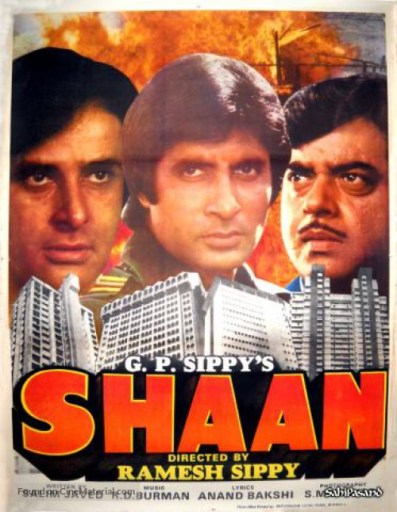
5 years after his masterpiece Sholay, Ramesh Sippy returned to the big screen with the big action adventure Shaan.  Written by Salim-Javed, the story is a suspense thriller with many of the film elements seemingly inspired by a hotchpotch of James Bond films. Just have a look at the Bondesque opening title sequence for instance.

The movie is still Bollywood at heart though with Amitabh Bachchan and Shashi Kapoor playing two personable rogues at odds with a police officer who also just happens to be their older brother. In addition to the sibling conflict there is a villain with a fabulous island lair, car chases, helicopters, sharks and even a man-eating crocodile thrown into the mix, adding up to a great masala movie and one definitely well worth a watch.

Vijay (Amitabh Bachchan) and Ravi (Shashi Kapoor) are con-artists who make a living by fleecing money from corrupt officials and small time crooks. A little in the style of Robin Hood except that Vijay and Ravi keep the money rather than giving it to the poor. However the shoe is on the other foot when they themselves are conned by uncle and niece team Chacha (Johnny Walker) and Renu (Bindiya Goswami). To get their money back Vijay and Ravi join up with Renu and Chacha to carry out a daring jewellery heist, but are again pipped at the post by fellow thief Sunita (Parveen Babi).  Sunita not only manages to steal the necklace before anyone else but has an audacious method for getting it out past the police search; although I do think recovery might have proved a little difficult if things hadn’t gone exactly to plan. Her introduction is rather fab too as she appears in a wonderfully sparkly dress with glamorous backing dancers who have silver tassels everywhere, even on their boots.

Needless to say Sunita is added to the merry band of thieves who go ahead with another con based on the old ‘holy men walking on water’ scam. This time though they are caught by Police Officer Shiv Kumar (Sunil Dutt), who goes ahead and arrests Vijay and Ravi, even though they are his two younger brothers. Above all else Shiv is a police officer sworn to uphold the law, and that is what he does. Shiv’s character is established early on when he rescues some hostages in a beautifully choreographed action sequence. His wife Sheetal (Rakhee Gulzar) shares the same values although she has a soft spot for Shiv’s two brothers and is altogether more forgiving than her husband. However, once the brothers are released from jail they make a vow to ‘go straight’ and move in with Shiv and Sheetal in their house in Mumbai.

While Vijay and Ravi have been in jail, Shiv has been making inroads into the criminal empire of a villain known only as Shakaal (Kulbhushan Kharbanda) and his efforts are starting to seriously impact on criminal business. Shakaal sends an assassin Rakesh (Shatrughan Sinha) after Shiv and his family, but after two attempts on Shiv’s life fail, Shakaal ups the ante and sends his henchman Jagmohan (Mac Mohan) instead. After one of the best kidnap attempts I’ve seen onscreen, Jagmohan manages to spirit Shiv to the island hideaway while leaving everyone else totally baffled as to Shiv’s whereabouts.

Shakaal’s lair is absolutely wonderful and mixes many of the best elements from various other villain hideouts. It’s located on an island some 300km off the coast of India but in reality was filmed on the island of Steep Holm near the UK. The lair has long corridors with rough-hewn rock for walls but fancy modern automatic doors and nifty surveillance cameras. Shakaal lords it over his minions, Blofeld-style in a conference room with a rotating circular table and a retractable floor, underneath which lurks a man-eating crocodile. This allows Shakaal to indulge in a form of roulette to dispose of unsatisfactory employees or anyone else he doesn’t like. Meanwhile sharks (and the odd oversized goldfish) can be seen swimming past the green tinted windows for extra menace. Adding to the ambience in a large audience hall is a massive golden statue of an eagle, and Shakaal has a throne strategically placed underneath for those moments when you just have to be seen to be the head villain! And of course there are plenty of panels with flashing lights and hidden switches– everything your discerning villain could require for world domination, although Shakaal has more modest aims despite his grandiose lair and petulant manner.

Shakaal has his own distinctive look too combining his bald head with black or white military style tunics featuring his ‘S’ logo prominently displayed. His henchmen all wear identical smart white suits, and later on his henchwomen are attired in silver miniskirts and fetching black blouson style shirts – always good to see a properly style-conscious villain!

Shakaal finally manages to dispose of Shiv although it takes him quite a few attempts and the stage is set for Ravi and Vijay to avenge his death. Naturally this involves infiltrating Shakaal’s lair with a song and dance troupe (how else could you possibly sneak into an impenetrable hideaway?) which also features the inimitable Helen leading the way in this excellent song.

There is a lot going on in Shaan, but the plot follows a mostly logical and clear progression building up to the grand showdown in Shakaal’s lair. The comedy works well, the romances are mainly just an excuse for a few songs, but the action sequences and special effects are first-rate. The camaraderie between the two brothers is one of the major assets to the film and Shashi and Amitabh have great chemistry together. Perhaps it’s the enmity between Amitabh and Shatrughan Sinha, but even once Rakesh turns on Shakaal and joins the brothers, there is still just a frisson of tension which makes the shaky relationship between the marksman and the brothers that little bit more believable. Generally the addition of Rakesh halfway into the film is a masterstroke, adding uncertainty to the second half and also an opportunity for another good car chase and action scene. Rakhee Gulzar is also excellent as Shiv Kumar’s wife, both in playing a steadying influence to the brothers and as the grieving and vengeful widow. She has a major part to play in the final proceedings too and she plays her role with grace and elegance throughout. Bindiya Goswami and Parveen Babi have rather less to do, but they get a chance to throw a few punches in the final scene and both do a good job with their rather limited roles.

Kulbhushan Kharbanda is fantastic as a rather different kind of villain; smiling and soft voiced one moment and angry the next. It’s a definite departure from the more usual thuggishly violent criminals and the more subtle psychological approach works well here and enhances the cracking good story. Kulbhushan Kharbanda uses his smile to project chill and menace while his initially affable demeanour serves well to mislead both friends and foes alike. It’s a great performance and Shaan is worth watching for his character alone, even without the good story, excellent action and R.D. Burman’s memorable songs. I love every minute of Shaan and recommend viewing for a great all-round entertainer. 4 stars.