Ennum Eppozhum (2015)

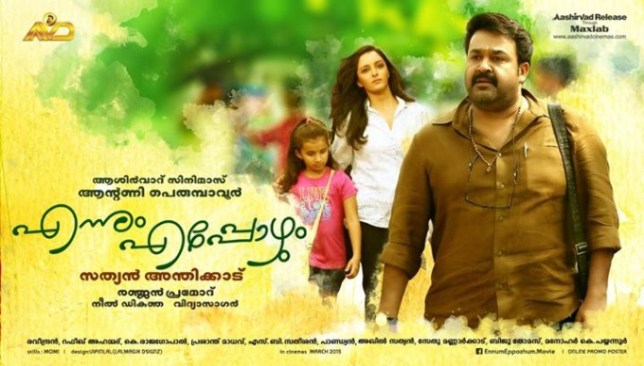
poster

Mohanlal and Manju Warrier together sounds too good to miss but despite the casting and potentially interesting storyline, Sathyan Anthikad’s Ennum Eppozhum doesn’t quite meet up to expectations. The film tells the story of an erratic, middle-aged journalist and his attempts to interview a crusading local advocate but although the central storyline works well, diversions off the main path are rather less successful. However Mohanlal and Manju are excellent, the supporting cast is equally good and the down-to-earth ordinariness of the characters does work in the films favour.

Mohanlal is Vineeth N. Pillai, a lazy middle-aged bachelor who is notable more for his lack of hygiene and questionable work ethic than his skill with journalistic interviews. His lack of energy is noted by Vanitharatnam magazine’s new editor in chief, Kalyani (Reenu Mathews) which doesn’t bode well for Vineeth’s continued employment. Kalyani is just returned from London with plenty of new ideas and has no time for a slob of a journalist who doesn’t pull his weight. Luckily for Vineeth, the former chief editor still has a fond spot for him as the son of her dear friend and ensures that he gets a second chance to prove his skills.

Vineeth is sent to interview Deepa (Manju Warrier), an advocate who has been in the news for successfully campaigning to have potholes in the road fixed.

Deepa is the antithesis of Vineeth. She is a single mother and not only manages to raise her daughter, work as a successful advocate and campaign for better roads, but she also teaches dance and performs too, as seen in this beautiful piece from the film.

For more information on the dance style and more of Manju’s beautiful dancing check out the excellent post by Cinema Nritya here

In his attempts to speak to Deepa, Vineeth is accompanied by bumbling photographer Maathan (Jacob Gregory). Maathan also lives with Vineeth and the interactions between the two form one half of the comedy track to the film. The other half is supplied by a shady developer (Renji Panicker) and his inept security guard, but this is one of those diversions that doesn’t add anything to the storyline while the comedy is slapstick and not particularly funny. The comedy with Jacob Gregory also fails to raise much of a laugh but there are a few moments that warrant his inclusion. Vineeth is further hampered by his car that continually runs out of petrol, some dodgy advice from a young employee and his own inertia regarding the assignment. However as he watches Deepa, her busy life starts to make an impression and Vineeth is drawn into assisting when Deepa and her daughter are involved in an accident.

Deepa has her own problems to deal with, including her over-protective neighbour Kariachan (Innocent) and his wife Rosy (Usha S Karunagapally). They hover attentively around Deepa and her daughter Miya (Baby Adhvaitha) but seem to be more of a hindrance than a help. Deepa is also visited by a friend Farah (Lena Abhilash) who is another character who seems to run out of steam just when her story starts to get interesting. Farah talks about her marital problems which could potentially have been a major plot point, given that Deepa is also divorced from a rather obnoxious-sounding character. Instead the story goes nowhere and Farah’s inclusion seems fairly pointless except as a glimpse of ordinary middle class life in the suburbs.

There are more odd and pointless diversions that peter out just when they start to get interesting. Deepa has dealings with a gangster who seems to help her when she wants to keep some cases out of the court system. This had potential since Vineeth spots Deepa paying money to some shady looking characters, but instead the story fades away without reaching any resolution. Vineeth also seems to be on the cusp of developing a romance with Kalyani, who in turn has an amazing about-face when it comes to Vineeth and his work. For no apparent reason, other than perhaps a shared like of Rod Stewart songs, Kalyani decides that Vineeth can take as long as he likes to finish the interview, and even doesn’t seem to mind when he admits he may not be able to interview Deepa at all! The romance which almost starts in one scene then vanishes completely without Vineeth even appearing to notice.

The slow pace of the film suits the scenes of day-to-day living that form most of the story but it does mean that it takes a long time for Vineeth to approach Deepa. It takes even longer for the two to actually start speaking to each other, but when they do, they have a lovely and easy chemistry together. There is no real romance in the story, although the possibility is hinted at towards the end, but instead it is the characters and the details of their lives that are the focus of the story.

Ennum Eppozhum is at its best when showcasing the lives of the two main characters, their strengths and weakness and their interactions with the world around them. Without all the added threads that go nowhere this could have been an interesting picture of two very different personalities, but the noise created by the sub-stories dilutes the effect. However, it’s always good to have a strong female lead character and Manju Warrier is adept at portraying such roles. Mohanlal does an excellent job with his rather unpleasant reporter and yet still makes appealing enough that we want him to succeed and keep his job. Not a great film, but one still worth watching for excellent performances from all the cast and the pleasure of watching Manju Warrier dancing. It just could have been so much more. 3 stars.


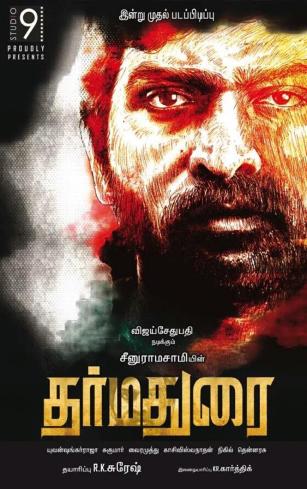
Dharma Durai (2016)

Dharma Durai poster

Seenu Ramasamy’s Dharma Durai tells the story of a doctor from a small village, his highs and lows and his final redemption through the love of a good woman – of course! The film has a slow start and even after the main character is established the pacing is occasionally uneven and erratic, but it has excellent performances from the main leads, a good story and plenty of thought provoking themes around social justice, caste, dowry and responsibility. However, it’s not as nearly as heavy as that sounds and even though the story is about an alcoholic, there are plenty of light hearted moments making the film an overall entertaining as well as a thought-provoking watch.

The film starts in the village where Dharma Durai (Vijay Sethupathi) roams around making a nuisance of himself, mainly to the embarrassment and general detriment of his brothers. Dharma is an alcoholic which explains his rather erratic behaviour, although it did take me a while to realise that alcohol addiction was the problem. It’s not immediately obvious and Vijay Sethupathi is subtle in his portrayal of a drunk, so it’s not until a village event that the full extent of his alcoholism is made clear.

Dharma accuses his brothers of cheating the villagers with the chit fund they run and seems intent on making life difficult for them, to the extent that I started to sympathise with the family, even though their method of dealing with Dharma is fairly extreme. The brothers decide to lock Dharma up in a shed until they can decide what to do with him, and the signs are clear that Dharma is not destined for a long and happy life. Dharma’s only well- wisher is his mother Pandiyamma (Radhika Sarathkumar) and in classic filmi style she arranges a way for him to escape his temporary prison.

Once he escapes the village, Dharma goes back to Madurai and the medical college where he had studied to become a doctor. The film moves into flashback as we relive Dharma’s years as a student and his romance with fellow student Stella (Srushti Dange). I would love to know if medical students in India really do wear white coats and stethoscopes round their necks all the time. It seems odd to me but at least means that they are easy to recognise as medical students rather than trainee engineers or something else entirely!

Dharma is a good student despite a tendency to spout poetry at the least provocation, and ultimately he follows his professor’s advice to return home and work for the village. After all, it’s the common people who have paid for his degree so he is morally obligated to go back and serve these people. The ethical message here is hammered home a little too much, and the students are all somewhat unnaturally altruistic, but overall the flashback is a pleasant interlude that shows Dharma is a much better light and starts to explain his past.

Back in the present day Dharma tries to track down his old friends – Stella and her friend Subhashini (Tamannaah) who also had an unrequited crush on Dharma. These were the last people he felt who really cared about him, and eventually he does manage to meet up with Subhashini and relates the series of events which led to him becoming an alcoholic.

This is the best part of the film and the flashback to the love story between Dharma and villager Anbuselvi (Aishwarya Rajesh) is beautifully done. Aishwarya is easily the best of the female leads and her characterisation of a farmer’s daughter is simply perfect. Anbuselvi is more than she first seems and it’s no surprise that Dharma is immediately smitten. Vijay and Aishwarya have wonderful onscreen chemistry and Sukumar’s excellent cinematography makes this golden time appear even more radiant as the two romance each other through song.

What makes Dharma Durai interesting is the clash between new and old. Dharma is college educated but comes back to his old village to work as he feels that is his duty. But once back at home, his modern ideas don’t sit well with his brothers’ ideas of caste and dowry and that leads to the serious conflict between them. There is also the contrast between Dharma’s old love – the beautiful and traditional Anbuselvi, and his new romance with the more modern and well educated Subhashini. Subhashini has a shiny new medical clinic of her own, but also has an ex-husband to deal with and her own share of past issues that make it difficult for her to reach out to Dharma. The only real downside to the story is the contrived and unlikely method that Seenu Ramasamy uses to get Dharma back to the village at the end. It’s all a little too far-fetched and unlikely, but why should we let any of that get in the way of a good ending!

One other issue is that the story has a few too many stops and starts as it moves from one portion of Dharma’s life to the next and as a result not all the scenes flow smoothly. The moral messages tend to be over-emphasised which also slow down the narrative and move attention away from the characters. However, once the camera is focusing on Dharma and Anbuselvi, or Dharma and Subhashini the film comes alive again and draws us back into the story. Vijay Sethupathi is wonderful throughout, and his Dharma is the absolute essence of a village boy done good for most of the film. Tamannaah is also excellent as Subhashini, although she doesn’t click quite as well with Vijay as Aishwarya, but her depiction of a career woman with a very definite set of values is nicely done. Radhika Sarathkumar is very good as Dharma’s long suffering mother while Rajesh makes a brief but notable appearance as the college professor. The portrayal of village life and a rural clinic is also very well done – I’m sure that I have seen many of those patients in my trips into rural Tamil Nadu on a health camp each year, which probably adds to the whole authentic vibe I got from the film.

Dharma Durai is an interesting story that just needs a little tighter editing to move proceedings along more consistently. The songs are good, the cinematography excellent and both Vijay Sethupathi and Aishwarya Rajesh are on top form, making a perfect match. Worth watching for their performances and for Tamannaah Bhatia and the rest of the cast who all do their part in bringing this fascinating slice of village melodrama to life.

For The Love of a Man

Film poster

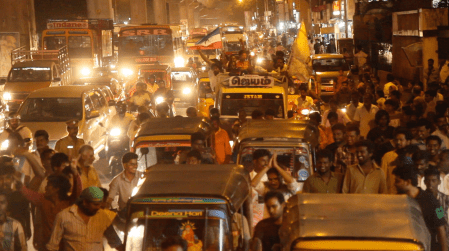
For The Love of a Man is a documentary primarily about Rajinikanth’s fans, directed by Rinku Kalsy, produced by Joyojeet Pal and partly funded through crowd-funding. It’s a fascinating glimpse into the obsessive world of the fans, and the extremes to which they go to show their devotion. Here we see the packed out fan shows at 1am in the morning on the day of a new Rajinikanth film release, 12 day long celebrations for the actor’s birthday and word-perfect recall of the dialogue from his films just as a taste of some of the extreme fandom on display. There are apparently 150,000 Rajinikanth fan clubs in India and the film looks at a couple of the clubs and a few of the fans in detail while trying to explain the phenomena that is Rajinikanth.

It is assumed that everyone has at least some idea of who Rajinikanth is, and while that is likely true for Cinemachaat readers, for most Westerners Rajinikanth is unlikely to be a household name. There is some discussion of the Superstar but it is minimal and I would have liked to see a little more of the background rather than just the bare tale of a bus conductor turned actor, turned Superstar. While there are a few excerpts from the Rajini’s films, these tend to occur when a particular movie is mentioned by one of the fans rather than in any chronological order and his rise to stardom is only briefly discussed. The other missing element is any input from the man himself which is understandable, but could possibly have given more context into the reasons why the fans behave the way they do.

Giant cut out

Rinku Kalsy has picked an interesting group of people who all have in common their total passion about the Superstar or as they all call Rajini – Thalaivar. There is G. Mani, an ex-gangster who changed his ways after watching Rajinikanth and is now a peanut seller, N. Ravi and his brother N. Murugan who run sweet shops in a small Tamil Nadu town and started life as uneducated orphans but followed the principles espoused by Rajini in his films to turn their lives around, and Kamal Anand, a mimicry artist who earns a living by impersonating the superstar for various functions and gatherings. There is also an auto driver who keeps pictures of Rajini in the front of his auto where most other drivers have pictures of the gods and an online fan club called Superstar Rajinikanth or SSRK for short.

Here there is fanatical devotion at its most extreme but although the film shows the lengths these people will go to for their Thalaivar, there is little insight into why Rajinikanth fans are so obsessed with their idol. There are a few academics who talk about the Dravidian movement and secularism as ways to explain the deification of movie stars such as Rajinikanth, but these discussions are rather superficial and don’t delve into ‘why Rajinikanth?’ in any detail. There is no discussion of his acting skills or even of his many philanthropic acts that the fans are so keen to emulate. Rinku Kalsy and her experts refer to his scruffy appearance, darker skin colour and roles as a common man that were so different to those undertaken by previous movie stars such as MGR or Gemini Ganesan. The fans however refer to Rajinikanth as simply a good man and try to follow his altruistic principles as much as they can; often despite their own, frequently quite poor circumstances. The feelings here are deep and emotions run high. Even when simply recounting the period of time when Rajinikanth was ill and admitted into a hospital in Singapore, N. Ravi can hardly contain his tears as he speaks of his distress. He even sent his brother to Singapore to report back directly and describes this period as the worst time of his life.

Film celebrations

Interestingly all the fans shown are men. There are a few women seen in the cinema watching Rajinikanth films, but for the most part the groups organising events for Rajinikanth film openings are exclusively male. G Mani’s long suffering wife Suganthi seems to take his fandom in her stride, including the revelation that he has pawned her jewellery to obtain money for another celebration and she doesn’t even seem to mind that he spends all of his income on his fan club rather than on their family. However the best line comes from the mimic artist who explains that despite making his living impersonating Rajinikanth, he himself is actually a Kamal Hassan fan!

It’s not all good works and birthday celebrations though. There is violence too, with a fans’ show resulting in broken windows at a cinema and G Mani’s mention of a long drawn out court case after a screen was destroyed at one of his fans-only screenings. It’s hard to understand even though I’ve seen the first night first show mania at first hand here in Melbourne, but the extreme reaction in Tamil Nadu suggests more than simple fandom. This is serious fanaticism with the followers believing that their hero can do no wrong and in many cases literally worshiping Rajini. One of the frequently expressed desires from many of the fans is that Rajinikanth should enter politics, not so unexpected given that many politicians in Tamil Nadu were movie stars but there is an absolute belief that he would bring better times for all in such a role.

For The Love of a Man is fascinating, at times disturbing and occasionally uplifting but does illustrate the intensity of fans in India. Like the banners and Rajinikanth cut-outs, the hero-worship is larger than life and really needs to be seen to be believed. The film was screened in Melbourne as part of the Indian Film festival and has been shown at a number of other festivals around the world but hopefully will get a wider release – well worth catching it if you can.