Chaappa Kurish

chaappa-kurish

Chaappa Kurish tells the story of two men: one a successful land developer who lives in a smart uptown apartment and the other a slum-dweller who works as a cleaner in a small supermarket. It seems unlikely that their lives would ever intersect, but when Arjun (Fahadh Faasil)) loses his phone and Ansari (Vineeth Sreenivasan) picks it up, their lives intertwine in an unexpected way with unintended consequences. Sameer Thahir’s debut film is a study in power relationships and how even a small amount of advantage can alter outlook, change relationships and even affect personality. While one man starts to gain control the other begins to lose it and the fall-out has far reaching effects for both.

The film opens by contrasting the lives of the two men. Arjun is woken in his modern apartment by the ringing of his smart phone and wanders into his spotless kitchen to have cereal for breakfast. Ansari also has a phone, but his is an old-fashioned mobile and his single room is a long way from Arjun’s luxurious apartment. He sleeps with his mattress on top of his shirt to press it for the morning, and has to pay and queue for his turn in a shared toilet. Breakfast for Ansari is a roti in a local café and his journey to work by bus and ferry is vastly different from Arjun’s smooth ride in the back of his chauffeur driven car. Their relative positions define their personality too. Ansari is quiet, pushed around by everyone who comes into contact with him and unable to stand up for himself. He walks apologetically – hunched over and hesitant, and he doesn’t meet anyone’s eyes even when they are talking to him. Arjun on the other hand is autocratic, demanding and very well aware that he is the boss.

Although Arjun is engaged to be married to the daughter of a family friend, he is also in a relationship with a work colleague Sonia (Ramya Nambeeshan). Sonia is a modern working woman who seems to be in control of her life but despite her apparent comfort with her relationship with Arjun, she is devastated when she discovers he is engaged and is organising his wedding. Her despair and sense of betrayal is made even greater when she discovers that Arjun has filmed the two of them together on his phone during their lovemaking session. Sonia has lost her lover and her self-respect in an instant and seems likely to lose her job too, all as a result of Arjun’s selfish behaviour. She threatens to tell his fiancée Ann (Roma) about their relationship and it’s during the resultant argument that Arjun loses his phone. As well as the video, Arjun’s phone contains details about his latest dodgy property deal and it’s a toss-up as to which concerns him more – the loss of the deal or the possibility that the video might make it onto Youtube.

Ansari picks up Arjun’s phone when it falls at his feet in a café, and in the spur of the moment decides to keep it. He has little idea of how to operate the phone and is frightened by Arjun’s demands for his phone’s return when he does turn it on. However slowly as Ansari realises Arjun’s desperation, he starts to feel the effects that holding even such a small amount of power can bring. His new found confidence spurs Ansari on to pay back his various tormentors but it also affects his relationship with his co-worker Nafeesa (Niveda Thomas). She doesn’t like the new Ansari and eventually persuades him that he has to return the phone – but it may already be too late.

Sameer Thahir’s story is simple but very effective as he takes time to establish his two main characters and how they each fit into their place in society. The contrast in the two men is well described and the characterisations of each are natural and realistic, while still maintaining their differences as each are at opposite ends of the social scale. The gradual transfer of power is subtly done but very effective and the alteration in each character occurs almost imperceptibly at first. Although the story is at times very dark, there is a strong sense of hope that runs throughout, mainly shown by Nafeesa who is the one bright spot in Ansari’s life and by the end it seems possible that both men have altered for the better. It’s a film that gradually draws you into Arjun and Ansari’s struggle for control while at the same time showing exactly how difficult life can be for those who lack confidence.

Both Fahadh Faasil and Vineeth Sreenivasan are excellent and their performances ensure the effectiveness of Sameer Thahir’s story . Vineeth Sreenivasan does a fantastic job with his portrayal of a downtrodden man who slowly starts to gain some confidence. His body language and demeanour is perfect throughout and his facial expressions brilliantly capture his thoughts. Ansari is a man who has had little to hide in his life and he lets his emotions play out over his face when he thinks no-one is looking. The furtive sullen looks gradually make way for sly grins and rising excitement when Ansari realises the power he has over Arjun and that finally he can tell someone else what to do. Everything just works to build up a detailed picture of a lonely underdog who has a miserable life but no real motivation to change anything and no awareness that change is even possible.

Fahadh Faasil is just as good in his role as a rich and conceited businessman who rarely thinks of anyone other than himself. His fiancée is an inconvenience and he avoids her phone calls whenever possible – although given how inane and annoying she is; I can understand his reluctance. Sonia is beautiful and convenient since she works with him and he initially treats her distress as an annoyance, until his friend John (Jinu Joseph) manages to get through to him just how much more Sonia has to lose if the video becomes public. It’s a classic picture of a self-absorbed jerk, but what makes Fahadh Faasil’s performance so good is the way he gradually changes and shows Arjun’s desperation so clearly. The realisation of what he is about to lose and his absolute frustration with the situation is excellently shown while his fraying grip on his composure is perfectly done.

The rest of the cast are good too. Ramya Nambeeshan doesn’t have a lot to do, but her outrage and then absolute despair are nicely portrayed and she is good as a woman brought to the very edge by emotional upheaval. Jinu Joseph and Niveda Thomas provide the stability and act as the ‘voice of reason’ to the two main protagonists while Sunil Sukhada brings a good dose of oily sleaziness to his role as the Store Manager of the supermarket where Ansari works.

Rex Vijayan’s soundtrack is excellent and this song is beautiful. The picturisation here isn’t the same as in the film where it’s shown over Arjun’s search for Ansari and his phone, but this does give a good overview of the film and the main characters.

There are a number of things I really liked about Chaappa Kurdish. The many differences between the two men are well characterised without being too clichéd and provide a revealing look at society in general. The slow shift in the balance of power is nicely done, even if in real life I don’t think Ansari would have have been quite so brave. I also like that Sonia has some resolution and that having a physical relationship with her boyfriend doesn’t mean that she is automatically a ‘fallen woman’ with no possible options. With all the positives there are only a few negatives. The climax is repetitive and goes on for too long – a shorter, sharper resolution would have helped and I would have liked a little more of Nafeesa and her relationship with Ansari. Overall, Chaappa Kurdish is an excellent début film from Sameer Thahir and definitely well worth a watch. 4 stars.

Sahasam Swasaga Sagipo

sahasam-swasaga-sagipo

Gautham Menon’s latest released simultaneously in Tamil and Telugu, but I preferred this version, even though both are identical in terms of story and cast apart from the male lead. Naga Chaitanya is excellent in the lead role in this version, although Simbu is almost as good in the Tamil film, but the story seems to work better with the less physically imposing Chaitanya and the chemistry between him and female lead Manjima Mohan has significantly more sparkage too. Gautham Menon has stuck to his two favourite themes of action and romance but this time with a rather different approach to give a film with two distinct and very different halves. The first half is all about the romance with no indication about what lies ahead except for brief flashes during the opening credits that suggest there may be troubled times at some point, and a message that the film is inspired from a scene in the Godfather – not a film known as a touchy, feely love story! The second half explodes into violence and action just before the interval and the film quickly becomes a thriller with plenty of suspense and good action sequences. Overall the combination works well, although the action part of the film is somewhat let down by unlikely police corruption and a few too many co-incidences. Still, if you can just go with the flow and ignore the implausibility of parts of the plot then Sahasam Swasaga Sagipo is a good entertainer helped along by excellent performances and a better than average soundtrack.

Naga Chaitanya’s character doesn’t get a name until near the end of the film, and since it’s part of the plot I won’t reveal it here but will just refer to him as Chaitanya. At the start of the film we learn that the first love of his life is his Royal Enfield and that he plans to go on a road trip to Kanyakumari and watch the sun rise over the sea. Chaitanya has completed a degree in engineering and an MBA but now has to decide what he wants to do with the rest of his life. Around the same time his sister finishes her degree and starts an internship along with a friend, who also comes to stay with the family. As soon as Chaitanya sees Leela (Manjima Mohan) he falls in love with her, although he plays it cool and doesn’t immediately say anything. Instead he talks to his friends incessantly about Leela, spends more time at home so that he can see her and spends most evenings chatting to her after everyone else has gone to sleep. They develop a friendship and when Chaitanya finally leaves on his road trip Leela asks to come along too. Chaitanya happily drops his friend Mahesh (Sathish Krishnan) in favour of her company and without telling anyone the two set off on Chaitanya’s Royal Enfield for the South.

The romance is handled with a light touch as Chaitanya is determined to be ‘decent’ and Leela initially seems to think of him as just a friend. However, there are significant glances, chance looks and those late night conversations that slowly develop into significant chemistry between the couple when they head off on the road trip. A.R Rahman’s music provides emotional support to the romance and with that, and the wonderfully evocative sunrise it does seem inevitable that love will bloom before the couple return home. Chaitanya has improved significantly since his role in Ye Maaya Chesave and his performance here is excellent as a young man experiencing his first real love of the non-vehicular kind. He appears more mature and this gives him more plausibility when he talks about his feelings during the voiceover sections of the film. The scenes with his friends are also well written and include some comedy that helps keep the first half light. The combination of family life, friends and developing romance ensure Chaitanya is a likeable character with an easy-going personality and generally upbeat approach to life.

Manjima Mohan looks beautiful and does a good job with her character, successfully combining traditional (her father checking out the family before she starts her stay) with modern (her decision to go on a road trip with a guy she hardly knows) to give an overall picture of a confident young woman who has definite plans and the determination to follow through with them. I liked her in Oru Vadakkan Selfie and she is even better here, appearing very natural and coping well with a role that demands a range of emotions as events start to head out of control in the second half. She seems very natural and was just as good in the light romantic scenes as in the heavy emotional drama where she really got to pull out all the stops and give it her all. I loved her ability to still look amazing even with her make-up running down her face and as always I love it when a heroine contributes to her own rescue, even if she couldn’t quite manage it all by herself.

The action and violence of the second half comes as a real shock after the slow-building love story and everyday characterisations of the lead pair. Suddenly Chaitanya has to deal with situations that are far from his previous experience although as he frequently mentions in the voice-overs, he believes he has the confidence and capability to deal with whatever life throws at him. Luckily for both Chaitanya and Leela this does indeed seem to be the case. The action sequences are fast, frequently very violent and generally unexpected. Dan Macarthur’s camera work ensures these scenes seem full of energy and confusion, just as I’d expect in any real life fight. There is a blurriness and disorientation as the action unfolds which is in direct contrast to the periods of calm where events move slowly and there is a chance to breathe. The contrast is brilliantly done and makes the action sequences stand out even more as completely alien to Chaitanya’s experience and expectation.

Unfortunately, all of this technical excellence is let down by the screenplay which starts to become ever more fanciful, particularly with the inclusion of corrupt police officers led by Kamath (Baba Sehgal). The police appear to do whatever they want without any fear of being caught or held to account for their actions despite these occurring in full view of hospital staff, hotel patrons and numerous other witnesses. Baba Sehgal is ridiculously over the top, almost cartoonish in his portrayal, and this badly impacts the rest of the film, even when the story becomes more rational. The climax too is disappointing with the final events appearing rushed and too opportune and neatly packaged to be fully engaging.

Still, despite the issues with the second half, the film is still engaging. There is plenty of suspense and like everyone else in the cinema I was on the edge of my seat waiting to find out what was going to happen next. In particular, the picturisation of the song Vellipomake is unique and a great way to completely change the direction of the film while the rest of A.R. Rahman’s songs fit well into the screenplay and enhance the romance between the lead couple. Both Naga Chaitanya and Manjima Mohan are excellent, as too is Sathish Krishnan and the various actors who play members of Chaitanya’s family so that even though the story doesn’t always make sense, the actors draw you into their world regardless. Sahasam Swasaga Sagipo has its flaws but there is still much to enjoy despite the dodgy ending. Focus instead on the excellent performances from Naga Chaitanya and Manjima Mohan, enjoy the soundtrack and beautiful scenery, and suspend disbelief enough to appreciate the contrasts and suspense of the second half.

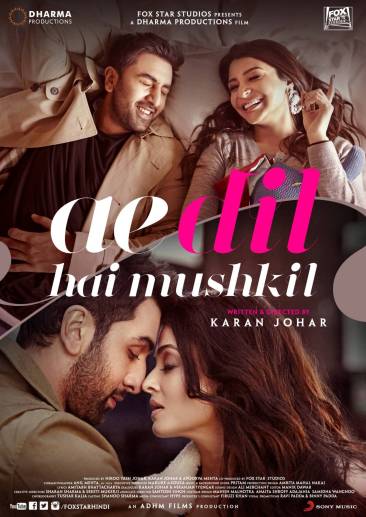
Ae Dil Hai Mushkil


ae-dil-hai-mushkil

You know what you’re going to get with a Karan Johar film and his latest film Ae Dil Hai Mushkil doesn’t contain any surprises. As usual the film is all about unbelievably wealthy characters who look fabulous, live in amazing houses and agonise over simple human relationships the way only the truly idle rich can afford to do. It’s fluff, but beautifully filmed fluff that makes for a reasonable time-pass if you can ignore the few serious flaws that prevent the film from being a total success.

The film follows the antics of Ayan Sanger (Ranbir Kapoor) as he wastes his father’s money while studying an MBA in London and secretly dreaming of becoming a singer. One night he meets Alizeh Khan (Anushka Sharma) another rich kid who doesn’t even get a back story to explain her family wealth or her presence in London. Despite already having a girlfriend (Lisa Haydon), Ayan falls head over heels in love with Alizeh but unfortunately for Ayan, Alizeh is also already in a relationship (although unlike him she has no qualms about a quick one-night stand) and has no interest in anything other than friendship. Alizeh still has feeling for her ex – a DJ with a roving eye (Fawad Khan) and there is no room in her heart for anyone else.

It’s a wafer thin story and the theme of unrequited love is one that’s been told many times before, but that’s not the problem with the film. The biggest flaw here is Ranbir’s character Ayan who seems to be the worst possible reprise of almost every role Ranbir has played to date. Ayan is an overly emotional man-child with anger management issues who depends on his partner’s maturity and tolerance to solve all his problems for him. Like JJ in Rockstar, Ayan blames the object of his unrequited love for his issues and totally fails to see that only he can take responsibility for his own emotions. It’s hard to feel any empathy for such a self-centred character, particularly when he behaves like a five-year-old, bawling his eyes out when his girlfriend leaves him and pushing Alizeh around when she doesn’t fall into line. At least Alizeh pushes back, but this kind of violence without repercussions is just not acceptable and has no place in any film that purports to be a ‘romance’. Ranbir puts in a good performance, possibly no-one can pull off bratty man-child as well as he can, but his character here is too obnoxious for me and I seriously questioned Alizeh’s judgement when she decided that Ayan was her BFF.

My other big issue is the dreadful cliché used to resolve Ayan’s emotional immaturity at the end of the film. It’s such a let-down and a weak finale, especially when Ayan’s behaviour becomes even more appallingly self-centred and he is quite brutal in his treatment of Alizeh.  It’s disappointing as there are plenty of good points to the film too, but with the end such a let-down the overall feeling on leaving the cinema is one of dissatisfaction.

It’s not all bad though and the first half in particular has plenty to enjoy. Thankfully, apart from her poor friend choice, Anushka Sharma’s Alizeh is a more sympathetic character and appears charming and likeable, even in her loyalty to her philandering boyfriend. Her decision to marry DJ Ali despite her awareness of his indiscretions rings true to real life relationships, and the mistaken but frequent belief in marriage as a cure for infidelity. As if! Alas, Alizeh’s love for Ali seems much greater than Ali’s love for Alizeh and both Anushka Sharma and Fawad Khan are excellent in their portrayals of this mismatched couple in a seemingly doomed relationship.

What also works well is the friendship between Ayan and Alizeh, which sparkles off the screen in the first half. I love that they have a shared love of old cheesy Bollywood songs (after all, who doesn’t!) and that they re-enact them on the snowy slopes of Europe. As someone who has run around Golkonda in Hyderabad trailing a scarf and singing the songs from Magadheera, I have immediate rapport with anyone attempting the same thing, especially when they take the time to dress appropriately for the occasion! There are a few glimpses as flashbacks in the song below but this scene is definitely worth catching in the cinema and for me was totally worth the price of admission alone.

Anushka Sharma is the best thing about the film and her portrayal of Alizeh’s down to earth pragmatism and sheer common sense ensure she is the most relatable character on-screen. She looks great and gives Alizeh plenty of pep and personality to counteract frequently Ranbir’s snivelling Ayan. It’s not that Ranbir doesn’t put in a good performance – he does – but his character is nothing he hasn’t done before and in this instance his immaturity is particularly annoying when compared to the other characters in the film.

Also excellent is Aishwarya Rai Bachchan who appears in the second half as a divorced poet Saba Khan. Saba begins a love affair with Ayan just as his heart is broken by Alizeh’s marriage and the two have an interesting relationship.  Ayan is as callous and immature as ever, but hs a genuine affection for Saba, while she is mature enough to revel in a love affair that has no expectations. Aishwarya is stunningly beautiful and gracefully elegant as she swans around her amazing apartment in Vienna, again with no indication of how a supposedly struggling poet could afford to live somewhere quite so spectacular and expensively furnished. Of course there is her ex-husband (Shah Rukh Khan in a brief cameo) who is supposedly a successful artist, and is still in love with his ex-wife so perhaps he is happy to fund her wealthy lifestyle. The relationship between Ayan and Saba is much better realised than that of Ayan and Alizeh, and here the contrast between Saba’s maturity and Ayan’s self-centred youth makes for a more plausible relationship. Even the way it ends is well written and perfectly acted by Ranbir and Aishwarya, something that makes the final scenes even more disappointing in comparison. After all if K-Jo could write this part of the story so well, why not have such a satisfying conclusion to the main relationship too?

I wanted to like As Dil Hai Mushkil more as there are some very funny moments and clever situations in the first half that work really well. The songs are good, the sets spectacular and all the actors perform well. But no matter how much I enjoyed the friendship between Ayan and Alizeh, or the relationship between Ayan and Saba, it’s all overshadowed by the clichéd ending and the general unpleasantness of Ayan’s character. Worth watching for Aishwarya and Anushka and the wonderful re-enactment in the snow but be prepared for the banality of the ending and seen-it-all-before sameness of  Ranbir’s character.