Katheyondu Shuruvagide

Katheyondu Shuruvagide PosterSenna Hegde’s Katheyondu Shuruvagagide is a leisurely stroll through three different love stories that run alongside the tale of one man’s struggle to keep his hotel business going. It’s ‘slice-of-life’ storytelling that works thanks to the rich dialogue, detailed characterisations and excellent performances from the entire cast. However, it’s also reminiscent of European movies that take a slow approach to story development, so this is one more for those who prefer emotions and character-driven drama over fast action.

Tarun (Diganth Manchale) runs a small hotel somewhere on the coast of Karnataka near an absolutely stunning beach. Despite the gorgeous setting and well-appointed rooms, the hotel is struggling and at the beginning of the film Tarun is seen heading to the airport to pick up his only guests for the week – a married couple from the north of India. The opening scenes also establish Tarun’s bachelor status in his ultra-cool pad with a totally awesome wall light, and introduce his relationship with his Uncle Shankar (Babu Hirannaiah) and Aunt Radha (Aruna Balaraj). The other characters in the hotel make a brief appearance here too – chef Kutty (Prakash K. Thuminadu), driver and general dogsbody Pedro (Ashwin Rao Pallakki) and hotel receptionist Swarna (Shreya Anchan).

When Tarun arrives at the airport he finds only Tanya (Pooja Devariya) who explains that she has been recently widowed but asks Tarun to keep her status secret from the other hotel staff. This is in an attempt to prevent sympathy which she feels unable to handle. And indeed she is visibly upset and struggling to cope. At various times Tanya breaks down in tears and on the first occasion Tarun responds by chivalrously handing her a box of tissues from the car. However, as the week goes on he becomes more and more intrigued by Tanya and eventually offers her a shoulder to cry on.

While Tarun takes Tanya out sight-seeing and provides her with a ready ear for her problems, Pedro is desperate to let Swarna know that he is in love with her. Swarna on the other hand is getting ready to go to Dubai where her NRI fiancé is located. The two spend time chatting online while Pedro plots how to best persuade Swarna to stay in India with him instead. He’s aided by Kutty who bases his suggestions on talk-back radio, ensuring plenty of gentle comedy as the rather naïve Pedro tries to win over the much more sophisticated Swarna.

The third romance is the long-standing relationship between Shankar and Radha, and the interactions between the two suggests a love marriage that has only deepened over the years. However, Radha reveals a rather different story when chatting to Tanya, providing good contrast to the other threads and showing a different side to love. Their story is beautifully developed and both Babu Hirannaiah and Aruna Balaraj suit their roles perfectly. Their scenes are the typical day-to-day reality of an older couple and yet still allow their characters plenty of scope to flourish. The only odd note is Shankar’s advice for Tarun to find a partner to help solve his monetary woes, I’m not sure if this was supposed to be a reference to dowry or just to have support through his troubles, but either way this seemed to come out of nowhere.

All the characters are excellent and the slow development suits the realistic nature of the story. Tarun’s back-story of living in the US before returning to Karnataka to realise his dream seems plausible and his attempts to rescue the business rather than sell out to a developer also ring true. Diganth does a good job in the role and has good chemistry with his co-star, Pooja. Pooja is fantastic and manages to make Tanya a totally relatable character despite initially declaring that she has decided to come on her honeymoon even after being widowed. It’s that  ‘already booked and I needed to get away’ rationale that has worked for movies like Queen but it’s Pooja’s attitude that really makes this so believable. She varies between genuine grief and attempts to be distracted by the scenery which comes across as totally understandable given her circumstances. Even the final scenes which reveal all is not quite as it seems are entirely plausible while writer Abhijit Mahesh’s dialogues are the icing on the cake that makes Tanya’s character really come alive. Although Pedro and Swarna’s story is mainly lighter and used as comedy, the dialogue here too is excellent and hits plenty of truths along the way.

The events of the film take place over a week, but rather than focusing on the romance between Tarun and Tanya the story follows the characters through their normal day-to-day lives – for example, conversations between Pedro and Radha as she readies the hotel room for Tanya, or between Pedro and Kutty as they prepare breakfast. Nothing happens quickly and the focus on the minutiae of each day adds authenticity to the story. Added reality comes with discussions about reviews on traveller websites and the problems Tarun has had as a result of posted complaints about the food.

The scenery is well shot to showcase just how beautiful the Indian coastline can be. The waters look pristine and the beaches sparsely populated, which made me wonder if this is the reality, and if so why I wasn’t already booking a trip! There are a few odd shots taken at approximately knee level which didn’t quite work as they pushed me out of the fly on the wall approach and made me lose contact with the characters. However there aren’t very many of these and the rest of Sreeraj Raveendran’s cinematography is stunning.

Sachin Warrier’s songs are good and well pictured with an appropriate mix of sad and happy tunes and a great party song too. Thankfully these were all subtitled which is always a plus, and the rest of the film had great subtitles too. Unfortunately though I missed the name of the subtitler.

Katheyondu Shuruvagide is a sweet film that doesn’t try to be anything other than a snapshot of life for a group of people in a small seaside resort. Senna Hegde has the mix of characters exactly right and the few others who appear briefly, such as Raghu Ramanakoppa as a coconut seller are smoothly integrated into the routine established by the main leads. It’s good to see such a character driven film with great attention to detail and well written dialogue. Slow-paced, yes, but definitely one to savour.
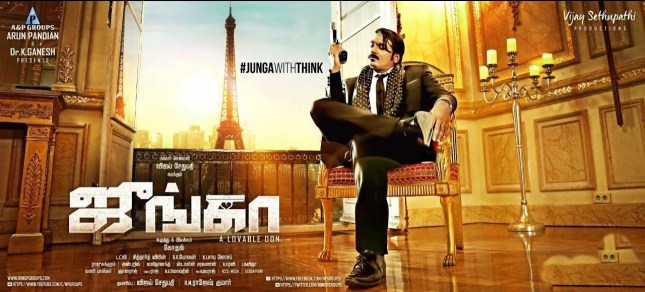
Junga (2018)

Junga

A Vijay Sethupathi film never fails to be entertaining even when, as in this case, the story fails to impress. Gokul’s latest is a comedy that alternates between some hilarious, laugh-out-loud moments and scenes that fall conspicuously flat, mainly due to the ridiculous plot. When the comedy is good, it’s very good, but when it’s bad it’s pretty meh and not helped at all by the glaring plot holes. Still, Junga is not meant to be taken seriously, and Vijay Sethupathi strolls through all the mayhem raising laughs with his take on a parsimonious criminal out to win back his family fortune.

The film starts with Junga (Vijay Sethupathi) being removed from jail by two policemen who plan to kill him in an encounter. Sadly, despite the presence of Rajendran as one of the officers, these are some of the least successful scenes in the film where the dialogue seems forced and not remotely amusing. Luckily this is only a brief introduction to allow Junga to begin relating his life story, which is where all the action happens.

The flashback shows Junga as a small-town bus conductor (all comparisons with Baasha are deliberate) whose love for a Telugu girl (Madonna Sebastian) leads to him taking on a persistent and unwanted stalker and his gang of friends. This foray into fighting shocks his mother who reveals that he is genetically predisposed to violence as he is actually the son of Don Ranga and the grandson of Don Lingaa; gangsters who lost all their money due to their extravagant celebrations and poor accounting skills. Junga’s mother (Saranya Ponvannan) and grandmother (Vijaya) bewail the loss of the family fortune, particularly a picture hall in Chennai which was Junga’s mother’s dowry. Junga vows to be a money conscious Don and heads back to Chennai to restore his inheritance along with his best mate YoYo (Yogi Babu).

Junga quickly builds up a reputation as a cheap option for those seeking intimidation or assassination skills, but fails in his attempts to buy back Cinema Paradise from its new owner, Chettiyar (Suresh Chandra Menon).  Plan B involves heading to Paris to kidnap Chettiyar’s daughter Yazhini (Sayyeshaa) and thus force him to hand over the theatre. Naturally all does not go to plan and Junga’s kidnap scheme is foiled by the Italian mafia who have their own plans for Yazhini.

The first half has plenty of excellent comedy, mainly based around Junga’s miserly tendencies and extreme economies to save money. The film is irreverently tongue in cheek and pokes fun at classic Tamil films as well as modern-day tropes and even at the actors themselves, most of which works well. Radha Ravi channels Marlon Brando as the head of the Committee of Dons who are morally outraged by Junga’s discounted thuggery while Yogi Babu provides solid back-up as Junga’s chief henchman.  The first half has some good fight scenes too along with the best of the songs, including the wonderfully colourful Amma Mela Sathiyam.

The second half falters when the action moves to Paris and the Italian mafia muscle in. What does work is Junga’s obvious pain when he realises just how much money he has spent and the various jokes around the confusion between Parry’s (in Chennai) and Paris (in France). Best of all are Saranya Ponvannan and Vijaya who swagger around as a brilliant double act and completely steal the show as Gangster Amma and Gangster Patti. They have the best lines as they try to shake down Chettiyar and it’s great to see Saranya Ponvannan have a chance to step out of her usual standard mother role, albeit in a small way.

What doesn’t work is the whole storyline with the Italian mafia and French police, although we do get a great fight scene with an umbrella and some good car chases. But there are just too many silly plot holes that stop some of the comedy dead in its tracks while the rather contrived romance between Junga and Yazhini doesn’t work at all. After good chemistry with Madonna Sebastian and an amusing end to that whole episode, the love story with Sayyeshaa is limp and anaemic without even the benefit of any comedy to lighten the romance.

As with Oru Nalla Naal Paathu Solren, Vijay Sethupathi gets to wear some outlandish costumes as part of his trip to France and when he plays the roles of his father and grandfather. There is plenty of moustache twirling along with flamboyant gestures which have become Vijay’s signature comedy style, but he is very funny in this persona and his charm and charisma are almost enough to carry the film through the problematic second half. Almost, but not quite. Thankfully, Vijay is ably supported by Yogi Babu and the double act of Saranya Ponvannan and Vijaya who ensure their scenes are funny and help to keep the plot (such as it is) moving along.

Junga is a film that works when the action is kept close to home with the comedy centred on Vijay Sethupathi and his Don Amma and Don Patti. The more action-based sequences disrupt the flow and don’t fit into the overall pace of the film, even though the fight sequences are well choreographed. They also drag out the film which is already overly long by the time Yazhini is kidnapped. However the songs are good, the comedy for the most part is very funny and Vijay Sethupathi is excellent in the title role. Junga isn’t consistent, but it is hilarious in parts and that, along with the enthusiastic cast make it worth at least a one-time watch.


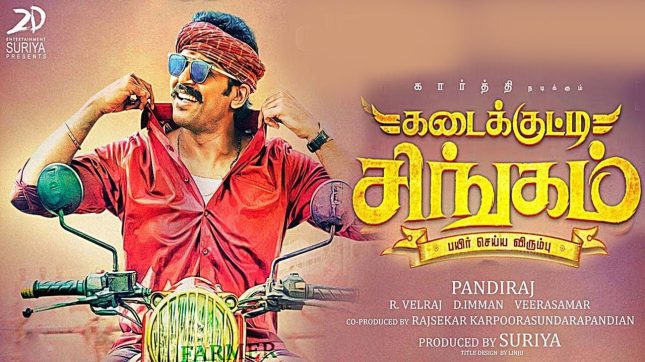
Kadaikutty Singam (2018)


Kadaikutty Singam

Pandiraj’s latest film is a village-based family drama with an extended cast and surfeit of relationships that ends up feeling more like an over-stretched soap opera. The story focuses on the only son of Ranasingam (Sathyaraj) but it’s his various sisters, their husbands and Ranasingam’s two wives that make the most impact in the rather wandering screenplay. The film includes a number of social messages and the story tends to disappear under the requirements to include the benefits of a career in farming and a myriad of moral issues associated with ‘traditional’ village life. However, Karthik does a good job with his role, the support cast are excellent and the film is full of colour and light, even if it does have an overly melodramatic finale.

The film starts with the story of Ranasingam and his quest for a son. His first wife Vanamadevi (Viji Chandrasekhar) has four daughters which leads to Ranagingham casting his eye about for a second wife. He ends up marrying Vanamadevi’s sister, Panchamadevi (Bhanupriya) who promptly also has a daughter, but before Ranasingam can marry for a third time, Vanamadevi falls pregnant again, and this time the baby is a boy. By the time Gunasingam (Karthi) has grown up, his five sisters have all married and two have grown up daughters of their own. The expectation is that Gunasingam will marry one of his two nieces, but when he sees Kannukiniyal aka Iniya (Sayyeshaa) he is immediately smitten, making a family marriage seem unlikely. Luckily for Gunasingam, Iniya reciprocates his feelings and the two happily embark on a relationship. However, there are a few obstacles to overcome, such as Iniya’s politician uncle Kodiyarasu (Shatru) and Gunasingam’s sisters who all vociferously object to the match.

What works well here are the relationships between Gunasingam and his sisters, and between his sisters and their various husbands. Mounika, Yuvarani, Indhumathi, Deepa and Jeevitha play the five sisters who all have distinctly different personalities, and are all convinced that they know what is best for their younger brother – that’s marriage to either Aandal (Arthana Binu) or Poompozhil (Priya Bhavani Shankar) and a life spent running the family farm. Gunasingam has no problem with the latter half of that plan as he’s proud to be a farmer, and makes a point of announcing his monthly salary (1.5 lakhs) and giving expensive gifts to his family. However, Gunasingam only thinks of his nieces as ‘family’ and he’s determined to marry ‘soda-girl’ Iniya, so-called because she runs a soda business. These parts of the story are well nuanced and I like that Iniya has a successful life by herself and isn’t just on the look-out for a husband to take the place of her Uncle Kodiyarasu. Apparently Iniya’s family follows the same uncle/niece marriage idea, but that’s mainly a method for Kodiyarasu to irritate Gunasingam. Kodiyarasu is a politician, but he’s firm on the idea of caste and involved in an honour killing which leads Gunasingam to report him to the police. The feud between the two men seems mainly to be an excuse to include the message that casteism is bad, and of course, the obligatory masala fight scenes.

While the arguments with Kodiyarasu go on in the background, Gunasingam attempts to deal with his sisters who try everything in their power to break his relationship with Iniya. Being family, they know exactly where to attack for the most impact, and eventually the argument leads to a schism in the family. Added to the rift between the sisters, Panchamadevi leaves Ranasingam, but unfortunately, despite being potentially the most interesting thread in the drama, this gets only brief screen time and isn’t fully developed, presumably because there is so much else going on at the same time. Much of the writing here is excellent, and it’s a shame that the rather more predictable ‘villain’ thread keeps intruding into the more compelling family drama.

The romance between Iniya and Gunasingam mainly takes place during a song, which is probably enough time given that it’s the fall-out from their relationship that is more interesting. Although Sayyeshaa looks somewhat out-of-place in a Tamil village drama, she is otherwise fine in the role. Her Iniya has plenty of charm and personality despite limited time on-screen, and her romance with Karthik is plausible. Karthik too is good as a confident and dedicated farmer who buckles under pressure from his family. He’s energetic in the fight scenes and dance numbers, and his various speeches about how wonderful it is to be a farmer aren’t as pompous and patronising as expected. He also has good rapport with the various members of his family and gets his inner conflict across well. His best relationship is with his nephew (who is roughly the same age) Sivagamiyin Selvan (Soori), which is used to add light-hearted comedy that’s mostly relevant to the story. Soori is actually very good here and he handles the role intelligently which helps add more depth to Karthik’s character.

I enjoyed the songs from D. Imman which are catchy enough in the cinema, although not particularly memorable. The film looks good too, and cinematographer Velraj captures both the colours of the countryside and the warmth of the community. A word too about the subtitles from Rekhs and team, which are easy to read and in proper grammatical English – yay! Rekhs has also subtitled any significant written signs which is a delight and really does help with understanding the story.

Overall Kadaikutty Singam has too much going on to be truly successful. It’s also let down by an overly dramatic finale that fizzles just when it should be starting to heat up. However, the family relationships are well done and I love the realistic interactions between the sisters and their husbands. There are a few too many moral messages too, although it’s hard to complain given that they fall into the – ‘girls can do anything’ and ‘caste isn’t a barrier to relationships’ baskets that still need more promotion in cinema. It’s also good to see farming portrayed in a more positive light with a nod to the importance of the people who feed the nation. Worth a one-time watch for Karthik, Soori, the excellent support cast and the well-written family relationships.