7 Aum Arivu

After reading all about the buzz with 7 Aum Arivu, this was the film I was most looking forward to watch this Diwali. Especially since we had the promise of English subtitles for the first time for a Tamil film in a mainstream cinema release here in Melbourne. However there was so much hype in the build-up to its release that it was almost inevitable that it would fail to meet my high expectations. Despite an interesting concept and a generally good cast, the film pacing is slow with too many gaping plot holes to be anything more than just an OK watch. But there are some good points along the way and finally seeing a Tamil film in the cinema (with subtitles) is a definite plus. This is the first time I’ve seen Surya on the big screen and he certainly makes a good impression. The action scenes are well shot and I’m always happy to see a heroine who is capable of more than hand wringing, sobbing and looking helpless. I just wish they had spent more time on the actual plot and less on the set-up which takes up most of the film.

The film starts with an almost documentary style depiction of the life of Bodhidharma – the 5th century Tamilian monk who reputedly was the founder of the Shaolin temple in China. The documentary feel comes mainly from the interview style used and the lecturing voice-over as 150 years is neatly compressed into 20 minutes. The entire story is treated as factual although a quick internet search shows there appear to be a number of different versions around and no clear agreement on Bodhidharma’s lineage. But that really doesn’t matter here as the point is to illustrate Dharma’s expertise in war craft, medicine and hypnotic techniques, which these opening scenes do very well. Surya is perfect as the Pallava prince who journeys to China to become the ‘blue-eyed barbarian’. Yes, I did notice the blue contact lenses. Much is also made of the fact that people in China know exactly who Bodhidharma was while the Indians interviewed had never heard of him. This lack of knowledge of Tamilian heritage and history by people in India is pointed out a few times throughout the film and does become a tad wearing after a while.

Once the story of Bodhidharma has been established, we are transported back to the present day where an assassin has, rather improbably, been sent from the Chinese government to deal with a troublesome scientist and to initiate something called Project Red. The assassin Dong Lee (Johnny Tri Nguyen) is the top student of Kung Fu from the Shaolin temple and apparently an expert in all forms but seems to prefer the use of hypnosis where possible.

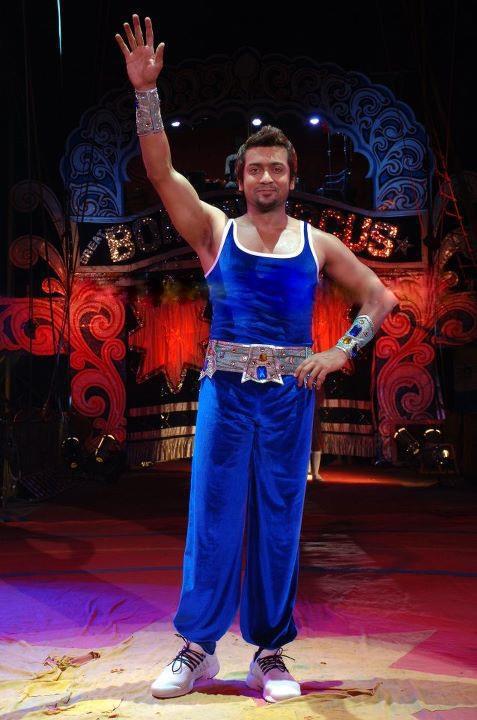
The scientist in question is Subha Srinivasan (Shruti Hassan), a researcher in the field of genetics whose work involves manipulating genes to resurrect DNA encoded attributes such as the fighting techniques and medical prowess displayed by Damo. Subha has tracked down the descendent of Damo who is most likely to be suitable for a little gene manipulation and he just happens to be the circus performer and general layabout Aravind (Surya). While Aravind thinks he has managed to trick Subha into meeting him to further their relationship, in fact she has been stalking him for over a year and has a scary collection of his discards including a tooth brush to show for it. It makes a change for the hero to be the victim of some determined stalking and I liked this deviation from the norm. Strangely Aravind is not as upset by the stalking as he is by the realisation that Subha doesn’t love him but just wants to get at his genes. Although from my SI filmi education so far I thought that stalking was supposed to prove true love but maybe I’ve just got it all wrong?
Not only has Subha been collecting Aravind’s DNA, but has compounded her dishonesty by stealing  a book from the local museum to further her research. It’s no surprise then to discover that her project doesn’t get past the local ethics committee although their reasons for rejecting her are more based on her youth and lack of kow-towing to their authority rather than her actual unethical approach to research. I found a lot of the science very funny since I do actually work as a medical researcher, often alongside geneticists, so have more than a passing knowledge about the subject. So while a lot of the science is very dodgy and eventually becomes implausible, it does have some basis in fact and it’s a relief not to have too much dumbing down of the subject matter. However the most unrealistic part of the film for me is Shuba’s apparently unlimited source of funds for her research – now that really was unbelievable!

Having learnt that Subha was only interested in him as a human lab rat, Aravind is devastated and mopes around theatrically (well he is a circus performer) until he finds out about the threat from Project Red. Dong Lee is also trying to assassinate Subha and decides Aravind needs to be removed too in order to guarantee the success of his mission. In between saving Subha and trying to save the world, Aravind barely has time for Subha to genetically transform him into Bodhidharma.

The first section of the film detailing Bodhidharma’s exploits in China is definitely the best part of the film. There is very little dialogue and Surya makes the most of his very expressive eyes to convey the various trials Bodhidharma has to undergo. While copious amounts of research appear to have gone into the making of the film, in this section it has paid off and it makes for a strong opening. Sadly though this isn’t maintained. The story has a lot of potential as it mixes science fiction with a disaster movie theme and a dash of Indian masala romance but it doesn’t quite gel. The plot rambles over the first half and it takes far too long to find out exactly what Project Red is and why Subha is a threat to the Chinese. The romance doesn’t work very well as a plot point and there is very little chemistry between the two leads. However I think this is intentional as Subha tries to keep her distance from someone she essentially sees as a walking experiment but there was a lot of time spent developing this non-relationship which slowed the story. There also doesn’t seem to have been any need to make Aravind a circus performer other than to make Surya learn a few new tricks since the whole circus background is totally abandoned in the second half.

Shruti Hassan is fine as the researcher and committed geneticist. She has plenty of passion and is able to convey the obsession necessary for Subha’s research although this does make her lack of enthusiasm in her romance with Aravind more obvious. She is particularly good in the confrontation scenes – those with the research committee and also with Dong Lee. Her character is strong, decisive and capable all of which she handles with ease.

Johnny Tri Ngyugen has excellent presence as the villain and exudes chilly menace. However there is a little too much reliance on his super hypnosis and not enough good old fashioned kick-ass kung fu for my liking , and this  slows down the action sequences. In one scene, where he hypnotises a large number of innocent bystanders and sends them after Aravind and Subha like destructo-robots, he keeps attacking for much longer than any respectable villain should allow before realising that the technique isn’t working and a change of tactics is in order. Perhaps it’s my over exposure to Southern Indian cinema but Peter Hein is an excellent action choreographer and I wanted to see more actual fighting between Dong Lee and Aravind. The few fights they had were worth waiting for though and I did enjoy the final sequence despite the overtones of Crouching Tiger, Hidden Dragon.

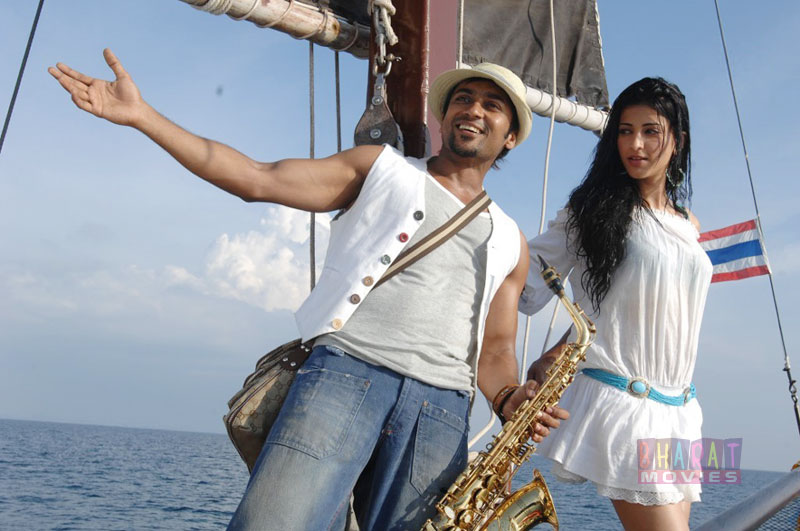
The soundtrack by Harris Jayaraj is great and I do love the songs, but while they are generally well pictured they don’t fit easily into the narrative and only serve to further disrupt the story. The exception to this is the first song ‘ Oh Ringa Ring’ which is fun and a good introduction to the character of Aravind. The songs are however the only time Aravind and Subha have any chemistry together so perhaps that’s one reason for leaving them in.
The screenplay by director A. R. Murugadoss is the main problem with 7 Aum Arivu as the film takes so long to get going once it moves to the modern era, and then is full of plot holes and unlikely scenarios. The last few minutes are dedicated to moralising about history and having pride and belief in your ancestry referring back to the lack of knowledge in India about the life of Bodhidharma. It seems very ‘Hollywood’, which seems to feel the need to deliver a sermon along with a happy ending, and didn’t seem to fit into a film which ends up being more masala than perhaps is intended. It’s still worth watching for the opening scenes and good performances from the leads, but just don’t expect too much from the actual story.

Varsham

I do really like Prabhas. He always seems to be a little surprised to be the hero of any film and with his height and general gangliness he has a ‘St Bernard puppy’ type of cuteness that is very endearing. Even though his films seem to follow a similar pattern, he brings enough personality to each character that I’m usually happy to watch no matter how many plot holes or illogical scenes there seem to be and this film does have a few of those.

Varsham is a typical Prabhas action/romance movie. The story involves two guys fighting over the heroine like dogs over a bone, with each one growling ‘she’s mine’ at appropriate intervals. But when one of those two is Prabhas and the other is Gopichand it’s suddenly a lot more fun. Add in Prakash Raj as ‘Prakash Bad Dad’ and it’s much more entertaining than it first sounds.

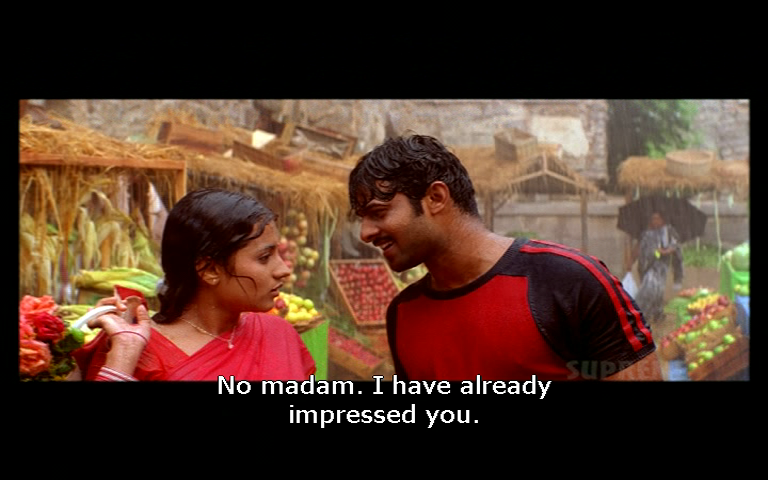
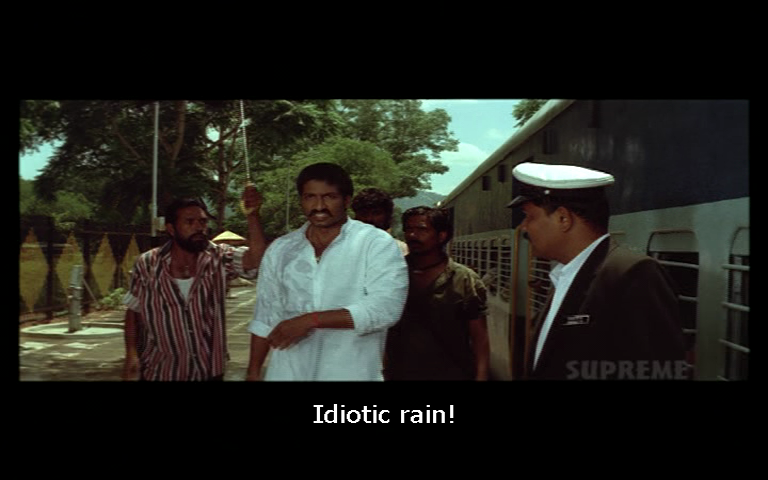
Trisha plays Sailaja, the girl who both Venkat (Prabhas) and Bhadranna (Gopichand) lay claim to. Sailaja is a fun-loving girl who adores the rain, and I fully understand and endorse her compulsion to dance in it at every possible opportunity. Venkat and Bhadranna first both see her at a train station where their train has been delayed. Once the rain starts Sailaja leaps out onto the platform to dance with total child-like abandon. She follows the ‘dance as if no-one is watching’ creed, despite the fact that everyone is actually watching her and this is a very fun song with plenty of dorky moves by Trisha. There’s a great pigeon move in here too and I’m very impressed by Trisha’s grasp of the bird-impression genre of dance step.

Venkat and Sailaja are separated as the train moves off, but find each other the next time precipitation hits their local market in Warangal. Since the rain seems to bring them together they make a pact to meet again when it next pours. However, just as the rain clouds form again there is the small problem of Bhadranna who has come to Sailja’s house to arrange marriage with her.

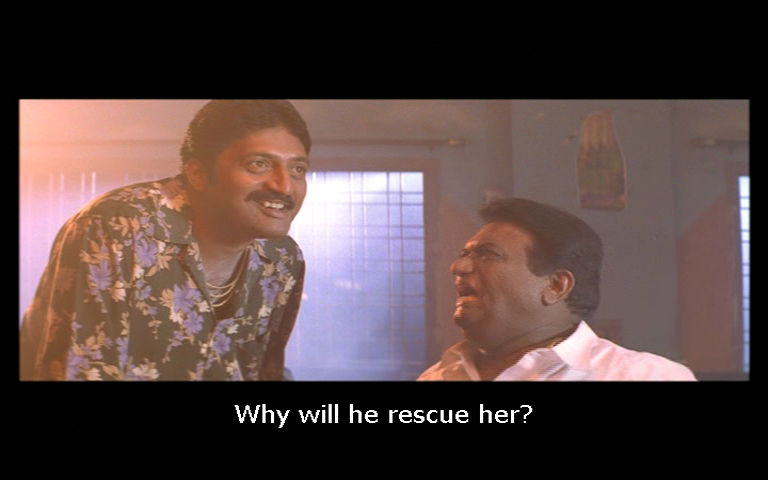
Sailaja’s father Ranga Rao (Prakash Raj) is a drunken gambler who wants to make the best use possible of his daughter to fund his chosen life style. But while Bhadranna has schemed to put Rango Rao in his debt, trying to use his weakness for gambling to force Sailaja into marriage, Rango Rao is one step ahead.  Luckily, a film producer has seen Sailaja and is desperate for her to act as his latest heroine. This will naturally pay extremely well, plus hopefully be a source of revenue for years to come, so Ranga Rao is in no hurry to marry his daughter off. And despite appearances, Ranga Rao is wilier than Bhadranna gives him credit for.

He plays Venkat and Bhandranna off against each other, reasoning that he can use Venkat to get rid of Bhandranna and therefore his debt, and then separate Sailaja and Venkat. This is exactly the path he follows and even when his daughter is later kidnapped by Bhadranna he’s still tries to make the situation turn out to his advantage. Luckily for Sailaja she has the support of her feisty and opinionated grandmother who has a very low opinion of her son-in-law. It’s also a pretty accurate one. Sailaja’s mother is a bit of a wet blanket and unable to take a stand against her scheming husband, whereas her grandmother actively supports her relationship with Venkat and obstructs  Bhandranna as much as she can.

Bhandranna doesn’t stand a chance though – he has entirely the wrong opinion about the rain. Unlike Venkat who has a much better appreciation of the things that matter to Sailaja.

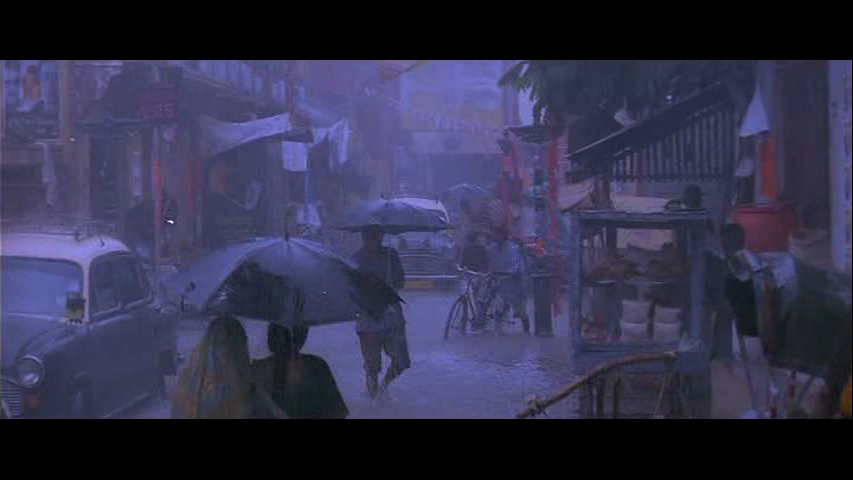
Although the story itself is nothing new, the appeal here lies in the performances of Prabhas and Trisha who really do bring their romance to life. They have great chemistry, especially in the songs and the love story comes across as natural and unforced. After all as Sailaja puts it, Venkat is tall and handsome – what more does a girl need? Their first meetings in the rain are beautifully captured and make good use of the hazy lighting. In the later scenes Prabhas is all action, which he does so well, especially with the great fight scenes choreographed by Peter Hein. But Sailaja fights back too and isn’t at all a typical sobbing heroine. I really like her characters attitude even if she is a little too gullible when it came to her father and too ready to believe the worst of Venkat. I also appreciate the references to the Ramayana throughout the story. The kidnap theme is a straight take from the Aranya Kanda, but there are plenty of other references. These range from Bhandranna trying to change the outcome of the story in a re-enactment at his mansion, to the final showdown involving a large Ravana cutout, which all add yet more layers to the story. I love the songs by Devi Sri Prasad and they are generally well placed in the movie. The best are those with Venkat and Sailaja in the rain, although I do like the multi coloured chicks in this song, and both Prabhas and Trisha look to be having fun.

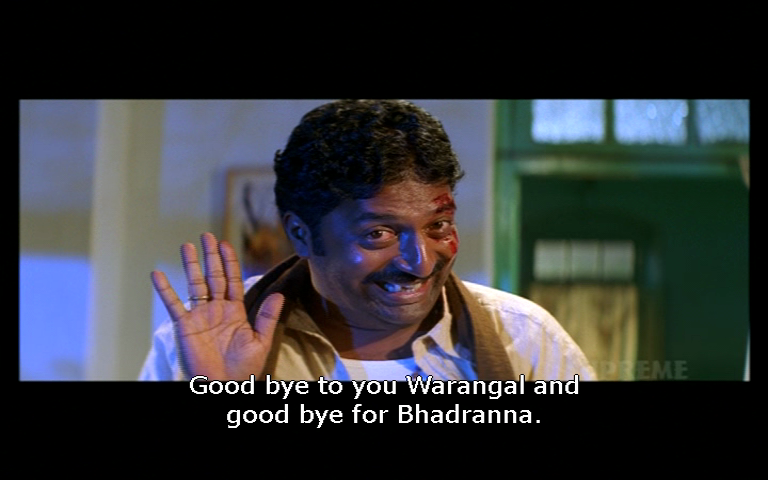
But despite my love of Prabhas, Prakash Raj is the scene stealer as the selfish and greedy father. He has a habit of running his tongue over his crooked canine tooth while he is scheming and it becomes quite mesmerising after a while, acting as a gauge of just how manipulative he is planning to be . Ranga Rao also has a collection of very loud shirts and the combination is enough to put him into the ‘bad dad’ faction even before he starts his fake suicide attempts and general bribery of his daughter. Jayaprakash Reddy as the producer aids and abets Ranga Rao’s plans in order to get his film made and the two have some of the funniest scenes in the film.

There is a small separate comedy track involving Sunil as Venkat’s friend Jagan and his quest for romance. Since Sunil is another favourite and the comedy is inoffensive and not too intrusive it doesn’t detract from the rest of the film for me. Ajay also turns up as one of Prabhas friends which is another point in this films favour although his character is of the blink and you’ll miss him variety.

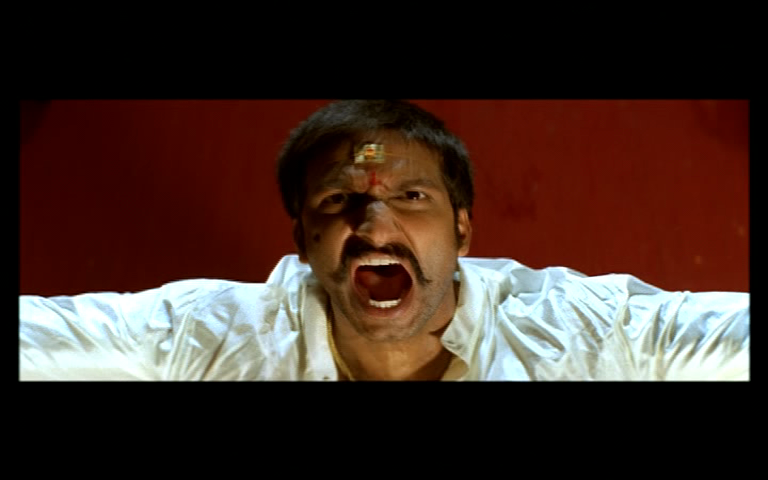
Varsham is the first time I’ve seen Gopichand act, and I think he’s excellent as the villainous Bhadranna. He’s not overtly evil, but you just know he’s the sort of person who pulled wings off flies as a child. OK, killing his father was the first clue, but most of the time he’s rational and normal until you look at his eyes, or he suddenly snaps and casually kills someone. Bhadranna is the centre of his world and the sooner everyone around him realises that and falls into line, the easier it will be for them.  Shafi has a small but important role here as Bhandranna’s step-brother Kasi, and he’s sleazy  and fanatical enough to make his initially pitiful character quite obnoxious by the end. It seems to be his special talent.

Great songs, crazy fight scenes (Venkat has amazing bullets that manage to flip jeeps), Prakash-Raj-bad-dad and a very sweet romance make this one of my favourite Prabhas movies. It’s worth watching for the beautiful rain shots alone but Trisha and Prabhas are excellent together in this film.  4 stars.

Temple says:

The structure of the simple story was quite good, and I like the overt Ramayana references. Bhadranna demanding that the local actors change the script to allow Ravana to tie the nuptial thread around Sita’s neck was just one of many signals that he was the real deal when it came to insane villainy. But the heroic Prabhas was just as demanding. Venkat was the type of hero who expects to be worshipped and he had no tolerance for people questioning him. In many respects there isn’t that much difference between hero and villain as they are both self centred and moody. Prabhas has a very likeable presence when he isn’t sulking or killing people, while Gopichand has a harder edged energy. It was the actors who made that dynamic work as apart from flagging Venkat as ‘poor but honest’ and Bhadri as ‘eeeeevil but artistic’, there was little else in the script to develop the characters. The small scale of the drama and the characters’ dreams made the film a little more engaging and plausible. The character actors were pretty good and helped paper over some of the plot holes just by being believable in their supporting roles. Prakash Raj was good but not great. I found his characterisation fluctuated between extremes of buffoonery and cunning and it didn’t feel cohesive. If he had dialled it down a little in some scenes, the sly con artist and schemer aspects of Ranga Rao would have been more convincing. My first thoughts on seeing Trisha cavorting around in the rain went along the lines of  ‘Hello..an escaped mental patient.’ Why do Indian film directors seem to associate carefree innocence with behaviour that is borderline crazy? And that is pretty much the last thought I gave to Trisha. She was adequate but I think almost any actress could have delivered that performance. There is rather a lot of kissing (seen and implied) although there is minimal chemistry between the stars, even with Trisha licking melon pulp off Prabhas’ face.

The songs are colourful, and Prabhas and Trisha incurred the wrath of the wardrobe team in some of the picturisations which made them extra entertaining. Prabhas’ signature dance steps seem to be stomping or undulating and he often got to do both. Sometimes while wringing wet. There are some nice little details in the design, and I liked seeing Bhadranna still using a gramophone – so stylish and retro. The action scenes were good, and I appreciated Venkat’s dedication to leaving no car unturned in one encounter. Prabhas is very comfortable as an action man, and tackles the fight scenes with gusto.

This is a pretty run of the mill romantic drama and while it was a perfectly acceptable timepass, there is little to set Varsham apart. 3 stars.

Anbe Sivam

Anbe Sivam is a film that many people recommended to me and since it stars two of my favourite actors, it was one I quickly moved up the ‘to be watched’ pile. The film has as its basis the themes of politics and religion, but it doesn’t take itself too seriously and there is plenty of comedy along with all the drama.  The viewer is taken on as much of a journey as the two protagonists and although the film details their endeavours to make their way to Chennai it’s not just the physical travel which is explored. The film was directed by Sundar C while Kamal Hassan wrote the screenplay and even sang on a couple of the songs. Anbe Sivam has a more unusual storyline for a Tamil film, and although there are one or two clichéd characters and a few unlikely coincidences, overall it’s an entertaining watch. Kamal Hassan and Madhavan make a great team and both give excellent performances.

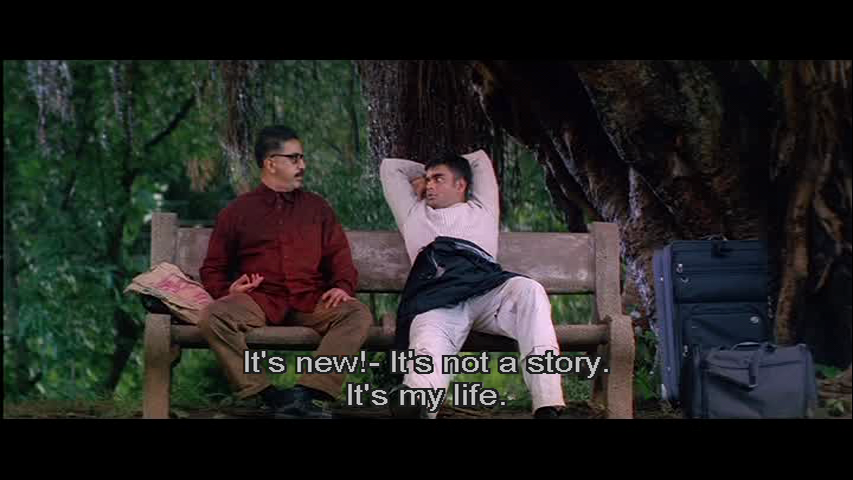
The film starts in Bhubaneswar airport in Orissa where Anbarasu (Madhavan) and Nallasivam (Kamal Hassan) are stranded due to the rains. Anbarasu works as a film maker in the world of advertising and since he despises the part of his name which refers to love, he prefers a shortened from of his name A. Aras. Initially Aras mistakes the bespectacled and physically handicapped Sivam for a terrorist wielding a pipe bomb, when in fact Sivam is armed with nothing more deadly than a cucumber.

A.Aras is as much of an idiot as his name sounds. He’s arrogant, quick to make judgments and quite convinced that he is always right. Sivam is a man afflicted with a paralysed right arm, one leg shorter than the other and an abundance of facial scars following an accident. He also has thick glasses and a facial tic which impressively Kamal Hasan manages to keep going throughout the whole movie. However, after his confrontation with the authorities Sivam explains to Aras that most terrorists don’t look like him at all, but instead are more likely to look handsome like Aras.

After all flights are cancelled Aras ends up unwillingly sharing a room with Sivam. Although Aras sneaks out early the next morning he still doesn’t manage to evade his unwelcome travelling partner as Sivam catches up to him in a flooded train station. Again Sivam comes to the rescue of the more impetuous Aras and aids him in his onward journey to Chennai. There are some beautiful shots throughout the film and the scenes here of the rain drenched streets and the countryside from the bus are excellent.

The duo end up taking a bus and a train on their quest to get to Chennai and along the way Sivam is unfailingly cheerful, chatty and full of unsolicited advice which drives the more reserved Aras crazy. Aras distrusts  Sivam and is rude and even callous in his continual attempts to get rid of Sivam, but his efforts backfire every time. This leads to a lot of comedy which, although often quite slapstick, is well-integrated into the story and is really quite funny. The conflict between the two allows discussion of their opposing views on almost every topic but most commonly Sivam’s communist beliefs. The dangers and benefits of globalisation and multi-national companies are touched on while the clash between Aras’s belief in capitalism and Sivam’s in socialism is an ongoing theme.

As they wait for the train back to Chennai, there is a long flashback which explains some of Sivam’s beliefs and how he came by his disabilities. An unscarred and healthy Sivam organises and takes part in street plays as a way to spread his message of equality and rights for workers. The main person ridiculed in these street plays is the rich and outwardly religious industrialist Kandaswamy Padayachi who is in conflict with Sivam as he refuses to give his workers adequate pay. Sivam meets his daughter Balasaraswathi and after some initial conflict the two end up falling in love. She persuades Sivam to paint a picture in her father’s factory as the fee for his art work will help fund further communist activity. His painting cleverly includes a large amount of communist imagery and I was intrigued to learn that both this scene and the painting itself were influenced by Diego Rivera’s mural at the Rockefeller Centre. Dolce and Namak’s excellent review notes a number of links between Dali’s work and the imagery depicted throughout the film too.

This part of the film is however the least satisfying and goes on a bit too long. Kiran Rathod is rather unsatisfactory as the rich daughter although I can’t decide exactly why, but she never engages any sympathy for her character. The love story seems very trite and there is no chemistry between the two actors here at all.Nasser as Kandasamy Padayachi is a typical evil factory owner although the duality of his evil deeds while continually offering prayers to Shiva was an interesting trait. There is a rather odd fight scene with Sivam using an umbrella as a weapon which doesn’t quite fit with the rest of the story although it is well choreographed. An earlier scene where the theatre group’s performance is broken up by the police is much more realistic and convincing, and this later confrontation seems unnecessary and more contrived. However the flashback does give insight into why Sivam looks at the world with his glass half full attitude despite his disabilities.

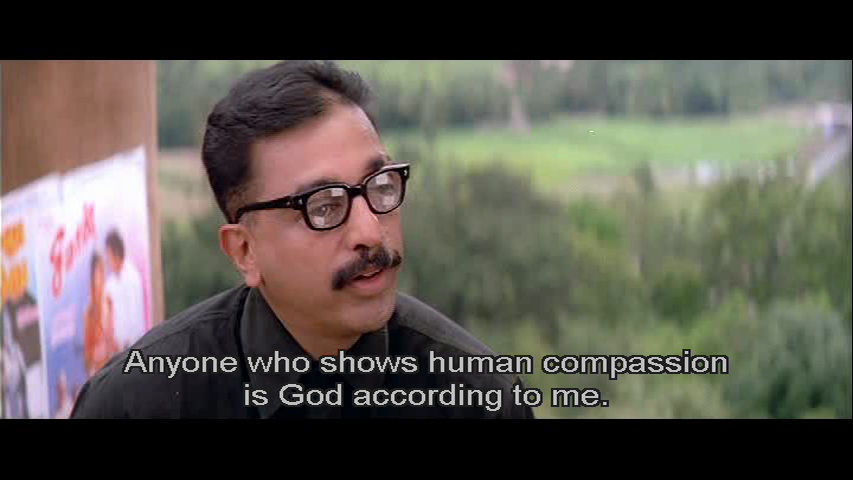
As the rest of their journey unfolds, Aras gradually becomes more compassionate, eventually becoming involved in the struggle to save a young boy’s life following a train accident. Sivam explains his belief that anyone who shows compassion and love to their fellow-man is themselves a god turning the more usual statement ‘God is Love’ neatly around. The last scenes are particularly powerful and moving and Sivam’s unfailing goodness does give the impression that he may indeed be a god. Albeit a flawed and very human one.

What really makes this such a good film are the performances from Kamal Hassan and Madhavan. Kamal Hassan plays Sivam with humility and warmth as a basically good man, but one who is not above playing tricks on his travelling partner. He’s also expressive and vehement in his role as an activist but rather more obtuse when it comes to personal emotions. The change in his character as a result of his injuries is very well depicted and despite his many irritating habits, Sivam is a very sympathetic character. Madhavan does well to hold his own against such a performance from Kamal Hassan. He has a great sense of comedic timing and his scenes with Kamal Hassan are compelling. Sivam is the person you really don’t want to sit beside you on the bus and Madhavan’s increasing frustration and anger is understandable and totally believable. His gradual change as he is exposed to the realities of life in rural India is also convincing and well portrayed. Perhaps the only odd note is his sudden desire to adopt Sivam as his older brother as this seems a rather sudden jump from just wanting him at his wedding. The coincidence that both men love the same woman is also a little unbelievable but for the purposes of the story I’m willing to ignore it. Uma Riyaz Khan appears in a small but very effective role as Mehrunnisa, a member of the theatre troupe and Santhana Bharathi is also well utilised as Padayachi’s enforcer. Both characters have more involvement with the story than first appears and I really enjoyed their contributions. The music by Vidyasagar doesn’t stand out particularly but it does fit well into the film and the songs seem to flow very naturally out of the dialogue. The title song, which appears as a recurring theme, is the most effective and haunting. This clip is fairly graphic and does reveal quite a bit of the story around Sivam’s injuries so skip it if you don’t like blood or don’t want to know more about what happens.

Anbe Sivam is a film I’ve now seen three times and I get more out of it on each viewing. Everything seems to have a second meaning, and that duality is reflected in the fact that the main characters are all known by two different names. It’s a fascinating film and it raises some interesting questions about love and the nature of God. I add my recommendation to all those people who advised me to watch it. 4 stars.