Hum (1991)

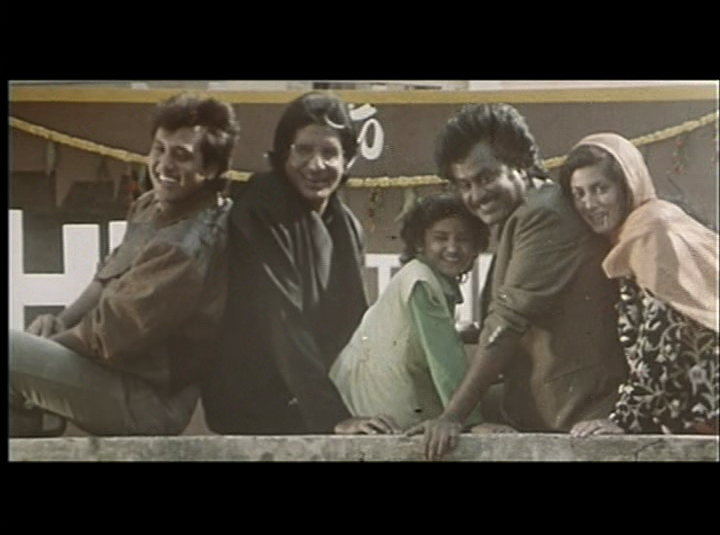
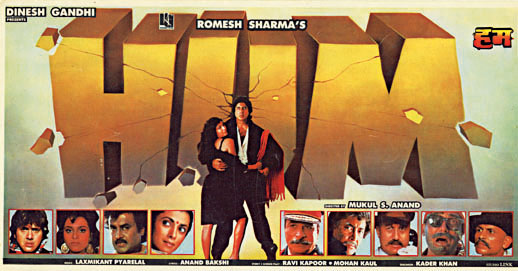
The late director Mukul S. Anand made 3 films with Amitabh Bachchan in the early nineties; Agneepath, Khuda Gawah and Hum. Although my favourite is Khuda Gawah I do have a soft spot for Hum which has a veritable who’s who of actors from the time including Rajnikanth, Govinda, Kimi Katkar, Anupam Kher and Danny Dengzongpa. The story combines the angry young man from Amitabh’s heyday with the sensible and authoritarian father figure he went on to portray in his later movies  and he does a good job of transitioning between the two personas. The film was a big hit at the time, and although it does drag a little in the middle, it’s still a great performance by Amitabh as the man whose past comes back to haunt him.

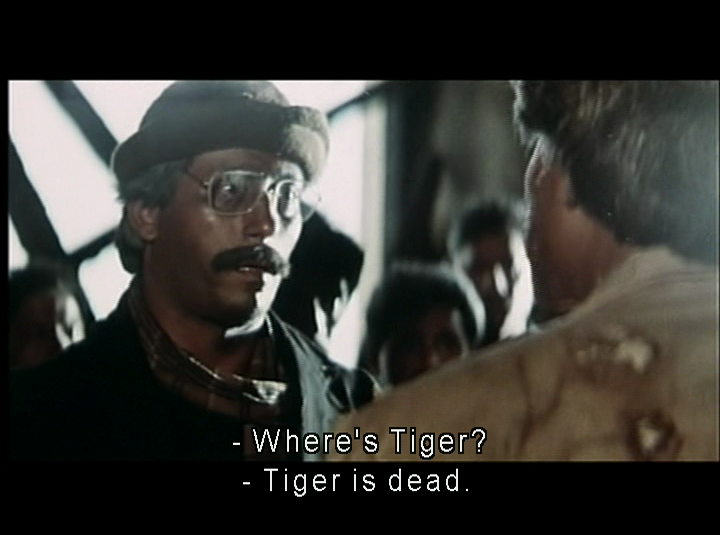
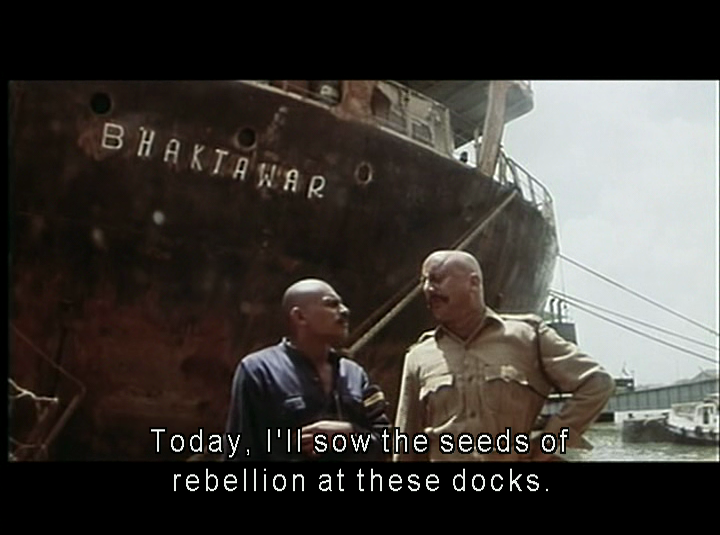
The movie starts as fairly typical masala fare. All round bad guy Bakhtawar (Danny Denzongpa) rules over the docks in Mumbai, treating his workers as slaves and killing anyone who dares to go against his despotic will. Despite his general dissatisfaction with this regime, Tiger (Amitabh Bachchan) extorts money from the workers for his father Pratap (Deepak Shirke), who in turn works as an enforcer for Bakhtawar and struggles to keep the peace between his son and his employer.

Tiger is in love with Jumma (Kimi Katkar) and the two have a rather stormy relationship, although we don’t get to see very much of them on-screen together. During one rebellion Tiger’s best friend Gonsalves (Romesh Sharma) is killed by Bakhtawar and in the subsequent fall-out Tiger’s father and step-mother also die, leaving two young step-brothers in Tiger’s charge.
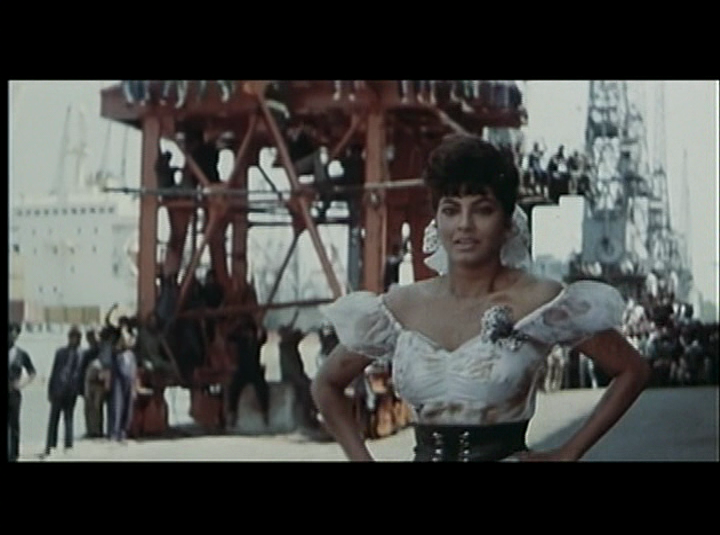
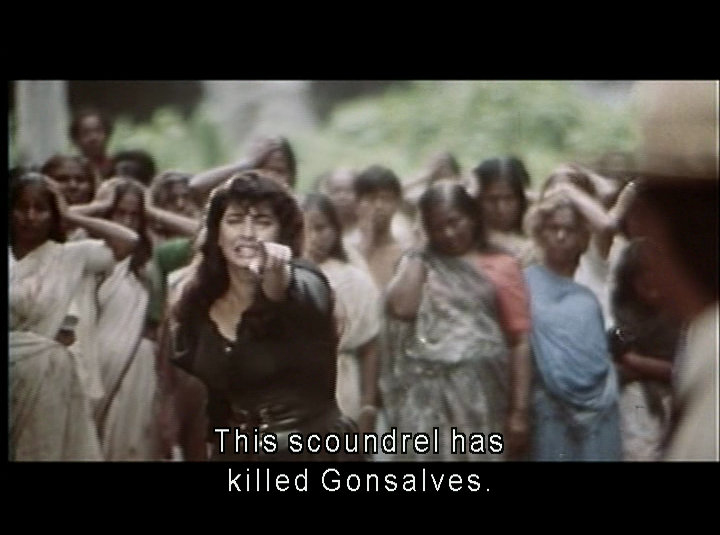
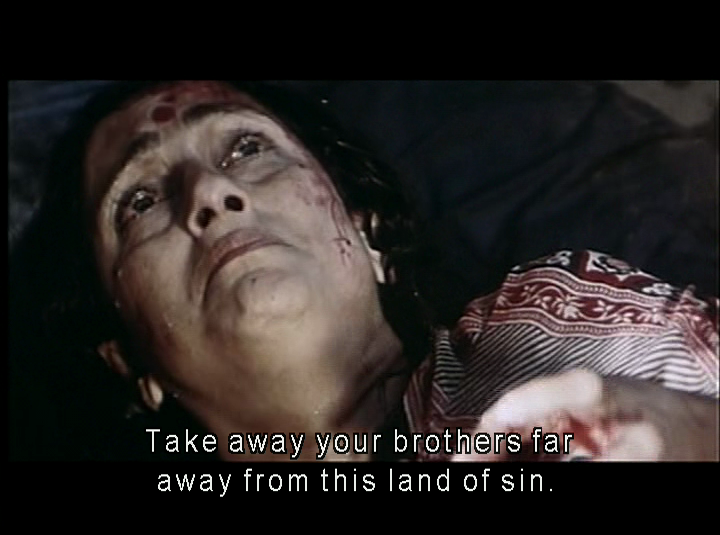
Tiger immediately sets out to kill Bakhtawar in revenge but is stopped by Inspector Girdhar (Anupam Kher) who has his own agenda, and has set up the whole situation by playing Gonsalves and his revolutionaries against Bakhtawar and his gang of thugs. Girdhar intercepts Tiger and convinces him to fulfil his dying step-mother’s wish and take care of his young brothers while leaving the police to deal with Bakhtawar. In the confusion Girdhar and his faithful sidekick Havaldar Arjun Singh break into Bakhtawar’s safe and steal everything. To cover up their crime they set fire to Bakhtawar’s house, killing his wife and children in the process. At the same time they arrest Bakhtawar and send him to jail, while finally Girdhar blows up the train carrying Tiger and his brothers to eliminate any possible witnesses of his crime.
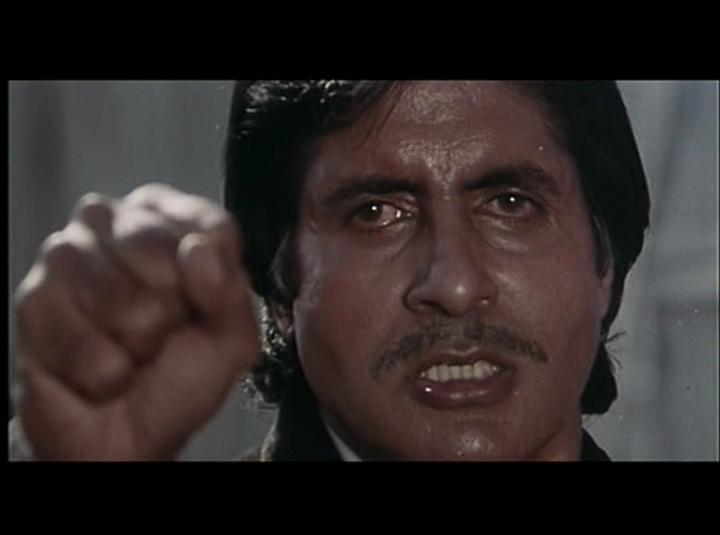
It’s all action in the first half of the film! Amitabh plays his classic role of the angry young man as only he can, even though he looks his age here and actually looks older than his supposed father and step-mother. But there is so much emotion and energy behind the character that apart from moments where the angled lighting shows up the wrinkles, it easy to put aside disbelief and accept Tiger as the slightly tarnished but still heroic saviour of the poor.

The first half of the film also features Laxmikant-Pyarelal’s classic song Jumma Chumma De De. Chinni Prakash won the Filmfare award for best choreographer in 1992 for his work on this. I’m not sure why the men have mugs of foam, although I presume it’s meant to represent beer and the water hose does seem a little excessive, but do enjoy what is actually a good song.

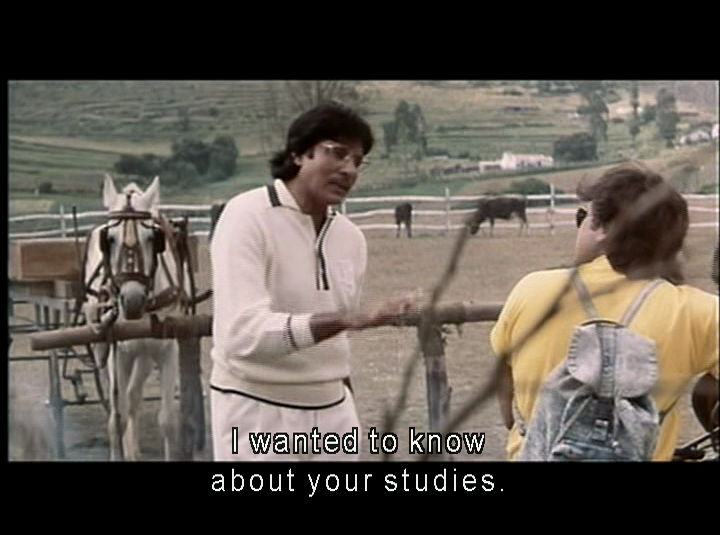
The second half of the film shows an older Tiger (we can tell because he now wears spectacles) who goes by the name of Shekhar and is a respectable farmer and timber merchant in Ooty. Kumar (Rajnikanth) is a police officer and is married to Aarti (Deepa Sahi) with a young daughter Jyoti. The youngest brother Vijay (Govinda) is a student pursuing Anita (Shilpa Shirodkar), the beautiful daughter of General Rana Pratap Singh (Kader Khan). Neither of the two brothers seems to have any memory of their time in Mumbai and both regard their step-brother as a rather staid and authoritarian figure, whose rules they generally ignore.
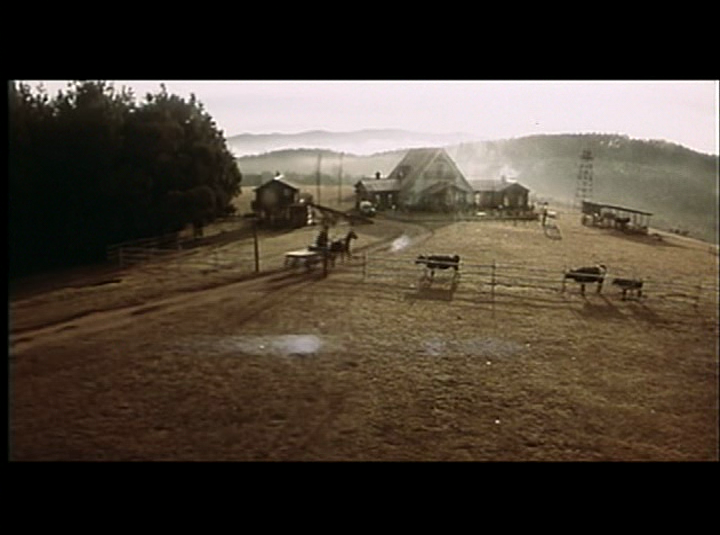
Meanwhile, Jumma has managed to overcome her early life and is now a successful actress while Girdhar and Havaldar are living well on their stolen riches and selling tanks from their base in Bombay.

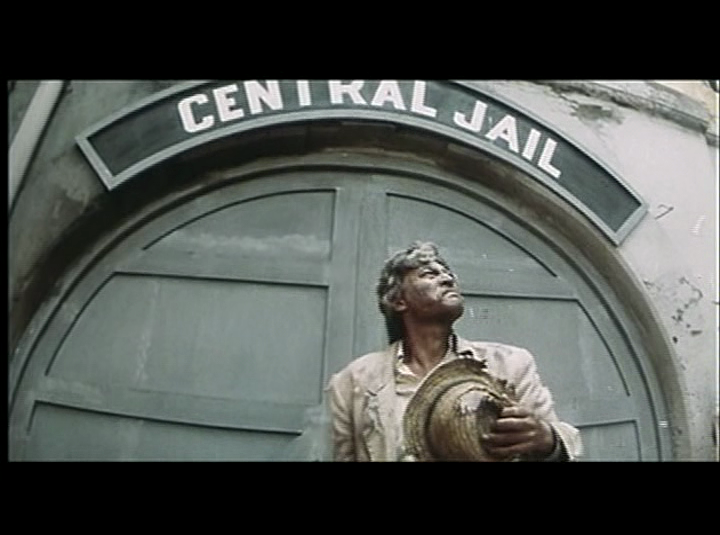
The middle part of the film tends to drag as it concentrates on the unity of the family and a rather involved romance track with Vijay and Anita slows the pace considerably. There is an unconvincing and unnecessary thread where Girdhar finds a duplicate General as the original has refused to buy his tanks and the whole character of the renegade Captain Attack would have been best avoided.. But things pick up when Bakhtawar is released from jail, still wearing his now rather grimy white suit, desperate for revenge on Tiger for the death of his family. As Shekhar’s past catches up with him, everyone ends up in Bangalore together before somehow managing to get back to the Bombay docks in record time for an exciting and action packed showdown.

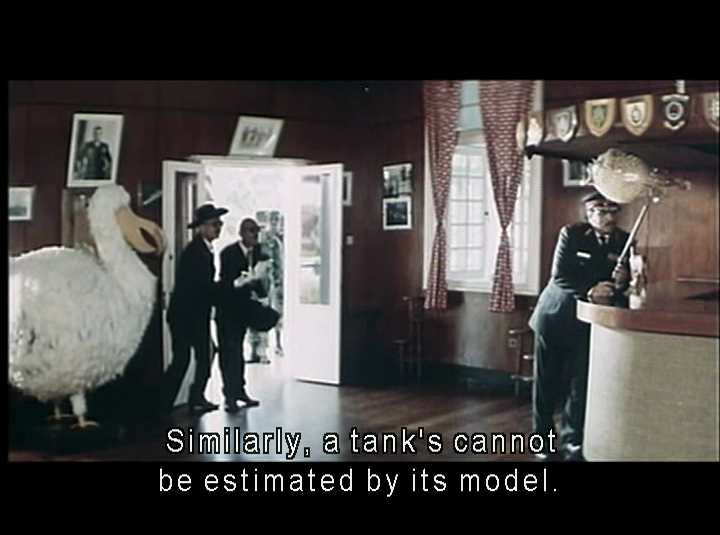
There are some things that are just never explained. Why there is a giant stuffed dodo in the army officers’ lounge, or a type of puffer fish above the bar we will never know.
Amitabh suits the role of the older Shekhar much better as he finally looks the correct age. His realisation that his somewhat shady past has finally caught up to Shekhar is brilliantly portrayed and the re-emergence of his Tiger character is excellent. Who knew that all it takes to become an efficient and competent fighter again is a shake of the head and a tiger’s roar! While Rajnikanth has a limited role as Kumar, the scenes where he faces off with Shekhar are excellent and the two actors are very natural together. Govinda is good as the more innocent Vijay, but as his character is there more to add comedy and some light-hearted romance he makes less of an impact. However he does have the best ever disco dance/fight scene and I do like his Crocodile Dundee inspired outfit.

Danny Denzongpa can always be relied on as a villain and here he brings depth and character to the role of Bakhtawar. He contrasts the money obsessed businessman with scenes of the family man, although even here his basic nastiness is still clear. As the revenge obsessed ex-prisoner his conviction that Tiger is still alive somewhere is perfectly shown as the driving force behind his increasingly agitated behaviour. The whole character of Bakhtawar is very well written and I like the way flashbacks to his family’s deaths help humanise him and make Bakhtawar more three-dimensional than the typical Hindi film villain.
Anupam Kher’s Girdhar is a much more buffoonish character and although his initial scenes as the police inspector are good and at times almost menacing, he becomes more irritating and cartoonish as the film progresses.  Deepa Sahi is the best of the actresses and also has the most convincing role as Kumar’s wife. Her attempts to look after the entire family struck a chord, although I wouldn’t have been as happy as she is to be fobbed off with the very annoying song that the family sing together at opportune moments. The music by Laxmikant-Pyarelal is generally good, although apart from Jumma Chumma De De none of it is particularly memorable.
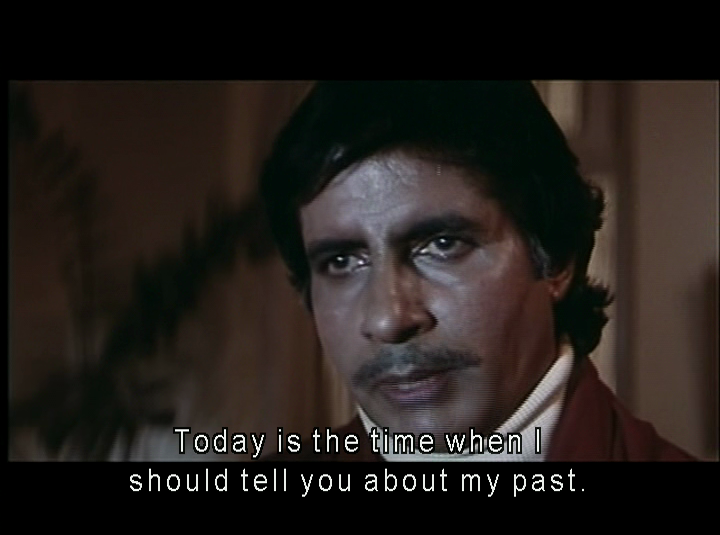
This is a masala film that reaches back to some of the classic Amitabh films of the early eighties and he delivers a great performance throughout. Although there are some flaws in the film, particularly in the middle section, there are plenty of great action scenes and excellent performances from the rest of the cast. Worth watching for Amitabh and Danny Denzongpa who steal the show. 3 ½ stars.

Temple says:

On paper, this looks like it should be really good. It has a great cast and many of the required masala elements. And I really like a good socialist masala. Sadly, it fails to live up to that promise on almost every count. Mukul S Anand directs with a leaden hand and what little zest resides in the story is overwhelmed by clunky plotting and some poor casting.

Amitabh didn’t really convince me as Tiger – not just on his physical appearance, but his performance. He had some great moments, especially when Tiger was just hanging around shooting the breeze or drunkenly trying to warn Jumma’s brother, but he sometimes looked like he was just going through the motions of his patented Angry Young Man. Shekhar suited Amitabh’s air of authority, but was so relentlessly dour. Rajnikanth is cast as an airhead policeman, too dumb to know if the gun he lets his daughter play with is loaded. He just isn’t frivolous enough, and Kumar doesn’t get much to do. Rajnikanth and Amitabh share a nice rapport, but what a waste of a fine actor. Govinda’s role was totally unnecessary and I wondered if Vijay was added in just to have a dancer in the cast. Kimi Katkar is introduced by having her chest heave into view and that is all you need to know about Jumma. The only thing I recall about Deepa Sahi is a scene where she apologises for her inability to cope with the brothers’ demands and they basically reassure her that she’ll get better at housework with practice. There is a terrible family song, and many trite ‘together we five fingers make a fist’ speeches. I’d rather be an orphan! Danny Denzongpa is excellent but Bakhtawar is sidelined for the middle of the film so the best bad guy is largely missing. Anupam Kher is both comic relief and villain, and does neither well. The comedy track is hammy and misguided, and he doesn’t portray Girdhar with enough menace. The plot goes off the rails a bit when Girdhar carries the story and Anupam Kher’s performance does nothing to help the situation.

Hum is tedious and ponderous where it needed to be a fizzy blend of melodrama, action and humour. It’s a sad misuse of some excellent talent and resources. 2 stars.
Bichunmoo

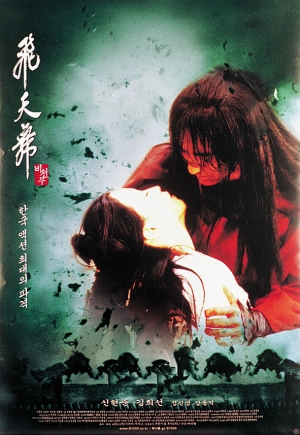
I know very little about Korean films and only a fraction more about the Wuxia genre in Chinese cinema. Even then, my knowledge is based on films such as Crouching Tiger Hidden Dragon and Hero which are aimed more at the Western market and probably not representative of the genre at all. But Bichunmoo was one of the first wire-work martial arts films I saw and it’s a little more unusual in that it is Korean. I love it so much because in many ways it reminds me of a cheesy masala film. It has all the necessary ingredients – tragic lovers, excellent sword fights, a hero who refuses to die despite some very convincing attempts on his life, a significant necklace, an evil warlord and even a dance number!

Bichunmoo is based on a comic series which ran to six volumes, and that is a lot of story to fit into 2 hours. Nevertheless, director Young-jun Kim includes as much as he can with the result that the film is at times hard to follow and almost every scene contains important plot points. Blink and it’s easy to get lost. To add to the confusion, the film was originally longer but a number of scenes were cut to make it fit into the two hour slot demanded by Korean cinemas. This means that there are characters that suddenly appear with no explanation of who they are. The film also jumps forward ten years and it’s hard to realise this has happened as the characters don’t age, and the advance in time is never mentioned. However despite these flaws there is plenty to enjoy and it’s certainly never dull.

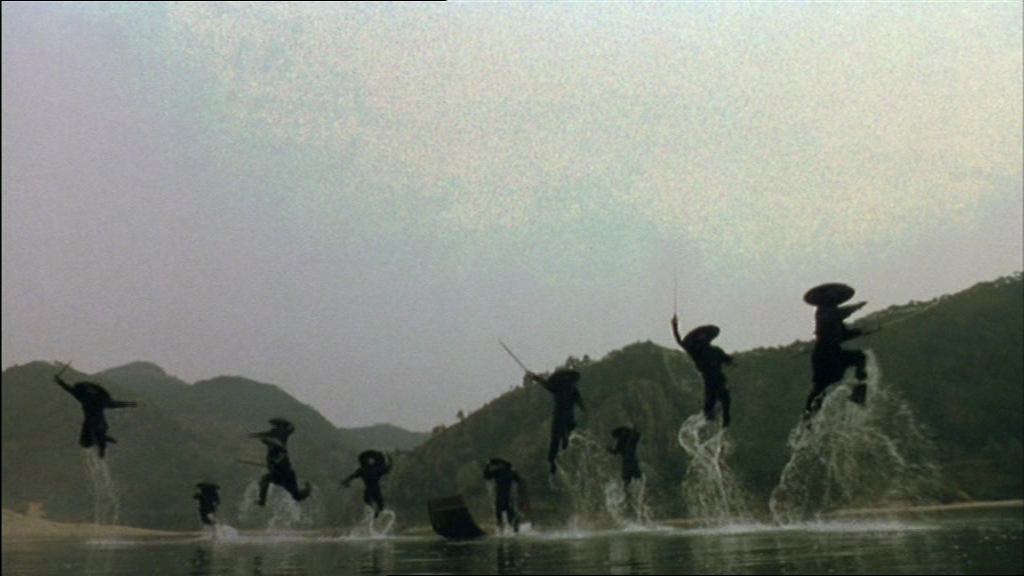
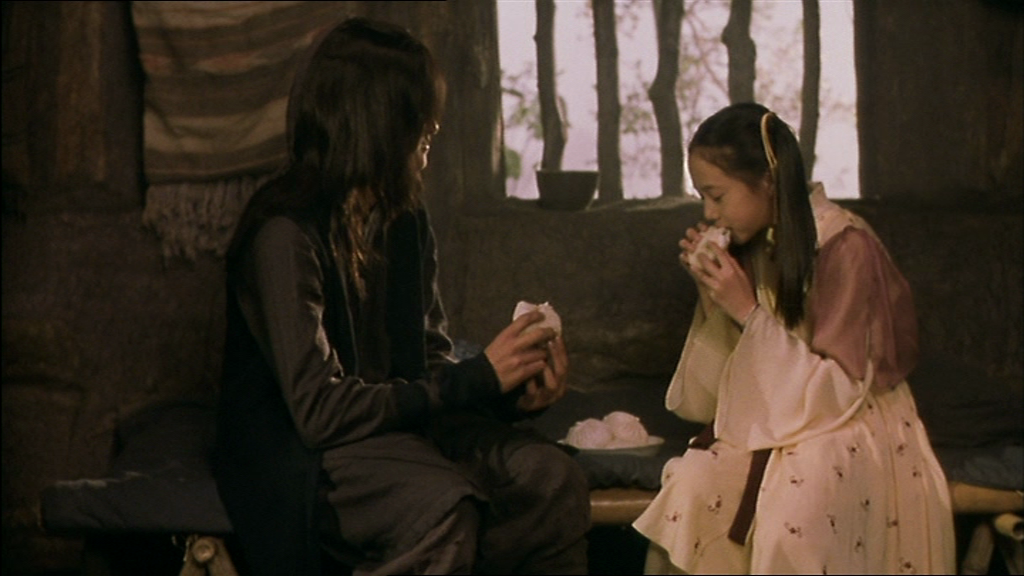
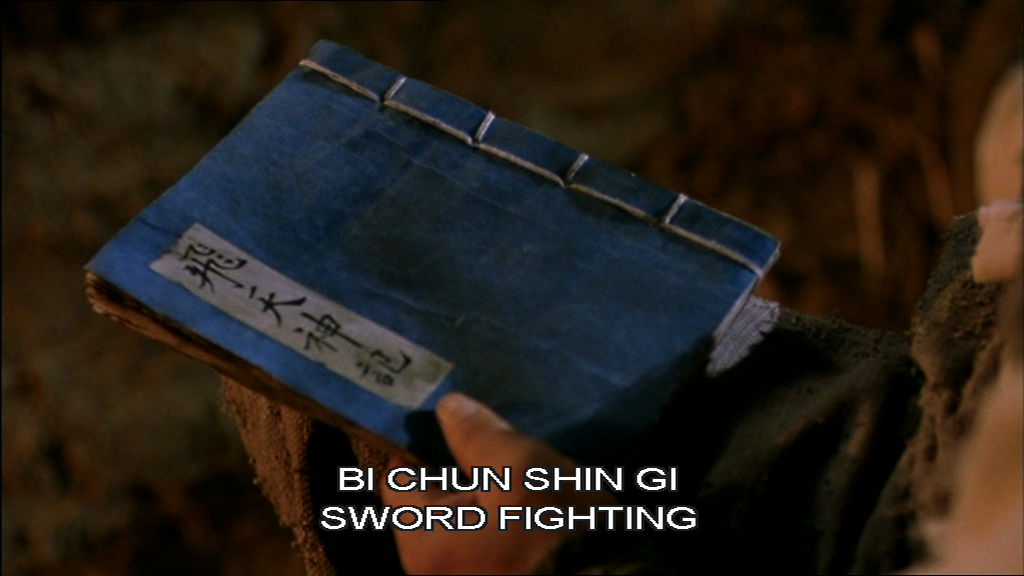
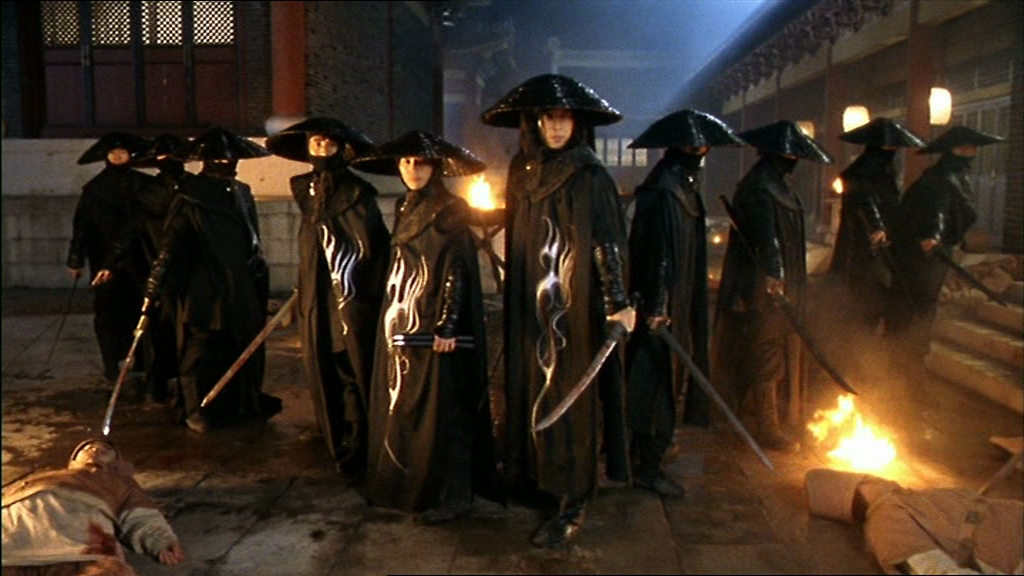
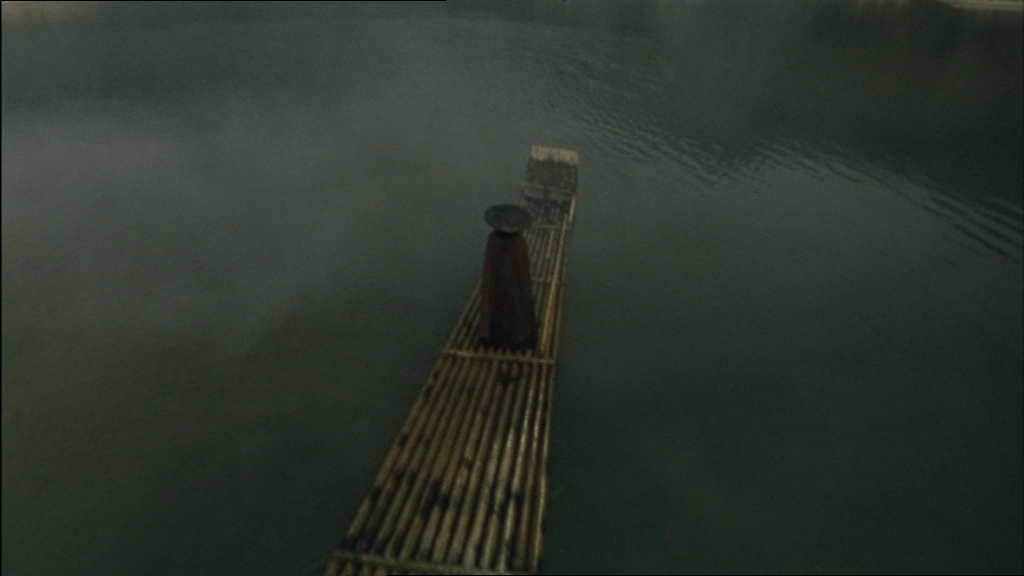
The film opens with Jin-ha (Hyeon-jun Shin) drifting down a river towards an army encampment. This gentle beginning doesn’t last long though as’ Ten Black Swordsmen’ explode out of the water and make quick work of the opposing Mongolian soldiers in the first of many excellently choreographed fight scenes. The next scene cuts to Jin-ha rather morosely sitting on a rooftop gazing forlornly at his lost love Sullie (Hee-seon Kim) and then quickly moves on to a flashback of their lives together as children. Jin-ha grows up under the tutelage of his uncle Kwakjung (Ju-bong Gi) and learns from the Bi Chun Shi Gi Sword Fighting Book – doesn’t every master swordsman have to start somewhere?

Sullie is the daughter of a Mongolian general and his concubine, but when her mother dies General Taruga (Hak-cheol Kim) takes Sullie to the city. Before leaving she gives Jin-ha one half of a jade necklace and arranges for them to meet in the city proving that no matter how fragile she looks, Sullie is one tough customer and not easily pushed around. Jin-ha’s uncle is killed by assassins trying to steal the secrets of Bi Chun Shi Gi but before he dies he reveals that Jin-ha is in fact the son of a Korean nobleman Lord Yu, and asks his student to take revenge on his parents’ killers. Who just happen to be the General Taruga and his men. This takes us about 10 minutes into the story and already we have separated lovers, a desperate heroine, vengeful hero and an angry father – phew!

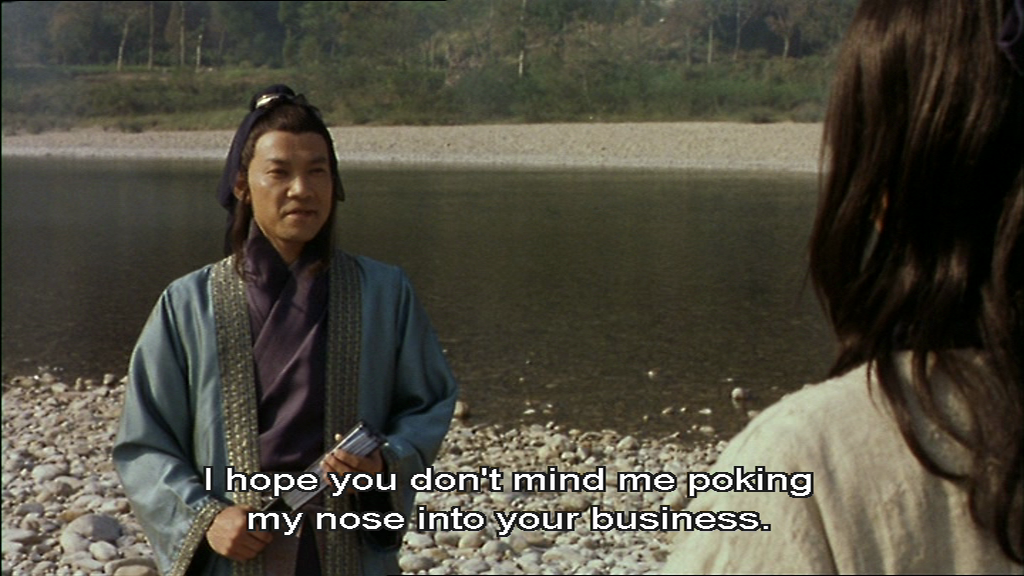
Jin-ha sets off to find Sullie and on the way is attacked by yet more assassins after his sword-fighting secrets. A Mongolian noble Namgung Junkwang comes to Jin-ha’s aid using a fan rather than a sword to defeat the assassins in an impressive and very fast action sequence. Meanwhile Jin-ha shows off his technique of Bi Chun Shi Gi which allows him to attack his enemies using the force of chi alone. It’s very cool.

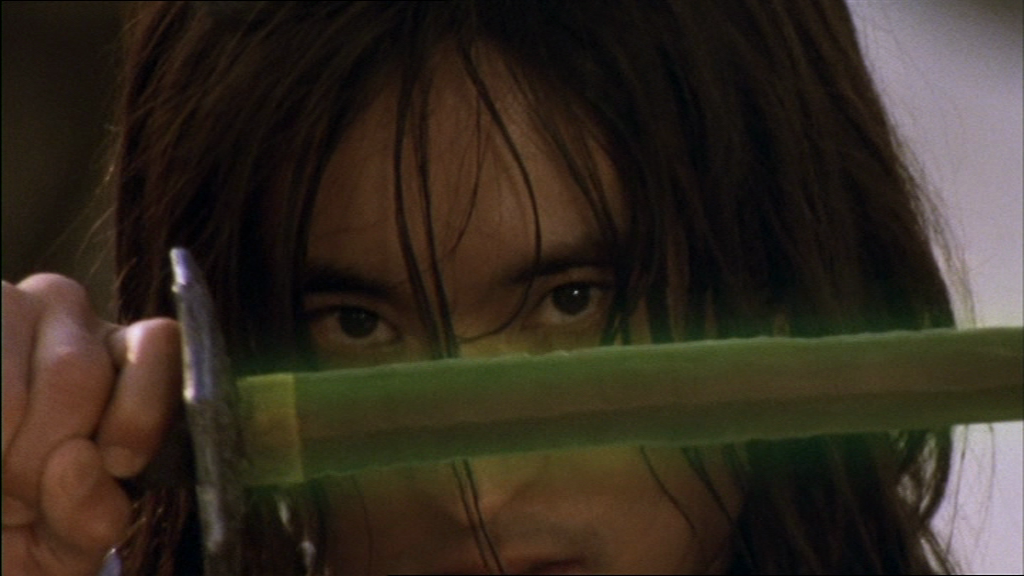
On arriving in the city, Jin-ha learns that Sullie is engaged to marry his new friend to help further her father’s political ambitions. Jin-ha attempts to run away with Sullie but the two are caught and after yet another superb fight scene Jin-ha is shot full of arrows by the treacherous General Taruga and falls off a cliff into a river. It’s interesting to note that the technique of Bi Chun Shi Gi not only allows you to explode your enemies but also has the ability to make your word glow green!

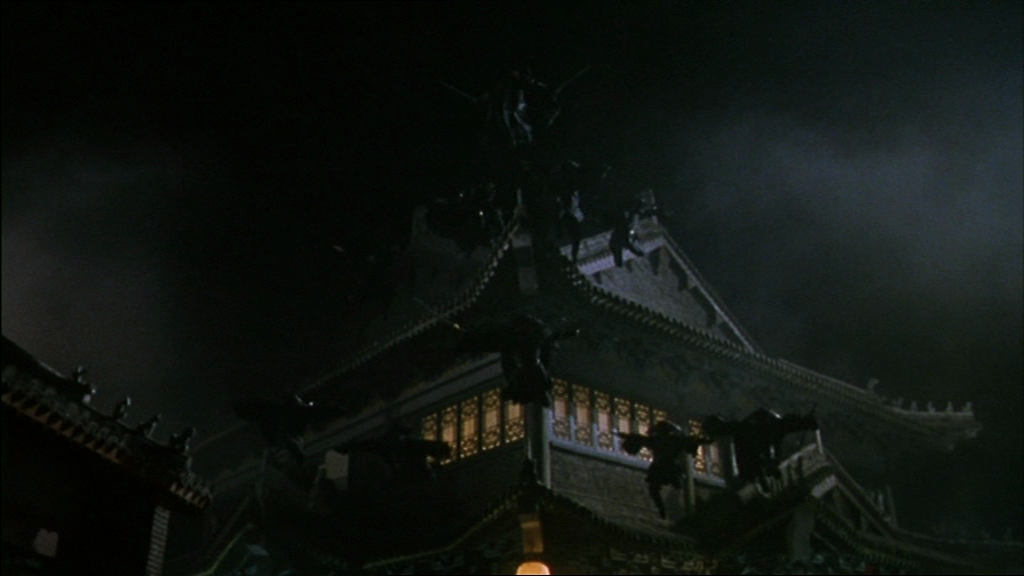
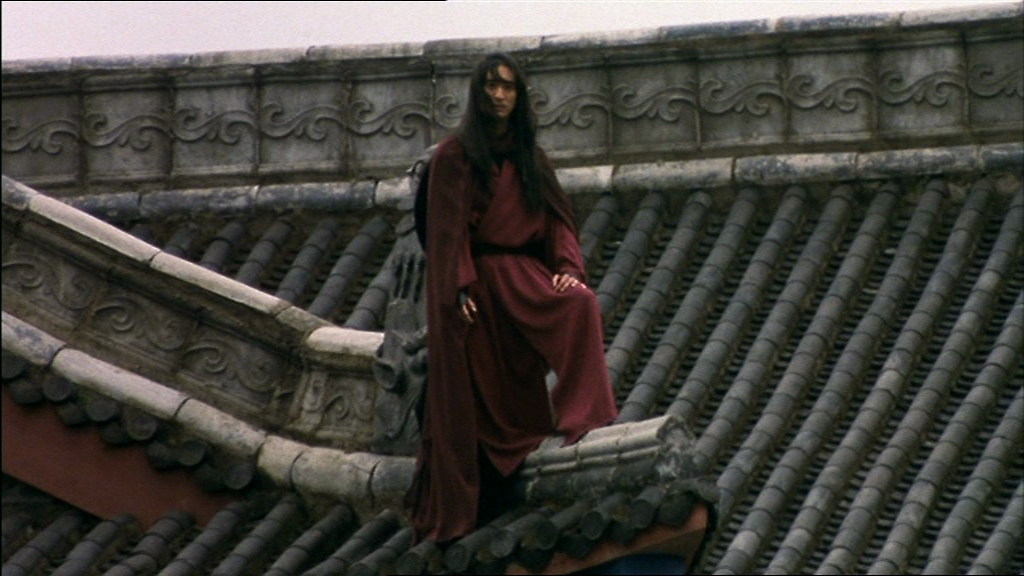
Jin-ha is however rather difficult to kill – he’s not going to let a few arrows, a large fall and near drowning stop him. He is found by Ashin (Su-ro Kim) who heals him with some village remedies which seem to involve a lot of mud. At some point here we jump forward in time where Sullie believes Jin-ha is dead and is now married to Namgung Junkwang and has a 10 year old son, Namgung Sung (Bang Hyep). Jin-ha has become the cold and ruthless Jaha-lang and is followed by the’ Ten Black Swordsmen’ who are all trained in the art of Bi Chun Shi Gi and look like very cool Goth ninja assassins. Jin-ha is aiding the rather despotic Han leader Jo-beak Seung and his evil general Saijune (Tae-hwa Seo) in their mission to kill all the Mongolians and generally mopes around trying to get over his lost love. However in the course of the Han’s campaign Sullie and Jin-ha meet again on opposing sides of the war and you just know they’re not heading for a happy ending.

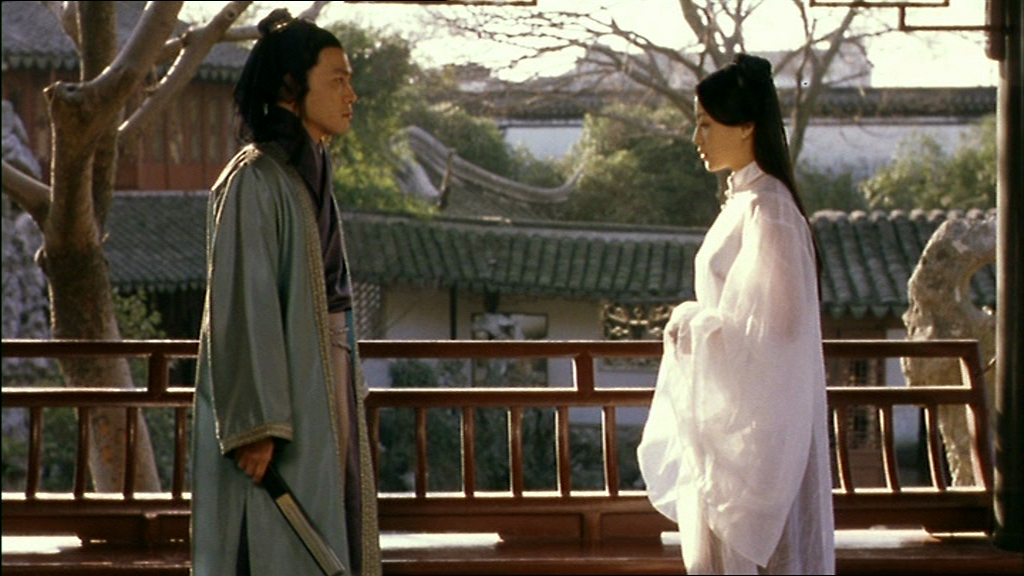
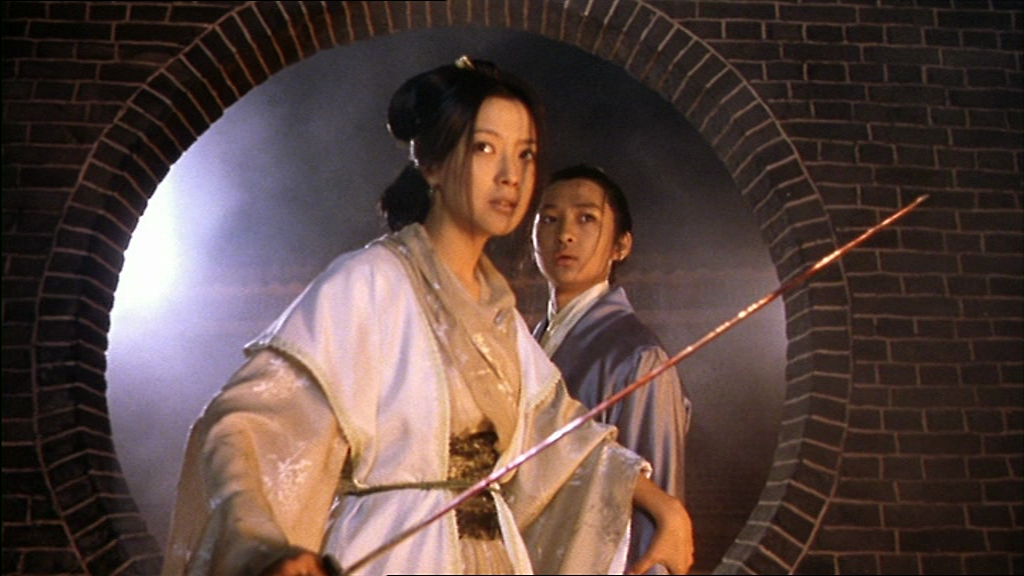
There is a lot more to the plot and there are betrayals, revelations, more assassination attempts and an ‘other woman’ in Lady Yeo-jin. It’s a story on an epic scale and really deserves more than 2 hours since a few scenes end up feeling rushed and there are some relationships which would have benefitted from further development. However the film looks stunning, the story does make sense despite the deleted scenes and the fight scenes are well integrated into the storyline. Although the actors are Korean, the film was shot in China using their more experienced crews, and it shows in the attention to detail throughout. The costumes by Min-hee Kim are wonderful and Hee-seon Kim is stunningly beautiful and ethereal as Sullie. Although her character seems quite passive, she fights back effectively against her father and is also quite capable of picking up a sword to defend herself if needed. She looks amazing here as she dances for the Han chief Jo-beak Seung and despite her rather fragile appearance she is much stronger than she looks.

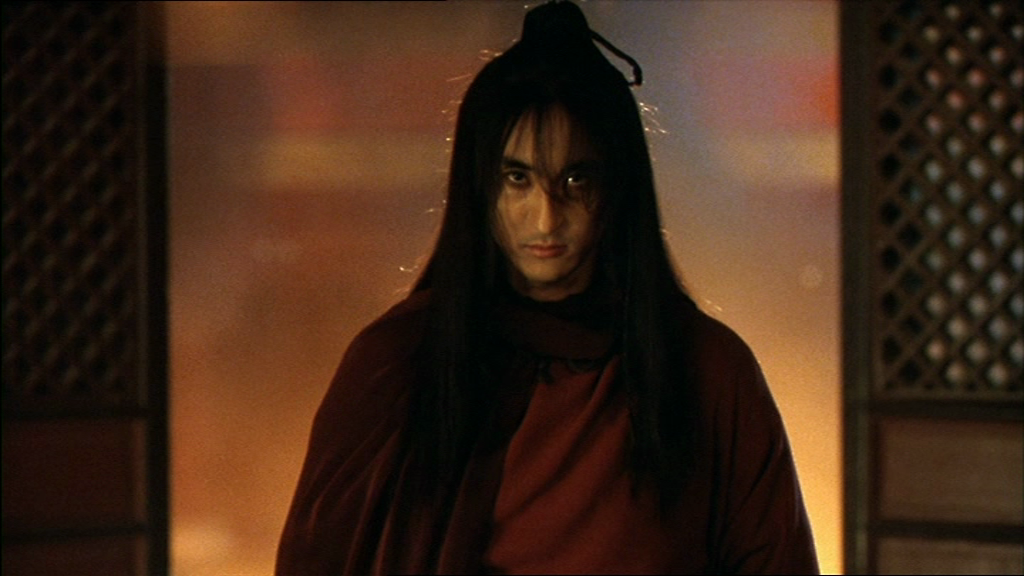
Hyeon-jun Shin is excellent as Jin-ha and convinces as the stoical hero. He is honest and innocent at the start of the story but changes as events turn him into a deadly fighter seeking revenge. He doesn’t let much emotion show on his face until it really counts, but his eyes speak volumes especially as he gazes at Sullie. Like all good heroes you know that his strength and loyalty will be there when needed and then he will never, ever give up. Jin-yeong Jeong is also excellent as Sullie’s husband who is also desperately in love with her but cannot ever replace Jin-ha in her heart.  The other supporting characters play their parts well, and in particular Han-gari Lee is memorable as Jin-ha’s lieutenant Changryeon. The story of the tragic lovers is very over the top and melodramatic but works well as the driving force for Jin-ha’s actions and is really more convincing than relying on the revenge plot alone.

The action is fast paced and frequent with fantastic fight scenes choreographed by Yuk-sing Ma. The atmospheric soundtrackby Seong-jun Kim gets replaced during the fights with electric guitars which gives a much harder edge and makes more of an impact. The Bi Chun Shin Gi technique allows Jin-ha to use force against his enemies and rather interestingly they burst apart in showers of dust rather than blood and gore, although there are the occasional rather anatomically unlikely spurts of blood to enjoy!

It is all very spectacular and although occasionally confusing the story is compelling. It’s not a great martial arts film and although I haven’t seen the comics I’ve read that it’s not a great adaptation of these either. But it is an excellent film if you take it as a love story and just enjoy the wonderful fight scenes and glorious cinematography without worrying about the jumps in the timeline or the suddenly appearing major characters. 4 stars.

Sivaji (2007)

Sivaji is a wonderfully over-the-top film celebrating all things Rajinikanth. There are references to the superstar’s previous films and to his own life, plenty of classic Rajni style and he’s present in almost every frame. Sivaji also features stunning sets for the songs and a myriad of different looks for Rajinikanth throughout the film. While the story has an interesting plot involving corruption, the screenplay gets somewhat tangled in the numerous set-ups to introduce the next song or fight scene.  But in the face of so much else that is fantastic, the disjointed nature of the story doesn’t seem to matter. When the first song is as much fun as this, then the film is already a winner for me. This features Nayantara in a cameo role along with an incredible number of  men with round, jiggling painted bellies – I love it!

The film opens with Sivaji returning from the USA with truck-loads of money and deciding to set up a University and Hospital where everything will be available to the poor for free. His grand plans are opposed by local businessman Adisheshan (Suman) who blocks him at every turn. To make Sivaji’s life more difficult there is the practice of bribes and kick-backs that seems to be built in to the system at every stage. Despite his unwillingness to play along, Sivaji has no choice but to fall in line and pay everyone off if he wants to get his hospital and university built. I’m quite sure that all these people in yellow hats were the inspiration for minions in Despicable Me – or at least they should have been.

Ultimately this works to Adisheshan’s advantage when he contrives to have Sivaji arrested and charged in court. There Sivaji admits that he paid bribes to get permission to build and ends up losing everything. This might have been the end of the Sivaji foundation, but Adisheshan is the one person in Tamil Nadu who has no idea who he’s really dealing with and he rashly mocks his defeated enemy.  This sparks Sivaji’s quest for revenge, and the 1 rupee coin Adisheshan tosses at him to start his begging career becomes a talisman and also funds the start of the fight back. Sivaji devises a cunning plan to restore his finances and bring about Adisheshan’s downfall at the same time.

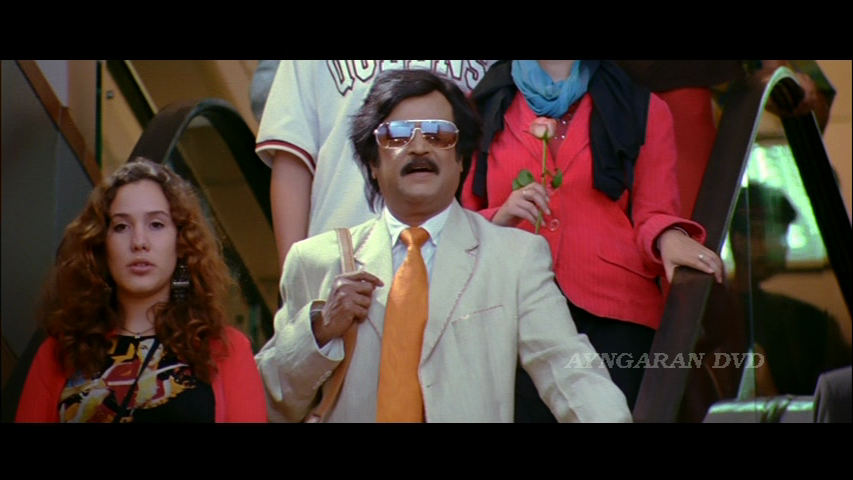
Rajinikanth is truly in his element here as the crusading Sivaji. He still has his trademark tricks, but this new  health conscious Sivaji spruiks the ‘cigarettes are bad for you’ message, catching mints and tossing his sunglasses instead of cigarettes. It’s all a little contrived, but the tricks are so much a part of any Rajni film that Sivaji would seem incomplete without them. There areplenty of fight scenes, and these are well choreographed by Peter Hein. The final showdown features some Matrix style action and Rajinikanth pulls it off with great style. If he has slowed down a little in some of the fight scenes and songs, well, that’s understandable but it’s barely noticeable. As well as the romantic songs, there is a fabulous sequence where Rajinikanth impersonates Sivaji Ganesan, MGR and Kamal Hassan and he gets really gets the mannerisms of the different stars very well.

During the course of his crusade against corruption, Sivaji meets and falls in love with Tamizhselvi (Shriya) and despite her family’s initial reluctance and dire predictions of disaster from the priest, the two go ahead and get married. Thankfully Shriya is much less annoying than usual, perhaps because she is totally overshadowed by Rajinikanth, but I stand by my previous observations that the more clothes she wears the less irritating she is. Her main raison d’être here is to look pretty in the songs which she does very well.

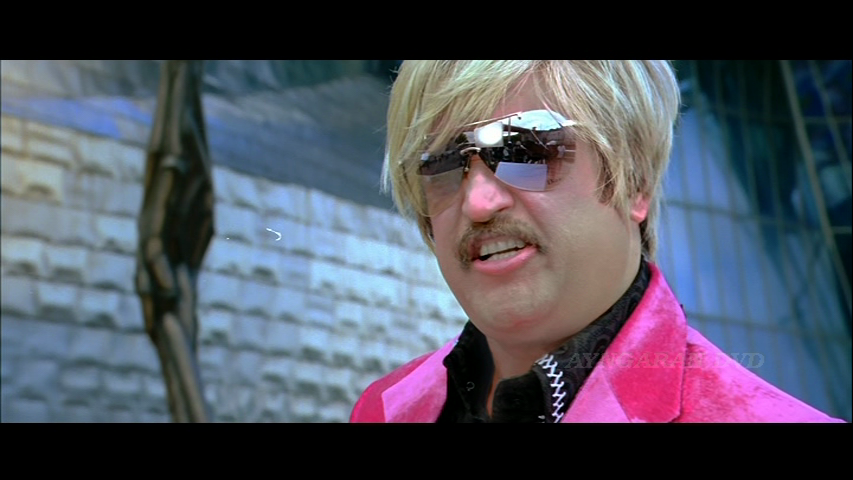
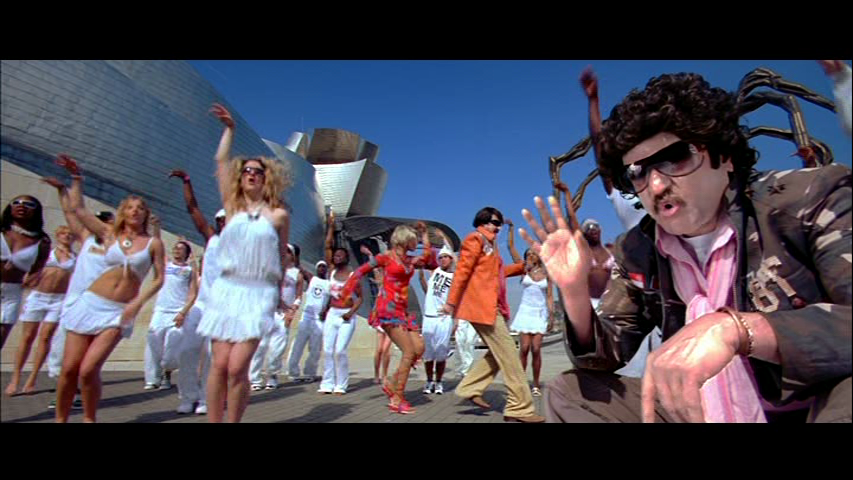
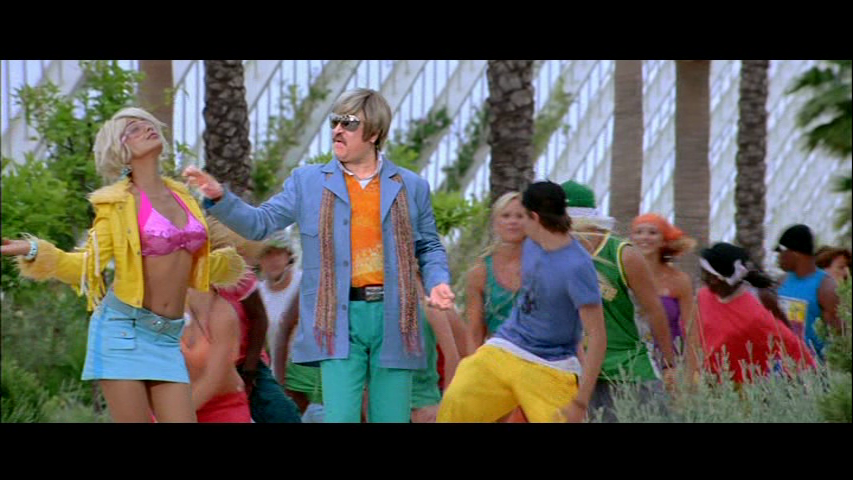
Other than her presence in the songs, Tamizhselvi is the ‘perfect Tamil girl’ of Sivaji’s dreams and that ensures plenty of traditional outfits and a fairly restrained performance, making her more tolerable than usual. Someone in wardrobe really does have a grudge against her though because she does appear in some of the worst outfits I’ve seen in the song ‘Style’.  I’m not quite sure what to make of this song for many reasons. As a song extoling style it has some truly dreadful costumes and the whole white-skinned Rajni just seems very wrong. I’m always perplexed by the quest for paler skin in India, but then I’m equally as baffled by the drive for tanned skin among Europeans. I don’t like the melody or the lyrics of this song at all, but it does feature an incredible selection of amazing wigs for Rajni and is worth watching for that alone. Pick your favourite style!

And the contrasting faces of Shriya.

While the film deals with the theme of corruption, there is still plenty of comedy along the way. Although much of the humour comes from Rajinikanth and his various mannerisms, Vivek is excellent in his role as Sivaji’s uncle Arivu and provides many funny moments. Even though I’d normally cringe at Arivu’s match-making technique of parading girls in front of Sivaji, Arivu’s character is self-aware enough to make this funny rather than crass.  There is more slapstick comedy in the scenes with Tamizhselvi’s family who disapprove of Sivaji and his exuberant family. The actor playing Tamizhselvi’s father (Pattimandram Raja) has some excellent expressions and I love the way he looks as if he smells something bad every time he sees Sivaji.

On the other hand, Suman’s Adisheshan is a very mild mannered villain without any real evil tendencies. Although I’m sure this is meant to make sure that all eyes are firmly on Sivaji, he still seems rather unimpressive in comparison. His demeanour however is quite realistic as a businessman with political leanings and his reasons for opposing Sivaji are understandable considering how much the free hospital and university will cut into his profits. His methods of opposition are also consistent with his character and perhaps S. Shankar is trying to point out that corruption can be present in even the most reasonable appearing businessman.

The second half of the film relies more heavily on the effects and gimmicks, and it’s disappointing that Vivek’s character gets more sidelined. But it’s still a lot of fun to watch mainly due to Rajinikanth’s performance. The music by A. R Rahman is excellent apart from the Style song mentioned previously, and the high budget of the film is easily explained by the song picturisations. The sets and costumes are totally fabulous and both Thotta Tharani as art director and K. V. Anand as cinematographer deserve the awards they received for their work. There are guest appearances by a number of established Tamil stars including Raghuvaran and Manivannan and  the support cast are all very competent, although generally overshadowed by the superstar.

Although Endhiran (S. Shankar’s latest film with Rajinikanth), had a bigger budget and even more special effects, I prefer Sivaji. The story is engaging despite the way it jumps around and Shankar shows corruption within government systems in a way that seems quite plausible. Even though the one man crusade requires a leap of faith, it is after all Rajni and so anything is possible. It’s one to watch for the lavishness of the sets and the larger than life presence of Rajinikanth. And for all those wigs! 4 stars.

Temple says: Sivaji is what I have come to think of as a typical Shankar blockbuster in that it is all spectacle and very little plot. I think Heather is being overly kind in saying there is a theme to the story as I see it more as a collection of ideas that never really develops. Shankar introduces statements about corruption, the brain drain overseas as bright graduates pursue careers outside of India, the returning NRI and how they navigate between worlds, the obsession with all things American being seen as ‘better’ than local, the clash between tradition and modern living and the nostalgic ideals that may no longer exist. All interesting, and yet there is no real exploration of these notions as there is too much else happening. We move from fight to song to comedy to spectacular song and rarely pause for breath. It’s hugely entertaining, but it doesn’t really bear analysis.

Rajnikanth is in excellent form and this is his film from go to whoa. Sure he is way older than his character, but it somehow works as he deadpans his youthful dialogues, daring you to not believe,  and throws himself into the action with gusto. The fights have been tailored to suit him, and the music shop sequence is one of my all time favourites from any film industry. Shriya can range from terrible (e.g. Kanthaswamy) to pretty good,  and this is one of her better performances. She handles the comedy really well  (I love her expressions in the “Chandramuhki” sequence), isn’t completely overshadowed by Rajni, and does justice to the massive song sets and costumes. And she manages to look like she isn’t staring intently at Rajni’s wigs in the romantic moments so I decided Shriya may be a better actress than I had previously thought.

See this for the spectacular sets and design, for a Superstar who can dominate the hyperactive pace and attention grabbing visuals, for the music (except Style) and for the filmi equivalent of a crazy amusement park ride. You’ll be dizzy and none the wiser at the end, but it was so much fun while it lasted. 4 stars!