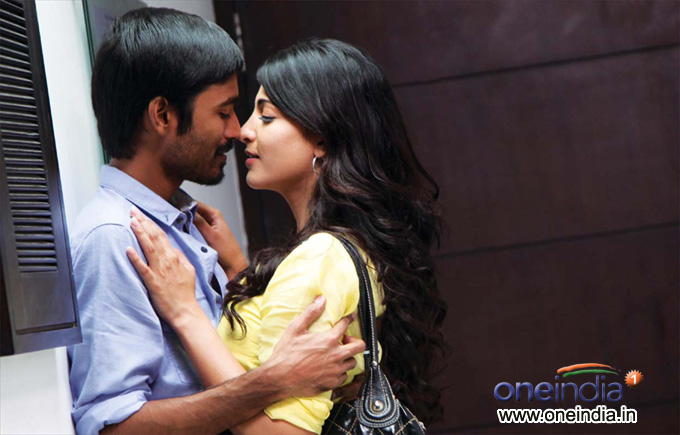
I’m a big Dhanush fan and since Shruti Haasan had impressed me in her last Telugu film, I was excited with the prospect of seeing them together in 3. In addition I wanted to see how Aishwarya Dhanush would approach her first film considering she had worked with one of my favourite directors, Dhanush’s brother Selvaraghavan on Aayirathil Oruvan a few years ago. The hype surrounding 3 since Kolaveri Di became such a hit seems likely to have been the reason that this was the fourth Tamil film to be shown here in Melbourne with subtitles and I really do hope that this trend continues. So it was with high expectations that I headed in to watch 3 and while the film as a whole didn’t quite meet them, the first half surpassed them easily.
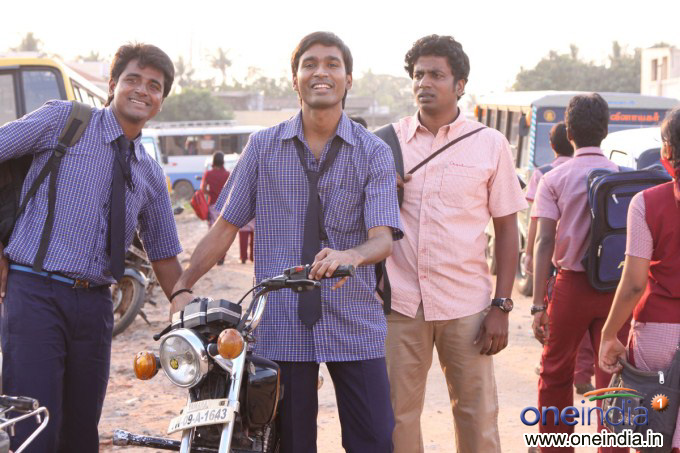
3 follows the lives of Ram and Janani who first meet while they are both at school and relates their romance through three stages of their life together. The two leads somewhat surprisingly don’t look too out of place in school uniforms and certainly with their attitudes and mannerisms they are convincing as high school students. But the real star of this part of the story is Siva Karthikeyan as Ram’s friend Kumaran. The interactions between the two friends are very natural and the dialogues between the two as Kumaran deals with Ram’s sudden infatuation are snappy and very funny. They had the whole cinema in stitches and it was fantastic to be able to understand and laugh along with the audience for a change.
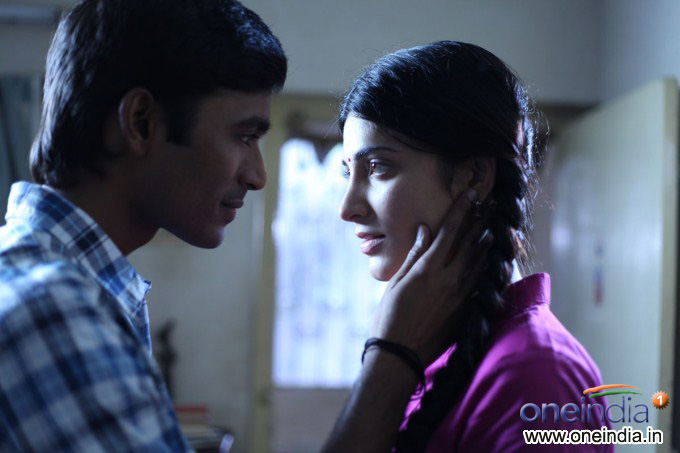
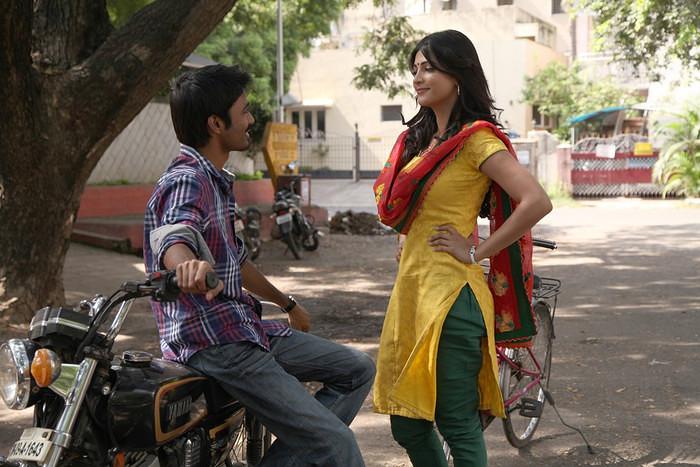
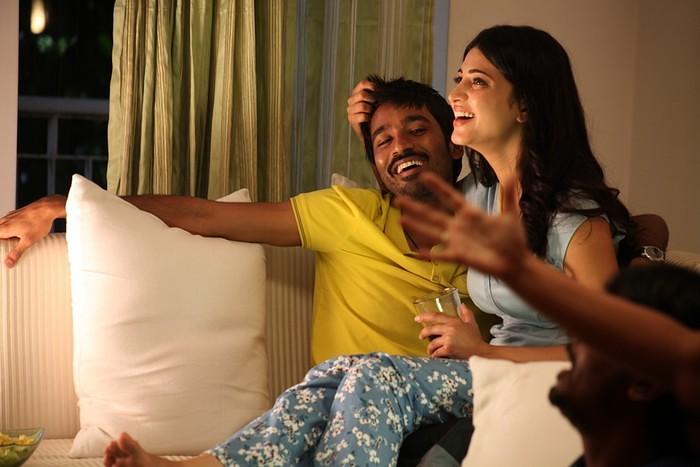
The love story progresses with the usual hurdles in the form of parents and familial expectation. Janani’s family are preparing to move to the USA and she has to deal with the prospect of leaving Ram just as she has realised her feelings for him. Shruti Haasan excels here as the young girl infatuated with her lover but struggling to conform to her family’s wishes and she finally makes a decision in spectacular style. The young actor playing her sister is also very impressive and overall the romance is beautifully developed. Shruti and Dhanush have great chemistry together onscreen and their relationship progresses very naturally. The interactions between Ram and his father (Prabhu) were also very genuine and well written with plenty of humour and a real sense of the sincere relationship between father and son.
However the promise of the first half doesn’t carry through to the rest of the film. I can appreciate that Aishwarya wanted to show a total contrast in the second half but it gets carried to extremes and the screenplay starts to drag as the melodrama goes into overdrive. The film starts with a dead body and Janani in mourning before moving into flashback mode, so we all know that there isn’t going to be a happy ending – well this is a Tamil movie after all, but the story just doesn’t make sense.
Janini spends most of the second half crying and Shruti Haasan is not an actor who can cry prettily, so the excessive amounts of sobbing become wearing very quickly. The assured and determined young woman of the first half totally disappears and while it is likely a much more realistic reaction it doesn’t make for such interesting watching. Kumaran has also vanished from the story and Senthil takes over as the concerned friend trying to help. While Sunder Ramu puts in a good performance his character is generally less convincing as most of his actions aren’t consistent with the family relationships shown in the first half. Dhanush puts in another amazing performance but it’s a role he has done shades of before in Mayakkam Enna and Kadhal Kondein so while impressive, it does feel a little overdone in the last scene. The general idea of the twist in the story is good but it seems let down by the over the top screenplay and some very dodgy medicine and ethics.
What does work well is the music. Anirudh Ravichander’s background score fits the screenplay very well and the songs are well placed within framework of the film. Kolaveri Di is certainly not as expected and although there are a few odd moments, specifically with a blonde tourist, it generally succeeds and adds a bright moment to the otherwise very heavy second half.
The first half of 3 is a delight to watch and for that reason alone I think it is worth seeing in the cinema. The support cast are all excellent and while Shruti Haasan does overact later on, Dhanush is as impressive as ever with a very convincing performance. The film is let down by an unconvincing and over dramatic second half but there is still much to enjoy. As a friend remarked on twitter, if only the second half had matched the first this would have been a perfect film. It’s still good, and an impressive debut by Aishwarya Dhanush, but it could have been even better.
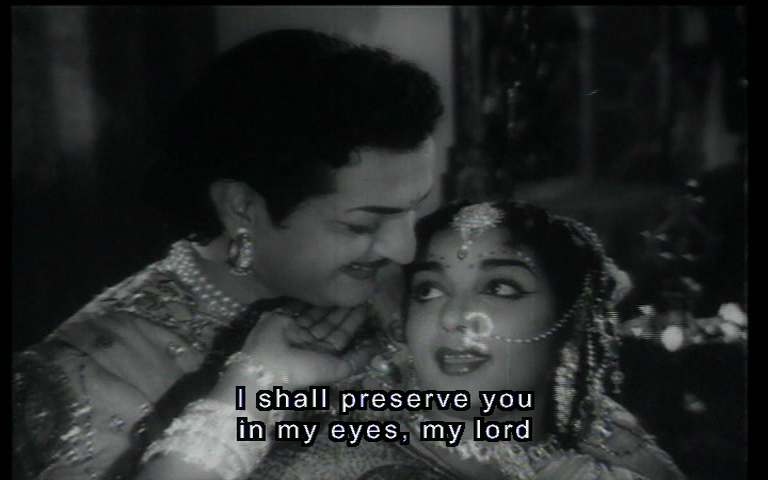
I love folk tales and fantasy in Indian cinema, and when they are combined with a theme involving eyes and blindness then that’s a combination guaranteed to make me watch. And Gulebakavali Katha doesn’t disappoint with plenty of eye references and fantastical scenes throughout. The story is reputably based on Madhira Subbanna Deekshitulu’s Kasimajili Kathalu which also provided the story line for Patala Bhairavi, although from time to time the story here reminded me of Jason’s quest in the Greek classics. It’s a fun film with the emphasis on the fantasy and NTR’s hero is dashing, suitably brave and self-sacrificing. The music is lovely and plentiful, and the sets and costumes are absolutely fabulous. There are excellent opening titles featuring an animated skeleton, and the story opens in the best possible way with a song featuring Geetanjali and Jyothy as dancers.
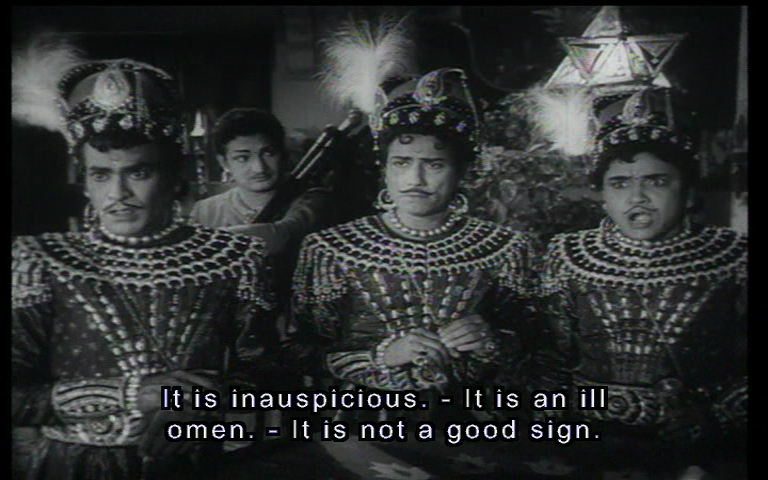
The storyteller introduces the tale of King Chandrasena (Mukkamala Krishnamurthy), his two wives and his wicked brother-in-law who is conspiring to take the throne. King Chandrasen’s first wife Gunavathi (Rushyendramani) falls pregnant after she is blessed by the goddess Parvathi. This makes his younger, second wife Rupavathi (Chayadevi) jealous even though Rupavathi already has 3 sons of her own. To make sure that her children will inherit the throne, Rupavathi plots with her brother Vakraketu (Rajanala Kaleswara Rao) to get rid of the baby and discredit her rival. With the help of the Royal astrologers, Vakraketu concocts a tale that the King will go blind if he sees his son. Not content with this form of banishment, Vakraketu then orders his soldiers to take the baby into the woods, kill him and bring back his eyes as proof of the deed. Of course it doesn’t go to plan and the baby ends up being rescued and brought up by a shepherd couple in the forest.
Rajanala makes an excellent villain here with his amazingly expressive eyes and appropriately evil laugh. His performance also provides a strong foundation for the story as he schemes his way towards the throne with the help of the treacherous army chief Dushtabuddi. He also has excellent moustache twirling skills!
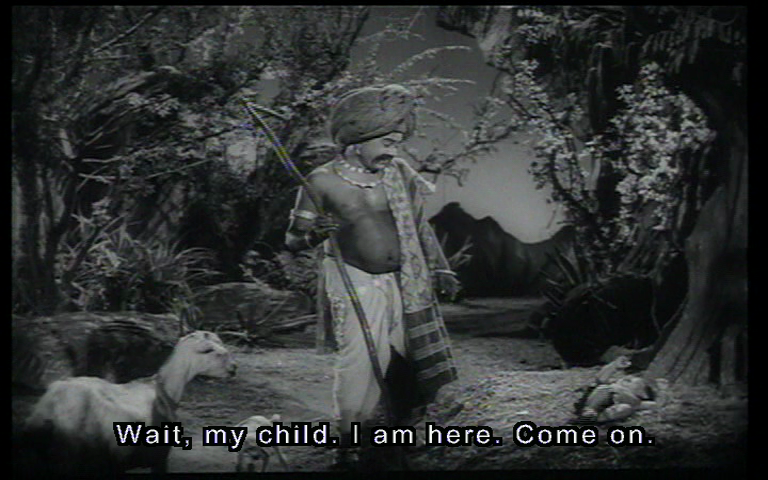
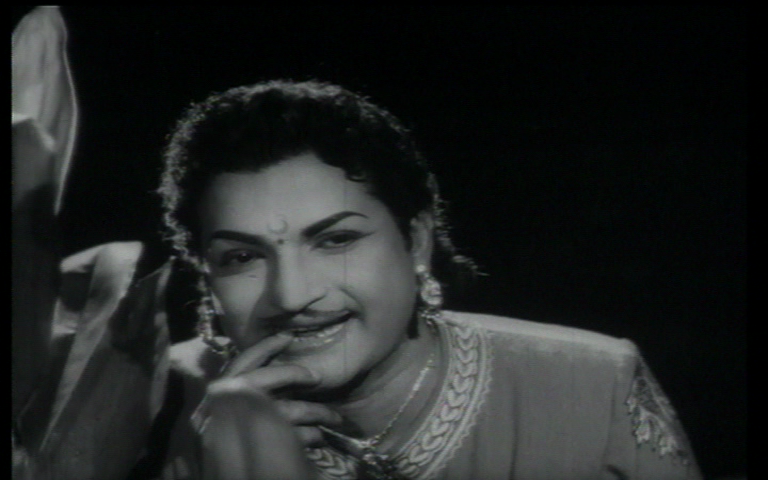
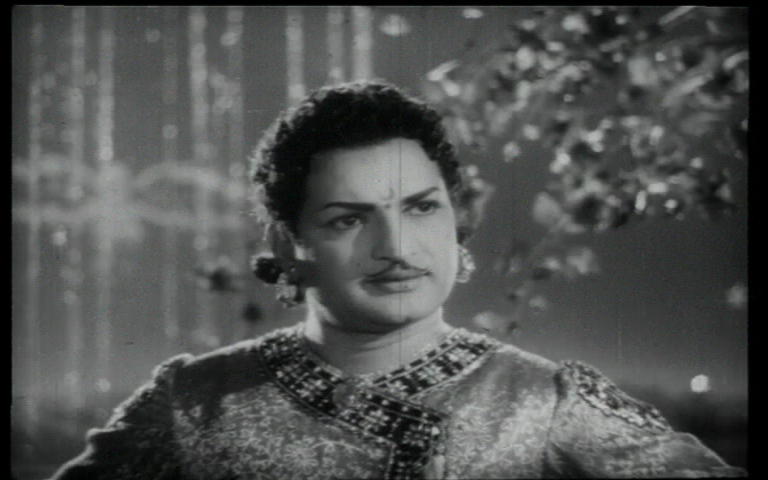
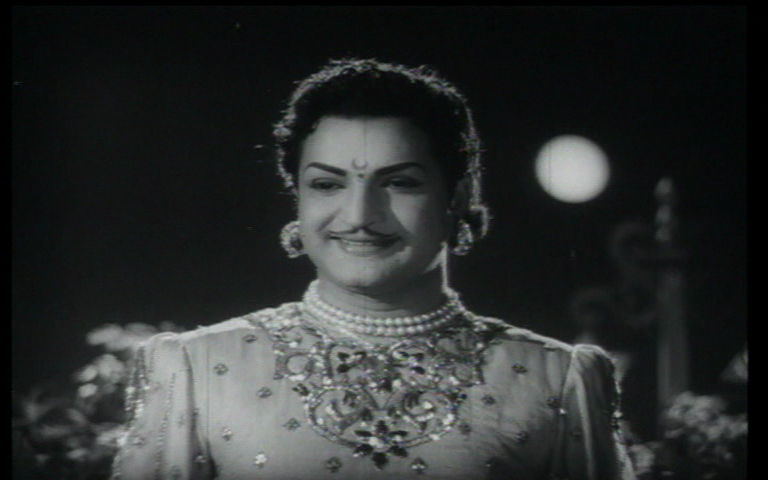
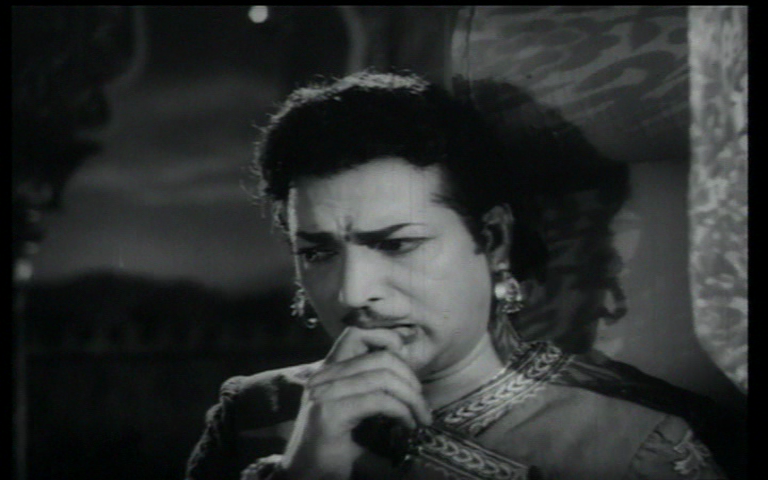
Meanwhile, as may be expected from someone who grows up as a goat-herder in the woods, Vijay (NTR) grows up to be a handsome well-spoken young man who has an amazing ability with a sword but no idea about his real parents. Despite his lowly start in life, Vijay is a man of principles and NTR gives him plenty of charm and humour to go with his bravery and spear throwing. He does look the part of the perfect fantasy prince and can look determined, puzzled, worried or intrigued as required.
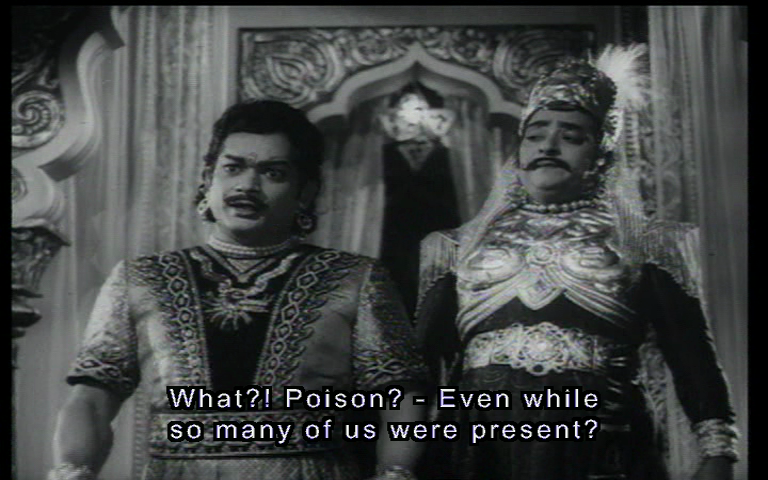
Now that Vijay is grown up and capable of thwarting his plans, Vakraketu finally decides to make his move on the throne by poisoning the King’s wine to destroy his sight. This happens to coincide with a hunting trip into the woods enabling Vijay to turn up just in time to be the last person the King sees before the poison takes effect, thus fulfilling the totally fabricated prophesy. While Vijay easily evades the soldiers sent to capture him he’s intrigued enough to climb up to the King’s lodge and discovers his heritage. After meeting his real mother, he sets out to discover the fabled Gulebakavali flower which will cure his father’s blindness.
Vijay’s three elder brothers have grown up to be complete fools under the influence of their uncle, but they also decide to search out the fabled flower and they provide much of the comedy throughout the film. Although they’re not particularly funny they aren’t too irritating despite the youngest brother’s incredibly squeaky voice, and they do have an important role to play as they cheat their younger brother later on in the film. The rest of the comedy is provided by Atitelivi (Balakrishna) who befriends Vijay and helps confound and defeat Vijay’s three brothers and by Vijay himself as he proves he has plenty of brains to go with his bravery.
On his quest for the gulebakavali flower Vijay has to overcome many challenges, and the first of these is in the form of a beautiful woman who has declared that she will marry the man who can beat her at dice. Yuktimati (Jamuna) provides plenty of glamour and looks stunning as she scams various rich men out of their wealth and takes them prisoner, although unlike Circe she doesn’t go as far as turning them into pigs.
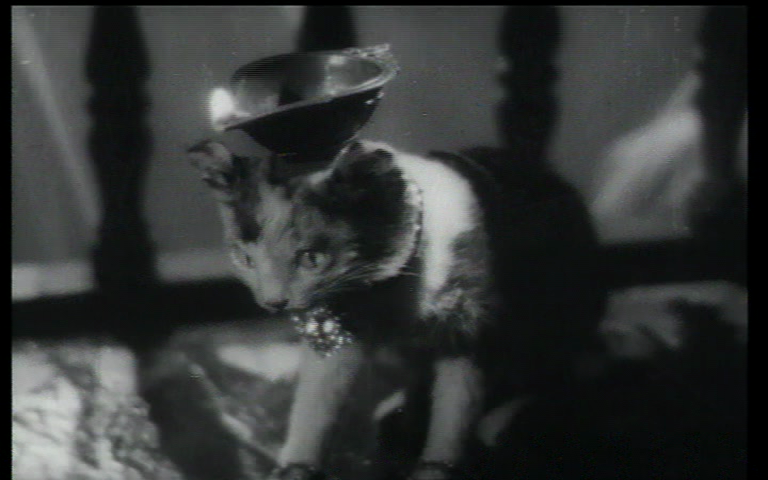
After his brothers succumb and are taken prisoner Vijay disguises himself as an old man and beats Yuktimati when he discovers her trick of using a mouse to distract her cat which serves as her lamp.It’s all rather silly and the cat and mouse are both obviously stuffed, but it’s a nice fairy-tale like idea and the song with NTR in disguise is excellent.
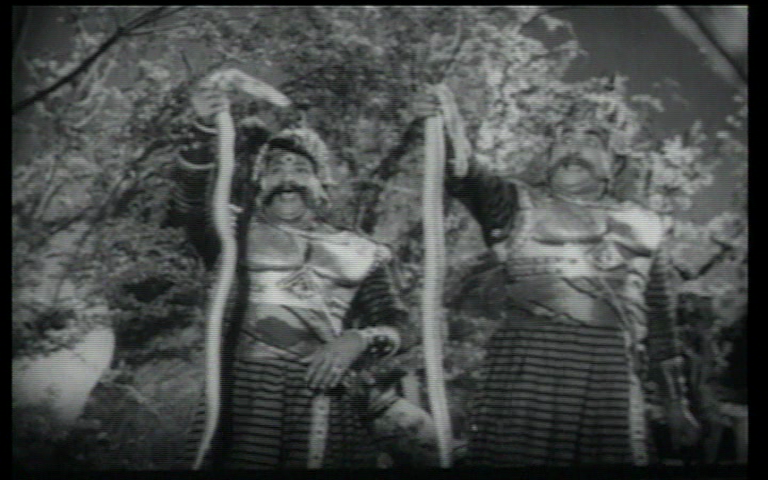
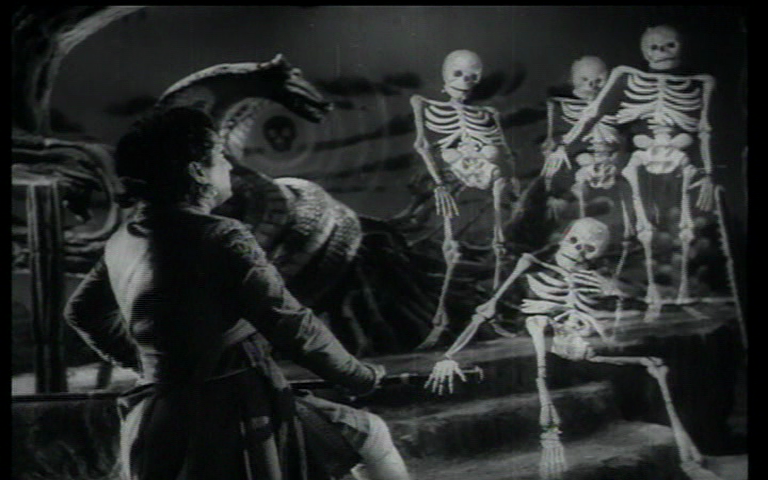
Despite beautiful women throwing themself at him, the search for the gulebakavali flower must go on and Vijay leaves his new wife to continue looking for the cure for his father’s blindness. He picks the scariest looking spot in the entire forest to go to sleep, so it’s not surprising that he is awakened by a skeleton that attacks him as the statue starts to breathe smoke, the moon sports a skull and there are bats and snakes in abundance. However it was all just a test and after proving his bravery, Shiva gives Vijay an enchanted jewel which will enable him to become invisible and reach the yakshaloka.
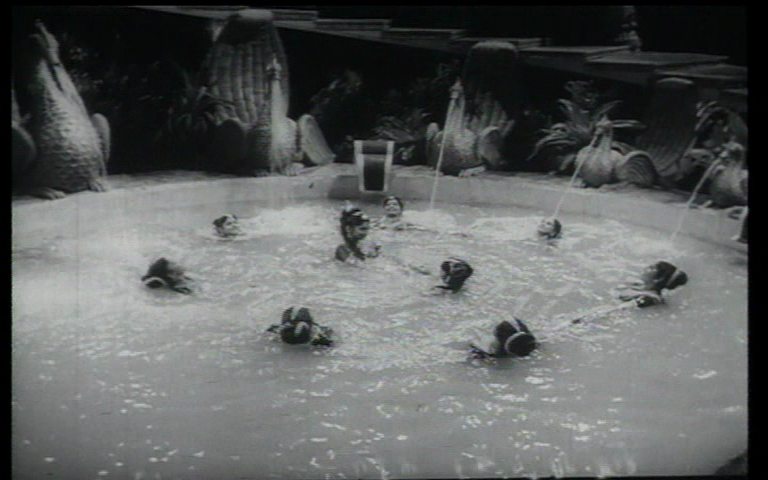
Once there he discovers the beautiful princess Bakavali and her entourage who guard the golden flower. The sets here are beautiful and as well as singing and dancing there is also synchronised swimming to enjoy. Peacock beds are obviously de rigueur for fantasy princesses and Bakavali has a rather nice example here.
Back on Earth with the flower Vijay meets treachery and betrayal and becomes progressively more unshaven and tattered which makes the resemblance between him and his grandson Tarak very obvious.
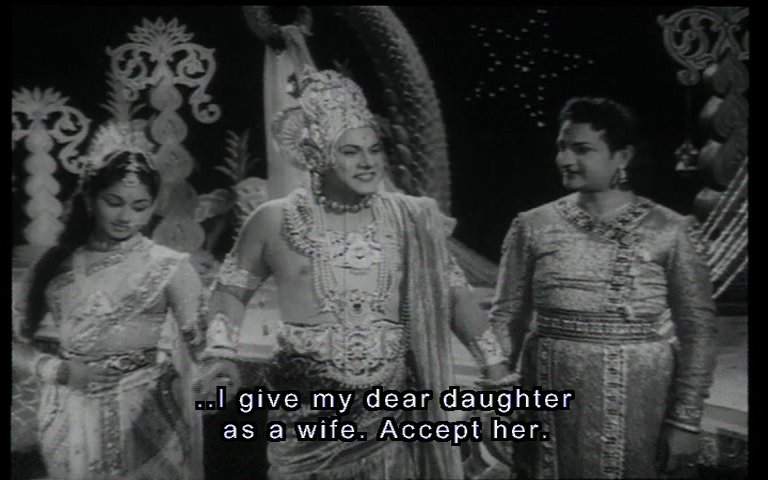
There are more damsels in distress to rescue and more fantastically gory eye scenes before Vijay adds a second wife to his collection by marrying Bakavali as well before heading home to save the day. Here are some more pretty pictures of the various beautiful women who all are happy to see Vijay, plus the elusive gulebakavali flower.
While Gulebakavali Katha follows a fairly standard fantasy theme with a heroic prince overcoming various challenges it’s all done beautifully with stunning sets and some very sparkly jewelry. There is enough humour in Vijay’s character that he doesn’t become too sanctimonious despite all his self-sacrifice, and he seems quite delighted at the various women who throw themselves at him. Jamuna has the best described role among the women as Yuktimati along with her chief handmaiden Asha and it’s a shame that they disappear from the story so quickly.
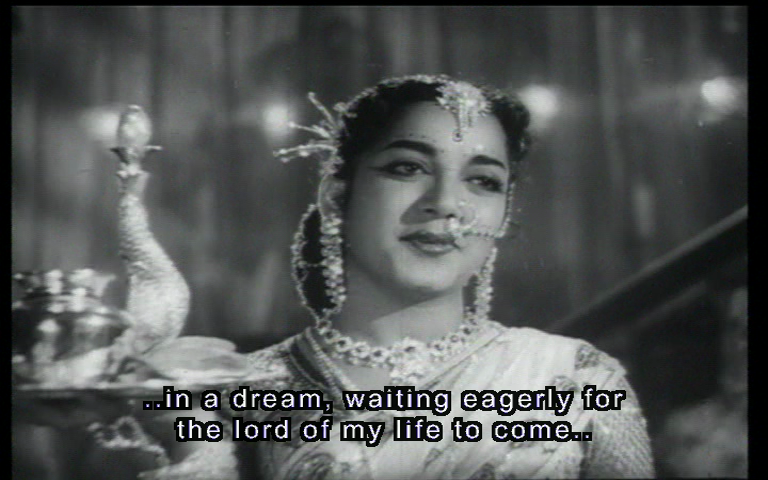
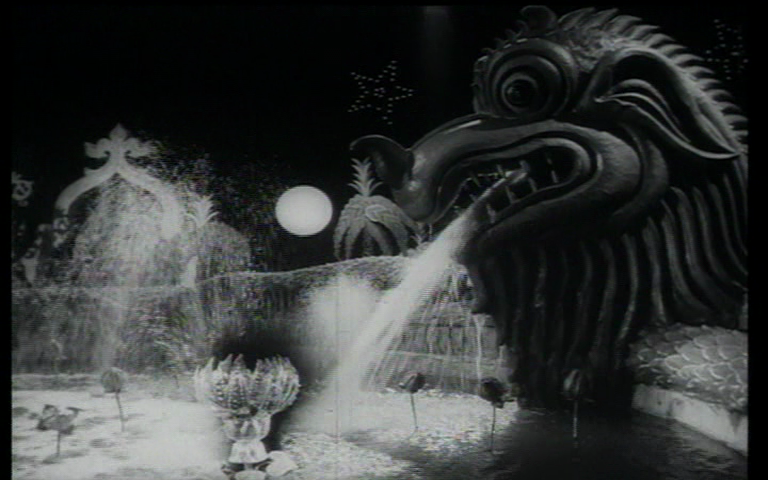
The effects are really quite innovative for the time and feature transformations, fighting skeletons and plenty of quite realistic eyes being thrown around. There is even a flying dragon as transportation although rather oddly it makes the same noise as is generally used for UFO’s. On reflection though, that perhaps does make sense! There are plenty of songs and some very beautiful duets although the mix of traditional songs and fifties ‘big band’ sound is occasionally a little strange. I really couldn’t decide which of these was my favourite, so here is a link to Nannu Dochokundavate with Vijay and Yuktimati, and below is Kalala Alalapai where Bakavali is dreaming of Vijay.
I really enjoyed this film as the simple story unfolds so smoothly and the whole film looks absolutely stunning. NTR makes a wonderful heroic prince and I love him in these roles, particularly with such excellent co-stars. The eye related theme is fantastic and so much fun without being overdone or used too heavily as a metaphor. I thoroughly recommend watching and as an added bonus, it is available with subtitles! 5 stars.
Temple says:
I tracked this film down after reading Minai’s excellent blog post. While I enjoyed it immensely, there are a couple of things that didn’t work so well and I wouldn’t put this quite at the top of my list of vintage Telugu fantasy.
After the great start with jaunty music and skeleton, the device of a story being told within the film detracted a little from the opening sequences. There was a bit too much telling via voiceover and not enough getting on with it. I don’t particularly care for the intrusive narrator in films, unless we are talking The Princess Bride, as it can be distracting and can break the rhythm of the story. While it was intended to convey the folktale flavour, I think just showing the events happening would have been better. Heather has pretty much retold the whole plot, so I won’t go over my favourite episodes, but there are lots of obligatory folktale challenges and obstacles, all solved in a stylish and heroic manner. But while there is a lot happening, and lots of characters coming and going, this felt like it was plodding along at times where it should have had more zing.
Maybe that is because there just isn’t enough dancing for my liking. Compared to other favourites of mine like Patala Bhairavi, Bhookailas (featuring Helen!) and Jagadeka Veeruni Katha (with the peppy L Vijayalakshmi as a snake goddess), this film is a bit light on for songs and dances. The music is very pleasant, and slightly eccentric at times, but I can’t recall most of the melodies now while I can immediately think of songs from the other films. Clearly I need the sparkly dance outfits and choreography to make me remember.
NTR has a romantic melting eyed look that suits the princely characters but is physical enough to be the heroic warrior or goatherd as the case may be. I can see why he is synonymous with this genre – it is just perfect for him. I’m quite fond of Balakrishna too so I enjoyed his contribution to the comedy and confusion. And the ladies all look stunning and suitably fairytale princess inspired, which for the most part is all they need to do. The costumes and jewellery are typically lavish and beautifully filmed.
The fantasy genre is something I think Telugu film makers excelled at in the 50s and 60s. Regardless of whether the inspiration was folktale, mythology, history or religion there is an abundance of delightful films that combine beautiful visuals with a sense of wonder and whimsy. But while I like Gulebakavali Katha, I prefer the more sprightly energy and derring-do of the other films I’ve listed. (Although this film has NTR plucking his eyes out, I don’t think anything can top him cutting his own head off in Bhookailas. Terrible pun, sorry!) It is well worth a watch but there are other films in this style that appeal to me more. A small deduction for the slightly draggy start, and the missed opportunity for more dances. 4 stars.
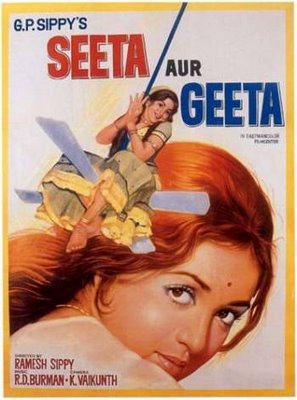
Seeta Aur Geeta is a classic dual role movie so common in Bollywood, but for a change it’s the heroine who has the double part to play and Hema Malini excels as both characters in this tale of separated sisters. This is my favourite film with her as she flawlessly provides drama, action and comedy and looks totally stunning throughout. It’s a pleasant change to have a heroine-centric film and although Dharmendra keeps trying to sneak a piece of the action, Hema always gets the last word. You go girl!
The film opens by explaining how the twin sisters get separated at birth and brought up by different families. But there are no mystical songs, lockets or other identifying objects needed because the two just happen to be identical, which means of course that there will be confusion between the two when they grow up.
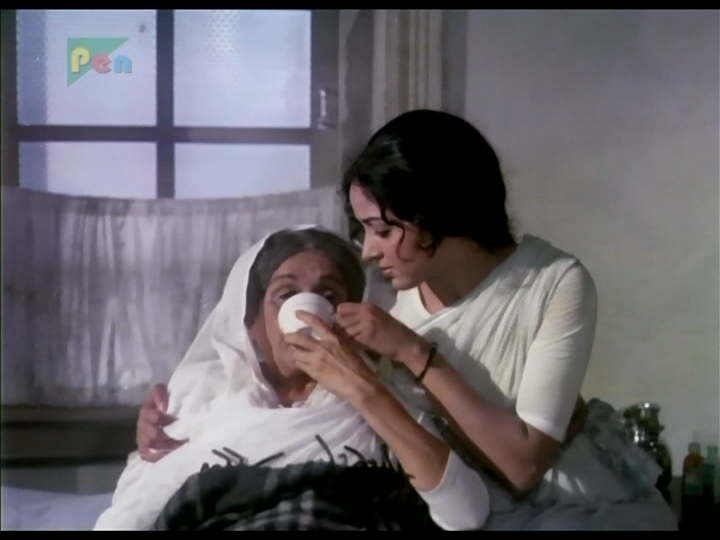
First of all we meet Seeta and her family. Her parents are dead and Seeta is living with her Aunt Kaushalya, Uncle Badrinath and their two children. Also living in the house is Kaushalya’s brother Ranjeet (Roopesh Kumar) and Seeta’s grandmother.
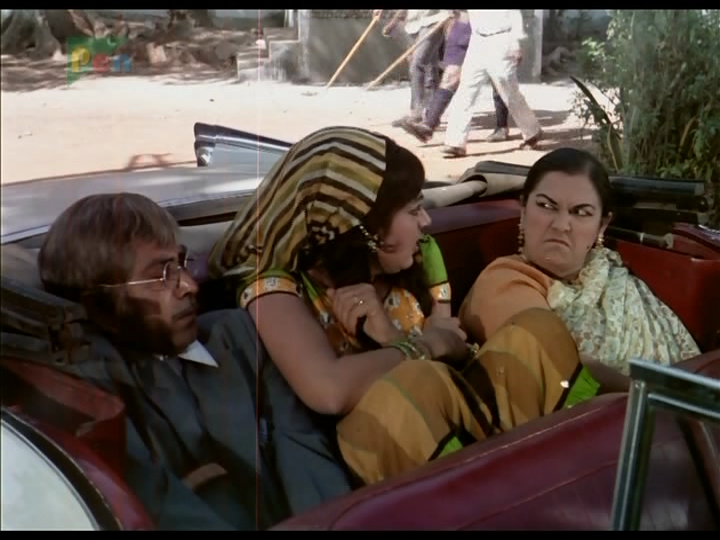
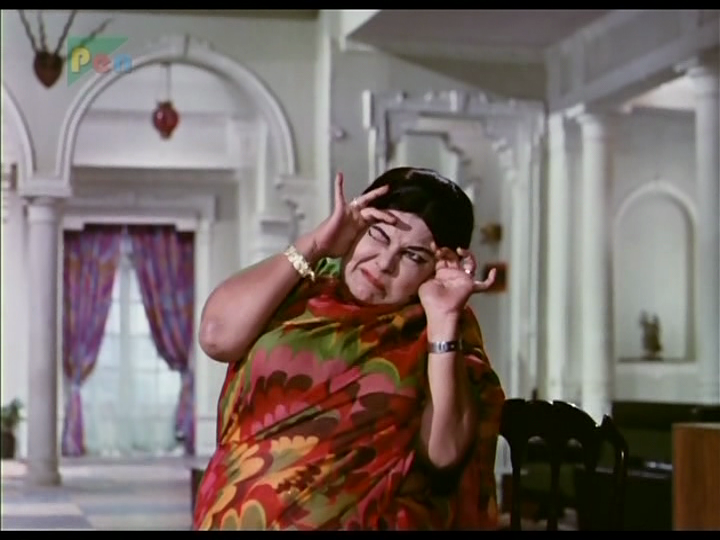
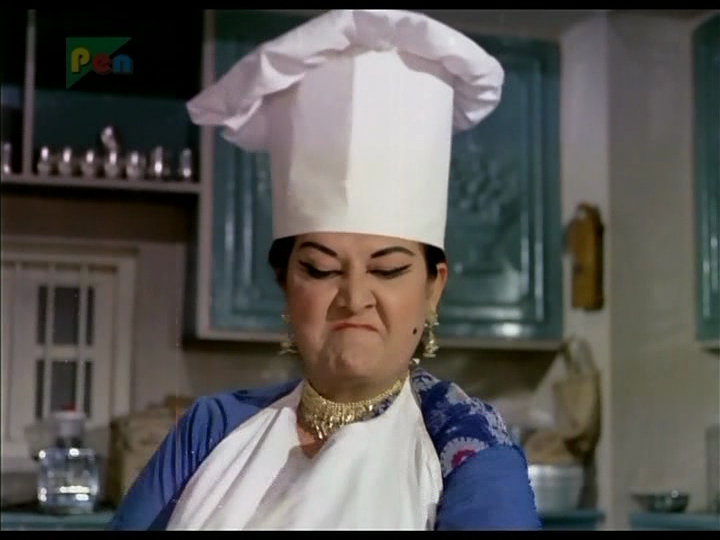
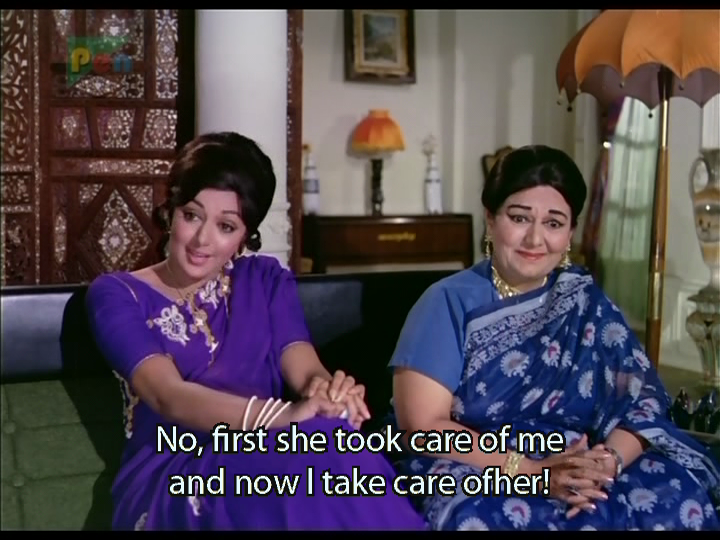
Kaushalya and her daughter Sheila treat Seeta as a slave and she is constantly abused and overworked. Seeta is the weak-as-water type of heroine I usually want to slap and tell to pull herself together, but since her rather pathetic and hopeless character is the whole point of this part of the film, I can live with it. Anyway, the focus at this point is much more on Kaushalya who is the best wicked aunt ever. Manorama is outstanding in her role as Kaushalya and has the best selection of grimaces I have seen outside of a gurning competition. Here is just a selection of some of her expressions which she uses to excellent effect.
Honey Irani appears in front of the camera in one of her first roles as an actress playing the mean and spoilt mommy’s girl Sheila. I love the way she stands and screams as an iron burns her sari rather than just lifting out a hand to move it away. She really does seem to believe she is the delicate flower her mother calls her and she wonderfully nasty towards her cousin. Ranjeet is appropriately sleazy and obviously the villain once he turns up in a selection of increasingly bad shirts and terrible scarves.
After Seeta’s trials and troubles have been established we are introduced to Geeta. What a difference! Seeta is introduced in a scene where she is scrubbing the floor and her evil aunt is yelling at her. Geeta is introduced by a song – upbeat, full of life and fun, it’s an apt description of Geeta and her outlook despite her humble status.
Geeta lives with her mother and works as a street performer with Raka (Dharmendra) and Jhumroo (Master Ravi). She’s loud, vivacious, a bit of a crook and nothing at all like her twin sister. There is much made of the differences between the two: Geeta’s fiery nature and her loving relationship with her mother for example, compared to Seeta’s meek obedience and her constant craving for her lost parents. It all sets the scene for the inevitable switch between the two sisters.
After further abuse and inappropriate attentions from the slimy Ranjeet, Seeta finally escapes from the house and Kaushalya reports her as missing to the police. However Geeta happens to be at the local police station where she is ‘recognised’ as the missing Seeta and picked up by her ‘aunt’ and ‘uncle’.
On the way home Geeta decides she doesn’t want anything to do with the crazy fat lady and escapes, ending up hiding in a car with Dr Ravi (Sanjeev Kumar) in a coincidence that is only ever possible in Bollywood. Dr Ravi has already met Seeta as a possible marriage candidate and at the time wasn’t impressed at the way Kaushalya presented her niece, but he finds the new ‘Seeta’ intriguing and the two end up falling in love.
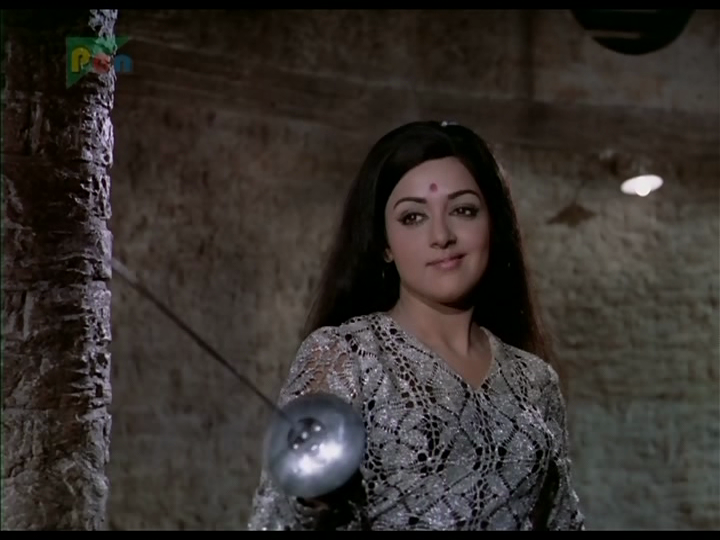
Since she feels sorry for the grandmother, Geeta ends up back in the mansion living with Seeta’s family, but she doesn’t appreciate the idea of being their servant and certainly won’t put up with any abuse. It’s a shock for everyone in the family when their previously docile slave lashes out and forces everyone else to work instead. Geeta is hilarious as she pretends to be Seeta and turns the tables on Kaushalya and Ranjeet. There is so much to laugh at, but also plenty of drama and a good balance between the two. It all works so well because of the excellent performance by Hema Malini as the two different sisters. Geeta is a strong and determined character and Hema conveys this resolution with body language and expression just as much as by the dialogue. Seeta is quieter and more submissive, keeping her eyes downcast and her voice softer, but in her own way is just as determined to get what she wants once she breaks free of her restrictive family. It’s hard to believe that no-one seems to question the identity of the two sisters, especially since Hema makes them two very different people but no-one ever seems to consider the possibility and that allows the chaos to continue.
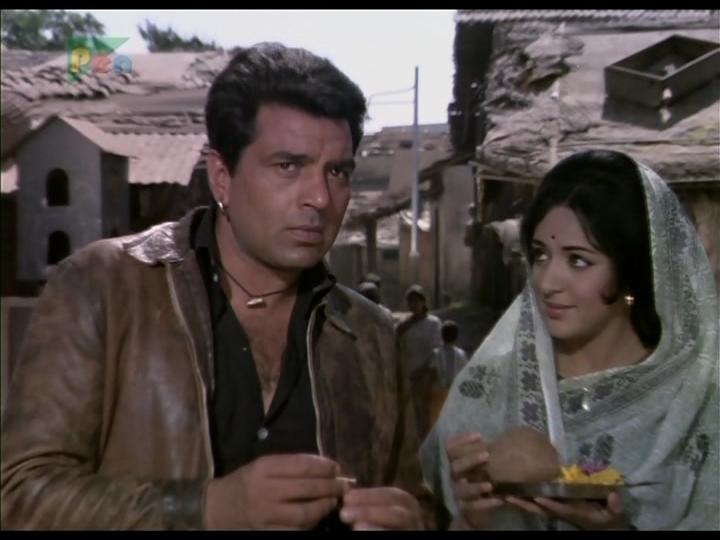
While Geeta is busy reforming Seeta’s family, Seeta is found by Raka who naturally thinks she is Geeta and takes her back to Geeta’s foster mother Leela (Radhika Rani). Seeta blossoms with the love of her new ‘mother’ while Leela is amazed to have a daughter who can cook, sew and volunteers to visit the temple.
Despite her abysmal attempts at street performing, Raka falls in love with Seeta while for no real apparent reason, Seeta falls in love with him. Although to be fair he is probably the first person she has met who is as self-absorbed about his orphan status as she is, and their shared misery does create a bond. Their wedding is set, as is Geeta’s to Dr Ravi but of course the path of true love never runs that smoothly and there is still the confusion between the two sisters to sort out. Although Raka tries to save the day, in the end it’s Geeta with a little help from her sister who proves that anything a Bollywood hero can do, a heroine can do even better. It’s all totally crazy, over the top and Hema seems to have an excellent time beating up all the bad guys in the fight scenes.
The cast here are all excellent and they are perfectly cast to fit well into their roles. Sanjeev Kumar is effortlessly charming and debonair as Dr Ravi. His assertion that he wants a good Hindustani girl as his ideal wife did make me groan, but despite his initial statement he doesn’t seem to mind when Geeta dresses in more Western style clothes and he positively encourages her to go roller-skating (which may actually be something that good Hindustani girls do considering the number of times it happens in films). I’m often quite ambivalent when it comes to Dharmendra, but since he is rather overshadowed by Hema Malini and his over acting goes almost totally unnoticed beside the caricature of Kaushalya, I really enjoyed his performance. Both Pratima Devi as the long-suffering grandmother and Satyendra Kapoor as Kaushalya’s hen-pecked husband provide excellent support, as do the various other members of the cast. But it’s Hema and Manorama who are the two essential elements to the film and their scenes together still make me laugh every time.
The music is by R. D. Burman and his songs are lovely and well-integrated into the story. Asha Bhosle and Lata Mangeshkar provide beautiful vocals for Hema while Kishore Kumar and Manna Dey provide the male voices for Sanjeev Kumar and Dharmendra. The songs are all pictured on Geeta rather than Seeta which is perhaps a shame, although there is one solo song with Dharmendra which works well. I love this famous song with Geeta pretending to be drunk to dissuade Dr Ravi from marrying her. It’s funny but very sad too and while Hema is excellent, Sanjeev Kumar provides excellent backing for her drama.
Javed Akhtar, Satish Bhatnagar and Salim Khan have done a great job adapting the ‘Prince and the Pauper’ storyline to suit a Bollywood audience and the dialogue is well written and very funny. Director Ramesh Sippy keeps everything moving along and despite knowing the switch is going to happen he still builds plenty of suspense into the story. This is a total Bollywood classic for me – great performances, good songs and excellent comedy, all delivered with such style by Hema Malini. I absolutely love this film and I’ve lost count of the number of times I’ve watched it. A full 5 stars!
Temple says:
I like Seeta aur Geeta, but I don’t love it. I first saw it several years ago and I really liked it at the time. I’ve watched it a couple of times since, and each time I enjoyed it a little less and fast forwarded a little more. I can’t quite warm to Hema Malini, Sanjeev Kumar is not my idea of hero material and I lack the Dharmendra Swoon gene. So it all comes down to the story and the characters.
I really like the way the story plays with the masala tradition of twins separated at birth, and there are lots of fun moments as Geeta impersonates Seeta. But it does drag on a bit once the twin swapping starts, and Seeta is such a wet dishrag that I get restless whenever she is at centre stage. Geeta is more lively but as with so many filmi heroines, she can only get a husband when she pretends to be something else – in this case, a demure young lass like her sister. So that detracts from the ‘you go girl’ mood as it turns into ‘you go girl and put on a nice sari and a long-sleeved high-necked blouse’. I also found the roller skate scene stupid and not in a good way – Geeta was a tightrope walker and acrobat and all of a sudden she can’t work out how to balance or control her body? Yes she was on wheels, but it was just a lazy way of asserting the hero’s superiority when there was no real need. Kickarse girls can only kick so much before decorum demands they are put in their place. And then to have Sanjeev Kumar as the vision of young love…oh dear. The romances didn’t grab me in the slightest as neither couple seemed to be well suited or even mildly interesting. There wasn’t really enough of a threat or menace to keep the dramatic tension either, as most of the ‘bad’ characters were more slapstick than villainous.
Overall, I like this enough to say see it as a good timepass. It’s colourful, the music is pleasant although I don’t think it’s great, the mood is generally upbeat (apart from all the attempted rapes and beatings). But it’s not a film that rewards repeated views and there are many other masala favourites I would rather see again. 3 stars.






















 Cinema Chaat