Raman Raghav 2.0

Anurag Kashyap’s Raman Raghav 2.0 takes us into a cat and mouse game between coked up cop Raghavan (Vicky Kaushal) and self-possessed serial killer Ramana. There are no heroes here, in a Mumbai that is more like a jungle peopled by predators and those who so easily become their prey.

Anurag Kashyap has never struck me as a wallflower, and his style is as much a feature of the film as his actors. There is a lot of technique out on display and the stylised effects actually do work pretty well with the action and narrative. When Ramana describes his thinking there are often sound effects like rain, or static, that make it seem like a genuine recollection but also that his imagination is his reality.  Kashyap supposedly employed guerrilla filming tactics to shoot his story out in the city, and very occasionally you see an extra execute a nice double take. The colours, the lighting, the ambient noise, it all says Mumbai and reminded me that every mega-city is a collection of villages. There is a real tension in some of the chase scenes that is as much “will they make it down that street in one piece” as it is about the story. I get why he used the chapter structure to string together disparate scenes and save on explanation, but they are a bit annoying and really don’t add anything other than exposition. I was more invested in following the characters than being hit over the head with the intent of the next section.

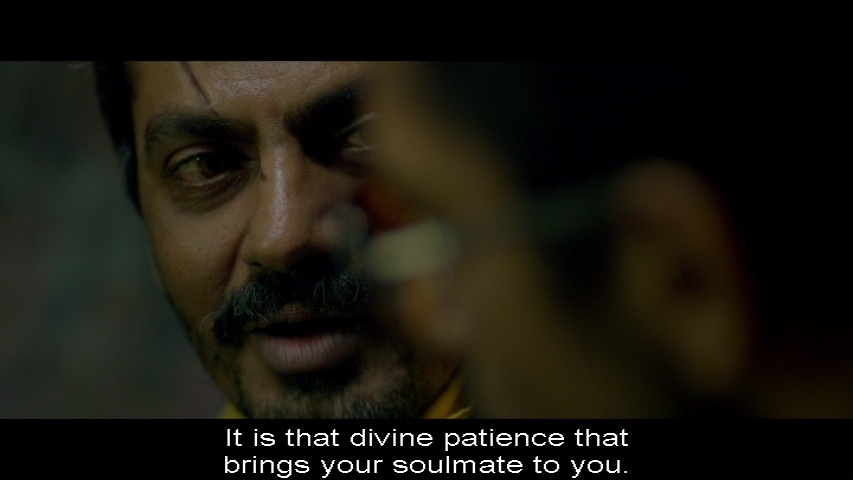
Nawazuddin Siddiqui is that terrifying movie bogeyman – a mild mannered, unremarkable, serial killer. His performance gives Ramana a menace and intelligence that helps gloss over some of the less plausible moments. Scenes that appear to be him reacting to something can later be seen as a rehearsal or test for how to get the desired reaction. He has a casual brutality driven by a rigorous inner logic, with a touch of religious mania. He seems to be guided by cats more than is good for a sane man. Ramana’s Mumbai is part forest and little shacks, not many people around him at times, and part concrete jungle. He is matter of fact and almost seems to expect people to agree with him that they must be punished. When he tracks down his sister and finds her recollection of events not to his liking, he cannot let that go by. His scenes with Raghavan are particularly mesmerising as Nawaz the actor and Ramana the character each play with the onlookers emotions and logic. His final scene with Raghavan was sick and creepy and yet held a sweetness that implied redemption had once been possible, perhaps. Kashyap should be thanking his lucky stars he got Siddiqui to star as I can’t imagine another contemporary actor being so prepared to show such unapologetic darkness, and making it look exquisite.

Vicky Kaushal is the coked up cop Raghavan. He disregards Ramana’s hints that they have seen each other before and leaves him as a harmless nut job to be scared off. He is on his own downward spiral, and there is no end in sight. Raghavan doesn’t seem to have a single honest or healthy relationship in his life. Like Ramana he believes he knows best and that whatever he does is somehow sanctioned. Raghavan is a nasty piece of work but I never felt drawn into his inner world the way I was with Ramana. Vicky Kaushal relied more on external expression of his turmoil – the sniffing and irritability that went with his habit – than showing the demons driving him. I rarely felt much connection with Raghavan as a person. I could easily detest him but I couldn’t really invest in his fairly predictable journey.

His sort of girlfriend Simmy (Sobhita Dhulipala) tolerates his behaviour although I really don’t know why. He makes it clear she is there for sex not forever, and he certainly doesn’t care about any consequences of their relationship, but she doesn’t seem to take his aggression and threats seriously. Sobhita is convincing with her party girl ennui and casual acceptance of Raghavan’s violent side. If only Simmy also had better attention to self-preservation. Some of the women in the film exhibit what could be called non-traditional values, and I couldn’t help but notice that none of them comes through unscathed. It’s a high body count film so that is not inconsistent, but I wondered why female sexuality had to be the trigger for punishment so often. I spent a fair amount of my viewing time urging the women in it to RUN.

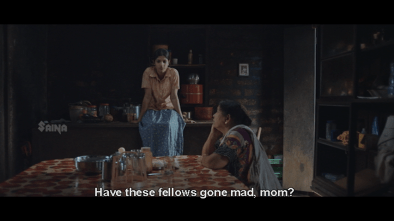
The rest of the supporting cast play the friends, family, cops and robbers of this world. They’re all good but very much pushed aside by the two lead characters. I particularly liked Amruta Subhash as Ramana’s sister Lakshmi, and Mukesh Chhabra as the wishy washy loan shark.

Raj Sampath’s score is driving and percussive for the most, underpinning the tempo of the city and the chase. The songs are obligatory rather than necessary but do speak to the characters inner state. And there are some nice touches as when the romantic music wells as Ramana explains to Raghavan that he is his soulmate. It’s a twisted but seemingly genuine love at first sight.
Whenever Nawazuddin is on screen I felt a chill. Unfortunately too much directorial faffing around to try and look cool drained the film of tension, and Vicky Kaushal wasn’t able to overcome either a compelling co-star or an underwritten role. 3 stars.

Maheshinte Prathikaaram

maheshinte-prathikaaram-poster

Maheshinte Prathikaaram is the début film from Dileesh Pothan, who has previously worked as an actor and as an assistant director on a number of Malayalam films. The experience has stood him in good stead as Maheshinte Prathikaaram is a well-crafted and entertaining film with a good balance of drama, comedy and romance. Screenwriter Syam Pushkaran has based the story on true events in his home town, building a simple tale of revenge into a more complex plot with plenty of interesting characters and situations. Fahadh Faasil stars and is excellent in the lead role, but the support cast are also good and with Shyju Khalid’s superb cinematography and Bijibal’s steady hand on the music, Maheshinte Prathikaaram is well worth a watch.

Mahesh Bhavan (Fahadh Faasil) is a photographer in Kattappana where most of his work involves taking passport photographs with a well-rehearsed spiel, although he does occasionally attend weddings and funerals and other such functions too. He’s a generally happy bloke, if rather quiet and somewhat set in his ways, possibly because he lives with his ageing father Vincent (K.L. Antony Kochi). Fahadh Faasil is always excellent as an ‘average bloke’ and his performance here perfectly captures the day to day life of a small-town businessman with plenty of details that ensure the character has plenty of charm. It’s the small touches that resonate so well, such as his bathing in the river, feeding his dog or fishing pieces of egg shell out of the bowl when he is cooking. Mahesh is a well-developed character and as such it’s easy to understand why he behaves the way he does for most of the film.

Mahesh is in love with his childhood sweetheart Soumaya (Anusree), but due to her job they only meet occasionally. When Soumaya returns home for her grandfather’s funeral her father approaches her with a marriage offer from an NRI living in Canada. He has a good argument too – presenting the offer to Soumaya when she is washing clothes the old-fashioned way and asking her if she wants to stay in the same town all her life, or if she would prefer a more comfortable life overseas. Soumaya’s indecision is beautifully written and it’s obviously a difficult choice for her, but finally she decides to follow her head rather than her heart and end her long-standing relationship with Mahesh. There is much here to enjoy, from the way Soumaya realistically agonises over what to do and her method of finally breaking the news to Mahesh, to Mahesh’s stoic acceptance, his appearance at the wedding to reassure Soumaya and his despair when alone. The relationship and the two characters are well portrayed to ensure the situation is kept believable but light without dipping into melodrama.

At the same time, Mahesh is dealing with the day-to-day running of the studio, helped by his father and his friend Baby Chettan (Alencier Ley Lopez). Baby runs a printing shop adjacent to the photography studio and has a good relationship with both Mahesh and his father. Baby is assisted by Crispin, aka Crispy (Soubin Shahir) and between them Baby and Crispy share most of the comedic dialogue in the film, although the rest of the cast also add some humour as the story progresses. Thankfully, instead of relying on slapstick and crude jokes, the comedic dialogue here is often subtle and relies on the characterisations carefully built up in the preceding scenes for its full effect, while overall the comedy fits perfectly into the main narrative. It’s effective and genuinely funny too, although I suspect I still missed a lot due to relying on the subtitles.

Events become more serious when Mahesh is involved in a fight with Jimson Augustine (Sujith Shankar) and loses badly. The build up to the fight is one of the best scenes in the film, as is the end where, in a move to save face, Mahesh vows to stop wearing his chappals until he has revenged himself on Jimson. However by the time Mahesh discovers exactly who is his nemesis and that he works as a welder, Jimson has moved on to Dubai for work. Rather than back down however, Mahesh continues to go barefoot, although there are times when it looks as if he regrets his vow, particularly when there doesn’t seem to be much chance that he will achieve his objective of revenge any time soon.

Mahesh also takes a hit professionally as his attempt to take a studio photograph for university student Jimsy (Aparna Balamurali) is less than successful with Jimsy ridiculing his work. However, her comments inspire Mahesh to stretch his photographic skills and in the process, he falls in love with Jimsy too.

Although initially the character of Jimsy is irritatingly brattish, she redeems herself later, turning out to be a pleasant young woman with a good understanding of how to nudge Mahesh out of his comfort zone. She’s frank and unafraid to speak her mind, and Aparna does a good job of ensuring her occasionally prickly character is still friendly and approachable when appropriate. She’s good in the more romantic scenes too, although here again her character is refreshingly down to earth and pragmatic. Plus any film with a flashmob scene wins my approval!

The entire concept of the fight and Mahesh swearing not to wear shoes until he has his revenge seems incredibly juvenile to me, but I can see that Mahesh feels his masculinity has been questioned by his defeat. Mahesh is not a natural fighter and has never been in trouble before, so his resolution to beat Jimson does make sense, even if the concept of a rematch seems a fairly pointless way to demonstrate he can fight. Sensibly, he responds by taking karate lessons and although they may not help much when it comes to fighting Jimson, at least it gives Mahesh something to do while he waits for his nemesis to return. I love that Jimsy and her mother appear to have the same opinion as me about the potential rematch, while Baby Chetan and Crispy are rather more encouraging, although they too try to persuade Mahesh to start wearing shoes and forget all about Jimson.

Maheshinte Prathikaaran

The story flows well and the blend of comedy, romance and drama ensure that there is never a dull moment. The film looks beautiful too with gorgeous shots of the Idukki region and local wild-life, even on the rainy days which seem to be the most common.

The songs and background music are also well suited to the narrative, adding more light and shade to the story. With excellent performances from all of the cast, particularly Fahadh Faasil and Alencir Ley Lopez, and a funny but still insightful screenplay, Maheshinte Prathikaaram is a refreshingly different and thoroughly enjoyable movie. 4 stars