Rudhramadevi (2015)

Rudramadevi-Posters-2

If Rudhramadevi had been made in 1956 I’d have loved it, no question. But Gunasekhar struggles to realise his grand vision and the ripping story drags at times. The main cast give their all, but they can’t compensate for some poor directorial decisions and sloppy execution.

The first thing that hit me was the VFX. I thought it was maybe a deliberate stylistic choice as there are animated montages that look like a childs picture book. But it is just shonky quality, used too liberally, and with poor judgement. At least it distracted me from wondering what Marco Polo’s stuck on beard was made of. And why Marco Polo was in the film.

The story is so interesting this should have almost written itself. A girl is raised as a boy and keeps up the pretence to protect her kingdom for as long as she can. But Gunasekhar spends far too much time with the various enemies and uses loads of clunky “As you know Bob” exposition. I felt that there were some holes in the film and Gunasekhar was trying to paper over those gaps with other techniques including a Mega voiceover and a peasant who announced every new character with bio as well as voicing the people’s dissatisfaction with their rulers.

Anushka owns every frame she is in. She adjusts her posture and facial muscles so there is a clear distinction between Rudradeva and Rudhramadevi and is convincingly commanding. She has some weird darkening makeup on as a boy, but it does allow her to look stunningly radiant when she girls up.

Her closest female friends are Nithya Menen as her wife Muktamba and Catherine Tresa as The Other One Who doesn’t Wear Much, and there is a lightness and ease in the way Anushka moves as she drops the pretence and heavy armour undershirt to dance in the “Yay! I’m a girl” numbers. She did her damnedest in the tandav but while her expressions told a powerful story, her dancing was not as compelling. Rudhramadevi used Veerabhadra’s feelings for her to get him back on task, but she evinced far more concern about Muktamba’s reaction and wellbeing. That ruthlessness and emotional intelligence wasn’t really explored and I felt the film needed to reveal how she ruled, not just show a sequence of events.


I put that clip in just for some shirtless Rana. He looks so chuffed when he is prancing almost in time.

Rudramadevi-Rana Anushka

I knew a “Zorro” moment was nigh when Rudradeva wore a blue tunic done up with pink princess ribbons, and the gender reveal is a bit ho-hum. Veerabhadra took the whole “Dude, you’re not a dude” revelation quite well, all things considered. There is little sexual chemistry between Rudhramadevi and Veerabhadra, but the actors have a nice rapport, like childhood friends. I enjoyed moments like when Rana playfully tweaked Anushka’s nose as he said goodbye. While the writing skimmed the surface of characters emotional lives, the actors added their own flavour.

Gona Ganna Reddy (Bunny) and his horse seem to have ridden in from a different film; something more gothic perhaps or even a KPop music video (Jaejoong’s stylist may be moonlighting as a Telugu horse costume designer).  Bunny plays his character as unrelentingly dour and with one facial expression, but his one liners got the audience cheering. And he rarely blinks. It’s intense and unsettling after a while.

Rudrama Devi Posters

The support cast is huge. Hari Hara Devudu (Suman) and Murari Devudu (Aditya) are the Statler and Waldorf of villains. They sit back and critique everyone else but rarely do anything themselves, unless you count letting their allies die horrible deaths. Their brother Naga Devudu (Baba Sehgal) shows commendable willingness to really go for the snake theme. Nithya Menen is underutilized as Muktamba. I enjoyed her scenes with Anushka and thought her decision to respect the sacrifice and say nothing was interesting. This contrasted with the shouty peasants who just flat out refused to accept a woman, despite a rousing Prakash Raj girl power speech. Prakash Raj is in good form as Shiva Devaiah, the mastermind of the scheme that sees Rudhramadevi raised as the boy Rudradeva. Villain Mahadeva (Vikramjeet Virk) spends most of the film prancing atop a phallic tower made of polystyrene. Amusing, but you know a great hero or heroine deserves a genuinely scary bad guy and he is not the real deal no matter how many people he kills out of spite. Hamsa Nandini is slinky and duplicitous, the Bond girl of courtly spies.

Gunasekhar’s massed set pieces lack richness. If you arrange a formation of extras with one or two carefully out of position people for randomness, but then use that same formation scores of times over it ends up looking ridiculous with the pattern repetition of those supposedly random bodies. A critical battle scene started with a cool idea – one army emerging in a serpent formation as their opponents attacked in an eagle formation. But it went on forever and looked far too fake. I was reminded of the similar but excellent lotus and arrow scene in Magadheera.

One of the few actors I could imagine would happily rappel down a structure (possibly without even checking there was a rope), Bunny was plagued with dodgy wire work. Anushka was also caught so that her feet didn’t quite hit the ground or was frozen in awkward and unconvincing poses in midair. Maybe it was supposed to look good in 3D but I can’t imagine it would. And too many fight scenes and chases were sped up to slapstick comedy pace.

There is abundant weird CGI, possibly a workaround for the 3D version, although I should have remembered the effects in Okkadu. For example, when a drawbridge is being lowered they faked the cogs and ropes too which you’d think would be doable and cheaper for real. The climax scene as Rudhramadevi and elephant bring doom upon her enemies should be thrilling but it is just opportunity to crank up the bad CGI. The use of CGI elephants seemed unnecessarily frequent especially when in many scenes there was no obvious risk of physical harm to an animal – why not use a real one? And there seemed to be a bit of tusk whitening done in post production that was distractingly odd.

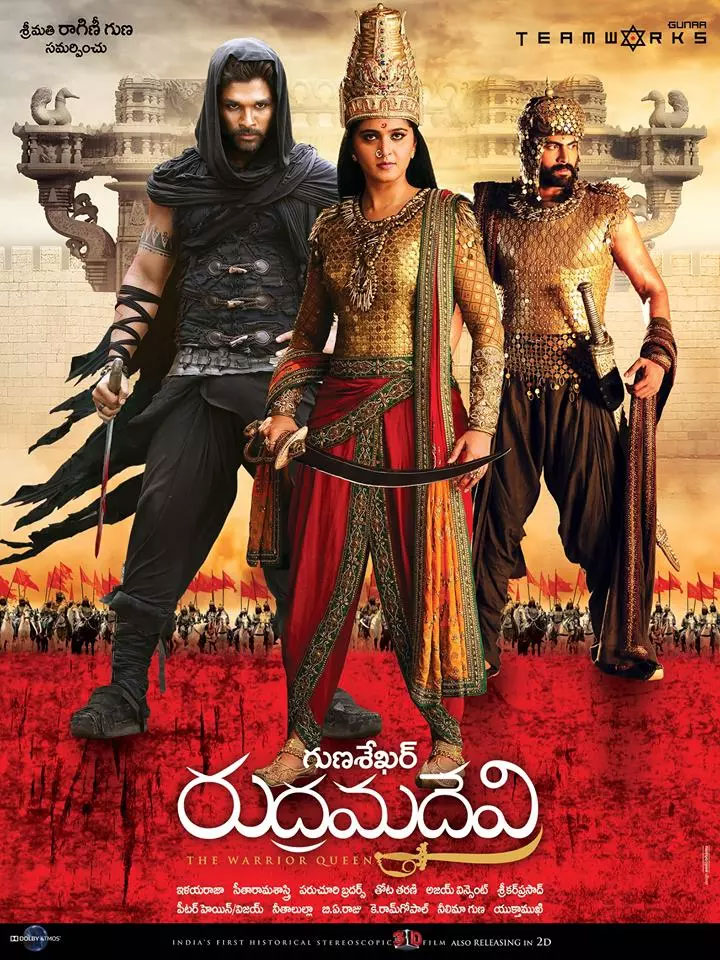
A big shoutout to the helmet and armour department. No design was too silly or impractical for them to try. I really wish I could find a picture of Bunny’s Glomesh helmet from the final battle, but you will just have to make do with Rana’s special dressing up armour.

Despite the negatives I really appreciate seeing Anushka as the lead with so much screen time in an awesome story. Bunny and Rana bring more interest to their characters than the screenplay demands. I would have liked to see more relationship development generally, and especially between the ladies given the story is of a woman pretending to be a man. I really wish the film had been better executed as I can see what it might have been, and the gap between what was delivered and that potential is frustrating.
 

How Old Are You?

How Old Are You

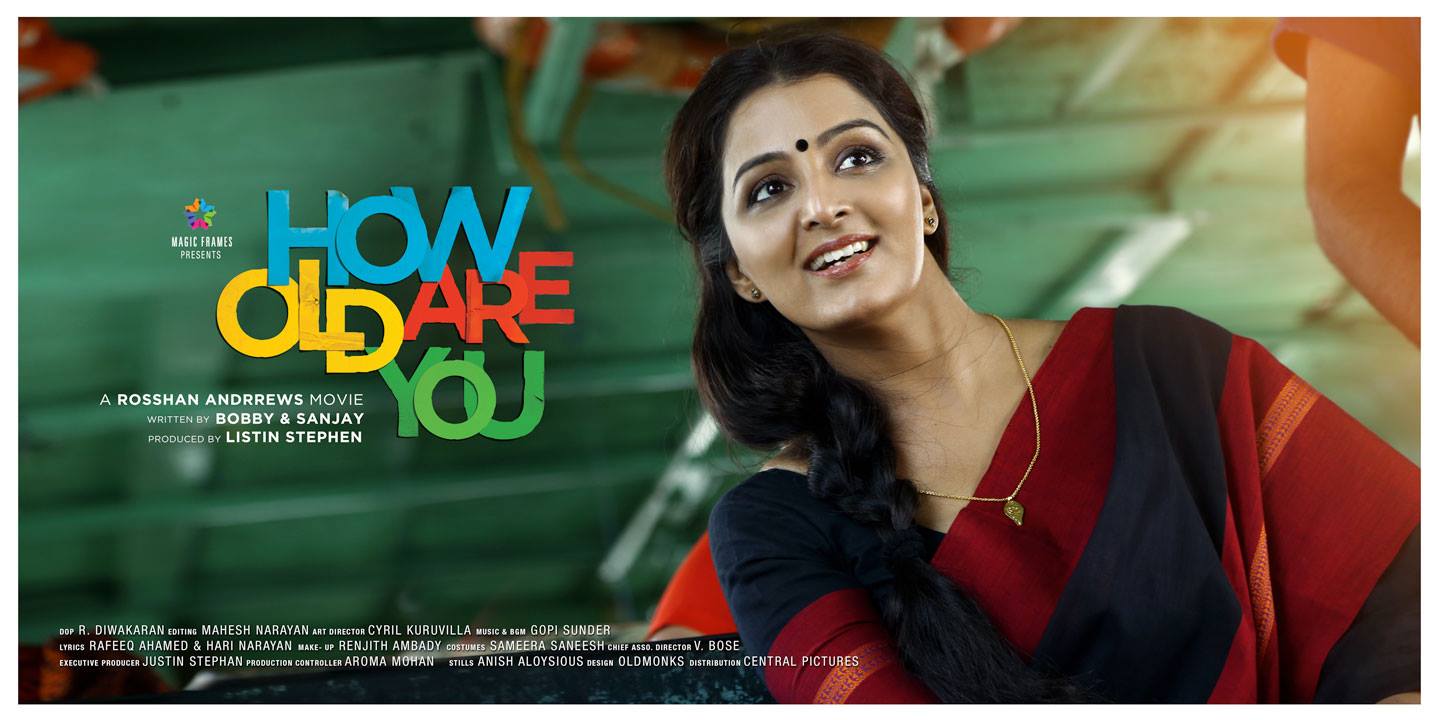
How Old Are You? is a completely different film from the last Rosshan’s Andrew’s film I watched, Mumbai Police. Rather than a complex murder mystery, this is a small domestic drama that nonetheless deals with weighty topics such as empowerment and never losing sight of your dreams. It could easily have become preachy given the subject matter but writer duo Bobby-Sanjay keep it light and close enough to home, making it easy to relate to the main protagonist. The title is perhaps a little misleading, since it’s not really Nirupama’s age that’s the issue, but rather her routine life which is slowly grinding her down. The film is the comeback for Manju Warrier and like Sridevi in English Vinglish she brings experience, maturity and a little glamour to a role which seems to suit her very well.

Nirupama (Manju Warrier) is a government employee who isn’t at all engaged in her work. She has no empathy for her clients and secretly reads magazines before going home to look after her family. At the start of the film she is rejected for a job in Ireland due to her age (actually that would be illegal in Ireland – you cannot discriminate against someone due to their age) which means that she won’t be able to accompany her husband Rajeev (Kunchacko Boban) and daughter Lekshmi (Amrith Anil) in their move overseas. Rajeev is fairly unpleasant, but in a way that doesn’t stand out as being unusual or even abusive. He doesn’t notice when Nirupama has changed her hairstyle, and when it’s pointed out to him, he doesn’t like it. He expects his wife to be there and make his dinner, but also to be able to work and earn money during the day. To cap it all off, when he’s involved in a motor vehicle accident he persuades Nirupama to say she was driving to make sure it has no effect on his visa application. But apart from his chauvinistic attitude he’s not a difficult husband. Rajeev and Nirupama seem to have a good relationship and chat amicably about their daughter and their respective workdays without any acrimony. Basically it seems like any other relationship where the wife does what the husband wants because that’s just the way it is, nothing more and nothing less.

However the planned move overseas puts a strain on their relationship, and Lekshmi in particular is obnoxiously bratty about her mother’s failure to get a job in Ireland. One day Lekshmi is part of a group of school children who get to ask the Indian President some questions and so impresses the President that he asks about the origin of her question. When Lekshmi explains it was from her mother, the President (Siddartha Basu) requests a meeting with Nirupama. Unfortunately things don’t go well, and Nirupama finds herself being ridiculed on social media and teased by her work colleagues. This makes her relationship with Lekshmi even more difficult and it seems that no matter what she does, nothing will ever be right. Part of the reason why I feel the film resonates so well is that most people have been in a similar situation at some time in their lives. We’ve all done something stupid, or something we regret and at the time it seems as if there is no way out of the mess without further embarrassment or loss. At any rate, I could definitely relate to Nirupama and her feelings of inadequacy, along with her increasing need for reading glasses and her discovery of grey hairs!

Nirupama’s notoriety allows a former University classmate to track her down and Susan (Kanika) is dismayed by her friends humdrum life. She reminds Nirupama that she was a firebrand and activist at University with plenty of ambition and drive to succeed. Along with the absence of her family who have moved to Ireland as planned, Susan’s memories provide the motivation for Nirupama to kick-start her life. She stands up to her husband and makes a new career for herself – in the process allowing the film makers to add in some valid points about organic farming and the benefits of city food production.

There is a side story involving an older lady who gets the same bus as Nirupama each day. Although the two don’t really know each other, Nirupama helps Madhaviyamma (Sethulakshmi) when she is ill, and gets more out of the relationship than she expected. I would have liked there to be more of Madhaviyamma and her problems, but sadly most of her relationship with Nirupama is skipped over. Mainly the friendship is a plot device to allow Nirupama to realise that she is not the only one with difficulties, and that in fact her problems are rather trivial compared to those of Madhaviyamma. Madhaviyamma also provides the inspiration for Nirupama’s business venture but there is not enough of Sethulakshmi, who does a wonderful job with her role.

There are a number of other familiar faces who appear as part of the support cast, including Vinay Forrt, as one of the office workers, while Thesni Khan and Jayesh Pazhanimala are good as friends of Nirupama. Kanika only appears briefly as Susan, and it’s a strength of the film that Susan doesn’t change Nirupama’s life for her. Susan is after all more successful with plenty of connections and the ability to give Nirupama a new job or bail her out financially, but instead it’s Nirumpama who comes up with the idea that turns her life around. It’s all Nirupama’s dream, her vision and she is the one who sets to and organises everything. With a little help from Madhaviyamma and her boss Seetharama Iyer (Devan).

Although mainly the film is realistic in the portrayal of relationships and in the intimacies of Nirupama’s life, the plot is occasionally rather too fanciful. The episodes with the Indian President seem unlikely, although the fuss and security around the visit is plausible, and the whole Immigration plot is generally rather nonsensical. Nirupama also seems to turn her life around rather more easily than I expected. However, the basic idea of a woman caught in a rut of her own devising is one which appeals, particularly when the character is played so skilfully as here. I felt most of Nirupama’s reactions were accurate in portraying how an average person would behave in similar situations, and her ideas and new business venture seemed to fit her general persona. It’s always good to have such a powerful female figure as the lead in a film, and How Old Are You? has a strong message and excellent cast too. Well worth a watch for Manju Warrier, Sethulakshmi and the idea that you’re never too old to change your life. 4 stars.

Puli (2015)

Puli

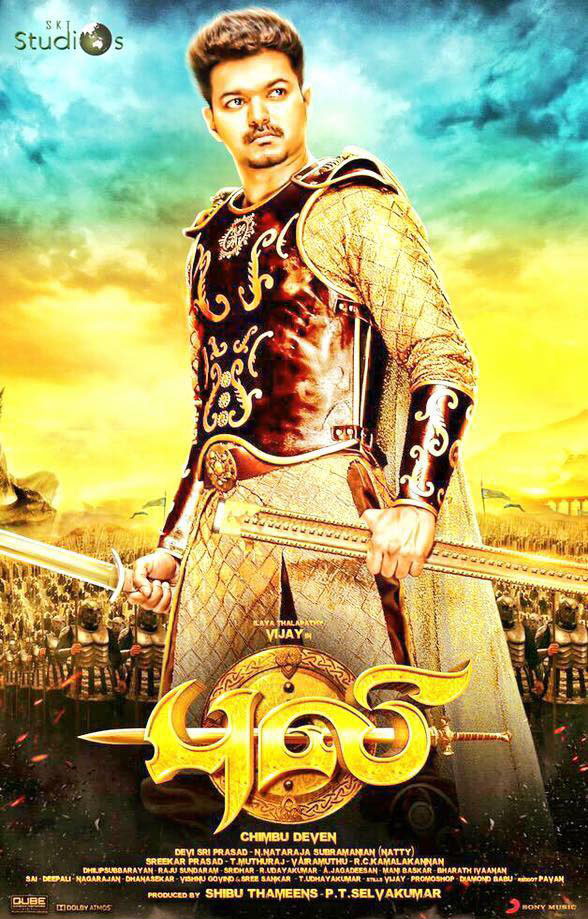
Chimbu Deven’s latest film may be set in a fantasy world of strange creatures and magical beings, but the story itself is mundane without any of the epic sweep required for such a tale. It’s also slow going, with most of the first half a dreary romance between Marudheeran (Vijay) and Pavazhamani (Shruti Haasan), although it does improve post interval once Sridevi and Sudeep appear onscreen. Despite the numerous fight scenes and explicit violence, the simplistic plot seems to be aimed more at children, with every obstacle easily overcome and the obvious outcome never in any doubt. That may also explain the relatively bloodless scenes of dismemberment and general carnage that would more usually be awash with gallons of fake blood, but instead the fight scenes here are frequently lacklustre, dull and repetitive. However there are a few reasons to watch, mainly down to Sridevi in her extravagantly evil queen avatar, good special effects and the always reliable Sudeep and Vijay.

Puli tells the story of a land which has been invaded and settled by a race of demons, who have enslaved the native humans. These Vedalam are easily recognisable by their blue eyes, tendency to sprout fangs when annoyed and ability to fly though the air, although their spiky armour and general arrogant grumpiness are a more distant and therefore safer method of identification. The young Marudheeran arrives in one of the subjugated villages as a baby, floating in a basket on the river, along with a mysterious egg that hatches into a talking bird. The talking bird is pretty well done as far as special effects go, and I was expecting it to be important to the plot in some way, but it really isn’t. Even though there is a sort of reason for the bird’s inclusion at the end, basically it’s a very under-utilized special effect that didn’t need to be able to talk and doesn’t get much chance to do so anyway. Overall this illustrates the problem with most of the special effects in the film. Although they are well done, the effects dazzle for a moment but are then relegated to background noise and ultimately have little to add to the plot. It’s a shame as the film looks fantastical but the uninspired story keeps it earthbound.

Marudheeran is adopted by one of the villagers and is trained by his stepfather in fighting and disguise as part of a general communal wish to overthrow the demons. However once Pavalamalli (Shruti Haasan) returns to the village, Marudheeran spends his time chasing after his childhood friend, much to the displeasure of her parents. Just as Marudheeran and Pavalamalli get married in secret, she is stolen by the demons and Marudheeran sets out with his trusty friends Thambi Ramaiah and Sathyan to rescue her from the impregnable city of Vedalakottai. They plan to disguise themselves as demons to get into the city and then hope they can find Pavalamalli and get out again, but that’s it in terms of preparation. There is no attempt to deal with the epic scale of such an endeavour and make the journey and planning part of the adventure. This means there isn’t any sense of danger or excitement, just a pedestrian slog to find the city and rescue the girl. Nothing new, and could just as easily have been set in the present time anywhere in India with much the same plot and ending.

Still, there are plenty of good ideas in Puli, it’s just that they get such short shrift and don’t have as much impact as they should. For example, Marudheeran and colleagues meet a race of miniature people where there is a brief ‘we can show you the way’ moment and then the little people are used mainly for comedy. However the effects and the cinematography are once again very good, with clever use of seeds and leaves as clothing, and wonderful peanut shell blouses that are simply inspired!

Unusually, Vijay doesn’t fit as the hero of the film as well as he should, at least initially. His introduction and the subsequent fight scenes establish his character as more of a trickster and comedian while his pursuit of Pavalamalli is pedestrian and lacking animation. It’s not until the second half of the film where he comes up against his nemesis General Jalatharangam (Sudeep) that Marudheeran starts to properly fill the role of the warrior hero and Vijay gets a chance to throw his energy fully into the part. Just about at this time though there is a flashback sequence where Vijay plays his father – a man born to be in a shampoo commercial and doomed by his reliance on slow-mo fighting and accompanying wind-machine. I did appreciate Vijay’s mastery of the hair toss though and once he gets into full warrior mode, there is no stopping him.

Sudeep is good in a role that lets him convey volumes with just a look and a sneer, although he really needed more time onscreen being evil to make his character thoroughly despicable. Jalatharangam is a fairly standard villain but Sudeep imbues him with an arrogant coldness that works well and there’s just enough sliminess added for good measure. Sridevi too makes the most of her role as an evil queen and shows what a fantastic actor she is even with her limited time onscreen. She totally owns each scene when she appears and her sweeping presence lifts the energy of the film. She has the best costumes and stunning make-up but these go almost unnoticed beside her commanding presence and expressive eyes. And she plays a harp – perfect! I hope this, and her recent appearance in English Vinglish mean that we will get to see more Sridevi films in the future – she is the best thing about Puli for sure.

Hansika Motwani plays Queen Yamanadevi’s daughter and at least Chimbu Deven doesn’t make the mistake of trying to get her to actually dance in any of her songs. Hansika looks good and has an amazing peacock outfit at the end but doesn’t do much else of note in the film, although she does manage better chemistry in a few brief moments with Vijay than Shruti does in an entire romantic song. Overall Devi Sri Prasad’s songs are fairly uninspiring and the choreography rather repetitive, but Vijay is energetic and the backing dancers are enthusiastic in a range of diverse costumes.

Except for Sridevi, Puli mostly disappoints with a weak story and fairly nondescript songs. Sudeep and Vijay are fine but both characters need better definition and depth rather than simply relying on the ability and star power of the actors. Both do what they can, but the film could have been so much better with just a little more complexity. Good cinematography from Natarajan Subramaniam and great visual effects make Puli worth watching on the big screen but probably only for fans. Otherwise probably best to wait for the DVD where the fast forward button will make Puli a more enjoyable watch.