Gajakesari

Gajakesari

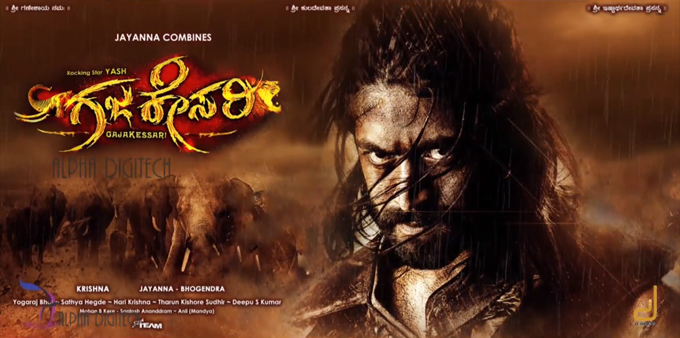
A very big ‘thank-you’ to Roopesh and Kannada Movies Melbourne for the opportunity to see Gajakesari in the cinema here in Melbourne.  This is the first time I’ve seen Rocking Superstar Yash, and I have to say he is pretty rocking!  However the real star of the film is an incredibly well trained elephant called Arjuna, who not only steals every scene when he appears but also perfectly defines the meaning of ‘on-screen chemistry’ with his co-star.  Noted cinematographer Krishna has stepped out from behind the camera to write the screenplay and direct this action adventure, which does mean that there are beautifully framed shots throughout even if the screenplay does drag a little at times. On the plus side there is an excellent flashback to a past life which helps lift the film out of the ordinary, and the combination of good fight sequences, an entertaining storyline and a charismatic elephant make Gajakesari better than average.
Gajakesari

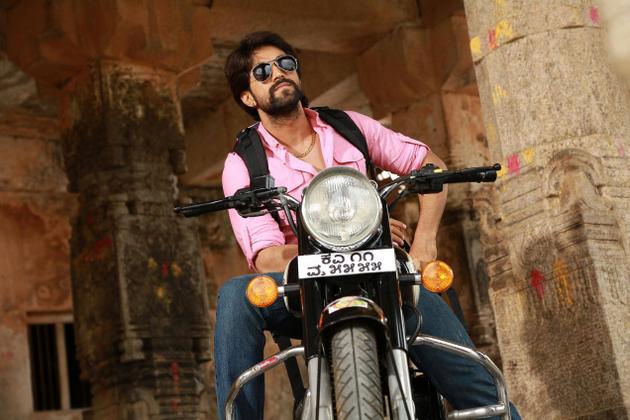
The story opens with the introduction of chief villain Rana (John Vijay) who intimidates the local politician into giving him the right to develop a tribal area somewhere in Karnataka.  After establishing that Rana has the nastiest henchmen and also the most googly eyes in SI cinema, the film moves location to a temple in Mysore to introduce Krishna (Yash).  Krishna is a modern guy who rides a Royal Enfield and likes to hang around with his two friends, but is about to discover that his freedom is coming to an end.  As a child Krishna was promised to the temple and is supposed to take over leadership from the current Mutt (Anant Nag), not something he has any real desire to do.  However there seems to be an escape clause – Krishna just has to donate an elephant to the temple and will then be free of his obligations.  Now I can see some of the logic behind this since an elephant would no doubt be much less trouble than a rowdy young man.  Still it seems to me that a herd of goats would possibly be more useful and easier to house than an elephant.  Regardless of convenience, the temple wants an elephant, so Krishna obediently heads up into the hills to find his pachyderm.

Gajakesari

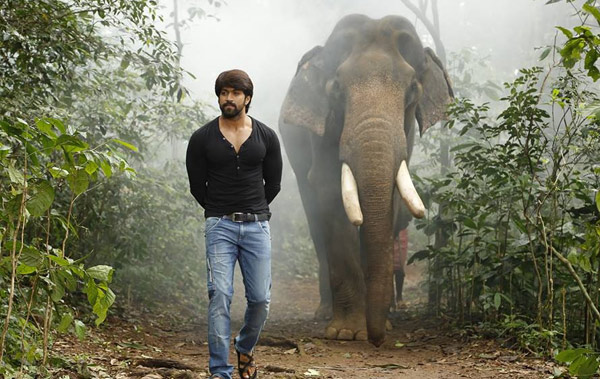
Luckily for Krishna he easily finds a small tribal village where there are plenty of elephants and the villagers are keen to help him in his quest.  However the local elephants don’t appear to want to leave their cosy jungle and since their leader is the particularly angry and intractable Kalinga (Arjuna!), it seems likely that Krishna may have to enter the temple after all.  Krishna though, is a man who seems especially blessed by his temple gods and he manages to calm Kalinga just in time to enlist his aid in fighting off Rana’s thugs.
Gajakesari

This is the start of a beautiful friendship, based (according to the village shaman) on the circumstance that Krishna is the reincarnation of hero Baahubali and Kalinga the reincarnation of his elephant.  This leads into an excellent historical flashback with plenty of heroism and action, although the low budget costuming for the attacking army is a little disappointing.  Baahubali and his elephant look awesome though!

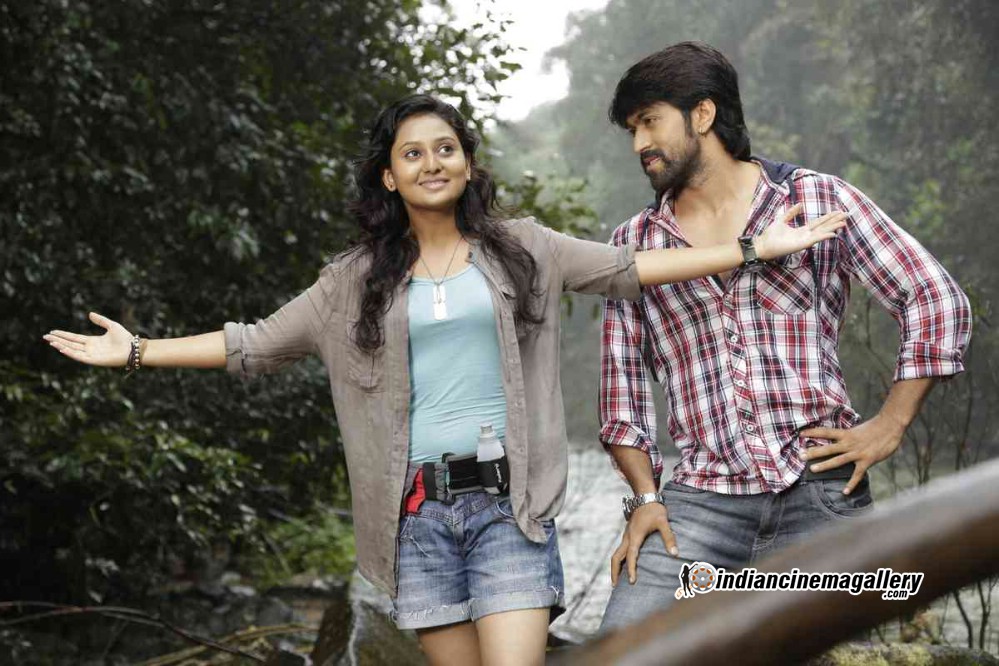
In the village Krishna also meets Amoolya, who ostensibly is there to record birds but really just seems to be looking for trouble.  She has a tendency to wear inappropriately short shorts around the village and while tramping around the jungle, and to add further insult indulges in patronising photography of the villagers.
GajakesariGajakesari

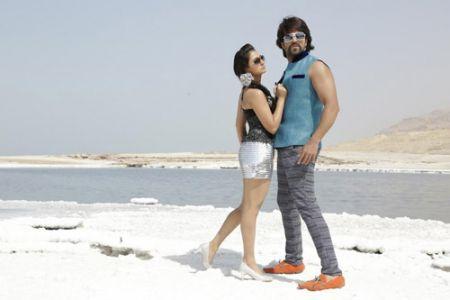
Sadly her character is poorly conceived as she looks nothing like the scientist she is supposed to be and instead is a 2 dimensional throwaway heroine with little apparent rationale for her romance with Krishna.  Amoolya does her best but there is very little she can do in such an unconvincing role while looking uncomfortable in most of the outfits.  Her best moments are in the songs where she does get the benefit of pretty and dance-friendly shoes, but it’s not enough to justify her presence in the rest of the film.

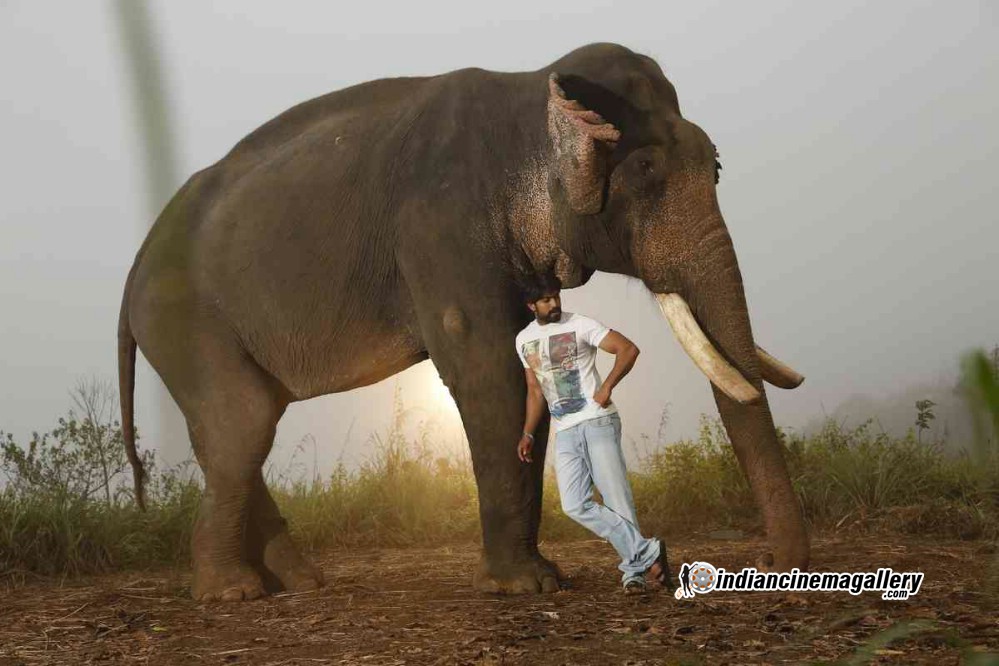
This really is Yash’s film and he is excellent in his role as Krishna.  He’s lackadaisical and perfectly casual as Krishna but takes on a completely different and more martial role when we see him as Baahubali.  The relationship between Krishna and Kalinga is the lynchpin of the plot in the second half and the two carry it off perfectly – excellent acting by Yash and great screen presence by the elephant combine to make an impressive duo.  Forget Amoolya, this is the real relationship that matters in Gajakesari!

Yash also looks great in the songs, and not just because he always matches his shoes to his outfits.  He has plenty of charm and while his Krishna appears to be a lovable rogue, he also manages to convey an innate honesty and sense of moral integrity.  No wonder his elephant loves him and the villagers rely on him to defeat Rana and save their village.
Gajakesari

Overall Gajakesari works due to Yash’s strong screen presence and a good story.  It doesn’t need the added burden of a romance, particularly when it fails to ignite and the heroine seems so completely out of place.  The scenes set in the past are definitely a highlight, but the action in the present day is almost as good, and the inclusion of an elephant as a fighting partner is inspired.  Definitely one to catch in the theatre if you can and appreciate just how much star quality one elephant can bring to a movie.

Pistolwali (1972)

pistolwali

I often wonder how gangs of ne’er-do-wells get along before they reach the critical mass that attracts a hero to sort them out, and what it is that they do all day. Pistolwali doesn’t answer the first of those questions, but it does provide plenty to look at as you ponder whether what they do all day is make their own outfits and fight over the dress-up box.

K.S.R Doss’ Pilla? Piduga? was either dubbed or partially reshot in Hindi as Pistolwali. Both (unsubtitled) films are on YouTube so choose your poison. I have chosen to use the Hindi version as some actors and both Helen and Jayshree T appeared to be speaking Hindi and this film is all about the authenticity…Plus I understood more of the dialogue even if I couldn’t read the significant clue written in blood.

Like so many other Telugu cowboy themed revenge films, this one is set in a time and place that exists only in Telugu cowboy themed revenge films.The movie opens with Raaka (Satyanarayana Kaikala) and his gang attempting a train heist. A brightly clad cowboy (Ramakrishna as Amar) puts them out of business from his perch in a convenient tree. It’s cowboys vs cowboys and hat colour is not a reliable indicator of anything.

Maybe if we saw the floral sunhats being stolen from helpless old aunties it might be suitably Bad, but instead it just looked like a job lot guaranteed to brighten up every occasion. And there was that one guy who just painted his scalp silver. Reeka (Prabhakar Reddy) seems to have fewer marbles and fewer outfits than Raaka. He throws childish tantrums that quickly escalate into homicidal rampages. And that is the nicest thing I could say about him.

“South Bombshell” (according to the poster) Jyothilaxmi is Neelu. She is first seen cavorting in a daring swimsuit but later changes into equally fashion forward pantsuits. The villains go too far when they steal from the temple, and Neelu sets off in pursuit. She swaggers, shoots and curses like a hero rather than a heroine relying on womanly wiles, and generally she rescues herself. Jyotilaxmi wears some abbreviated costumes and gets a big dance number, but Neelu isn’t a girly girl. Neelu gets roughed up by her adversaries but how to say this… they don’t get rapey and creepy with her despite the allure of her midriff. She is a foe and they deal with her as a threat, not as a plaything. She is tough cookie and I suspect it would take a bit to outrage her modesty in any case. When Helen gives it her all in Hoga Sa Hoga, Neelu fills the time honoured role of hero looking like they’d rather be elsewhere. Although that may also be professional item girl rivalry.  Neelu has her own ideas and just goes and does her thing. Even if that includes falling through a trapdoor and wrestling a (sight impaired) tiger.  And she has a straightforward approach to relationships.

Pistolwali-Graceful

I am not sure it was desire for authenticity or just directorial cruelty that had her struggling to get on and off horses, but it looked like Jyotilaxmi did a lot of her own action scenes.

The viewer learns that Raaka is Neelu’s biological father long before she does.  Raaka raped Lakshmi and left her for dead before also maiming his friend and rival for Lakshmi’s love. She fell pregnant as a result and she and the baby were taken in by her now one-legged true love who seemed to think it was the right thing to do. He may have been grooming Neelu for vengeance as well, but he seemed like an affectionate and over indulgent filmi Daddy. Neelu was none the wiser about her parentage until quite late in the film. That might all sound a bit progressive so let me assure you that the way it was revealed to her made me deduct a lot of the good parenting brownie points.

Ramakrishna is technically the hero but Neelu overshadows Amar in all respects. He does an OK job and he doesn’t get in her way, but apart from some excellent outfits he achieves little of note. Although I did giggle at his inept dealings with the ladies. On the subject of costumes, it looks as though each main character was issued with one distinctive pair of boots and they pretty much wear them throughout. Raaka’s boots were particularly special and Satyanarayana Kaikala was suitably over the top to match. And the outfits did help a little with identifying characters in the many and varied fights and action scenes. K.S.Madhavan threw everything and the kitchen sink into the stunts. However I have to say that the plot is quite cohesive and to an extent, I would almost say logical.

The background music is a brilliant mish-mash of fuzzy surf rock and funky Hammond organ with classic cowboy guitar strumming and the odd slide whistle. The song set pieces are unashamedly random and the film has an embarrassment of item girls that all get a guernsey in featured numbers.

Jayshree T is always so perky, I love watching her dance. She always seems to wear more hair than clothes but I never see her as really skanky.


Helen and her creepy blue contact lenses appeared in a nightclub song and Jyotilaxmi got a dance in a fabulous Fauxgyptian inspired village set with what may be happy go lucky tribal cannibals. The camera is often at crotch level which is a bit confronting. But to be fair, the camera wasn’t just upskirting the ladies. Once seen, never unseen.

This is one of my favourite heroine-centric B movies from 1972 and Jyothilaxmi is perfect as the righteous gunslinger. See it if you have ever harboured thoughts of wearing a fur trimmed vest with fringed pants but weren’t sure how to accessorise, or if you want a primer on tiger wrestling for the modern lady. 3 stars!

Drishyam (2013)

Drishyam

I started to watch Drishyam late one night intending to just watch the first half, but found I couldn’t tear myself away until I’d seen all 2 hours and 44 minutes of the film – it’s that kind of movie.  Although it starts simply enough by drawing a picture of a fairly conventional family, it develops into a fascinating thriller where it’s difficult to predict exactly what will happen next.  The very ordinariness of the family makes their reactions and those of the other characters unexpected, while the developments in the plot are surprising at every turn.  There are a few moments where the story falters a little, but overall it’s intelligently written to show the effects of a sudden crisis and how important it is for a family to stick together when faced with adversity. Great performances by all the cast and beautiful cinematography contribute to make Drishyam compelling viewing and it’s definitely one of the best Malayalam films I’ve seen recently.

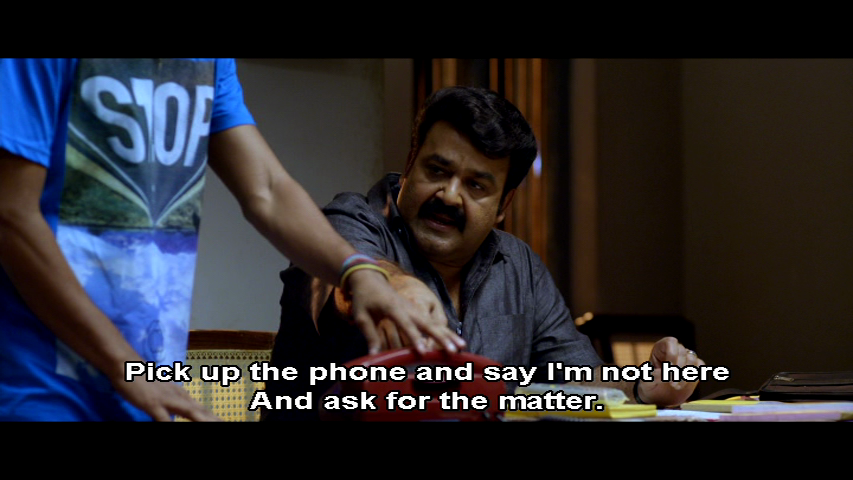
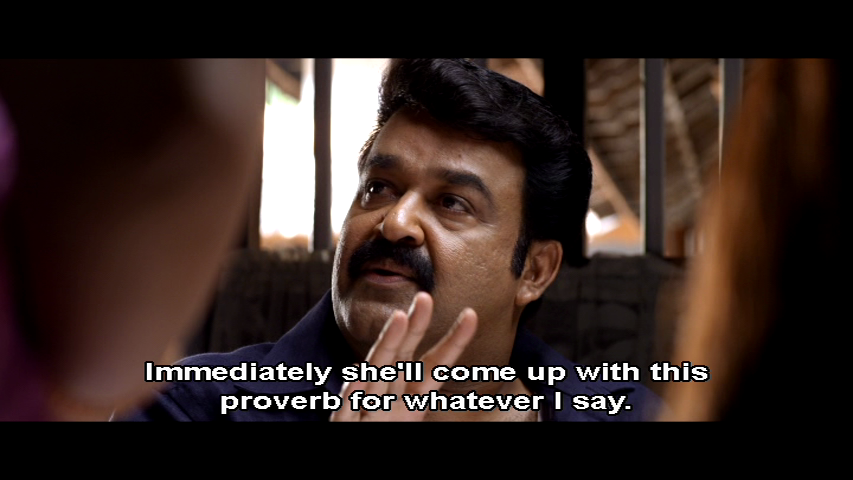
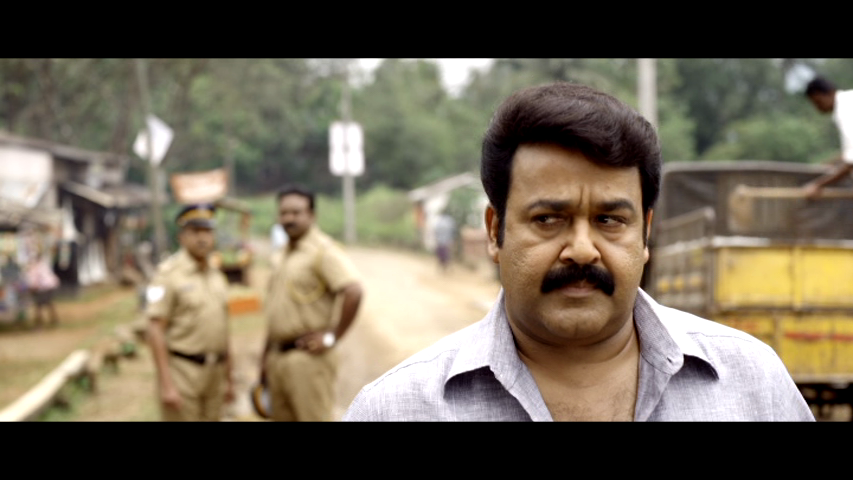
The film has a fairly slow beginning as writer/director Jeethu Joseph spends the first hour developing the characters of George Kutty and his family, focusing on their day to day interactions with each other and various other people they meet.  George Kutty (Mohanlal) operates a cable TV business in a small village near Thodupuzha.  He’s an orphan who never made it any further than 4th standard at school, but he has a wealth of knowledge gleaned from watching films all night long in his office.

DrishyamDrishyamDrishyamDrishyam

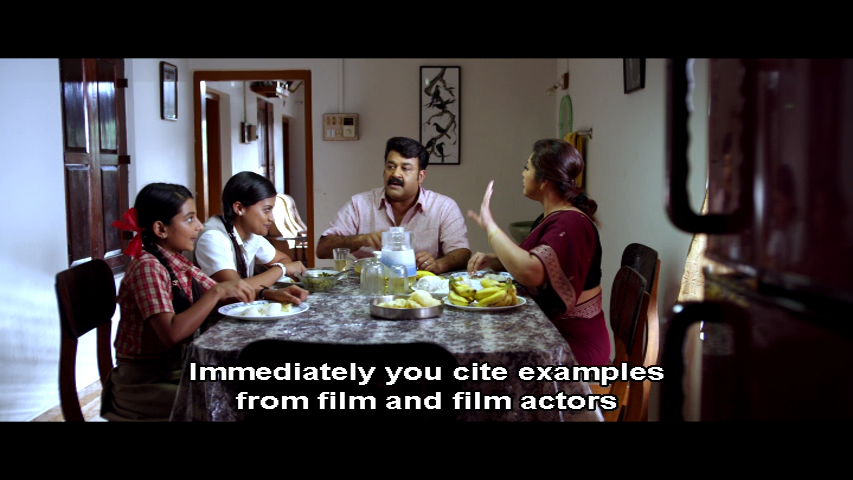
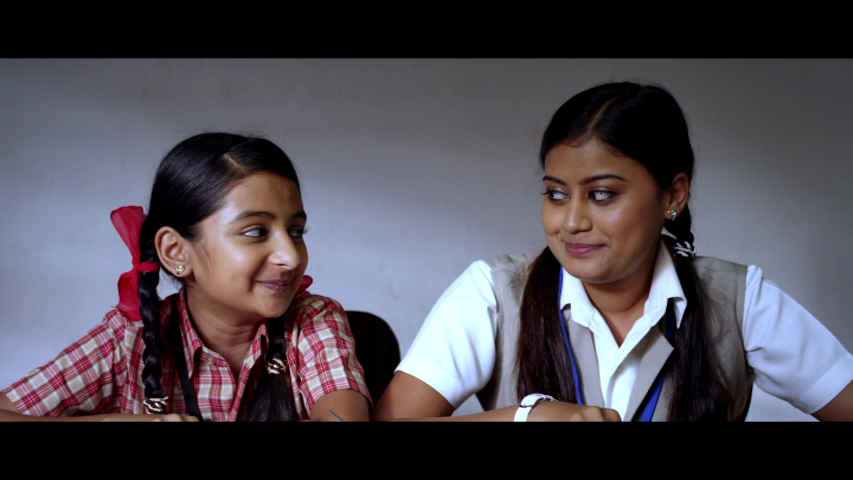
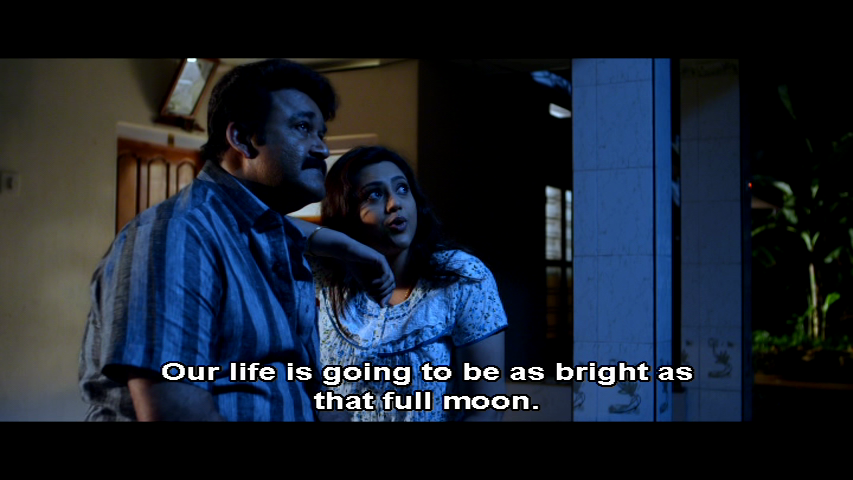
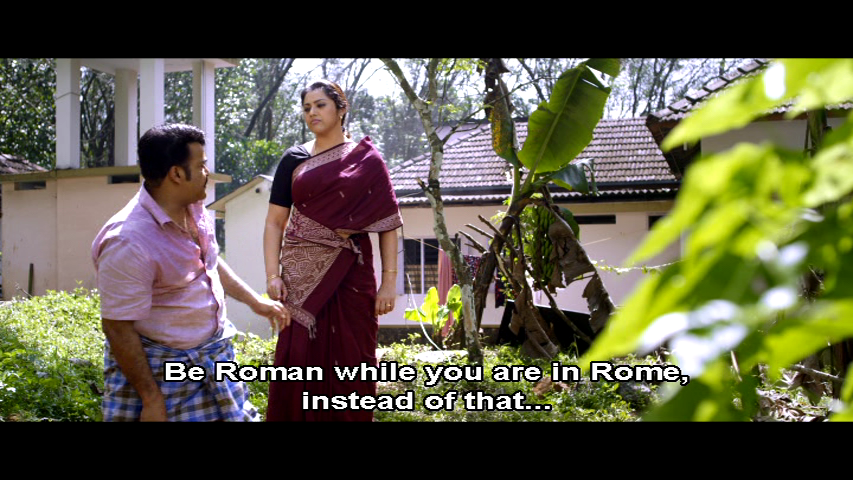
George Kutty is married to Rani (Meena) who generally seems content with her life despite putting up with her husband’s absences at night and his obsession with saving money.  They have two children, Anju (Ansiba Hassan) and Anu (Esther), and the family lives in a pretty house surrounded by banana trees and woodland. It all seems, if not idyllic at least comfortable and happy, although there are of course the dull routines and petty squabbles that occur in any family.  Jeethu Joseph uses each family member’s small ambitions to round out their characters and define their relationships while gradually building up the background for the rest of the story.  What also stands out is that despite the bickering and George Kutty’s somewhat eccentric lifestyle, there is a lot of love in the family and the marriage is built on very solid ground.
DrishyamDrishyamDrishyamDrishyam

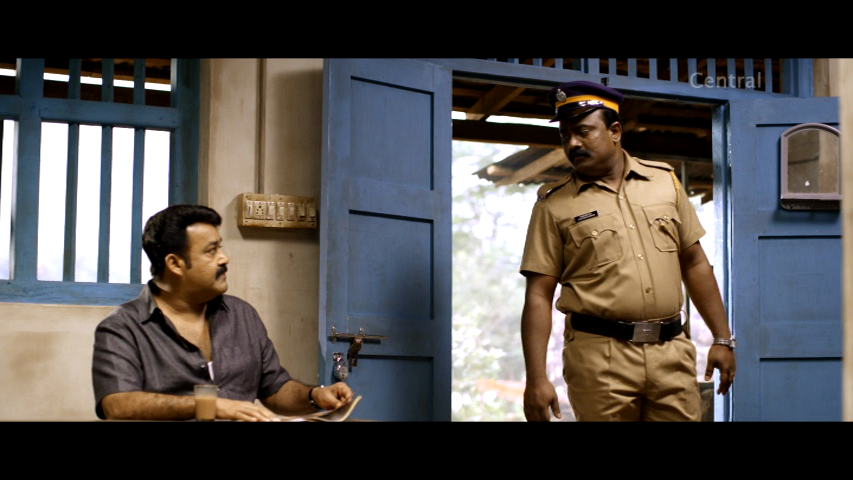
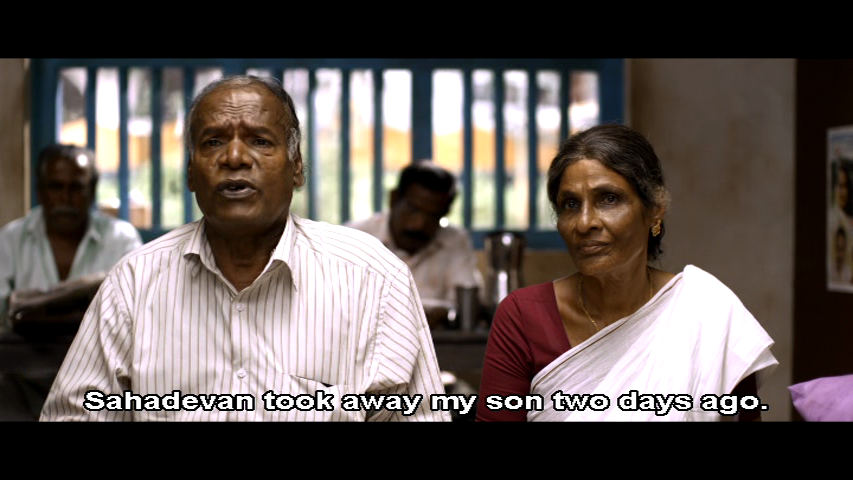
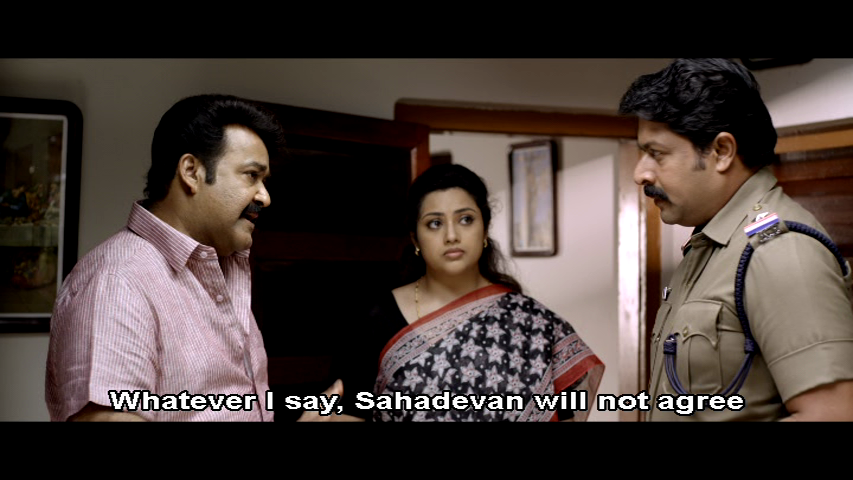
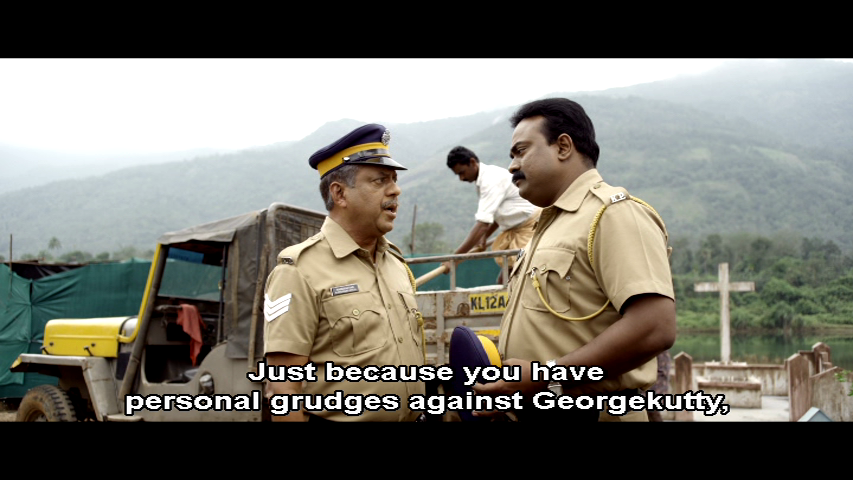
When not in his office or sitting at home, George Kutty spends his time in a local tea shop where he uses his knowledge of films to solve other people’s problems and if that just happens to antagonise the moderately corrupt Constable Sahadevan (Kalabhavan Shajohn), so much the better.  Sahadevan is a bully who extorts money through a variety of petty schemes and his character is best summed up by a brief scene where he happily steals money from a man whose child is in hospital.  Such a nasty man, and beautifully played by Kalabhavan Shajohn who does a fantastic job of displaying Sahadevan’s mean-spirited character and giving his emotions free rein. Part of the intrigue of the story is that this dishonest policeman becomes the unlikely pursuer of justice although his methods are definitely unethical and disturbing.

DrishyamDrishyamDrishyamDrishyam

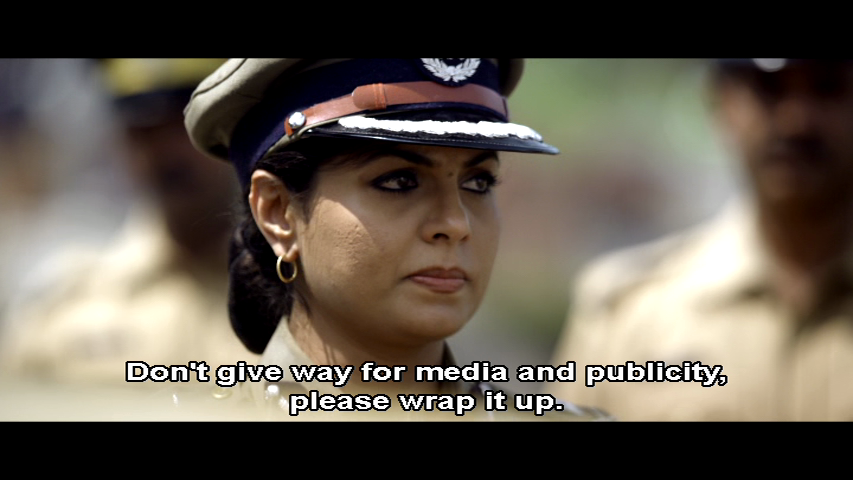
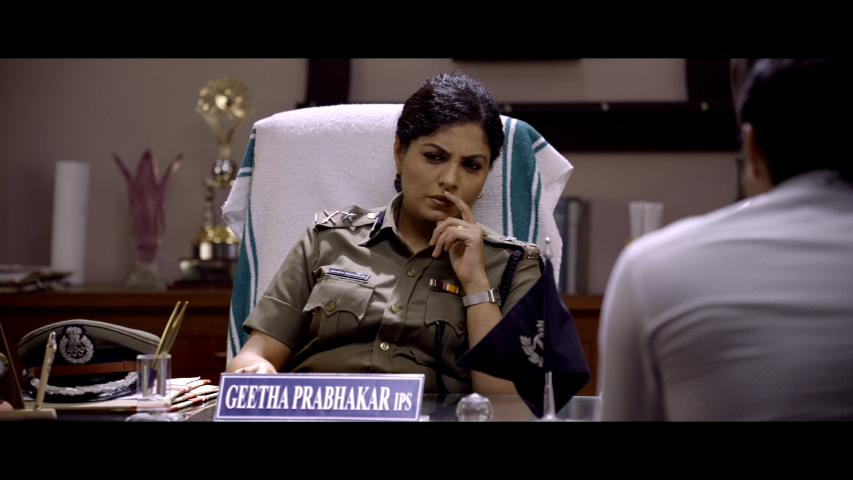
While the first half of the film introduces George Kutty and his family, the second half deals with what happens when the police suspect they are complicit in the disappearance of the Inspector General’s son.  Geetha Prabhakar (Asha Sarath) plays the part of the IG, and it’s a pleasant surprise to have a high ranking female officer as a main character.   Perhaps this is as a counterbalance to George Kutty’s firmly held belief that a woman belongs at home, but it also brings a very different dynamic to the film.

DrishyamDrishyamDrishyamDrishyam

Geetha is the one making all the decisions while her husband (Siddique) is the voice of reason and conciliation in the background.  The missing Varun Prabhakar (Roshan Basheer) is a typically spoilt rich kid, and there is the inevitable cliché here that rich kids are bad, while kids from lower and middle socio-economic backgrounds are always good and righteous. Geetha doesn’t believe George Kutty’s version of events and is determined to prove that his family are lying even though the local police officers (with the exception of Sahadevan) are convinced of George Kutty’s innocence and are reluctant to get involved.

DrishyamDrishyamDrishyamDrishyam

It’s mesmerising and even though the audience knows the true sequence of events, subsequent outcomes are impossible to anticipate as everyone brings their own needs and responsibilities into the mix.  Keeping to the thriller aspect of the film, there are only 2 songs in the whole film.  Both are well used to describe George Kutty and the dynamics within the family.  The first shows them on a happy shopping expedition while the second illustrates the change in family attitude when the police start to suspect they may have something to hide.  This is the first happy song which does an excellent job of summing up the family and their personalities.

Part of the film’s effectiveness is due to the high standard of acting from all involved.  Mohanlal is outstanding as are the two young actors who play his daughters.  Meena, Asha Sarath and Kalabhavan Shajohn are all also excellent and from Sahadevan’s brutal interrogations and shifty plotting to Geetha’s desperate attempt to balance her police persona with a mother’s concern for her missing son, the actions all feel genuine and typical of the characters involved. The dialogue seems natural, even with the barrier of subtitles, and the only apparent misstep occurs at the very end where Geetha appears to act a little out of character.  However it’s a small thing and does allow the story to be completely wrapped up Hollywood style.  Personally I would have liked a little less explanation and have been left to form my own theory, but that could be just me.

DrishyamDrishyamDrishyamDrishyamThe film is beautifully shot by cinematographer Sujith Vasudev and once the family is under suspicion the threat of prison is accentuated by the number of shots behind barred windows.  There are also some good contrasts between George Kutty’s family and the extended ‘family’ of the police and the lone outsider of Sahadevan.  By the end of the film a number of small throwaway moments are shown to have more significance than they appeared to have at the time, which shows just how effective good story development and intelligent writing can be.  Everything was there to be seen for anyone who looked, but the film shows that what we see can be easily manipulated and misinterpreted when it is outside expectations. Definitely recommended viewing but be warned not to start watching too late at night as it’s impossible to stop!  4 ½ stars.