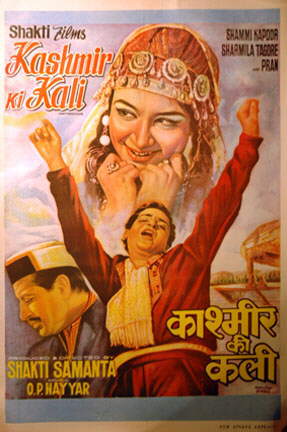
Kashmir Ki Kali

This is one of my favourite Shammi movies, although I’ve never been able to clearly decide why I prefer it over some of his other equally fabulous films. Maybe it’s because there is plenty of Shammi shimmying and trademark contortions going on? Or perhaps because Sharmila is beautifully innocent and the love story is sweet with a fantastic soundtrack? Whatever the reason, it’s always a film I watch to the very end and enjoy every second.

The film opens with Seth Rajiv Lal gaining control of his father’s businesses. He is a millionaire’s son and wants to give the business profits back to the people who actually do the work. His mother is appalled by this regrettable instability in her son and decides that the most appropriate way to curb his socialist tendencies will be to marry him off. Almost overnight, the house is full of prospective brides and their hopeful parents but Rajiv manages to get rid of them all by a not very convincing display of madness.

Deciding that he has to get away from his mother and thus avoid more potential brides, Rajiv leaves to visit the family holiday home in Srinagar with his friend Chandar (Anoop Kumar). Along the way he has to spend the night on the veranda of a small hotel as the rooms are full with Champa and her friends who have come to dance at a local fair.  Rajiv’s first meeting with Champa isn’t too auspicious as she empties a bucket of water over him and his smoking stove, but her kindly nature is revealed when she later takes him a  blanket to stop him from freezing overnight.  It’s not long before Rajiv has succumbed to her charms, but he is a wealthy man and she is a flower seller who has no time for the indolent rich. At their next meeting, he pretends to be a driver so that she will look more kindly on him.
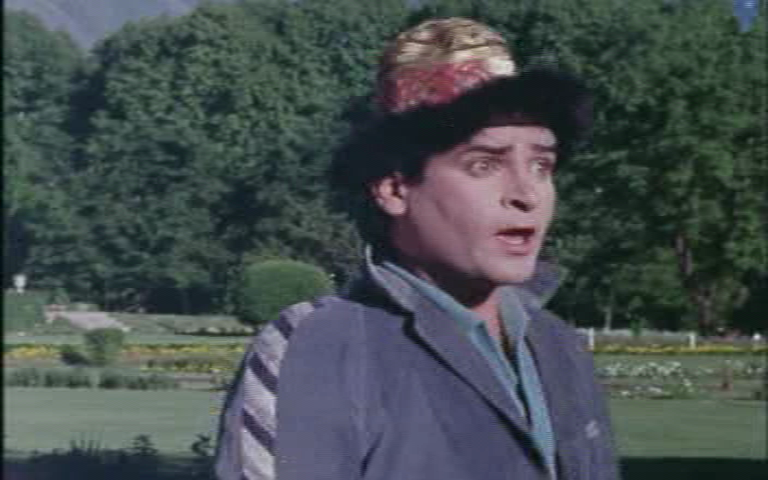
There is a slight diversion here as the family caretaker Bola Ram (Dhumal) has rented out Rajiv’s house to a party of 3 girls and their guardian Rama Devi (Tun Tun). In an attempt to get rid of them all Rajiv reveals his true identity and then immediately has to pretend to be the insane friend of Chandar, who in turn pretends to be the real Seth Rajiv, to make sure that Champa doesn’t find out the truth. This allows for some mix-ups between the three girls, Chandar and Rajiv as the former try desperately to snare a rich man as a husband, Chandar enjoys the attention, and Rajiv only has eyes for Champa. Confusing? Well, not really, as most of the time Rajiv just acts insane unless he is with Champa, so it all makes sense – honestly!

This is a wonderful song where Rajiv romances Champa while sailing on the lake – only Shammi could get away with these contortions in a boat!

Just as Ravi and Champa are falling in love, intrigue is added as local bully Mohan threatens Champa’s blind father Dinu. Mohan is also determined to marry Champa and  warns Dinu that he will reveal the truth about her parentage if he doesn’t get his way.  The plot thickens as Mohan does some investigating and finds out exactly what did happen the night that Champa’s father lost his sight.

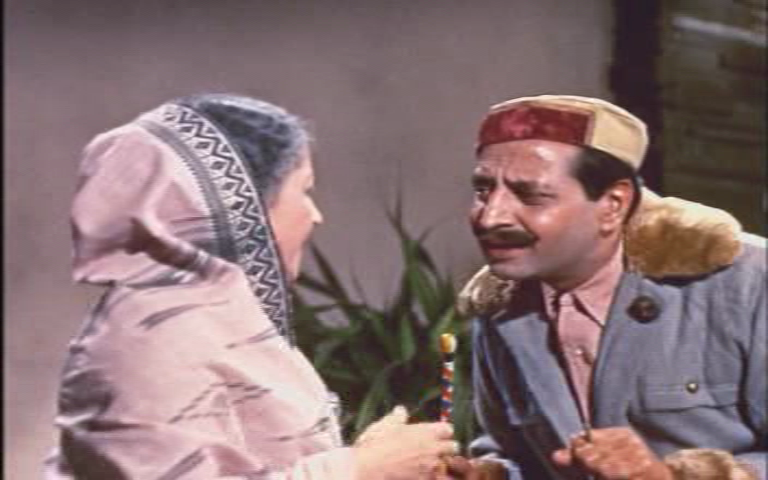
There are many complications on the way to the film climax but naturally there is an old family servant who reveals the truth just before she dies and almost everything is explained by the end. The obstacle of Mohan in the way of Champa and Rajiv’s romance does make for some great disguises such as this one at a local fair.

While the story is improbable at best, there is so much going on that the many plot holes don’t really matter. I adore Shammi in this film. He cavorts around with plenty of trademark hair twitching, and looks to be having the time of his life. And really, who can blame him when Sharmila looks so totally fabulous. This is one of her very early films and she does look very sweet and natural as a Kashmiri flower girl,  instilling her with grace and beauty which contrasts well with Shammi’s more over-the-top persona. She has a wonderful collection of massive earrings and hair adornments. I would love to know how she managed to dance without them either hitting her face or getting caught in her hair as this is a skill I’ve never mastered!

Pran is suitable slimy and conniving as the villain, although I do wonder how he always knew the right place to be lurking at precisely the right time. Nasir Hussain does a very good job of being blind Dinu here and in the flashback scenes is very convincing as the alcoholic father. I’m not entirely sure that Dinu’s blindness was enough of a reason for him to change his ways, but there were enough shades of grey in his later actions to make him a more plausible character. The comedy track with Chandar, Bola Ram, Rama Devi and the girls works well for me within the main story, although with so much else happening in the plot it probably was an unnecessary addition.

Another highpoint of the film is the soundtrack. Mohammed Rafi and Asha Bholse are perfect as the playback singers for the two leads, and the music by O. P. Nayyar is beautiful.

This is probably a film more for the Shammi fan as he really does throw himself into the role with great gusto and it might be a little too much for anyone not accustomed to his mannerisms. But Sharmila is excellent, the pair have good screen chemistry as a couple together and the story really does have almost everything. A 4 ½ star film for me.

Temple says: I like Shammi but I don’t think this is his finest work. Every time I watch this film I remember, just a bit too late, that I hate the first hour. Shammi is just so annoying with his zany animal noises Paagal Act!Ing! and Sharmila looks about twelve years old and that creeps me out a bit. But once all the characters are settled in Kashmir, things improve greatly. The location is one of the biggest attractions for me – I love being able to see places that I may never get to visit and the lake scenes are very pretty. The O.P. Nayyar soundtrack is beautiful and all the songs are delightful, especially Isharon Isharon which I think is a perfect romantic duet. After the first hour, for some reason Sharmila looks less like a schoolgirl, there does seem to be some appreciable non–creepy chemistry with Shammi, and her Kashmiri costumes are beautiful. Shammi drops a lot of the OTT mannerisms and goes for brooding romantic instead which is more successful and more appealing in this kind of story. Well, he does wear a hot pink burqa in one song but cross-dressing is par for the Kapoor course. I much prefer him in ‘Evening in Paris’, ‘Rajkumar’, ‘Bluffmaster’ and ‘Teesri Manzil’ where he is a bit less self consciously whimsical and more character focussed. The story is the typically convoluted romantic comedy blend with none of the surprises actually coming as much of a surprise to anyone but the lead pair. See it for gorgeous scenery, lovely costumes, a wonderful soundtrack and count your blessings that on DVD you can skip the boring bits! 3 stars
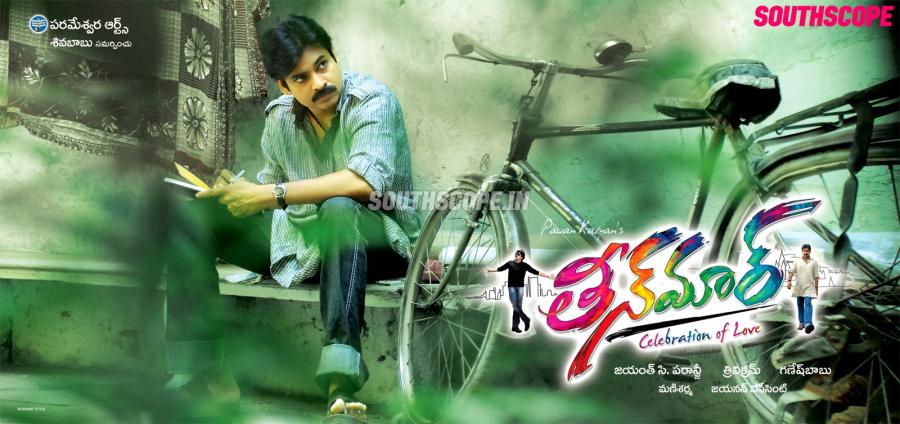
Theen Maar

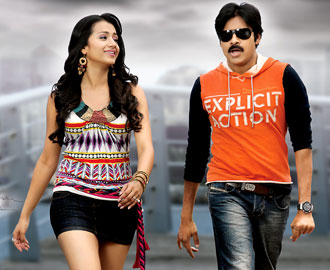
Theenmaar is a fairly faithful remake of the Hindi film Love Aaj Kal, with a few minor changes and thankfully a lot more Southern style action and drama.

We do think that Pawan Kalyan has the most enthusiastic fans we have ever encountered. There was a good turnout at India Talkies, especially considering this was the second night showing, and more ladies and families than we usually see. In many of the Cape Town location scenes, bikini clad extras strutted around to no audience reaction at all. But let PK appear in shot and the roof almost came off! And we must add – it was the guys making the most noise!

Pawan Kalyan is Michael, a chef working in Cape Town while he waits for an opportunity to be a stockbroker in New York. Trisha is Meera, a fine arts graduate who specialises in restoration work (or something). Michael is selfish, impulsive, charming but ultimately high on talk and low on commitment. His dialogues are hilarious and he actually used the vintage line ‘Coffee, tea …or me?’ which had us in fits of laughter. It was followed up by a kiss so clearly the old material hasn’t lost any of its magic…or maybe it’s all in the delivery? And he does speak Italian (not so well, but it was actual dialogue in actual Italian delivered with great gusto).

Trisha plays Meera as vain and princessy, accepting compliments on her beauty with a smile and an ‘I know!’ Their relationship is shown in a series of montages deteriorating from the happy honeymoon phase to him being bored and her being restless and the performances develop more subtlety as the characters situations change.  Meera loves Michael but goes back to India to pursue her career dreams. They both try to move on from this relationship, but really don’t, and the question of will they or won’t they get back together is the story.

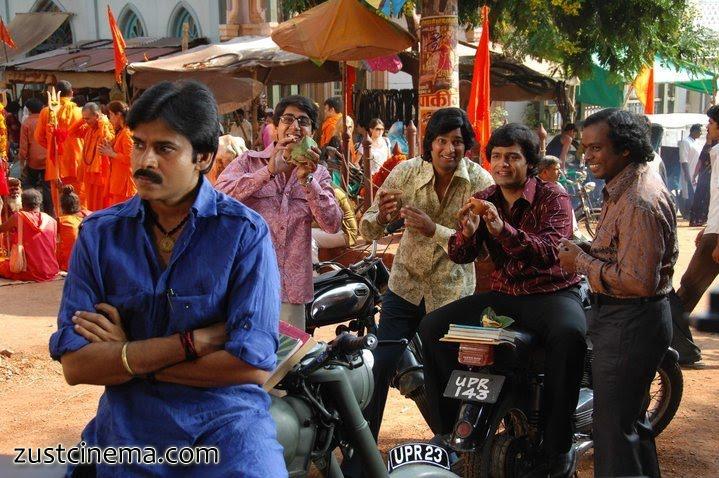
Paresh Rawal introduces the flashback story of his friend Arjun (Pawan Kalyan) and his love, played by Kriti Karbandha. The Varanasi locations and slightly faded colour palette are simply stunning. Arjun is a student activist, albeit one who never seems to do any study, a man of few words and deep feelings. Arjun and his nerdy mates follow Kriti around Varanasi and these are some of the funniest scenes.

Pawan Kalyan’s expressions flicker from nervous to smouldering to determined and back again as he wordlessly conveys his feelings and confusion. There is a fabulous vintage style song with Arjun and his mates skipping around and dancing like madmen and it is just brilliantly done. Kriti didn’t have a lot to do except stand around and stare at Arjun and is a bit low energy in many of her scenes. She does come to life in her dances and those scenes are where she looks her most appealing. Her family don’t approve of Arjun and his determination and resilience are a total contrast to Michael’s floundering and apathy. His body language is completely different to Michael – Arjun stands up straight, shoulders back, head up and looks people in the eye where Michael’s gaze is always shifting or angled and he rarely stands still or takes a stand.

One of the side effects of Filmi True Love is that all other partners end up as Romance Roadkill. Australian Misha or maybe Michelle (played by someone maybe called Jahna) and Sonu Sood as Meera’s new man are adequate in their roles, but they aren’t given a lot to do. Sonu makes more of an impression, mostly because he gets more dialogue and also has a confronting scene with Trisha. We did find it interesting that although the relationship between Meera and Michael was clearly physical, it was only the white girlfriend who was overtly shown as having a sexual relationship. It is obvious she is a pale (pun intended) substitute for Meera, although she did spark a truly funny Dirty Harry impression by Michael.

The remaining support cast were their usual selves. Tanikella Bharani was Michael’s Skype savvy dad, Paresh Rawal was avuncular and natty in golf knits, Mukesh Rishi was imposing and mean as the olden days father. The actors who play Arjun’s friends are really expressive and fun, and have a fab collection of Seventies polyester body shirts and flares. The male backing dancers were great and looked the part – if they were random street dancing IT guys, they looked like IT guys. There were too many skinny white girls in the club dances. Considering we were supposed to be in Cape Town, there was little diversity in the ethnic makeup of the extras so it was a bit odd. Another very strange thing – no Brahmi. We really can’t recall the last Brahmi-less film we have seen. Ali however did turn up in a fairly restrained (for him anyway) cameo.

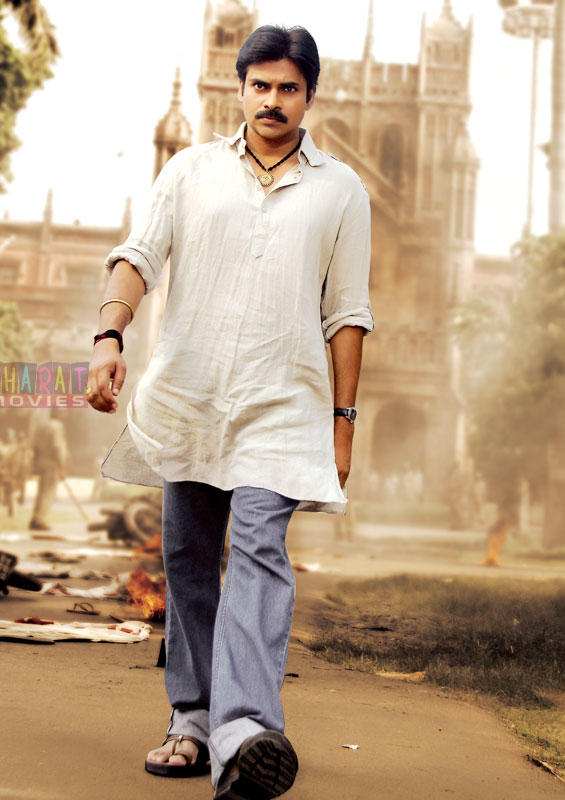
Mani Sharma’s music is well matched to its place in the story.  We particularly liked a gorgeous temple song dedicated to Shiva that used perfect retro Bollywood choreography. The club numbers were fun, and Pawan Kalyan went all out to entertain. The costumes were occasionally puzzling – we have no idea who was styling Meera’s return to India wardrobe but apparently going home means wearing lots of patchwork and garish harem pants. A big hurrah for whoever designed Arjun’s look. We loved Pawan Kalyan in the simple kurta and jeans.

Imtiaz Ali’s story is a great basis, and Trivikram did really well in translating it into the Southern film style.  We missed a lot of the dialogue based jokes, but judging by the audience reaction, they were very funny indeed. The action scenes are way more energetic than in the Hindi original. We aren’t sure about the climax fight that seemed to have been designed solely to allow a motorbike blow up but heroes must be heroes. Jayant Paranji kept the story ticking along for the most. There is a draggy section towards the end, but as usual the final scenes seem to happen at breakneck speed.

Theenmaar is a really entertaining film that has something to say but doesn’t beat you over the head with a message. We can’t wait for the DVD!

Godavari

Sekhar Kammula has become one of my favourite directors, always entertaining me with interesting observations and a satisfying story. In Godavari he deposits his characters and their relationship issues on a boat, adding a philosophical dog, a sideplot or two and some beautiful scenery to leaven the mix. I’m not totally convinced by all of the elements but I do really like this film.

This song sets up the main characters, and acts as the now familiar promotion clip for Andhra Pradesh.

Kamalinee Mukherjee is Seetha, a would-be fashion designer. She has nightmares about losing her independence and her close relationship with her parents after she marries. I liked Seetha’s spirit, and I really felt for her coming off a rejection from a groom her parents pressured her into accepting. That had to sting. Seetha is vain and bratty at times but she is funny, insecure and compassionate as well, and admits fault when she is wrong.

Sumanth is Sriram, an unassuming guy who wants to get into politics and make the world better. He reveals a manipulative side as he cons his way into appointments with party officials. Perhaps he is a precursor to Arjun Prasad from Leader? He isn’t as effective in his personal life however. Ram is inarticulate when he should speak up, and doesn’t really see things for how they are – he is lost in a vision of how it should be.

Raji (Neetu Chandra) is spoilt, silly, self centred and yet not totally unlikeable. Raji judges a relationship by the trappings of Valentines’ cards, fancy coffee shops and all the showy things, things that just never occur to Ram, and she uses this as an excuse to push him away. Her parents know Ram wants to marry her but refuse as his simply isn’t the best offer and they are quite honest with him about this. Perhaps they know their daughter better.

Ravi (Kamal Kamaraju) is a cashed up bully, making the most of his status in the IPS. He seems to have some notions of manners and decency underneath all the arrogance, but has done a marvellous job of burying his better side. I can’t say I liked him at all, but I did end up thinking he could be a good match for Raji if he got over himself a little.

All the characters are flawed, but not in a dramatically damaged way. They’re just a bunch of people who have good and bad points, and for the most part are quite unremarkable. I found them easy to relate to, even the unpleasant ones, as they were well rounded and I could imagine them having lives outside of the film setting.

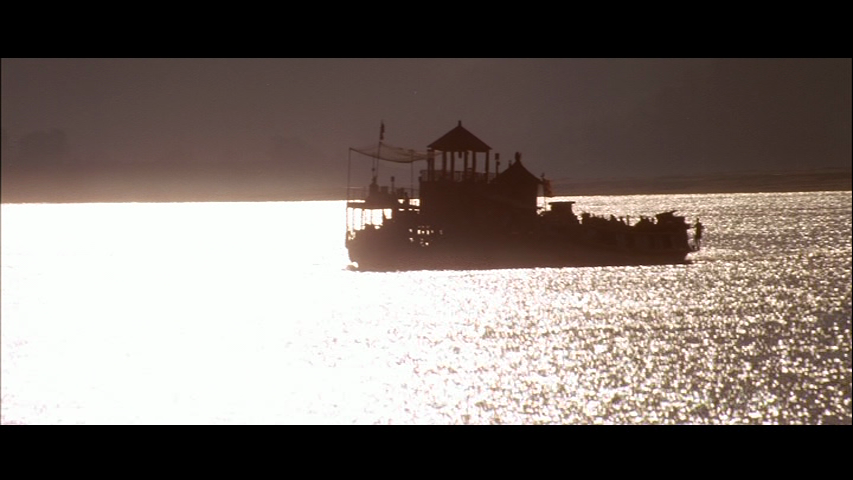
The boat setting appealed to me for a number of reasons. Not only did it provide a great device for containing the characters and their interactions, it looked great. It had all sorts of strange little additions,extensions and even a tower of sorts. I thought it looked delightfully like something out of a Miyazaki film. Whoever did the set dressing did a fantastic job too. All the powers were invoked to keep the boat safe and sound.

The boat trip also allowed the supporting characters to have things to do other than hang around Ram and Seetha.There was a nice sense of energy as the ever reliable Tanikella Bharani (the captain) and others bustled around. I enjoyed their presence all the more as they contributed to the background life and colour of the film. Seetha’s parents and sister had their own stuff going on at home, and there was a real lived-in feel to their domestic scenes as well. The nominal villains Raji and Ravi had their own issues to deal with, and even in their smaller roles showed some growth.

It wouldn’t be a boat story without stowaways. Chinna is a poor kid who pursues a mystery man (OK, it was Ravi) who does him out of the balloons he sells.  Koti, a dog, decides for his own reasons to get out of town. When Koti sees Chinna pay his bribe, he has a flashback to Daana Veera Suura Karna and swears fealty to his new master. They team up and give us their points of view but also provide the catalyst for people to reveal their own character – are they charitable, curious, mean or oblivious to the boy and dog?

While I liked the idea of Koti and the voiceover (by Sekhar Kammula, and what a world weary creature with a 3am whiskey voice he sounded), I did not like the CGI dog. The real dog had ample charm and verve and I don’t see the animation was necessary. I kept hoping it wasn’t because the real dog became, er, unavailable after a boating mishap. For those of you who demand pirates, there was a fairly silly episode involving a fugitive and a night ambush but it only served to show that Ram is reliable and Ravi isn’t so I will move on.

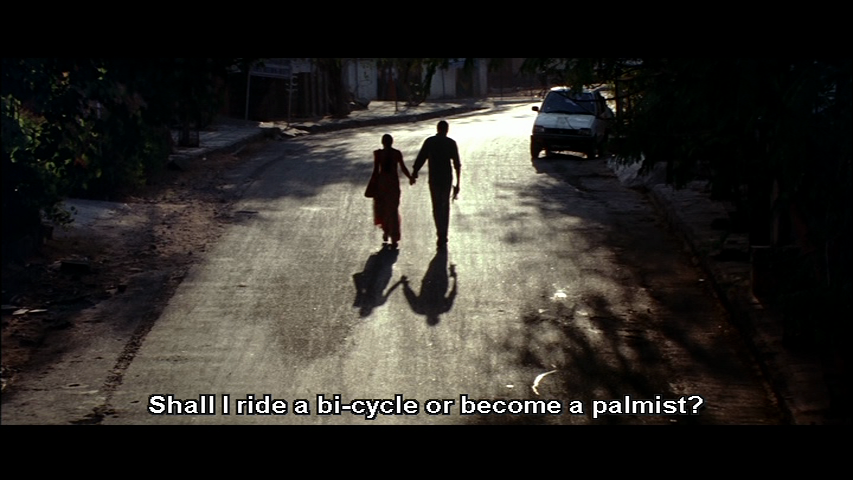
There is no surprise in the romantic pairing of our waterborne humans as their journey to Bhadrachalam follows that of Ram and Sita. Our Ram and Seetha are attracted to each other but there are obstacles, both real and imagined. I really enjoyed their conversations and the way both Sumanth and Kamalini showed the growing intimacy and comfort they felt in each other’s company as well as the pressure of the potential relationship.

They did daft things, sure, but there was no sense of them being stupid or unpleasant people. Kammula uses a lot of voiceover monologues, and both actors did a good job of mirroring the inner voice with their expressions, ranging from funny to heartfelt. Sometimes I find a voiceover can leave me at a distance, but in this case it worked well enough and suited the introspective nature of the characters.

I don’t like the background score at all. It is too cheesy, and seemed to try too hard to be whimsical. But the actual songs are more attuned to the mood of the scenes, and subtitled, so I could at least appreciate a fraction of Veturi’s lyrics as well as K.M Radha Krishnan’s melodies and the beautiful scenery. There is little dancing in the film, and it wouldn’t have been appropriate to much of the story; but if I have a criticism of Sekhar Kammula it is his over use of the montage. Then I saw Sumanth dance and I thought well, yeah, montages have their place— but there has to be a limit.

The lyrics draw attention to the beauty of the river and the power of unseen forces in our lives. The river is a metaphor for the forces in life that nudge us hither and thither, and the power of chance meeting and parting. But this Ram and Seetha also show that you can fight the current when you want to and make your own way.

Finally, I give Godavari 3 and ½ stars. For those who think 3 and ½ is just plucked from the air , it goes like this – Points on for the convincing performances, points off for the animated animals, points back on for the real dog, more points on for a parrot asserting her independence, some points off for too many montages, and finally points on for the film being so pretty. Watch it for the beautiful balance of observational style with a fresh twist on the filmi clichés.

Heather says: I really like the way that instead of road movies, the Telugu film industry has river films which surely do a great job for the tourist industry. The river looks beautiful here and the Godavari boat is fantastic. I love the way it’s at least 3 boats joined together, one of which has fantastic wooden panels and just to add a little more space it’s also towing a raft behind. It looks like a great way to travel from Rajamunday to Bhadrachalam, although I suspect in reality it would be rather wet and cold. I do appreciate the way that in time-honoured fashion everyone jumped underneath big blue plastic tarpaulins when the rain started. I remember those well from travelling on the top of buses in India and Nepal!

The story of the romance between Ram and Seetha, both rejected by their prospective partners, is different enough from the usual to be interesting and I like the way that Ram had to deal with being in such close proximity to Raji and her fiancé Ravi for the duration of the boat trip. Kamalinee Mukherjee’s Seetha is beautiful and chirpy and I really liked her character from the beginning. Even her obsession with her beauty is funny rather than irritating and I feel that she stayed true to her independent nature throughout the story. Although Ram is initially a very pedestrian character with his idealistic ways and mooning over Raji, he becomes more likeable in his interactions with Seetha and the young balloon seller Chinna. Ram and Seetha’s gradual attraction as they argue is realistically handled and I think both Sumanth and Kamalinee Mukherjee are well cast in their roles here. The cook Pullamma is a great character and her indignation when she thinks Ram has given her brother money because he feels sorry for him is one of my favourite scenes. I like the way Sekhar Kammula’s points out that poor people have pride and dignity very well, particularly since there is so much emphasis in the story about altruistic behaviour being the ideal to aim for.

As well as another reason to dislike Ravi (and I’m not sure we needed quite so many), Chinna’s character adds some funny comedy. The CGI talking dog is strange and I agree with Temple that it wasn’t necessary. The talking dog idea was fine and the voice-overs were quite funny and used well but I think this could all have been done with the real dog,  rather than introducing the CGI. But it wasn’t too much of a distraction and the story of Chinna and Koti is well written into the main story.  The characters of Raji and Ravi are also more than just part of the backstory and I appreciate the way that all of the supporting cast are used to further develop the romance between Seetha and Ram, either by helping them or by adding more obstacles to their path.

There are a few things that confuse me. I’m not sure why the fortune-teller decides to jump into the river. I can’t work out if he’s just chasing his parrot or if his declaration to Rama is more significant. The fight scene also seems totally unnecessary and the whole storyline of Veeraiah didn’t add anything other than a chance for Ram to be a hero.

There is so much to enjoy in this film. the boat setting, the lead actors, the story and the support characters are all excellent. I love the songs as well, especially Tippalu Tappalu in the rain, and the shots of the river are beautiful. Godavari is a really entertaining film and I give it 4 stars.