Vinnaithaandi Varuvaayaa

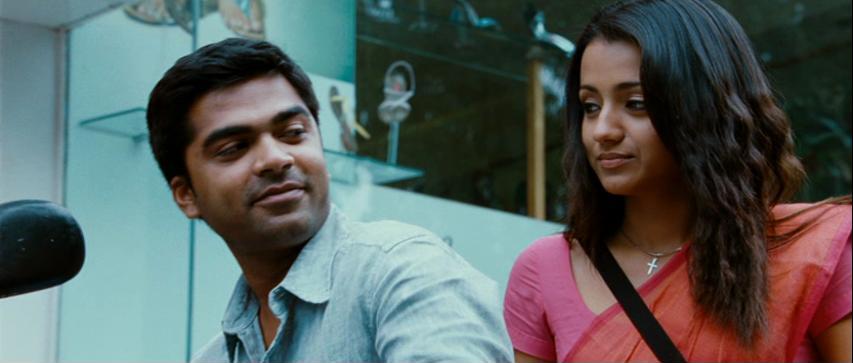
A number of people recommended this film to me, and I really should have listened to them and watched it sooner!  VTV (to save on space!) released earlier this year and was an instant hit.  Much of its success must lie with the performances from the two leads – Silambarasan (Simbhu) and Trisha as much as from the excellent direction, beautiful music by A R Rahman and a very realistic story.  The title, which is translated to ‘Will you reach for me across the sky’ is actually a lyric from Minsara Kanavu, a film by Rajiv Menon, and this is credited in the opening titles – a very nice touch.

The film is the story of a relationship between Karthik and Jessie.  Karthik sees Jessie walking along his street shortly after his family has moved in, and falls instantly in love with her.  One of the few typical filmi devices used in the film.


Jessie is his neighbour, and as Karthik sees her every day he tries various ways to get her attention.  After exchanging meaningful glances and brief conversations he eventually blurts out that he loves her, and she instantly tries to dissuade him.  She is Malayali Christian while Karthik is Tamil Hindu and Jessie knows that her family will never consent to the match. Despite this and her initial reluctance Karthik pursues Jessie, but we never feel that this is creepy filmi stalker love.

He is very open in his admiration and Jessie appears to reciprocate – she obviously has feelings for Karthik, but her upbringing and the fact that she is trying very hard to stay true to her family’s values means that she holds him at arm’s length.

This indecision is wonderfully depicted in a scene in the train back to Chennai.  Karthik has followed Jessie to her family’s home in Kerala and after managing to meet her, he catches the same train home.  We can see Jessie’s developing feeling for Karthik warring with her loyalty to her family.  She is attracted to Karthik, perhaps even excited by his obvious adoration of her, and while she wants to kiss him, and take things further, she is reluctant to take those steps.

This realism is what makes the story so compelling.  Karthik’s frustration is very evident – both with Jessie when she blows hot and cold, and with the whole situation.  He clearly just wants her to be with him, and has no real thought to her family and the consequences to her if she marries him since his family does not seem to have the same reservations.

Whereas Jessie has seen the problems caused when her sister fell for a man her father did not approve of, and doesn’t want the same pain for herself.  Almost in spite of herself we see her fall in love with Karthik and then struggle with how to reconcile her family and her love.

The couple is often pictured with the gate, or some other barrier between them very poignantly illustrating their troubled relationship.  In fact, they are often not shot together, and the camera switches between them.

But when they are together they look fantastic and the chemistry between them zings!  Karthik is an aspiring film director, and this is cleverly worked into the film.  However it’s another source of their separation as Jessie doesn’t watch films, and Karthik ends up going to Goa for a shoot.  Yet another divide is the age difference – Karthik is a year younger than Jessie.  Despite all of this, and in spite of Jessie’s family’s opposition, their romance flourishes.

The end comes as somewhat of a surprise for such a romantic story, but is absolutely brilliant and just works!  The Telugu version, shot simultaneously with Naga Chaitanya and Samantha, has a different ending which for me diluted the film’s impact, making it less powerful and memorable.

Both leads in this film are fantastic in their roles, and have great chemistry together.  They convey their growing attraction to each other in such subtle but very natural ways adding to the realism of the film.  Since the whole story revolves around them, their performance has to be perfect to capture the audience’s attention, and they succeed admirably.  I haven’t seen Simbhu before, and while I’ve read that this isn’t his typical type of role, I will definitely keep an eye out for more of his films.  Gautham deserves much praise for the restrained way in which he handles the screenplay.  The soundtrack is beautiful and the songs by Rahman add to the whole romantic feel of the film.  Even the more upbeat numbers contribute to the overall feel of the film.  As always for his music, I was left singing the songs, (or rather humming along since I don’t speak Tamil), for weeks afterwards.

The supporting actors are really just there to provide reactions to the main couple, but all do a good job in their much less realised roles.  Ganesh is very good as Karthik’s friend, while Kitty as Karthik’s father and Babu Anthony as Jessie’s make the most of their small roles.   The conflict between Jessie’s father and brother and Karthik is very well played, and their interactions with Jessie are also well depicted.  A clever touch is that the Telugu leads play the roles of Jessie and Karthik in his film within the film, and vice versa in the Telugu version.

The other standout of the film is the scenery, captured so well on camera by Manoj Paramahamsa.  The locations, particularly in Malta for the songs and in Kerala, are stunningly beautiful.  And what a way to arrive for your wedding!Perhaps the only flaw to this film is that it is paced quite slowly.  There is only 1 fight scene and not a machete in sight!  However this approach worked for me considering the subject matter, and I was never bored.  In fact I absolutely loved this film!  The story is simply and well told and the actors are amazing.  5 stars. Heather

Avakai Biryani

Avakai Biryani is not only a boy meets girl romance; it is also a romance of a filmmaker and the country he clearly loves. Written and directed by Anish Kuruvilla, a protégé of Sekhar Kammula, it is a simple story that relies on a strong script, excellent characterisation and deft execution to lift it above the clichés.

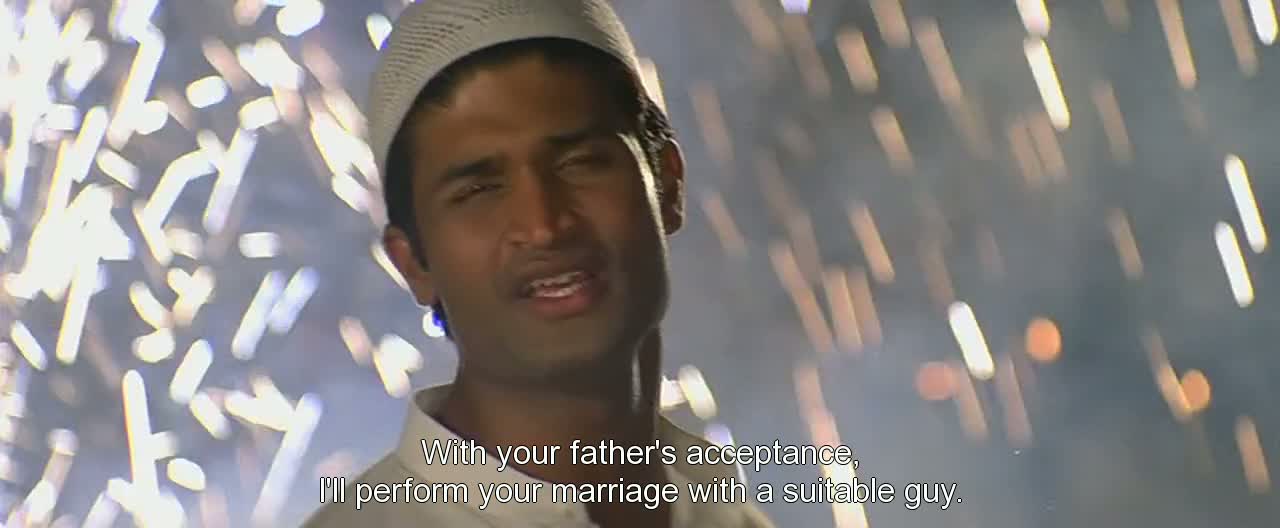
Akbar Kalam is a Muslim, an auto driver, a student and an orphan. He is caught between worlds and striving to make his way. He lives in a charity cottage, works for Master-ji the local big-wig, and dreams of getting his B.Comm despite failing his exams several times. His exam record is a running joke in Devarakonda.

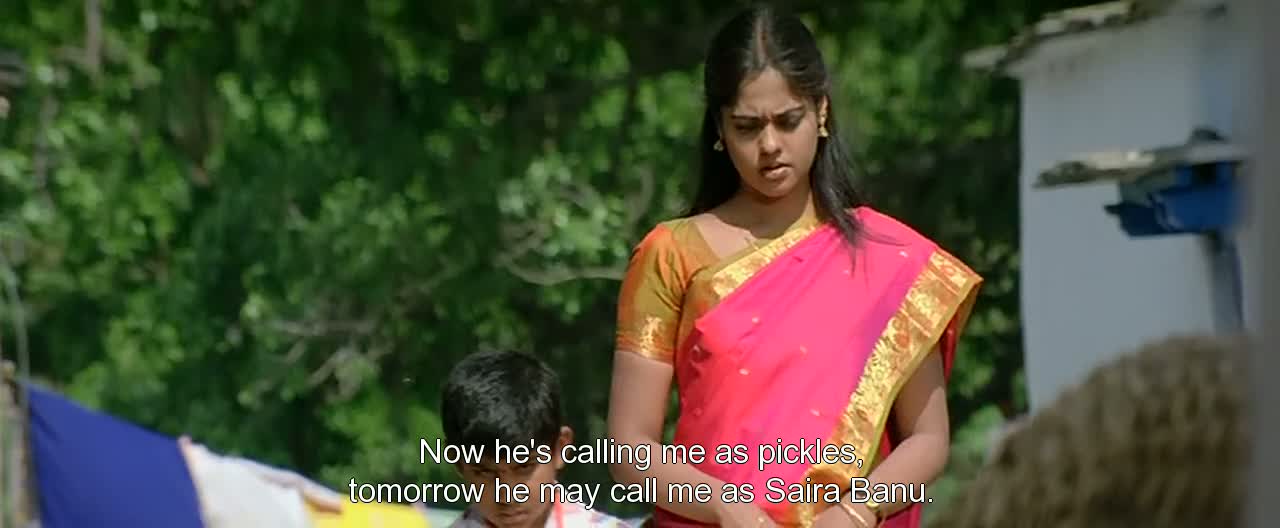
Spirited graduate Lakshmi (Bindhu Madhavi) and her Brahmin family arrive in Devarakonda needing to start over after losing their fortune. Lakshmi starts making and selling her signature avakai and tries to get her father motivated to get back on his feet.

They both belong and yet they don’t, both making the best of what they have, and so a friendship grows. Lakshmi agrees to tutor Akbar and he helps her fend off unwanted attention from Babar – a leader in the Muslim community and a man with a predilection for satin pajamas. I seriously doubt Akbar was failing only because of his English skills, but Lakshmi doesn’t give up on him as quickly as I would have!

The handling of diversity in the Devarakonda population seemed to me to be very well done. I don’t have the expertise to comment on the reality of this portrayal but can say that as a narrative device it works extremely well. While religion does draw a line through the community, it is depicted as one among many divisions in this village. There are lines of caste, creed, financial status, education and of relationships. Characters cross these lines and back again as the business of making a living and getting the chores done is uppermost and there are few moments of speechifying. The lines of division become much sharper when marriage is in question, and that underpins much of the story.

We see where this is heading a long time before Lakshmi and particularly Akbar seem to. I have my doubts as to how long a boy and girl can hide any “friendship” in a small community, but their roaming around does give Kuruvilla the chance to show the beauty of rural Andhra Pradesh. The growing relationship seems natural and unforced and is not based on any love-at-first-sight or stalking. He calls her Avakai (or as my subtitles have it, Pickles), referring to her identity but also to her hopes for building a future. Their love grows from knowing and valuing each other.

The obligatory spanner in the works comes from the ongoing tension with Babar which is fuelled by testosterone, religion and politics. Babar tries to use religion as a lever to force Akbar to back down but fails as the hero decides to do what’s right for the whole village in a scene with shades of SRK in Swades.

Threats are made, scuffles take place and things boil over between the two men. There is only one way for honour to be satisfied. By an auto race around the village! I know some people rolled their eyes at this episode but it rang true to me. I just rolled my eyes at the sheer stupidity and very boyish behaviour.  Oh and it allowed Kamal Kamaraju to get his shirt off, which I suspect is a legal obligation for any Telugu film hero.  And there was an explosion, which may also be a compulsory element as well as a machete flourish.

Having established his right to stay in the village, managed a scheme to bring mains water to Devarakonda and finally passed his exams, Akbar has one last obstacle – getting Lakshmi. Despite acknowledging his help and decency towards them all, her family refuse to consider him as a suitor because of his religion and because of his limited prospects. Akbar and Lakshmi simply go their separate ways. Her family pressure is too much to withstand, and he has no family to offer them shelter or support.

This is a total spoiler so stop now if you don’t want to know how it all ends.

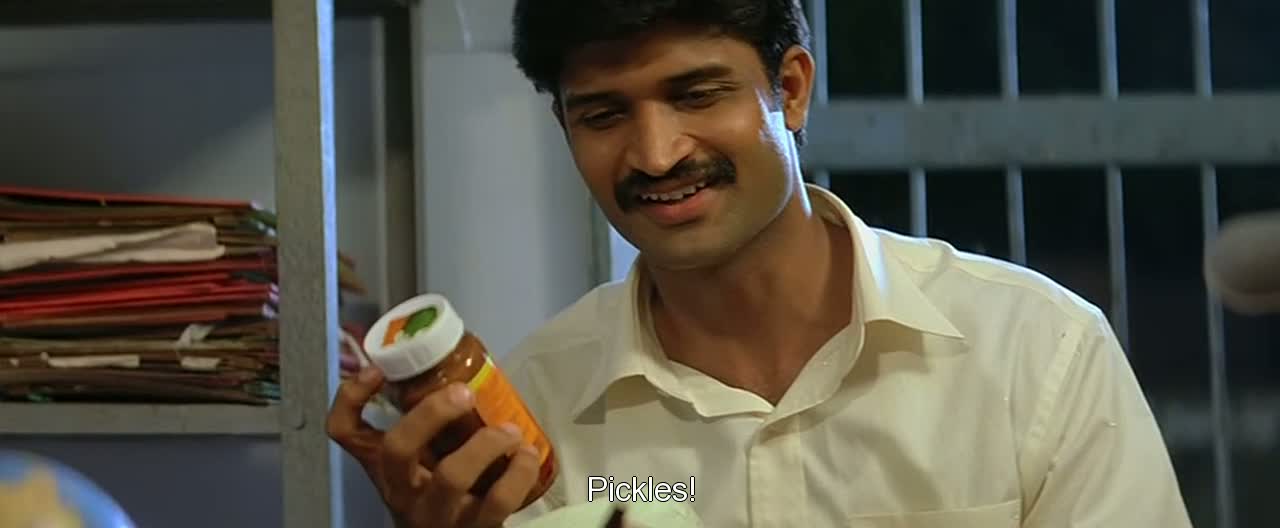
Akbar throws himself into work, builds on his success in politics and becomes a respected member of the local council. Two years on, Lakshmi’s father hears him speak at a political meeting and apparently undergoes a change of heart on hearing successful Akbar still speak of Lakshmi with feeling. She sends Akbar a jar of pickles with a note asking him to meet her. He looks radiant with joy as he realises the note is from Lakshmi and she is doing well.

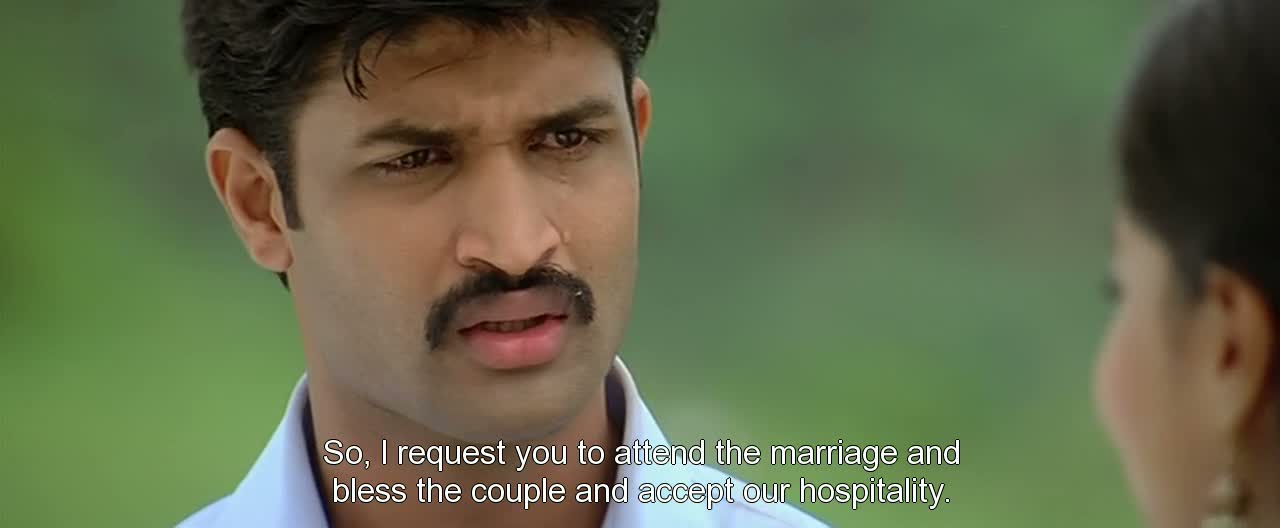
They meet, she pretends not to mind his dodgy moustache, and then hands him a wedding card. There are tears on both sides before he sees the card is for their own wedding and that’s it. Happy ever after time. I expected a bit of anger from Akbar at this cruel trick but I think it’s already clear who really wears the pants in this relationship.

Surprisingly I don’t think this ending was either a cop out or disgraceful behaviour by her dad. Neither Akbar nor Lakshmi had the resources to throw family aside and go it alone. I can imagine it would be hard to marry off an opinionated educated girl especially if people began to talk about her relationship with the Muslim boy. She may not have had many takers after all. And why wouldn’t career success influence a father who has experienced losing everything and seeing his family suffer? Anyway I liked the resolution. No fireworks, just happiness and relief. I really liked that the girl was fully involved in choosing her own path and went in with eyes wide open.

The cinematography is beautiful. The colours are lush and welcoming; the village is dilapidated and picturesque. Kuruvilla paces the story well and doesn’t resort to the predictable speeches and characters. Both leads look good but not too glamorous. Their dancing is not brilliant but it seems entirely suited to the characters so their emotions were the real focus, not fancy footwork.  The music blends with the story and the songs are used well, with matching choreography from Prem Rakshith

All the support cast are effective and resist descending into total caricatures. The actors who play Akbar’s best friends are great fun, particularly Praneeth as Sondu who is the embodiment of the fiery spirited party boy that loves his booze, good times and his mates.

I have said before that romance is my least favourite genre. Often I find the plots too silly and the characters poorly acted or insufficiently interesting for me to care about how they are going to navigate the ridiculous story. Avakai Biryani is a successful film for me. It has substance and some thoughtful commentary in addition to charm and pretty visuals. The leads give good solid performances, and the supporting performers are excellent. I give this 4 stars! Temple (Heather will post a film review soon. Don’t panic!)

Khaaleja

Friday night and time for another expedition to India Talkies for the latest Telugu release.  Mahesh time!  Even though we’ve only been watching Telugu movies for 8 months, we were caught up in the excitement around his long-awaited return to the big screen .  We had with us a true Mahesh fan – someone who had been there for him right from the start – and despite her concern over the lack of subtitles, came along with us for our first look at Mahesh on the cinema screen.  So how did it go?

Although the plot was surprisingly easy to follow for the most, we won’t get too detailed or reveal too many spoilers in this review. We thought this appeared to be two separate films in one.  It starts out with a very funny story about Raju, a taxi driver who is jinxed by the stunningly beautiful and walking disaster Subbhasini, played by Anushka.   It detours into buddy film territory as Raju meets up with a documentary director, played by the very funny Sunil. And then becomes a story about corruption and environmental politics all tied together by Mahesh as the saviour of a village in Rajasthan. And we should probably mention that Raju somehow becomes identified as an incarnation of Shiva. Our friend the Mahesh fan spotted his godliness as soon as she saw his snake wrangling skills. It was very exciting!

Our hero starts off as the taxi driver who has a disaster every time he meets up with Subbhasini.  There are many excellent and very funny scenes set around the numerous ways in which it is possible to destroy a taxi. These are nicely illustrated by Mahesh in later discussions with his boss by the use of model cars – a technique which really should be used by all insurance agencies. The romance is played well by both leads. They are worlds apart, don’t speak the same language (he is pure street, she is more the college girl) and of course, she seems to be an omen of doom for Raju. Their meetings are usually capped off with Raju’s taxi being totalled so it was always going to be a rocky relationship.

Anushka plays the daughter of a wealthy businessman who has some very undesirable associates, and an eye for marrying her off to his own advantage. She is smart, well off, a really bad driver but seems to be a decent human being. She does have terrible taste in get well gifts though (and Mahesh would seem to agree with us).  Her father is involved in some dealings with GK – the evil Prakash Raj. We were perturbed by the wardrobe chosen for the multi-billionaire GK as some of his suits looked to have been designed for a schoolboy not a magnate.

Through a series of typically filmi coincidences, arguments and relationships (no really you don’t need subtitles to work this bit out), our hero and heroine find themselves in Rajasthan and on the run. Raju is delivering or demanding an insurance payment relating to a deceased friend or colleague or the guy who died and landed on the cab  (we don’t know and it didn’t matter so much why he went). Subbhasini is running from her intended fiancee who turned up for a romantic dinner in the desert and in a fine public health announcement, dropped a packet of condoms. So she ran to her almost certain death rather than deal with an over eager boyfriend who planned to practice safe sex. Hmmmm.

Once Raju and Subbhu are together in the desert, the plot takes a turn.  Siddha (played by Shafi) has been searching for the saviour of his village, a man he will recognise by certain signs. Guess who? Yes. Raju was indeed the man. Anushka was then sidelined for the remainder of the film as it became the more familiar Mahesh style of action adventure.

The ending was both predictable and exciting in it’s epic scale and the grandeur of Trivikram’s vision. Mahesh fans will be delighted to see their hero in full flight, and dominating the action.  Prakash Raj was in total villain mode, and made the most of every second of his gore-splattered finale.

The songs were well filmed and the choreography suited the performers. They were also well placed in the story so actually helped enhance our understanding of the plot and the developing relationships. And the songs gave the costume designers the chance to see how many layers of clothes they could make Mahesh wear and still allow him to dance.  We did enjoy the occasional daring flash of an elbow or even a collarbone whenever the three shirts and a scarf permitted. The modesty singlet made several appearances too. Mahesh keeps himself well under wraps. It just adds to the allure according to our resident Mahesh fan.

None of us expected Mahesh Babu to have the comic flair and style to carry this off. We know the dialogues must have been hysterical as we could hear the crowd laughing and the boys sniggering like naughty kids at some of the colourful language. But to perform this role , and still keep us fully engaged, laughing and cheering along really takes something special  from an actor. Mahesh delivered that. In fact we found him funnier than comedy stalwarts Ali and Brahmi and he certainly kept up with Sunil who is one of our favourites. Khaaleja really is hilarious! We were never bored, it seemed to make sense despite our lack of language, and the time just flew by. We would have to give this 5 stars!