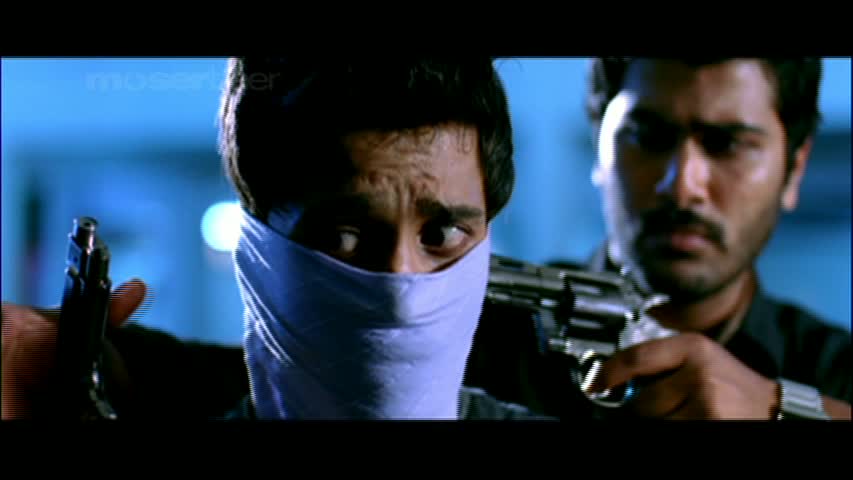
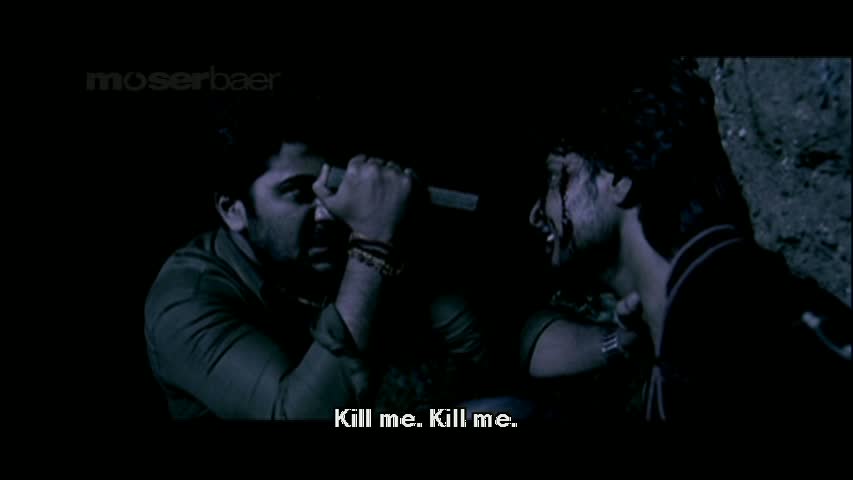
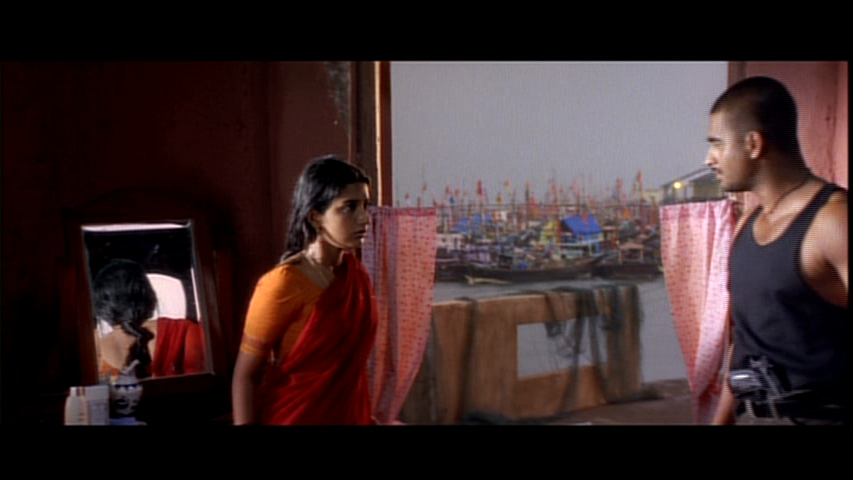
Aayutha Ezhuthu

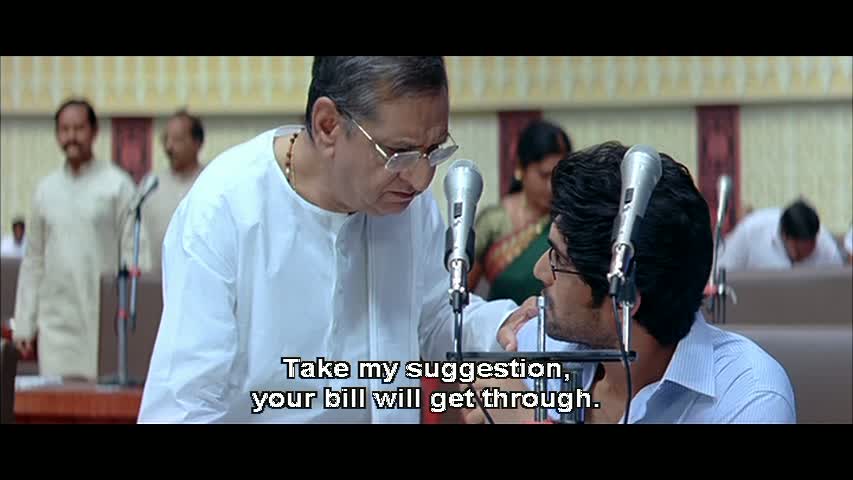
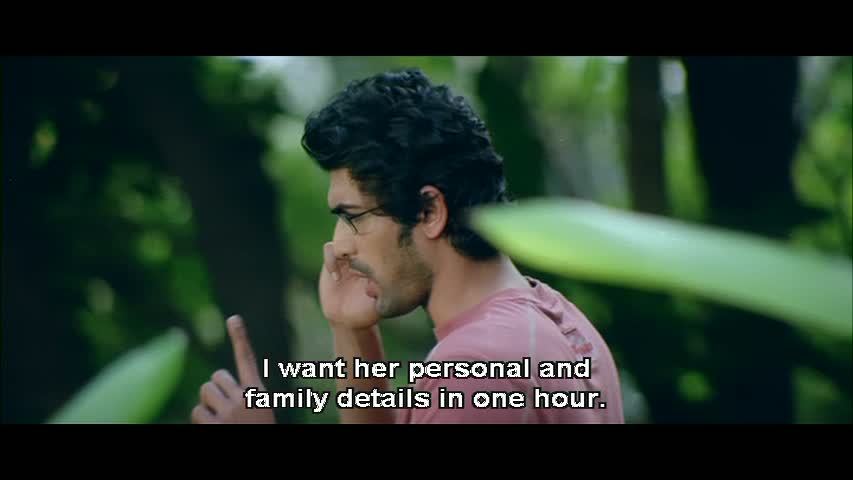
A little bit of research informs us that Aayutha Ezhuthu was supposed to be a call to the youth of the nation to take up politics and generally to encourage political awareness. We really don’t know if this was true, since this film seems to show that life in politics is apt to be short, violent and fraught with danger. In addition, the wily politician who sets up the main characters seems to be thriving through his various corrupt dealings, so perhaps the film serves more to show what the problems are within the system. Aayutha Ezhuthu uses the converging storylines of three characters to set the scene and their subsequent interactions form the rest of the story. As the story unfolds the film becomes more of a straight ‘good guys’ vs. ‘bad guys’ although it’s not totally clear who exactly are the ‘good guys’ here.

The film opens with three main characters following their own storylines in traffic on a bridge. The same scene is shown from the viewpoint of each of these three and, after each vignette, we are shown that same character’s life in the few months prior.

First we meet Inba, played by Madhavan in an uncharacteristically brutal role for him.  He is a thug, who works for his brother mainly ensuring a local politicians campaign runs smoothly. Inba beats his wife and almost casually chooses violence over any other form of social interaction. Inba’s current employer, Selvanayagam the local politician played by Bharathiraja, is the spider in the centre of the web.  He employs Inba to police his rallies, and is in direct conflict with the second character in the drama, Michael.  Through their involvement with each other, the third, Arjun is drawn into the fray.
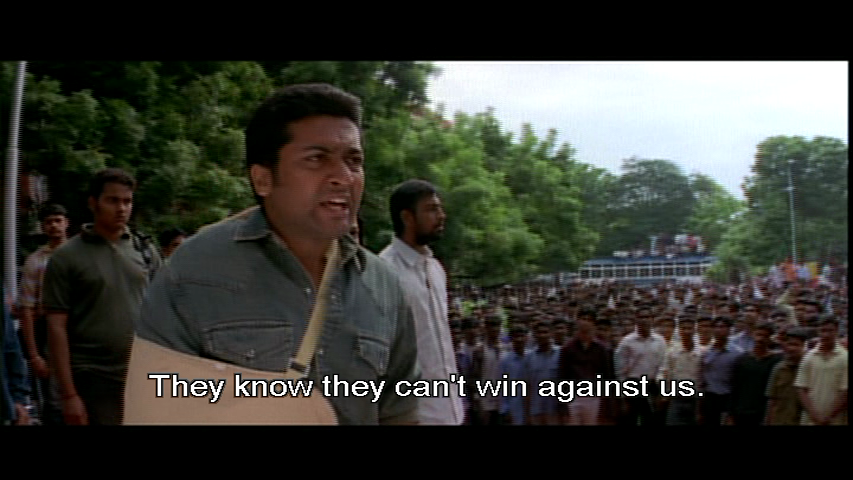
Suriya plays Michael Vasanth, a student, apparently a mathematical genius and also a political activist.  Not for him the more normal student methods of agitation such as demonstrations or debates, he prefers to be more direct in his approach and encourages retaliatory action.  This brings him into direct conflict with Selvanayagam and thus ultimately with Inba.  Suriya also seems out of place in his role.  He is muscular and obviously powerful, which doesn’t fit the image of a serious scholarship winning student.  His solution to problems faced by local villagers seems to be almost as confrontational as Inba’s violent tactics.  He appears belligerent and selfish as we see him brush off his mother’s concerns and treat his girlfriend badly. Although it is quite conceivable that students will use such extreme tactics, as has frequently been seen in many countries of the world, this approach just felt wrong with these characters. Perhaps this was partly an issue with the subtitles which may not have conveyed the dialogues accurately, but Michael came across as a very unpleasant character and his political aspirations felt more self-serving and less for the public good than perhaps was intended.
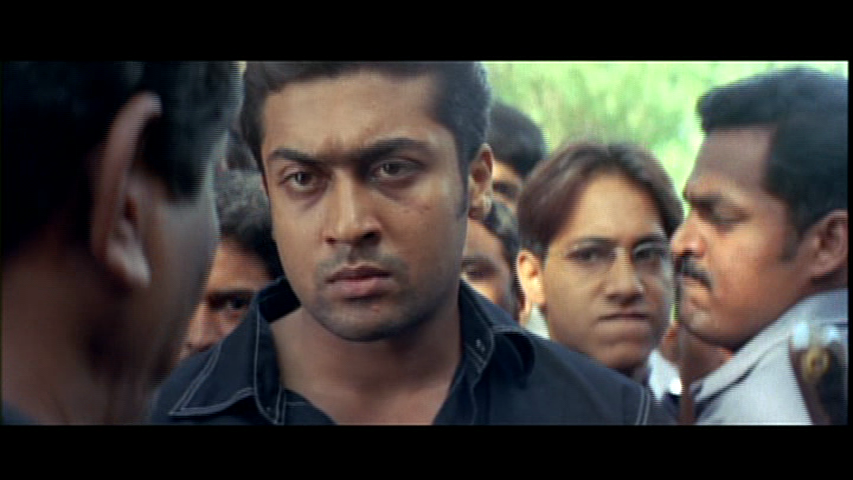
The final character in the drama is Arjun, played by Siddharth.  A playboy who has just finished his studies and plans to head to the US, Sid at least seems to fit the role he has been given.  His approach to life seems much more in keeping with his character and his pursuit of Meera, while typically filmi does feel much more genuine than Michael’s relationship.  By a series of coincidences all three are on the same bridge at the same time.  Inba uses this opportunity to get rid of Michael by shooting him, which sends him falling into the river past Arjun’s shocked gaze.

The storylines all converge at this point, and the aftermath of the confrontation is played out to its bloody and somewhat inevitable conclusion given the arrogance and brutality of the main characters.

What are much more interesting about this film are the female characters.  Although she is regularly abused by Inba, his wife Sasi is a very strong personality who is determined to wean him away from his brother’s influence and stop his forays into crime. Their relationship is very realistically portrayed by Meera Jasmine who is fantastic as the battered wife. Despite her family’s objections to her husband, Sasi enlists them to help get Inba a job, so she obviously has great powers of persuasion.  Madhavan’s scenes with her are the best in the film and she was very compelling in her performance. Trisha in her role as Meera is less of a driving character, but she is part of the reason why Arjun changes his playboy ways as he slowly falls in love with her.  She is convincing and effective in the initial scenes, but towards the end of the film she appears to be sidelined. Esha Deol plays Geetha, who is involved with Michael.  There is a lot of potential in their relationship as he doesn’t want to get married and asks Geetha to move in with him instead.  This opportunity to look at the issues surrounding marriage and commitment is squandered as the theme is never really developed further.  Geetha lies to her parents and to Michael’s mother and never really becomes anything other than the woman in Michael’s life.

However these three women, as well as the various female characters that stand for election in the story, seem to be at least an attempt to show women as other than just the pretty wife, girlfriend or daughter.  There is more meat to their roles here, although it’s not sustained and ultimately only Sasi makes a lasting impact.

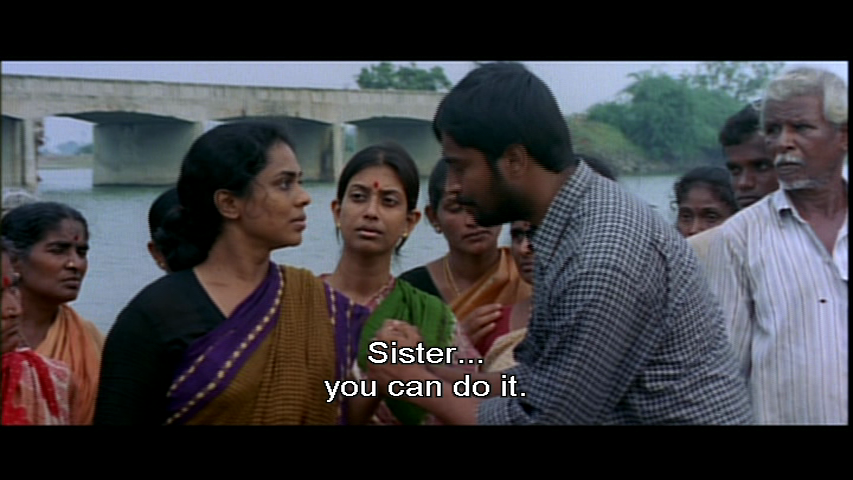
Because of the belligerence behind Michael’s actions it’s hard to see him as one of the good guys.  The virtual worship of him by the other students contributes to the impression of arrogance and he imposes his will on everyone around him without any seeming thought to the consequence.  Despite his thuggish ways, Inba appears as the more sympathetic character as he is genuinely trying to change his ways, but cannot get out of the cycle of violence he has lived with all his life.  The supporting characters all seem to have their own agendas as well, keeping the whole feel of the film as one of corruption and deceit.  The only genuine people seem to be the villagers caught up in the struggle for their village. While the film tries to be a statement on youth and politics, the end result seems to disregard Michael’s supposed motivation and political ambition and highlight the futility of anything other than corruption and violence as a means to achieve and hold on to power.  The secondary plot line of Inba’s attempts to escape his violent lifestyle is much better handled. While Meera Jasmine is the standout performance, both Trisha and Esha Deol ultimately aren’t given enough screen time to be effective.  A special mention for Sriman who played the character of Dilli, and was excellent in his role as Inba’s conscience.

Heather says: I really didn’t like this film.  For me it may have worked better if the casting of Madhavan and Suriya had been the other way round.  I found that Suriya didn’t fit the image of a student at all. He is too old and not convincing, while Madhavan in his role switches between mayhem and maniacally happy.  This didn’t seem to fit either the characters lifestyle or generally bleak prospects.  As a man recently released from prison, with a pregnant wife and no real job aspirations other than working for his brother, the ‘crazy happy’ was difficult to swallow.  Some of this was to show the reason why his wife stayed with him, and indeed some of these scenes were much less overdone.  This may have been a directorial decision as Abhishek Bachchan appears very similar in his characterisation of Beera in Raavan. I stuck with the film mainly because of the relationship between Inba and Sasi which was very well portrayed. Siddarth’s character was also quite watchable, and overall the story was interesting, but I was very tempted to fast forward every time Suriya was on screen. I have liked him in the other films I have seen him in and was horrified by him in this.  I really wanted his character to die as quickly as possible, just so that I did have to suffer through his flexing and belligerence.  I wish I had liked this film more but thought it was a potentially good story that for me was ruined by bad choices in the cast and poor directorial decisions. 2 1/2 stars from me.

Temple says:  This is another film that, like Leader, is well made but not likeable. I have issues with the character of Michael and his immunity from consequences. Everyone around him is made to pay for his activism but he escapes with a few flesh wounds. Surya was unappealing as he seemed to show only the arrogance of Michael and gave me nothing to respect in that character. Unlike Heather, I really liked Madhavan’s performance in this. I thought he really made sense of Inba and Sasi’s relationship, and showed the complexity of his character. He was boyishly impulsive, and casually brutal in turns. He showed the pressure Inba felt to be a man’s man and ignore his wife unless they were behind closed doors. Their relationship was compelling as Meera Jasmine showed the gamut of attraction and repulsion depending on which side of her husband’s nature was dominating.  I didn’t get the impression he was ‘crazy happy’, he was just a thoughtless guy who wanted what he wanted, and was happy so long as things ran his way. I thought the whole cast, with the exception of Surya, did a good job and made the most of their roles. I did have to laugh (a lot) at the idea of Esha Deol teaching French though! So, while I don’t like the inherent message that corruption is OK as long as you say you mean well, I do think this film was compelling and well made. The only disappointment was the lack of follow through on what seemed to be interesting roles for women. 4 stars from me.

Orange

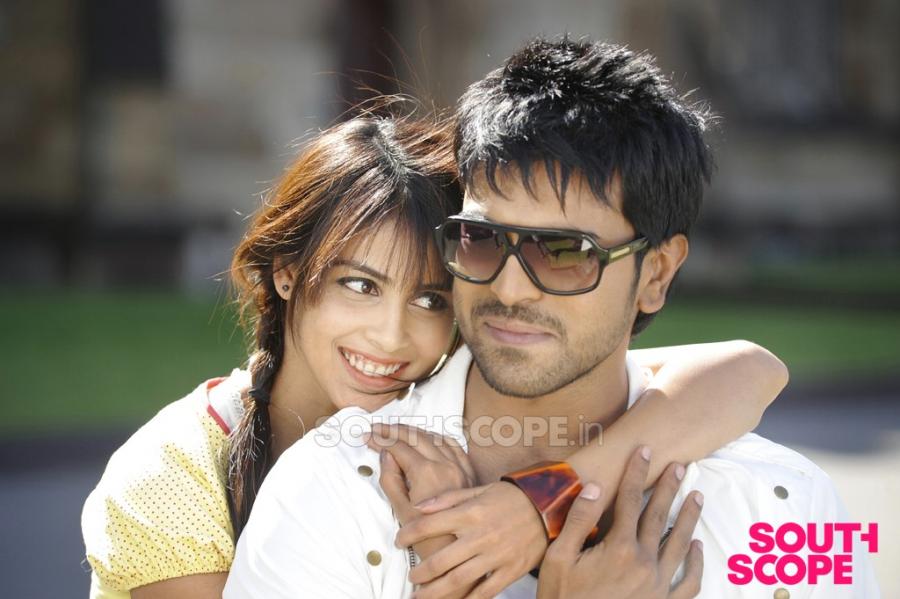
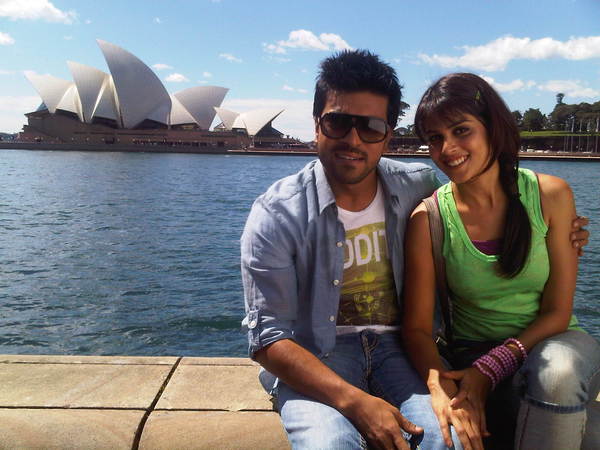
We had a vested interest in seeing Orange, having spent a lot of quality time loitering around the shoot as it took place in Melbourne. The lure of seeing Ram Charan on the big screen, along with the ever entertaining Genelia and our hometown was just too strong to ignore.  We avoid reading previews of new release films before we see them, as there is too much PR hype and politics to get much useful information, but the arrival of Charan on Twitter certainly got our attention! The cinema was full, and with a higher number of families and kids than we usually see at the South Indian films here.

Charan plays Ram, a wildlife photographer and graffiti artist with a truly excellent selection of t-shirts. He lives with his sister and brother-in-law in a fancy apartment and drives a flash car. He has strong views on love and honesty and won’t back away from his values. After an earlier relationship with Rooba (Shazahn Padamsee), shown in flashback, we see that he learned a lot about himself and what he wants from life. He doesn’t believe that simply saying ‘I love you’ makes for a relationship, and doesn’t believe it is honest or realistic to promise a lifelong love. He is affectionate, caring, demonstrative, but he is not going to commit to a lifetime, and he will not sacrifice just to keep his loved one happy. He doesn’t want his girlfriend to sacrifice anything for him either – he has been through this unhappiness and is genuinely trying to find an honest and respectful balance.

Genelia as Janu makes a ridiculously chirpy entrance to the film, cheering as she watches a marriage proposal and being as excited for the lovers as if it was her own relationship. She does believe in the idea of soulmates and lifelong love connection and wants that from her partner. She is in love with love, and looking for Mister Right. Several potential Mister Rights form part of the comic sideplot.

So of course, these lovely looking youngsters with completely opposing views fall for each other. The film is then about Ram and Janu getting to understand each other, and the choices they make.

With Puppy (Brahmi!) aiding and abetting Janu, the relationship develops in fits and starts. Ram is persistent and Janu is interested but wary of this charismatic suitor. We knew long before Brahmi mimed Krishna playing his flute that Ram was a ladies man! When he happily admits to having had NINE girlfriends, in relationships spanning from 1 to 387 days in length, Janu decides he is just too much to handle and tries to back off but cannot deny her feelings.

Although for the most part the film is a fluffy romance, there is a serious conflict at the core. While the audience can empathise with both sides, it is clear that something major would have to change for there to be a traditional boy gets girl happy ending.  We could maintain sympathy for both the romantic Janu and the more challenging Ram so found the conclusion to be reasonably satisfying and in keeping with the characters. However we suspect that if you can’t connect with Ram’s character, the film will not hold your interest.

Charan’s performance was great. He was charming, funny, energetic, emotionally engaging and totally looked the part. He was convincing as the school leaver Ram, and especially as the urbane young man about town and his body language really suited the different confidence levels of these stages of his life. The fight scenes were typically dramatic and physical, and Charan’s dancing is, of course, brilliant . The choreography was lots of fun and Charan seemed to have a great time sending up some cheesy romantic moves. Seeing these films without subtitles and having only a minimal understanding of language, we rely on the tone and expressions of actors. Charan made us see him as Ram and we understood his character’s views and feelings so we have to say it was a successful performance.

Genelia was her usual bubbly self, perhaps too bubbly, to start with but really showed some depth to Janu over the course of the film. She conveyed the struggle between having feelings for someone and knowing that it wasn’t going to work. We could see her grow from a carefree girl to a more independent young lady as she confronted her own beliefs and tested them for herself to see what she wanted.

Nagendra Babu had a small but pivotal role as Ram’s neighbour who was living in a stormy domestic situation.  Brahmi and Prakash Raj are always a familiar delight to behold. Brahmi got more to do in Orange , and his comedy was a bit more varied and often very funny. He also had a fine collection of t-shirts, and a habit of reading Mills & Boon before bed. Prakash Raj was the Telugu cop who gave Ram the reason to narrate his life story. He had little to do, and really it need not have been a Prakash Raj role although we are always pleased to see him. We did watch some of the scenes with him and Charan being shot so we certainly enjoyed that. The rest of the support cast were fine but as we have to concentrate on the main story, we didn’t really give them enough attention to be able to comment much.

We love the soundtrack and the songs looked amazing on screen. We are somewhat disappointed that Melbourne scenes are inter-cut with Sydney to give the impression of one Australian city, as the Melbourne -Sydney rivalry is HUGE, but we will forgive it as we got the opportunity to watch this film being made. Bhaskar managed to skirt the problem of geographic displacement by blending the locations well. The places Ram and Janu were seen were appropriate for their student lifestyle and helped the film’s credibility. We are always a bit judgmental about the skankily dressed white chicks in songs but Orange is family friendly for the most.

Some special notes: We greatly enjoyed Anand Ranga’s updates via Twitter, and shared his anxiety about the weather. When he casually mentioned filming with a lion, we expected maybe a fleeting appearance in a song. Not a full blown encounter with the King of the Jungle who apparently frequents the NSW forests. We cheered a lot! But the audience went wild when the Glen Iris tram was on screen – who knew the number 6 tram was that much of a star? We also enjoyed seeing a return of the pink panda t-shirt first spotted on Charan in  Magadheera, this time being worn by one of Ram’s friends. There was plenty for the alert viewer in Orange!

Leader and Prasthanam


Politics, corruption and family dysfunction provide a fertile ground for film-makers and while they are not top of the list for us to view, there have been some interesting films made on these topics. There has been a lot of talk about both Leader and Prasthanam taking an innovative approach to these themes but we found each conventional in both their story and structure. Both make reference to land and mineral rights disputes, but the films aren’t really about the issues as much as they are about relationships and power. Because of the parallels and contrasts we decided to discuss them together. For the sake of simplicity, as well as being in keeping with the films’ focus, we are also concentrating on the main story and will skim over the subplots.

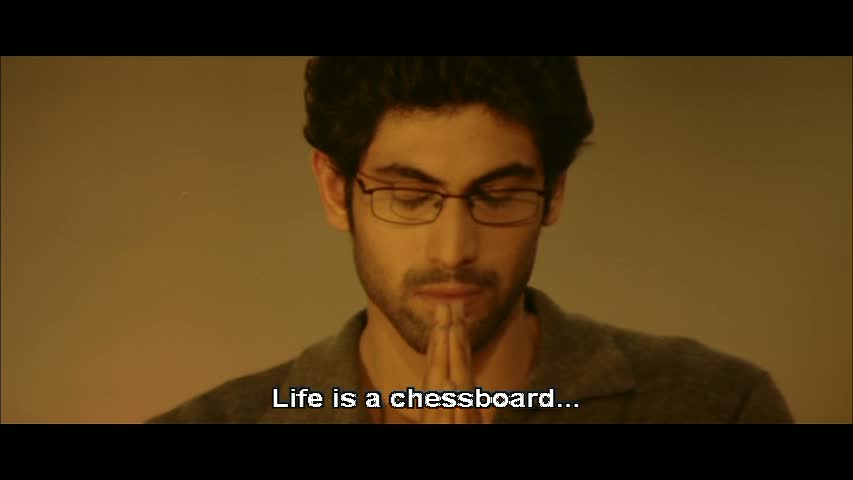
Leader is the debut film for actor Rana Daggubati, and is written and directed by Sekhar Kammula. That’s some seriously good pedigree and the production values reflect this. The story has more in common with Frank Capra’s Mr Smith Goes to Washington than any gritty political thriller but where Jimmy Stewart oozed heart, there is a hard manipulative core to Arjun Prasad (Rana Dagubbati). Arjun has money and is reckoned a man among men (CEO of a Fortune 500 company, Harvard graduate, tall, fine head of hair, looks good with or without a shirt, you know the deal). Despite his aim of rehabilitating the tarnished image of his murdered father through eliminating corruption and caste discrimination, Arjun immediately takes to his father’s methods.

He genuinely seems to believe the ends justify his means. Personal relationships are bought and sold and, while he does care for the people he is using, he will sacrifice anyone for his greater goal. Things come to a head after some emotional incidents, and despite some soul searching Arjun fails to change his strategy and continues to use any means at his disposal.  After a picturesque montage of Rana’s excellent enigmatic walking, he sets forth to rally the masses and triumph over his rivals. Characters appear along Arjun’s journey, some ready to give him wise advice and some there to set obstacles in his path.

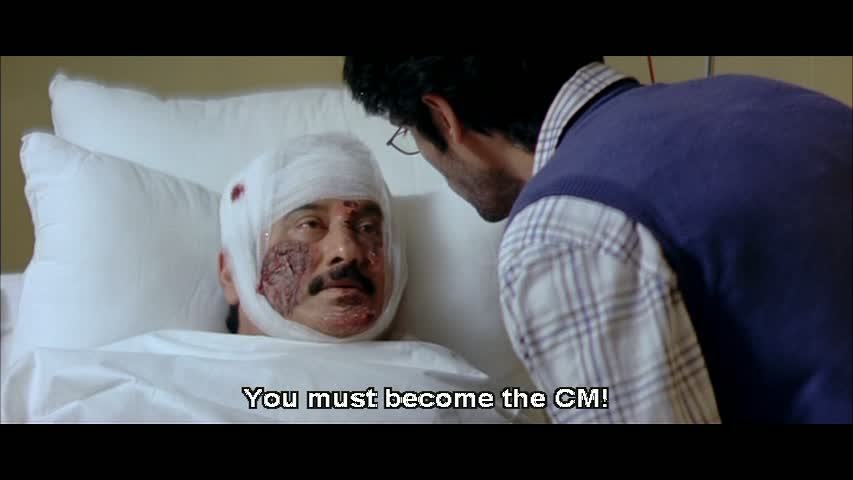
But he is a hero in a fable where everything seems to be in shades of grey. The tacit support for bribery and corruption as legitimate techniques is hard to swallow, as well as the disregard for anything that might get in the way of making history take a kindly view of the dead CM. Arjun’s treatment of two women who have feelings for him is cruel, and reminds us that the heart of this story is ice cold.

Rana’s performance was difficult to assess. In some scenes he appeared quite deadpan and almost wooden but we believe that was due to the character keeping his cards close to his chest and not wanting to give any clues to his opponents. He is physically imposing and looked the part of the young man on the up and up. Some highly emotional scenes were underplayed and very moving. In scenes that required him to be lighter, more open, and even flirtatious, he was quite appealing so we think it was a combination of his inexperience and the director’s choices that made some episodes appear a bit awkward.

There is nothing more to say about the plot – it succumbed to all the clichés and ended exactly as you might expect. But it is an interesting attempt to look expectations of justice and idealism, and transpose that into a political fantasy. The supporting cast were uniformly good, particularly Harsha Vardan as the secretary Ali and Richa Gangopadhyay as the love interest Archana. Priya Anand’s character Rathna was really short changed with some silly dialogues and behaviour but she made a strong impression in her time on screen and certainly injected a lot of energy into her scenes.

Prasthanam starts in an independent art house style before the much more conventional end. What begins as a dissection of a bitter dysfunctional family and the play of personal agendas in the public arena devolves into a gore fest with some badly placed songs.  Sharwanand plays Mitra, the ‘good’ son of an assassinated father, who seems to be the anointed one in his family’s dynasty. After his father’s murder, Mitra’s mother is married off to Loknatham (Sai Kumar) her husband’s adopted brother. The family relocates to the city but remain involved in politics and factionalism.

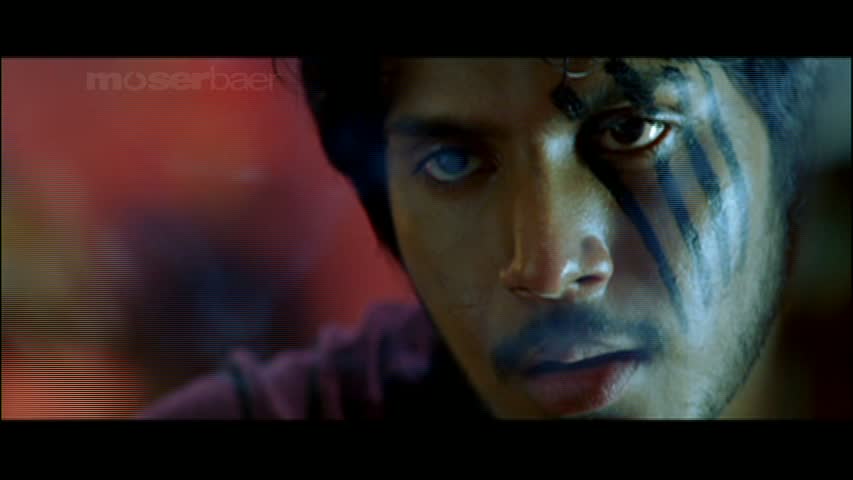
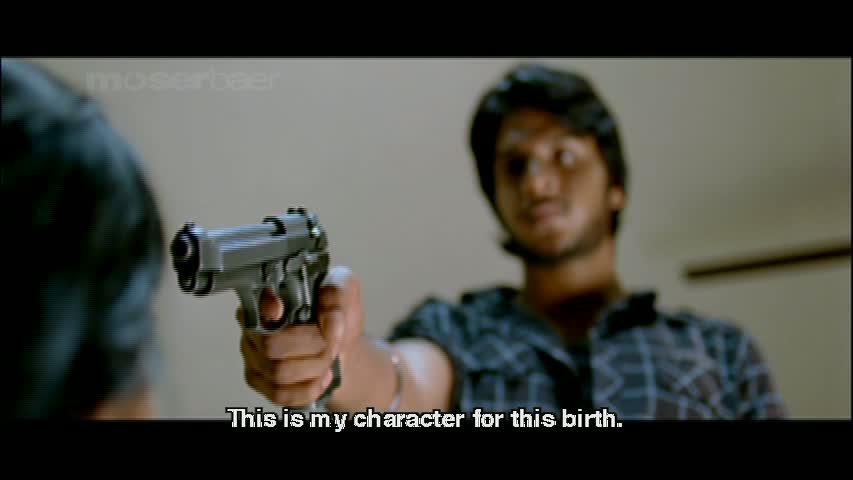
What really brought the story to life was the dazzling performance by Sundeep Kishan as jealous psycho step-brother Chinna – a substance abuser with a violent streak and a penchant for face paint. His character is a human train wreck: monstrous yet compellingly watchable as he ricochets from self pity to rage to scheming.

We differ in our opinion on Sharwanand’s acting but do agree he was one of the weaker elements of the film. The brothers are, on the face of it, totally dissimilar but both are driven by their notion of family and status. As the film progresses, the calculating intelligence and loyalty of Mitra is challenged over and over by the animal aggression of Chinna until the bloody and confronting climax. Mitra discovers that his brother and step-father are far more alike than he suspected and nobody wins as he ultimately takes up the same tactics as his family.

Visually the style of Deva Katta’s Prasthanam is both darkly real and annoyingly gimmicky with a reliance on clever angles and effects like blood spattering the camera lens. The songs in the first half are well integrated into the story and maintain a consistent style with the rest of the film.

It seems that someone panicked after watching the first half as there are several songs wedged at random into the second part of the film. Not only do they fail to match the narrative at all, but the placement of the picturisations is jarringly inept which contrasts with the more considered style of the earlier songs. [Thanks to the wonders of Twitter, we have just been told that songs were added for the DVD that were not in the theatrical release of the film. That still doesn’t explain the random placement, but it does help explain to us why reviews didn’t mention such a glaring flaw. Thanks for the explanation!]

Despite the much messier and grittier environment Prasthanam is as much a fiction as Leader is – but as Dolce and Namak pointed out, this family saga is inspired by Cain and Abel.

There is some attempt to inject humour, which is both misplaced and clumsy: one comedic sidekick character declares he will have to go commit a couple of rapes to get more respect, and has this remark met with sarcastic mirth. It was disappointing considering the intelligence behind the writing in general, and wedging the obligatory not so funny comedy track into a film with serious pretensions seemed odd.

As with Leader, the female characters provide an excuse for much of the action without having significant roles in the film. Both films rely on coincidence at crucial points, and the strain on our credulity diminished the impact of some key scenes.

Both leading men play outsiders. Arjun Prasad is the affluent, privileged, NRI son of a corrupt man, and we see Hyderabad and India through his eyes —mostly from boardrooms, restaurants and resorts. He does a lot of brooding and walking, often seeing without being seen as he floats through the ‘real world’. He says he is going to wake up the apathetic youth, and seems to be a symbol of the young cashed up generation in that respect.

Mitra is an unwitting outsider in his own family, but he is intimately involved in the workings of the political games. His world view is far more grounded in a village mentality and his vision of India is much less about air con and fancy cars and more about family and cash flow. This world view shatters when he discovers the truth about his father and step-father.

The soundtracks are forgettable, and apart from the really bad picturisations in Prasthanam, the songs had little impact. The lyrics in both films were quite significant in terms of the story but it just seemed to be a bit overstated at times.  And as for the naff English lyrics in the final ‘Leader’ song … Neither film really required much in the way of dancing and, while Sharwanand gave it a go, Rana stuck to his enigmatic walking.

Ultimately both films fall back into the familiar heroic narrative arc, one tragic and one triumphant. Both are fairly satisfying stories and generally well made films, but neither really departs from the predictable path.

Temple says: I found both films quite watchable and engaging, but both have flaws that prevent me from saying I totally enjoyed them. I don’t think they are really attempting anything different in either film as it’s the same old story of corruption and tangled family loyalties, just with modern urban backdrops.

Leader is the more successful film for me, as it is has an internal logic and the characters behave in a way that is consistent with their prior behaviour. As my friend Jenni The Mahesh Fan often says, the Dr Phil test for predicting future behaviour is based on past behaviour. So while Arjun Prasad is not a likeable person, the character acts in a way that accords with his previous behaviours. Even when he temporarily leaves politics, he manipulates that hiatus to eliminate an issue that couldn’t be resolved by legal means. So unlike Heather, I never thought he had ‘gone good’. I believed he was just manipulating the situation again which seemed in keeping with his actions to date. The film has a more cohesive story and builds to a cliched yet satisfactory conclusion. I don’t like the film, as I find its inherent message quite repugnant, but it does work as a piece of drama and once again Sekhar Kammula has told his story in an engaging and slightly offbeat way. Apart from some dodgy green screen effects, the visuals are really effective. I give Leader 4 stars for being a well made, quality film, but I hate the values it seems to promote.

Prasthanam was more entertaining on some levels, and yet a lot less satisfying overall. As the film moved away from the conflict between the brothers and became more about Mitra and Loknatham the wheels started to fall off. Sharwanand just didn’t make Mitra believable and his performance was weakest of the whole cast. He was fine in the lighter or more conversational scenes, but anything requiring extreme emotion fell flat. It didn’t help that many of the veteran actors around him were chewing the scenery for all they were worth, or that he was acting opposite Sundeep Kishan who just owned the screen whenever Chinna was around. There is something curiously immobile about Sharwanand’s face, and in all the scenes where I wasn’t hooked by his lack of emoting I found myself wondering  if he had already started to hit the Botox. The final scenes between Mitra and Loknath were just so tear-sodden and emotional and didn’t ring true for me. I thought the very last moments of Sai Kumar surrounded by a multitude of  his mirrored reflection was so much more real and powerful than all the snivelling as it showed what he really believed in. It’s very engaging to a point, but then the climax of the film just doesn’t work for me and the really silly handling of the songs threw the dramatic second half off kilter. I give Prasthanam 3 stars.

The women in both films are basically irrelevant to the plot. They are only there as mothers or potential wives and even when it seemed they would play a bigger role, it just didn’t eventuate. The actresses in these roles were all good, but the roles were on the margins of the heroic tales being told.  So while it was disappointing to see this happen yet again, it did at least allow for most of the focus to be on the core story.

Heather says: I enjoyed both these films, and despite a few irritating features which detract a little from the final overall impression, Leader and Prasthanam are very well worth watching.  I think that both are genuine attempts to step outside of the usual Masala fare, and within their limits are interesting stories, told well and with sincerity.

Leader for me was made by Rana’s performance, particularly considering this is his first film. However I really didn’t like his character at all!  Arjun is just as corrupt and manipulative as the other politicians around him.  Although I did sympathise initially as he possibly started with good intentions (I’m not convinced though), this very quickly changed as he began lying to everyone. After the interval where I suspect we were supposed to get behind Arjun and his campaign for the popular vote, I just found his deceitful attitude too much.  His attitude to the women in his life is another point against him, and I really didn’t want him to get the girl in the end.  But I think that to generate that response required some good acting which Rana delivered – as did the rest of the cast who are all excellent.  The lack of depth in the female characters stories was disappointing, and I don’t think a journalist could have been side-lined so easily – but this was fictional after all! Despite not liking the character and finding the whole story just too improbable, I still enjoyed the film.  Leader gets 3 ½ stars from me

Prasthanam for me was a more enjoyable story.  I do like a good villain, and Sundeep excelled in this role.  Sharwanand really appears wooden in comparison, and although I am not as critical of his acting as Temple, he doesn’t do his character justice here.  The biggest problem I have with Prasthanam is the strange song picturisations and their placement in the second half.  They just aren’t necessary and detract from the pace and mood of the film.  I liked the soundtrack on first hearing and found it a disappointment to see the songs on screen.  The female roles, although still small, seem to be better realised in this film but the struggle between the two brothers and the machinations of Sai Kumar’s character are the definite highlights.  The escalation of violence towards the end becomes improbable, and the conclusion is somewhat weak,  but despite these flaws the film kept my attention throughout.  Again all the supporting cast were very good, and I really liked the cinematography in the opening scenes.  Without the songs and the comedy track this could have been an excellent film.  As it is, I think it’s still very good and gets 4 stars from me.